
By A.J. Keilty, President, KEILTY Realty Management
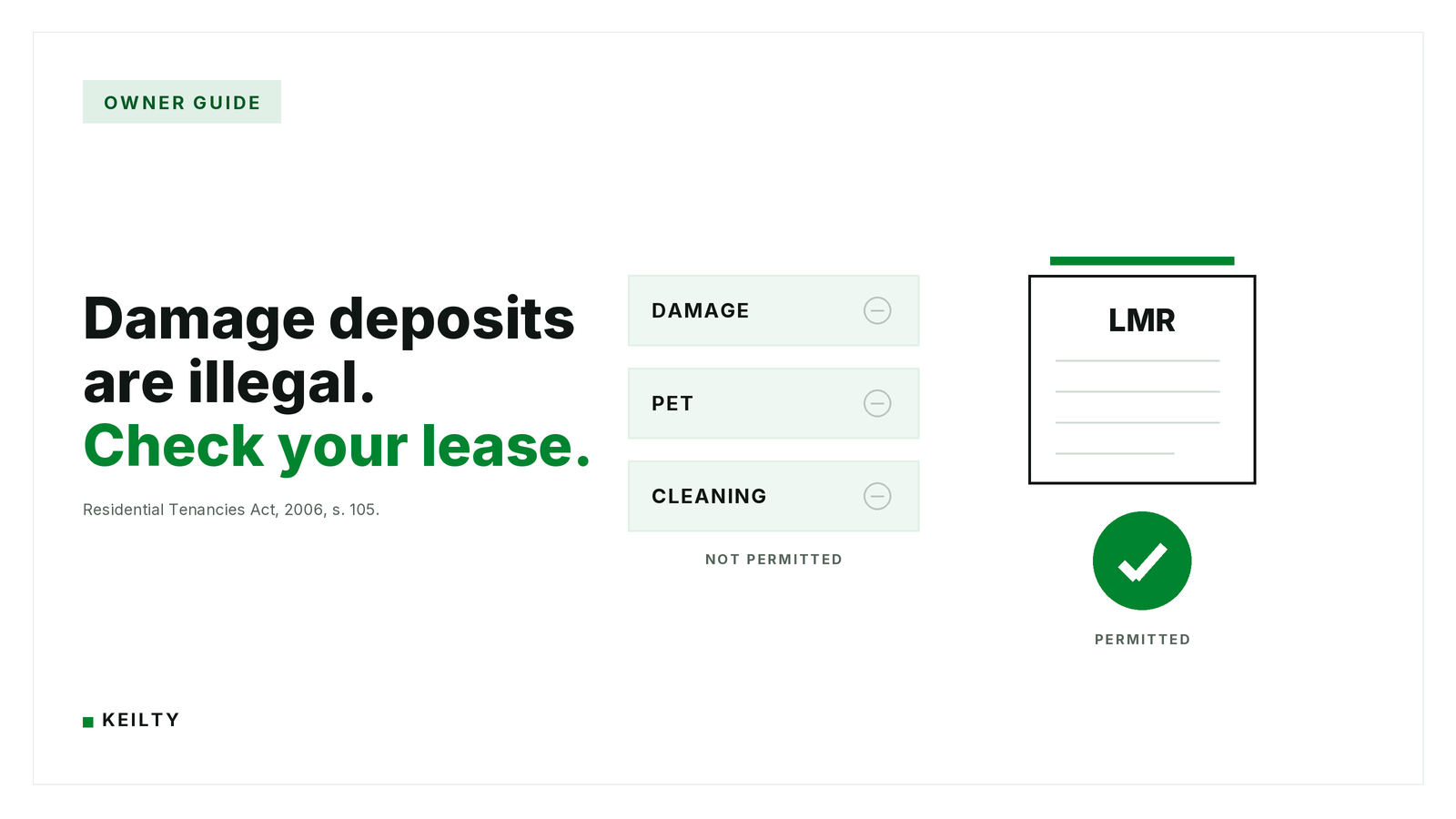
No. A damage deposit is illegal in Ontario. Under the Residential Tenancies Act, 2006, the only security deposit a landlord may collect is a rent deposit, capped at one month's rent, and it can only ever be applied to the last rental period of the tenancy. A refundable key deposit is also allowed. Damage deposits, security deposits, cleaning deposits, pet deposits, and credit check fees are not.
The short version.
This surprises a lot of owners, particularly anyone who has rented out property in another province or in the United States, where damage deposits are standard practice. In Ontario, collecting one is not merely unenforceable. Requiring or receiving a security deposit contrary to section 105 is a listed offence under the RTA, and the tenant can apply to the Landlord and Tenant Board to get every dollar back.
Is this you? If you own this rental rather than rent it, KEILTY manages homes and buildings across Eastern Ontario and will tell you what the unit should rent for. Start with a free rental evaluation.
Two, and only two:
That is the entire list. If a lease says otherwise, the lease term does not survive. Section 3(1) applies the Act despite any agreement or waiver to the contrary, and section 4 voids any provision in a tenancy agreement that is inconsistent with it. A signed clause promising a $1,500 damage deposit is worth nothing at the Board. Owners sometimes assume a tenant's written consent cures the problem. It does not.
No. The refundability is the whole point. A key deposit passes muster only because the money comes back, which keeps it outside the definition of a security deposit. Charge $200 for keys and keep it, or set the amount well above what a locksmith would charge to cut replacements, and you have collected an illegal deposit under a different name.
Where rent is paid monthly, the deposit cannot exceed one month's rent. Where rent is paid weekly, it cannot exceed one week's rent. Section 106(2) states it as the lesser of the rent for one rent period and the rent for one month.
The timing is stricter than most owners assume, and this is the detail that catches people. Section 106(1) permits a rent deposit only if the landlord requires it on or before entering into the tenancy agreement. The deadline is the signing, not the move-in.
So if you sign a lease on 2026-08-05 for a 2026-09-01 occupancy and nobody raised LMR at signing, the window has already closed. You cannot ask for it during the four weeks before the tenant collects the keys, and you certainly cannot circle back six months into the tenancy. Put the rent deposit in the lease, or you do not get one.
You also cannot stack deposits. First and last is the maximum, so on a $2,200 per month unit you can collect $2,200 in first month's rent and $2,200 as the rent deposit, and nothing beyond that. Asking for first, last, and a $1,000 damage deposit puts you offside by $1,000.
No, and this is where well-meaning owners get into real trouble. Section 106(10) says a landlord shall apply the rent deposit to the rent for the last rent period before the tenancy terminates. Failing to do that is its own listed offence under section 234(f).
So the common move at the end of a tenancy, applying LMR to a hole in the drywall and a carpet cleaning invoice, is not available to you. The deposit covers the final month's rent. Full stop. If the tenant owes you for damage on top of that, damage is a separate claim you pursue separately.
There is no consent workaround, either. Because section 3(1) applies the Act despite any agreement or waiver and section 4 voids inconsistent lease terms, a written authorization from the tenant to redirect the deposit is unenforceable, and the Board has said so consistently. The single narrow exception is a settlement mediated at the Board under section 194(2), which may contain terms that contravene the Act. That is a Board process reached inside a proceeding, not a form you hand a departing tenant on move-out day.
Yes, every year. Section 106(6) requires a landlord to pay the tenant interest annually on the rent deposit, at a rate equal to the rent increase guideline in effect when the payment comes due. That is 2.1 per cent for 2026 and 1.9 per cent for 2027, per the province's published rent increase guideline figures. On a $2,200 deposit, the interest due in 2026 is $46.20.
Because the rate is whichever guideline is in effect on the anniversary, a long tenancy is not one percentage applied over and over. Take a $2,200 deposit paid at signing on 2020-08-01, interest falling due each 08-01, and assume for simplicity the deposit is never topped up:
That is $237.60 owing over six years on a single unit. An owner who applied a flat 2.5 per cent to every year would have overpaid by $92.40. The 2021 freeze is the item most people miss, because that year the interest is genuinely zero.
Most owners have this backwards. It is not two separate errands that you may choose to net against each other. It is one sequence set out in the Act, and it runs from the interest to the top-up.
When lawful rent rises, section 106(3) lets you require the tenant to increase the rent deposit up to the new one-month ceiling. Section 106(7) then lets you deduct that shortfall from the interest you owe, and the deducted amount is deemed to form part of the rent deposit the tenant has paid. The interest is applied to the top-up first. Only whatever is still short once the interest has been used up is a fresh request to the tenant.
Two consequences follow, and both cut against the owner:
Document the calculation each year in writing. The tenant is entitled to a receipt for any rent payment, deposit, or other charge on request, and you cannot charge a fee for issuing one.
If the mechanics of guideline increases are new to you, our Ontario rent increase guide covers the notice periods and forms in detail.
All off the table before a tenancy starts. You cannot charge a prospective tenant an application fee, a processing fee, or a credit check fee. You cannot require a pet deposit. You cannot collect a cleaning deposit or a non-refundable move-in fee.
Ontario also makes it an offence to require a tenant or prospective tenant to buy something from you in order to get or keep the unit. Requiring a new tenant to purchase the previous tenant's blinds or appliances as a condition of the lease is not a workaround.
You can still run credit and reference checks. You just absorb the cost, which is how it should be priced into the leasing process anyway.
You can ask. You cannot require. A landlord and tenant may agree to post-dated cheques or automatic payments, but a tenant cannot be refused a unit or evicted for declining. Once you have agreed on a payment method, neither side changes it unilaterally.
The tenant files a T1, the Tenant Application for a Rebate of Money the Landlord Owes. The filing fee is $53, and the LTB tells tenants they save money by filing through the Tribunals Ontario Portal. The Board's standard remedy is an order returning the full amount. The size of the illegal deposit is not a mitigating factor, and a signed lease clause does not protect you.
One limit runs in your favour. Under section 135(4), the Board cannot make an order on an application filed more than one year after the money was collected or retained. Note who can bring it, though: section 135 covers tenants, former tenants, and prospective tenants, so a deposit taken from an applicant who never moved in is still live for a year after you took it.
Beyond the Board, RTA offences are prosecuted through the province's Rental Housing Enforcement Unit, and the fines run to $100,000 for an individual and $500,000 for a corporation.
Prosecution over a single $800 pet deposit is unlikely. A repayment order plus a tenant who now knows their rights is very likely, and that tenant is often the same person whose cooperation you will need later over an inspection, a rent increase, or a notice to end the tenancy.
Ontario pushes the risk forward, into screening and documentation, instead of backward into a pot of held cash. The owners who lose the least money are the ones who front-load the work.
Every one of those steps takes time and consistency, which is the real reason self-managing owners tend to skip them. We break down that trade-off in property management versus self-management.
KEILTY Realty Management has managed Ontario residential and commercial rentals since 2003, from Kingston and Belleville through Peterborough, Cobourg, Oshawa, Ottawa, and the Quinte and Durham regions. Deposit compliance is one of the least glamorous and most consistently expensive parts of the job, so we standardize it: LMR named in the lease and collected at signing, never touched afterward, key deposits set at replacement cost and logged, interest calculated at each year's own guideline rate and applied on the anniversary date, receipts issued on request, and a photographic condition report on file for every unit before the tenant gets the keys.
Our fee structure is a flat monthly rate per unit rather than a percentage of rent, plus a placement fee when we lease a vacancy. Because it is flat, it does not climb every time market rent does. For current numbers in your city, see our pricing page, and our locations page shows where we operate.
No. A damage deposit is illegal in Ontario. Under the Residential Tenancies Act, 2006, the only security deposit a landlord may collect is a rent deposit, capped at one month's rent and applied only to the last rental period of the tenancy, plus a refundable key deposit. Requiring or receiving a security deposit contrary to section 105 is a listed offence under the RTA, and the tenant can apply to the Landlord and Tenant Board to get every dollar back.
Two, and only two: a rent deposit, commonly called last month's rent, and a refundable key deposit limited to the reasonable cost of replacing keys, fobs or remotes. If a lease says otherwise, the term does not survive, because section 3(1) applies the Act despite any agreement or waiver and section 4 voids any inconsistent lease provision. A tenant's written consent to a damage deposit does not cure the problem.
Section 106(2) caps the rent deposit at the lesser of one rent period's rent and one month's rent, so a weekly tenancy means one week. Section 106(1) permits a rent deposit only if the landlord requires it on or before entering into the tenancy agreement, so the deadline is the signing, not the move-in. You also cannot stack deposits: first and last month's rent is the maximum.
No. Section 106(10) says a landlord shall apply the rent deposit to the rent for the last rent period before the tenancy terminates, and failing to do so is a listed offence under section 234(f). Damage is a separate claim pursued separately, and a written authorization from the tenant to redirect the deposit is unenforceable because the Act applies despite any agreement or waiver.
Yes, every year. Section 106(6) requires a landlord to pay the tenant interest annually on the rent deposit at a rate equal to the rent increase guideline in effect when the payment comes due, which is 2.1 per cent for 2026 and 1.9 per cent for 2027. If you miss a year, section 106(9) lets the tenant deduct the unpaid interest directly from a later rent payment, and failing to pay it is a listed offence under section 234(e).
Not sure whether your current lease and deposit practices would hold up at the Landlord and Tenant Board? Book a free rental evaluation and we will review your setup, tell you what needs to change, and give you a realistic rent range for your unit.
This post is general information about Ontario residential tenancy and human rights law as of 2026-07-30, not legal advice. Legislation, regulations and tribunal practice change. For advice on a specific applicant, property or situation, speak with a lawyer or licensed paralegal.
Ontario property management with published pricing, same-day answers, and no surprises. Since 2003.
300-80 Queen StreetNot served yet. Join a list and hear from us the day we open.