
By A.J. Keilty, President, KEILTY Realty Management
Commercial developers who move into apartment ownership for the first time usually get the hard part right. The building is well built, the site is well chosen, and the finishes are strong. The surprises show up in the lease-up itself: the window between substantial completion and a stabilized building. That process runs on a different operating system than a commercial deal, and it catches experienced, capable developers more often than you'd expect.
The short version.
Here are the six mistakes we see most often, and what the teams that run lease-ups every day do differently.
A commercial lease is a contract negotiated between two businesses. A residential tenancy in Ontario runs on the province's standard lease form and the Residential Tenancies Act, and very little of it is negotiable. Deposits, notice periods, and grounds for ending a tenancy are set by statute, not by what seemed reasonable in the draft. Developers who bring a commercial mindset to the paperwork often build in clauses that simply aren't enforceable. That's invisible right up until the first dispute reaches the Landlord and Tenant Board, where an unenforceable clause can weaken an otherwise straightforward case.
A single commercial tenant can be secured months in advance through one broker relationship. Filling forty or eighty units by a target date is a volume marketing problem, and it needs a much longer runway:
Waiting until the building is move-in ready to start marketing is the single most common reason a lease-up misses its occupancy target, and every month of miss has a real cost. Run your own numbers with our Vacancy Loss Calculator.
Commercial rent is priced per square foot against an asset class. Residential renters don't think that way. They compare your two-bedroom directly against the two-bedroom down the street: bedroom count, in-suite laundry, parking, what's included. A building priced from a spreadsheet formula rather than a real comparable set tends to underprice its strong units and overprice its weak ones, and both mistakes show up as vacancy or lost revenue.
This is the most counterintuitive one, and usually the most expensive. A building that leases up in two months almost certainly priced too low and left money on the table. A building that leases too slowly runs into a different problem: new vacancies start competing against units whose first-wave tenants are already approaching their one-year renewal, and the building begins fighting itself.
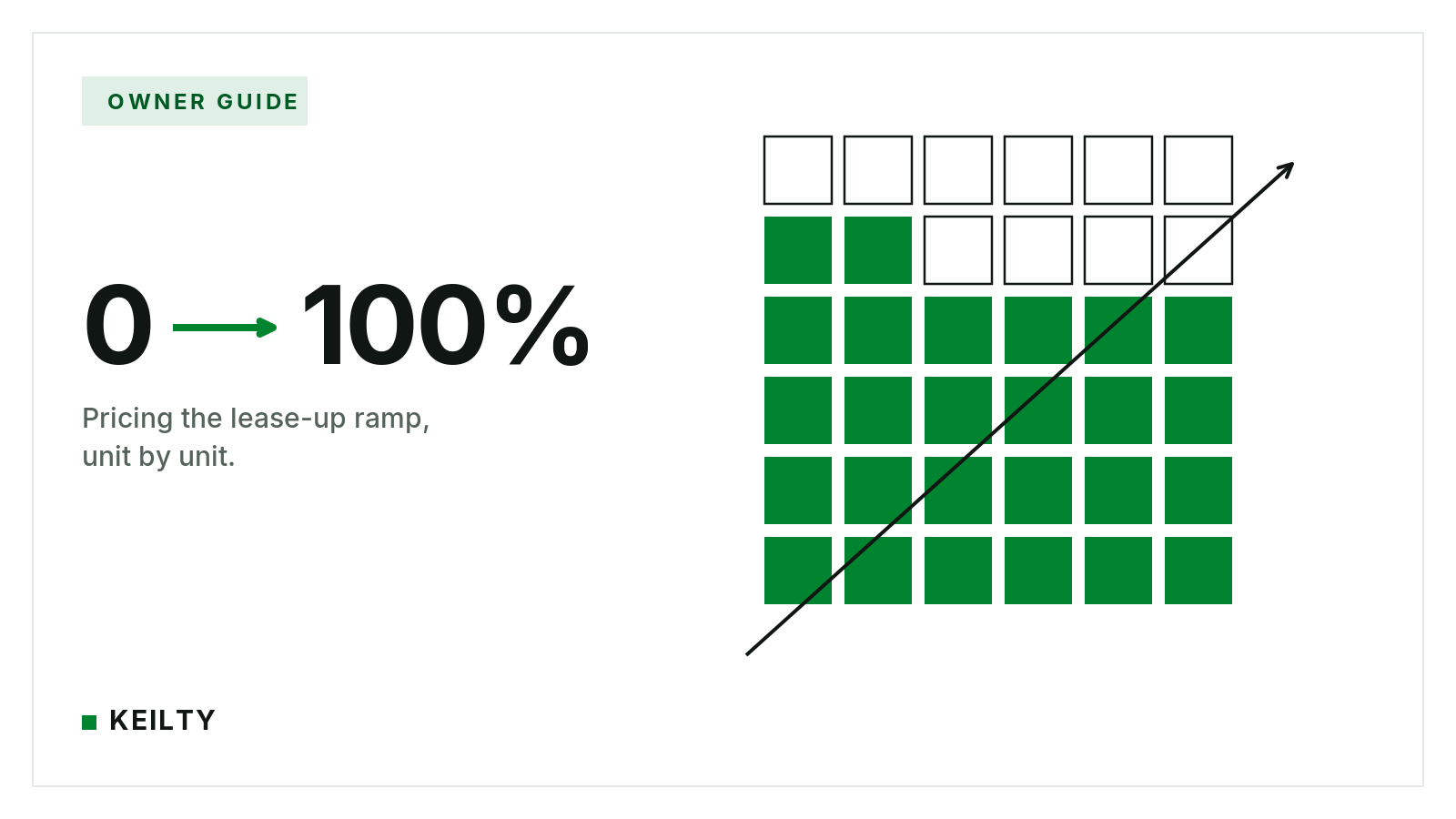
Managers who run lease-ups regularly treat pricing as a daily, unit-by-unit exercise, not a number set at launch. Every vacant unit is repriced continuously on its specific attributes: floor, position in the stack, proximity to the elevator, size. The mandate isn't to fill units as fast as possible; it's to optimize net operating income over the full lease-up window, which is a materially different job than chasing an occupancy date.
The pattern that works:
Timing against the renewal cycle matters just as much. The bulk of initial leasing needs to land inside the first year, before your earliest tenants come up for renewal. Otherwise, new-unit marketing and renewal negotiations compete for the same pool of prospects. Provincial rules shape the strategy too: Ontario currently has no rent control on newer buildings, British Columbia's rent control applies from occupancy, and Quebec allows a window before rent control applies. The right pricing plan depends on which province the building sits in, so it's worth confirming the current rules for your project before setting strategy.
One commercial tenant might file a handful of maintenance requests a year. A building full of residents generates a steady daily flow, and Ontario's rules set real expectations around response times and habitability. Self-managing works right up until call volume outpaces the team handling it. The problem is that this threshold is usually discovered during the first lease-up rather than planned for in advance.
If you're weighing the trade-off, we've written a candid comparison of self-managing vs. hiring a property manager.
Including some utilities in rent is a reasonable leasing incentive for a new building. But bundling utilities changes how future rent increases are calculated under the RTA, and it has to be priced and documented correctly from the first lease, because it's difficult to restructure after the fact.
None of this is a reason to avoid a first residential project, and plenty of commercial developers run their own lease-ups successfully. It's simply a different operating system, and most first-lease-up friction comes down to applying commercial assumptions to a residential process.
This is exactly the discipline a strong residential manager brings to the table: not just filling units, but running the pricing, pacing, and compliance work daily so the building hits its target NOI, not just its target occupancy date. Getting the paperwork, the marketing sequencing, and the pricing right from day one matters more than anything that happens after the building is full.
Planning a first lease-up? We run lease-ups for developers and asset managers across Ontario: pricing, pre-leasing, and RTA compliance, handled daily. Learn more about our Build-to-Rent and Institutional services, or book a lease-up strategy call. Same-day answers, no obligation.
A commercial lease is a contract negotiated between two businesses, but a residential tenancy in Ontario runs on the province's standard lease form and the Residential Tenancies Act, and very little of it is negotiable. Deposits, notice periods and grounds for ending a tenancy are set by statute. Developers who add commercial-style clauses often find they are unenforceable, which can weaken an otherwise straightforward case at the Landlord and Tenant Board.
Filling forty or eighty units by a target date is a volume marketing problem that needs a long runway. That means professional photography and staged units before the building is finished, listings live across multiple rental platforms, and a pre-leasing period that opens well before keys are ready. Waiting until the building is move-in ready is the most common reason a lease-up misses its occupancy target.
Commercial rent is priced per square foot against an asset class, but residential renters compare your two-bedroom directly against the two-bedroom down the street on bedroom count, in-suite laundry, parking and what is included. A building priced from a spreadsheet formula rather than a real comparable set tends to underprice its strong units and overprice its weak ones. Both mistakes show up as vacancy or lost revenue.
No. A building that leases up in two months almost certainly priced too low, while one that leases too slowly ends up competing with its own first-wave renewals. Experienced managers reprice every vacant unit daily on its specific attributes, open below the ultimate target rent to build momentum, push rents as occupancy climbs into the 70 to 85 percent range, and aim to land the bulk of initial leasing inside the first year, before the earliest tenants come up for renewal.
Including some utilities in rent is a reasonable leasing incentive for a new building. However, bundling utilities changes how future rent increases are calculated under the RTA. It has to be priced and documented correctly from the first lease, because it is difficult to restructure after the fact.
This post is general information about Ontario residential tenancy and human rights law as of 2026-07-22, not legal advice. Legislation, regulations and tribunal practice change. For advice on a specific applicant, property or situation, speak with a lawyer or licensed paralegal.
Ontario property management with published pricing, same-day answers, and no surprises. Since 2003.
300-80 Queen StreetNot served yet. Join a list and hear from us the day we open.