
By A.J. Keilty, President, KEILTY Realty Management
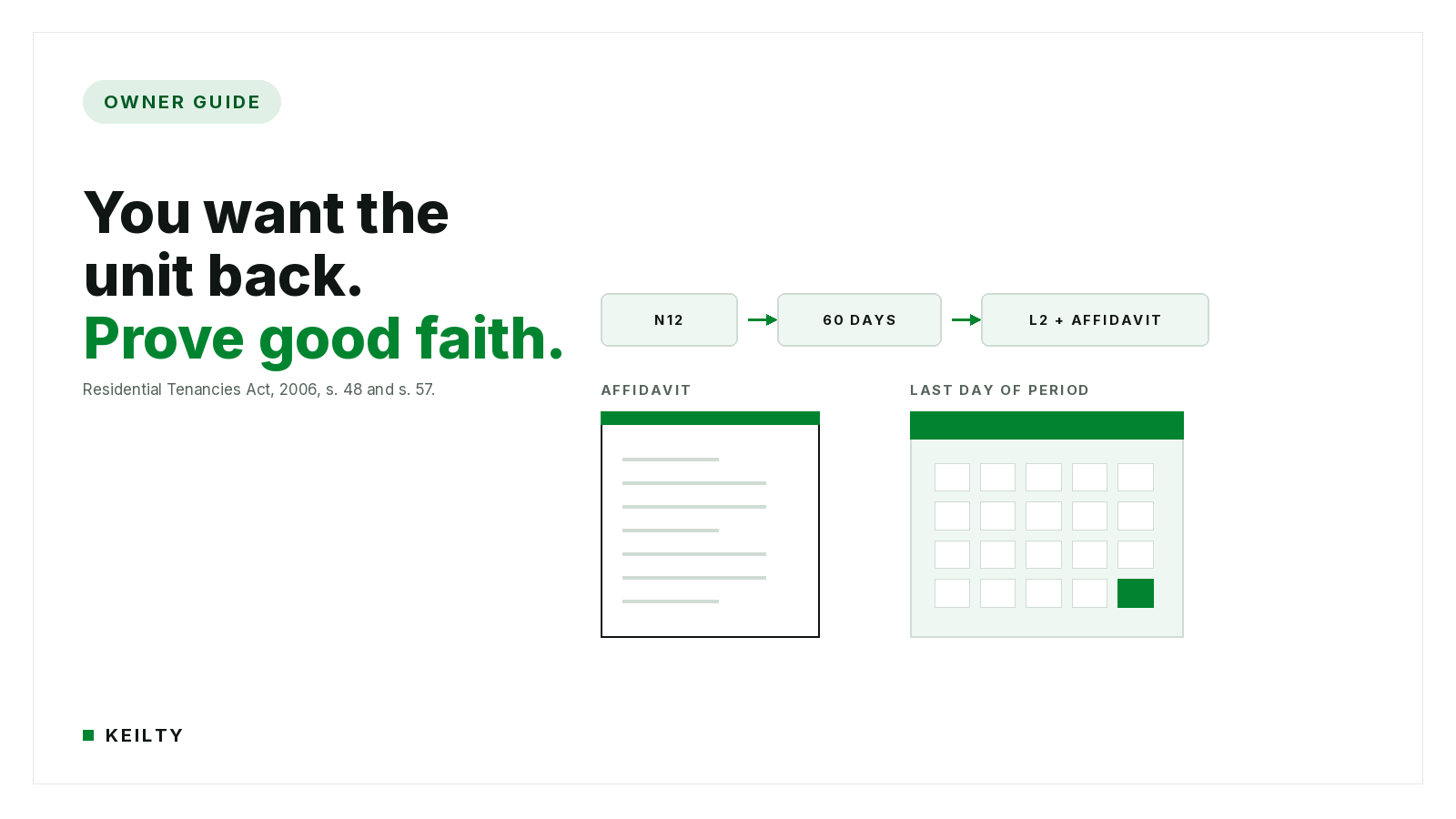
Short answer: yes, but only if an individual owns the unit and someone specific is actually moving in. Ontario lets you end a tenancy for your own use with a Form N12 if you, your spouse, a child or parent of either of you, or a caregiver will live in the unit for at least a year. You need to give at least 60 days' notice ending on the last day of a rental period, and you have to pay the tenant one month's rent, as a separate payment and not by waiving the last month's rent deposit, no later than that termination date. A corporation cannot use section 48 for its own use, but it can still serve an N12 on a purchaser's behalf under section 49.
The short version.
That is the whole rule in a paragraph. The trouble is that almost every N12 that fails at the Landlord and Tenant Board fails on a detail rather than the concept. Wrong termination date. Compensation paid late, or never actually paid because the owner thought forgiving the last month covered it. No affidavit filed with the application. A rental listing that went up four months later and turned into a bad faith claim. Here is what has to line up, and what changed at the LTB on 2026-07-01.
Section 48 of the Residential Tenancies Act, 2006 limits the intended occupant to a short list:
Siblings are not on that list. Neither are grandparents, grandchildren, nieces, nephews, cousins, or a friend who needs a place for a few months.
Read the third item carefully, though, because it is broader than most owners assume. The clause covers a child or parent of the landlord or the landlord's spouse. Your mother-in-law and father-in-law are on the list. So is your spouse's child from an earlier relationship. Your son-in-law is not, because he is the spouse of your child rather than a child of you or your spouse. The LTB has dismissed applications for naming someone outside the list, and the notice cannot be fixed after it has been served. A defective N12 is dead, and you start again from zero.
The other limit catches a lot of owners by surprise. Since 2017-09-01, subsection 48(5) permits a notice under that section only where the rental unit is owned in whole or in part by an individual and the landlord is an individual. Both conditions, not either one. If title sits in a numbered company or a corporation you set up for liability reasons, section 48 is closed to you, and no amount of good intention changes that. The LTB's Interpretation Guideline 12 is blunt about it: earlier decisions that let some corporations use this section are no longer valid.
That restriction is confined to section 48. Subsection 48(5) opens with the words "This section," so it does not reach section 49, and a corporate landlord that has signed an agreement of purchase and sale can still serve an N12 on the purchaser's behalf. If you hold rentals in a corporation and need a unit back for someone's own use, a sale is the only N12 route available to you.
That is section 49, and it is narrower than most sellers expect. You can serve an N12 on a purchaser's behalf only if there is a firm agreement of purchase and sale, and only if the property is a condominium unit or a residential complex with no more than three units. A four-plex does not qualify. The LTB will also look past the paperwork to the real nature of the deal, so a transfer to a family member at well below market value invites scrutiny under section 202.
One detail that trips up sellers: subsection 49.1(2) keeps the obligation to pay the compensation with you, the landlord who served the notice, and expressly does not transfer it to the buyer. Sort that out in the agreement before closing, not after.
At least 60 days, and the termination date has to fall on the last day of a rental period, or the last day of a fixed term if there is one. Both conditions, not either one.
A worked example. Month-to-month tenancy, rent due the first of the month, you serve the notice on 2026-08-20. Sixty days later is 2026-10-19, which is not the last day of a rental period, so the earliest valid termination date is 2026-10-31. Get that wrong by a single day and the notice is defective.
The tenant can leave sooner. Once they have the N12, they can end the tenancy early with ten days' written notice on Form N9. Plan for that, because it can pull your vacancy forward by weeks.
You owe one month's rent under section 48.1, or you offer the tenant another unit they find acceptable. Section 55.1 sets the deadline: no later than the termination date specified in the notice. Not after the hearing, and not when the keys come back. Section 83(4) then bars the Board from issuing an eviction order until you have complied with section 48.1, so compensation that is late or never actually delivered does not merely weaken the application, it defeats it.
Do not try to satisfy this by waiving the last month's rent. This is the most common and most expensive misunderstanding about N12 compensation, and it comes from running two separate obligations together. Section 106(10) already requires you to apply the rent deposit to the rent for the last rental period of the tenancy. The tenant's final month is covered by law already, N12 or no N12. Telling the tenant they need not pay their last month therefore transfers nothing they were not already entitled to, and it does not discharge the section 48.1 obligation. An owner who does this and arrives at the hearing believing compensation is handled loses the application under section 83(4).
Pay it as a separate transfer instead. An e-transfer, a cheque, or a deposit that shows on a statement, dated on or before the termination date, with the purpose recorded in writing. Keep the proof, because compliance is yours to prove at the hearing.
One related trap. If a first N12 falls apart and you serve a second one, you cannot quietly treat the money already paid as covering the new notice. The Board has held that you must tell the tenant clearly and unequivocally, before the new termination date, that you are giving up any claim to have the first payment returned. Barry v Vindis, 2024 ONLTB 72896, dismissed an application on exactly that point.
Close to it, with one narrow exception worth knowing. In 6150 Yonge GP Inc. v Boxma, 2023 ONSC 2859, the Divisional Court held that the section 55.1 deadline is not a "prescribed" time requirement under section 56 of O. Reg. 516/06, which means section 190(2) permits the Board to extend it. In that case the landlord had tendered a cheque before the termination date and the tenant delayed months in cashing it. That is a long way from an owner who simply did not pay. Board members have said that landlords should be held strictly to the section 55.1 deadline, so plan on the deadline being hard and never plan on the discretion.
Once the notice is served you can file Form L2, and it has to reach the LTB no later than 30 days after the termination date in the notice. File late and it gets dismissed outright.
Three things must go in with it:
That last item exists precisely to catch serial N12s, and members do read it.
Narrower than most people assume, and in a way that helps owners acting in good faith. The test is genuine intention, not whether your plan is sensible. In Salter v. Beljinac, 2001 CanLII 40231, the Divisional Court held that once the landlord genuinely intends to occupy the unit, that is enough, even if the choice of that particular unit is driven by economics. Fava v. Harrison, 2014 ONSC 3352, went further: motive is largely irrelevant, the only question is genuine intent.
What the member will weigh is conduct. Have you served N12s before, and did those people actually move in and stay a year? Is there a history of conflict with this tenant that makes the timing look convenient? Occasional use also fails. Keeping the unit as a pied-a-terre, using it as a business office, or leaving it empty have all been found not to be residential occupation.
This is the part worth reading twice, because the exposure lands on you a year later when the unit is long gone.
A former tenant can file a T5 under section 57 within one year of moving out. They have to prove the notice was given in bad faith, that they left because of it, and that nobody named on the notice occupied the unit within a reasonable time. If they succeed, the LTB can order you to pay:
And bad faith is presumed, unless you disprove it, if during the window from the date you gave notice to one year after the tenant left you advertise the unit for rent, sign a lease with someone else, advertise the unit or the building for sale, demolish it, or convert it to non-residential use. The presumption is rebuttable, but you are now the one explaining yourself.
Plans change. People take jobs in other cities and parents decide against the move. If the person named on your N12 backs out before the tenant vacates, withdraw the notice in writing and let the tenancy continue. That conversation is uncomfortable for ten minutes. A section 57 order is expensive for a year.
Tribunals Ontario confirmed several amendments in its operational update of 2026-06-30. Two matter for anyone considering an N12.
First, the deadline to request a review of an LTB order dropped from 30 days to 15. If an order goes against you, or contains an error you need corrected, the window is now half what it was. Diarize it the day the order arrives.
Second, maximum fines doubled. Individuals now face up to $100,000, up from $50,000, and corporations up to $500,000, up from $250,000. Those maximums live in section 238 of the Act, the penalty provision. Tribunals Ontario's update cites section 236, but section 236 is the offence of attempting to commit an offence, so if you go looking for the numbers yourself, section 238 is where they are. The increase was enacted by Bill 97 back in 2023 and only came into force on 2026-07-01. These are prosecutions brought by the Rental Housing Enforcement Unit at the Ontario Court of Justice, entirely separate from anything the LTB orders in a T5, and bad faith own-use evictions are exactly the sort of file the RHEU takes on.
The same update also brought in new rules for tenant-installed window and portable air conditioners, a mandatory Payment Agreement form for repayment plans under section 206, and tighter service deadlines on above-guideline increase orders.
Yes, and the date is now on the books. Schedule 12 of Bill 60, the Fighting Delays, Building Faster Act, 2025, adds a new subsection 48.1(2) that removes the compensation requirement where the landlord gives a longer notice period. e-Laws lists it as coming into force on 2026-09-21. Three conditions have to be met: the notice is given on or after that date, the termination date is at least 120 days after the notice is given, and the termination date is the end of a period of the tenancy or the end of a fixed term.
As of 2026-07-31 the one month of compensation is still required on every N12. Do not serve a notice today on the assumption that a future rule will excuse the payment. From late September, if your timeline can absorb 120 days of notice instead of 60, that trade may be worth making, and on a typical unit it is worth roughly a month's rent. One limit to note, because it is widely misreported: subsection 48.1(2) reaches a landlord's own use only. A notice served on a purchaser's behalf under section 49 still carries the compensation under section 49.1, however long the notice period.
Longer than most owners plan for. Nine to fourteen months from notice to vacant possession is the realistic range for a contested own-use file, and the sixty days of notice is the smallest piece of it.
The arithmetic runs like this. Sixty days of notice, then up to thirty days to file the L2 after the termination date, then the wait for a hearing. The LTB's published timelines put L1 and L9 non-payment applications at roughly three months from filing to scheduling, and most other application types, which is where the L2 sits, at five to seven months. Add time for the order to issue after the hearing, and more again if the tenant disputes good faith.
Then enforcement, where a widely repeated error creeps in. There is no eleven day grace period on an own-use order. That eleven days is the void period in a non-payment order, where section 74 lets the tenant pay the arrears and void the eviction before the order becomes enforceable. Section 74 is tied to notices given under section 59, so it has nothing to do with an N12, and an own-use order carries no equivalent right to void. Once the termination date set out in the order has passed, the order can be filed with the Court Enforcement Office, the sheriff, who is the only person permitted to remove a tenant. Mind section 81 while you are at it: the order expires six months after the day it takes effect if it is not filed within those six months. Enforcement is then scheduled by the sheriff's office, and that scheduling is a wait of its own.
We walked through the arithmetic in how long it takes to evict a tenant in Ontario in 2026.
Most tenants who receive a valid N12 leave without a hearing. The ones who do not are usually the ones who suspect the notice is a rent reset in disguise, which is another reason to keep your paperwork clean from day one.
An N12 is a legitimate tool and owners use it for entirely ordinary reasons. A parent needs to be closer. A kid is starting at Queen's or Trent. You are moving back into the house you rented out during a posting. None of that is a problem. What creates the problem is treating a statutory process as paperwork, and discovering in the hearing room that a date was off by one day or that the compensation everyone assumed was paid never actually left your account.
If you are weighing an own-use termination against keeping the unit tenanted, the numbers usually decide it. Our management versus self-management comparison lays out where the real costs sit, and the pricing section on the KEILTY single-family rental page explains how our flat monthly rate per unit works. It is a flat rate, not a percentage, so it does not climb every time the rent does.
Section 48 of the Residential Tenancies Act, 2006 limits the intended occupant to the landlord, the landlord's spouse, a child or parent of the landlord or the spouse, or a person who provides care services to one of those people where the person receiving care lives or will live in the building. Siblings, grandparents, grandchildren, nieces, nephews, cousins and friends are not on the list, while parents-in-law are. Since 2017-09-01 the unit must also be owned in whole or in part by an individual and the landlord must be an individual, so a corporation cannot use section 48, although it can still serve an N12 on a purchaser's behalf under section 49.
At least 60 days, and the termination date has to fall on the last day of a rental period, or the last day of a fixed term if there is one. For a month-to-month tenancy with rent due on the first, a notice served on 2026-08-20 cannot end on 2026-10-19 because that is not the last day of a rental period, so the earliest valid termination date is 2026-10-31. Getting the date wrong by a single day makes the notice defective, and the tenant can leave sooner with ten days' written notice on Form N9.
You owe one month's rent under section 48.1, or you offer the tenant another unit they find acceptable, and section 55.1 requires payment no later than the termination date in the notice. Section 83(4) bars the Board from issuing an eviction order until you have complied, so late or missing compensation defeats the application. Do not try to satisfy this by waiving the last month's rent, because the rent deposit already covers the last rental period by law. Pay it as a separate e-transfer, cheque or deposit dated on or before the termination date and keep the proof.
The Form L2 has to reach the LTB no later than 30 days after the termination date in the notice, or it is dismissed outright. Three things must go in with it: an affidavit or declaration from the person who intends to move in, swearing they in good faith require the unit for at least one year; Schedule B, the additional information form for own-use terminations; and a two-year disclosure listing every N12 and N13 notice you have given to any tenant in the two years before filing, including for other units or properties you no longer own.
A former tenant can file a T5 under section 57 within one year of moving out, and if they prove the notice was given in bad faith the LTB can order you to pay the difference between their old and new rent for a full year, moving and storage costs, a rent abatement, an administrative fine, and general compensation of up to twelve months' rent with no need to prove actual loss. Bad faith is presumed if, within one year after the tenant left, you advertise the unit for rent, sign a lease with someone else, advertise it for sale, demolish it or convert it to non-residential use. If the intended occupant backs out before the tenant vacates, withdraw the notice in writing and let the tenancy continue.
Not sure whether an N12 is the right move for your property, or what the unit would rent for today if you turned it over? Book a free rental evaluation and we will give you real numbers for your city, or get in touch and talk it through with someone who files these applications for a living.
This post is general information about Ontario residential tenancy and human rights law as of 2026-07-31, not legal advice. Legislation, regulations and tribunal practice change. For advice on a specific applicant, property or situation, speak with a lawyer or licensed paralegal.
Ontario property management with published pricing, same-day answers, and no surprises. Since 2003.
300-80 Queen StreetNot served yet. Join a list and hear from us the day we open.