
By A.J. Keilty, President, KEILTY Realty Management
You are buying three things: someone who does the recurring work on a schedule, someone who is accountable for the parts of it that carry a legal deadline, and someone who is already holding the Kingston details that are not written down anywhere obvious. The first you could do yourself. The second is where a missed date costs real money. The third is the part that is hardest to see from the outside, because Kingston runs two leasing years rather than one, the City's rules sit across several by-laws, and the utility that serves the middle of the city does not serve the ends of it.
The short version.
Strip out the language and a management mandate is a list of jobs that recur on their own timetable whether or not anyone is available that week. Someone lists the unit and answers the inquiries. Someone stands in the unit for showings. Someone screens the applicants and says no to the ones who do not hold up. Someone prepares a compliant lease and gets it signed before occupancy. Someone collects the rent and chases it the day it is late. Someone answers the phone when a tenant has no hot water on a Sunday. Someone scopes the turn, gets the trades in and gets the unit back on the market. Someone produces a statement you can hand to an accountant.
An owner with one unit and a flexible job can do every one of those. The question is not capability. It is whether the jobs get done on the days they need doing, in a year when you are also working, travelling or dealing with something else. A rental does not pause while you do.
What you cannot do by simply being organized is carry the exposure, and that is the second half of the answer. Several of these jobs are attached to a statutory clock, and the penalty for missing one is not a telling-off. It is a void notice, a refused application, or a deduction from next month's rent taken by the tenant without asking.
The lease itself, and it is stricter than it looks. Subsection 12.1 (1) of the Residential Tenancies Act, 2006 requires a tenancy agreement of a prescribed class to be in the prescribed form and to comply with the prescribed requirements. Subsection 12.1 (2) separately requires it to be "signed by the landlord and the tenant on or before the day the tenant is entitled to occupy the rental unit under the tenancy agreement". The dates are not in the Act. They are in O. Reg. 9/18: the requirement bites on agreements entered into on or after 2018-04-30, and an agreement entered into on or after 2021-03-01 has to use the December 2020 edition, the Residential Tenancy Agreement (Standard Form of Lease) dated 2020/12, or its French equivalent, available on the website of the Government of Ontario Central Forms Repository.
Before any of that, section 12 imposes a plainer duty and a harsher sanction, and it reaches every written tenancy agreement rather than a prescribed class. Section 12 (1) requires a written agreement entered into on or after June 17, 1998 to "set out the legal name and address of the landlord to be used for the purpose of giving notices or other documents under this Act". Section 12 (2) requires you to give the tenant a copy signed by both of you "within 21 days after the tenant signs it and gives it to the landlord", and note where that 21 days runs from. Section 12 (3) does the same job for an oral tenancy, requiring written notice of your legal name and address within 21 days after the tenancy begins. Then section 12 (4): until you have complied with subsections (1) and (2), or with subsection (3), "the tenant's obligation to pay rent is suspended" and you "shall not require the tenant to pay rent". There is no cap on that, no once-per-tenancy limit, and no deadline by which the tenant has to raise it. The two sections run side by side, and subsection 12.1 (12) says so in terms: "For greater certainty, nothing in this section affects the operation of section 12."
The recovery rules then run the opposite way to what you would expect, and this is the part worth carrying. Section 12 (5) lets you require the tenant to pay "any rent withheld by the tenant under subsection (4)" once you have complied, with no time limit attached to it. The capped section 12.1 route is the one with a deadline. So the bigger exposure is also the one you can unwind completely, and the smaller one is where money can be lost for good.
Not every tenancy is in the prescribed class, and the exclusions in O. Reg. 9/18 are worth reading before you rely on any of this. Out of the class are a rental unit in a care home, a site for a mobile home, a site for a land lease home, units described in clause 6 (1) (a) or (b) or subsection 7 (1) of the Act, units described in subsections 6 (1) or (3) of O. Reg. 516/06, and a catch-all covering any other accommodation for which the tenant pays rent geared to income because of public funding. Co-operative member units sit outside it too, because the class reaches only accommodation to which the Act applies other than Part V.1.
Getting the form wrong does not void the lease. Subsection 12.1 (11) says so in terms. What it does is hand the tenant a sequence, and the sequence follows non-compliance with subsection (1) rather than a late signature. The tenant may demand the proper form in writing, once during the tenancy. If 21 days pass and you have not complied, they may withhold rent payments "that become due after the expiry of that 21-day period", to a maximum of one month's rent, and they have to stop the day you comply. You can recover what was withheld only if you comply within 30 days of the first withheld payment, and if you miss that window the money is gone.
Section 47.0.1 is the sharper one, and it has more conditions than it first appears. A tenant on a yearly or fixed-term tenancy may end it early on 60 days notice ending on the last day of a rental period, but only after a demand has been made and then either 21 days have passed without you complying, or you have complied and the tenant has not signed the proposed agreement. The defence is in subsection 47.0.1 (2): once you provide the agreement, the tenant has 30 days to give the notice and no longer. So a missing form on a fixed-term student lease is a live termination right, and providing the form is what closes it.
The deposit is the other thing to get right at the front. Section 106 (1) allows a rent deposit only if you require it "on or before entering into the tenancy agreement", so asking after signing is not authorized. Section 106 (2) caps it at the lesser of one rent period and one month. And section 105 (1) is the prohibition that settles what else you can ask for: "The only security deposit that a landlord may collect is a rent deposit collected in accordance with section 106", with security deposit defined broadly enough to catch money, property or a right held as security for any obligation. Section 106 (10) then says you "shall apply" the deposit to the rent for the last rent period before termination. It is a last month's rent deposit and nothing else, and there is no power anywhere to put it against damage or arrears.
Because two different populations move on two different dates, and the shorthand you will hear around town covers only one of them.
Queen's University publishes 12 month fixed-term leases for its own University District units running "from 3:00 p.m. May 1 to 12:00 pm (NOON) April 30". Its off-campus housing service told students in February 2026 that April 30 "is a very common move out date here in Kingston". That is the cycle being referred to when people talk about Kingston turning over on May 1.
The same university runs the opposite cycle in its graduate and family buildings. Of An Clachan it says "The majority of lease agreements begin September 1st" and that units coming free during the year are re-leased to realign to a September 1 to August 31 year; of John Orr Tower it says "12 month lease periods generally begin on September 1st (some exceptions may apply)". St. Lawrence College publishes nothing at all about lease start dates, so none should be asserted on its behalf. Its classes for all students begin 2026-09-09, with orientation the day before, and Queen's Fall Term begins 2026-09-01, with classes from 2026-09-08 and residence move-in on Saturday 2026-09-05, which is the only move-in date its fall orientation schedule publishes.
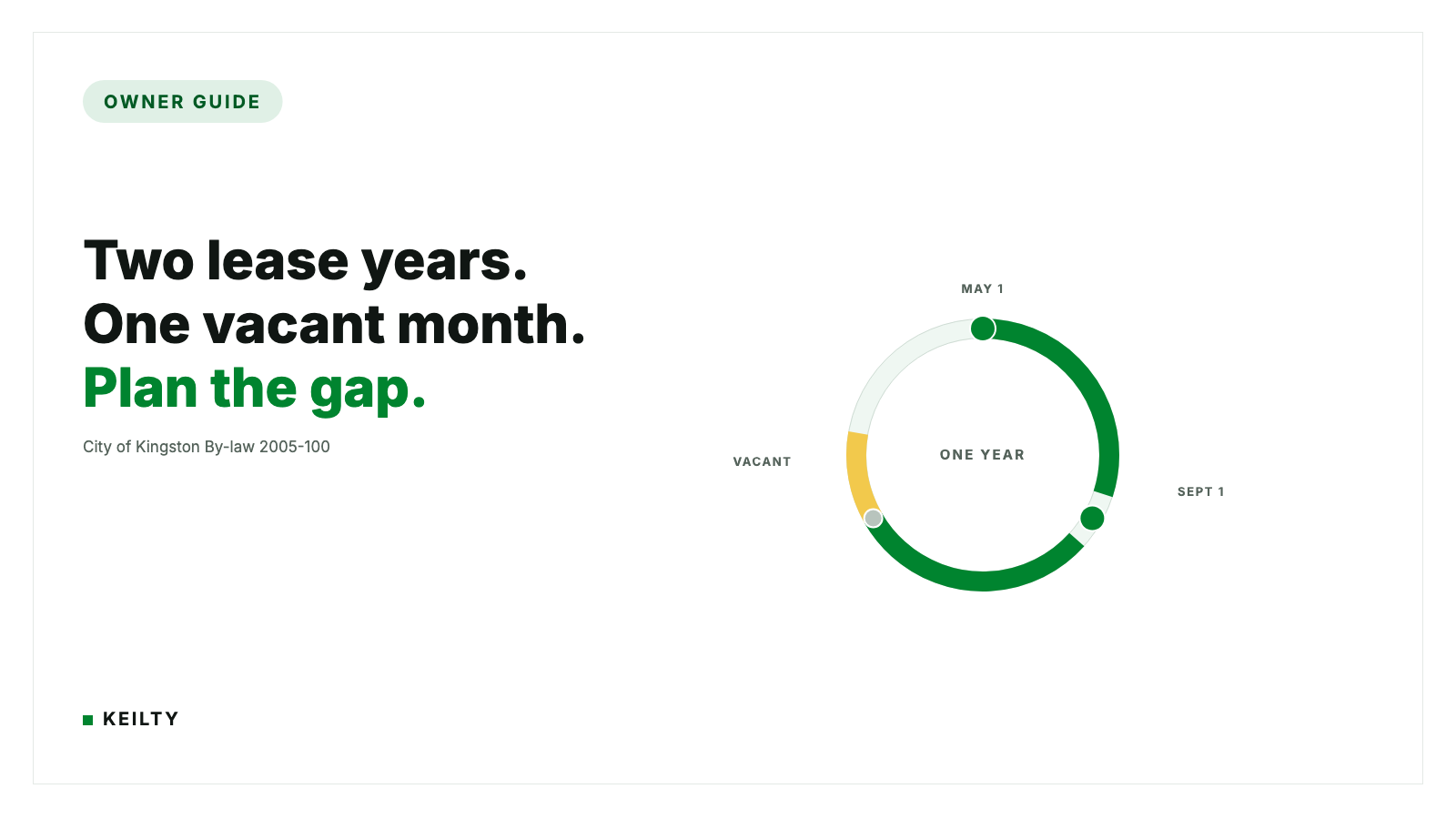
So a Kingston owner is pricing into one of two markets, and possibly into a gap between them. A three-bedroom in the University District that comes free at the end of April is competing in a deep, early, well-organized market where Queen's tells students that properties "are typically posted 60-90 days before they will be available". The same house coming free at the end of July is competing in a thin one. That is not a rule about student housing. It is a scheduling fact that determines whether you get one month of vacancy or four.
What a manager is doing with that is unglamorous and decisive: pre-leasing against the right date, starting the marketing early enough to sit inside the window rather than behind it, and structuring the term so the unit comes free at the end of the cycle rather than the middle of it. At KEILTY we have been managing Ontario rentals since 2003 and our Kingston office is on Queen Street, which is the reason we hold this calendar rather than look it up. We set out how we handle the local market on our Kingston property management page.
This is the part that is genuinely local, and it is spread across more than one by-law.
Property standards are governed by By-law 2005-100, passed 2005-05-17 and last updated 2025-09-02. An officer who finds a property does not conform with the standards may make an order under subsection 15.2 (2) of the Building Code Act, 1992. An owner who is not satisfied with the order may appeal to the committee the by-law calls the Appeals Committee, and the window is short: "within 14 days after being served with the order", by registered mail, with a fee. Fourteen days from service, not from when you open the envelope on your return. Miss it and subsection 15.3 (2) of the Act deems the order confirmed.
Two things sit past that point, and both change what a hearing is worth. Paragraph 2 of subsection 15.3 (3.1) lets the committee "Extend the time for complying with the order", so an appeal is not only an argument about whether the work is required, it is also an argument about when, which is often the cheaper thing to win. The committee may do that only where, in its opinion, doing so "would maintain the general intent and purpose of the by-law and of the official plan or policy statement". And subsection 15.3 (4) gives a further appeal to the Superior Court of Justice within 14 days after a copy of the committee's decision is sent, open to the municipality, to any owner or occupant, and to any person affected by the decision. That one has two steps rather than one: you notify the clerk of the municipality in writing and you apply to the court, both inside the 14 days. Nothing in sections 15.1 to 15.8 of the Building Code Act, 1992 lets anyone extend either appeal window, which is the sharp difference from the Landlord and Tenant Board's own regime, where section 190 (1) of the Act gives the Board a power to extend some deadlines.
The consequence of ignoring a confirmed order is the part owners should read twice. Where an order is not complied with, once it is deemed confirmed or is confirmed or modified on appeal, the City "may cause the Property to be Repaired or demolished", and the owner "will be responsible for the payment of the cost of such work, including an administrative fee". That cost is added to the municipal tax bill, which means it does not behave like an invoice you can dispute at leisure.
Heat sits in the same by-law rather than in a separate vital services by-law, which Kingston does not have. Every dwelling unit must have a heating system capable of maintaining 21.1C, and where the landlord supplies the heat the building must be provided with adequate and suitable heat "between the 15th day of September in each year and the 1st day of June of the following year". Portable heating equipment as a primary source is prohibited outright. That first date falls ten days after Queen's residence move-in, which is not a coincidence anyone planned but is a useful way to remember it.
Licensing is where the common answer is too simple, and it is too simple in two directions. There is no city-wide residential rental licence in force in Kingston today. There is, though, an active file. Council approved residential rental licensing on 2024-02-06, as amended by the Administrative Policies Committee on 2024-01-24, for properties containing one to four residential rental units in the Sydenham and Kingscourt-Rideau districts. The City's own strategic plan review, Report 24-157 of 2024-06-18, then records that on the same date Council directed staff "to undertake revisions of the City's already existing By-Laws and processes to promote the health and safety of tenants; and create a Residential Rental Registry system for properties with 1-4 residential rental units". So the direction of travel is a registry rather than a licence, in the City's own words. The public project page has not moved since 2024-02-08, and those districts hold a good deal of the student stock, so an owner there should ask the City where it stands rather than assume nothing applies.
The second direction is a licence that already exists and catches shared houses. The Business License By-law, 2025-34, passed 2025-11-18, licenses a boarding, lodging or rooming house, defined as premises "in which it is intended that four or more individuals are to be lodged in return for remuneration or for the provision of services or for both, and in which the lodging rooms do not have both bathrooms and kitchen facilities for the exclusive use of individual occupants". Read the carve-outs with it: the definition expressly excludes a short-term rental licensed under the City's Short-term Rental Licensing By-law 2021-10, a hotel, a hospital, a long-term care home, a home for the young, and any other institution licensed, approved or supervised under an Ontario statute. The 2026 fee is $177, and section 5.10 of the by-law provides that unless the by-law says otherwise "a licence is valid from the date it is granted or renewed until December 31 of that year, unless suspended or revoked earlier", so one taken out in November costs the full fee for six weeks. The City's business licence page puts the renewal side of that in one line: "Business licences must be renewed annually by Dec. 31." Whether a particular shared house is caught is a question for the City's licensing staff rather than for a blog post, and it is exactly the question an owner converting a family home into a five-bedroom rental should ask before the first lease rather than after a complaint.
Waste is a smaller point with a sharp edge on a small building. The City collects garbage from buildings with seven or more units for a fee of $67.61 per unit added to the property's tax bill, offers organics collection free to buildings with six or more units, and puts buildings with fewer than six units on standard household collection, which is one untagged bag a week with tags at $4.00 each beyond that. Read those thresholds against each other and a six-unit building falls in a gap on the face of the City's own page, which carries no date. Recycling is no longer a City service at all; the City's page states it is now collected by Circular Materials Ontario and its contractor. If you are buying a six or seven unit building in Kingston, telephone the City before you model the operating cost.
More than a name change on an account, and the trap is a default rule rather than a fee.
Utilities Kingston describes itself as "unique in Ontario, combining water, wastewater, gas and electrical services and a broadband networking business in one company under the leadership of a single CEO". That is true in the middle of the city and not at the ends of it. The utility states plainly that "Kingston is served by three electricity providers" and that "While Utilities Kingston provides natural gas services in Central Kingston (see below for a map of our service area), residents in the west and east ends of the city are served by Enbridge Gas". An owner buying in Reddendale or out past the causeway should not assume the arrangement that applies downtown.
On a turnover, the utility states that "A $15 standard application fee covers the costs to arrange for each service (totalling up to $60 plus HST, depending on the number of services)", and adds that where service to the address has been turned off a reconnection fee may also apply. It also warns that "it can take between two and five business days to set up a new service". Two to five business days on a May 1 changeover is the difference between a tenant arriving to a working unit and a tenant arriving to a complaint.
The part to underline is in the Terms of Service: "In the absence of a contract with a tenant, or in the event that utilities are used by an unknown person, the cost for that usage is due and payable by the Owner and/or Landlord of the property." Liability for the gap between one tenant closing an account and the next one opening theirs falls to the owner by default, without anyone signing anything.
There is a way to get ahead of that, and it also saves the application fee. Utilities Kingston offers owners an auto setup service, under which the service address is set up automatically in the owner's name between tenants, and it states that "Owners enrolled in auto setup are not charged the standard application fee per service". It is opt-in and it is applied for per address. On a building with regular turnover that is a standing administrative job someone has to own: enrol the address, then track the close date and the open date on every changeover. If it is not a manager doing that, it is you.
Three things that matter to a Kingston owner, and they all landed on the same day.
The notice period for non-payment of rent is shorter. Section 59 (1) was repealed on 2026-09-21 and substituted by section 4 of Schedule 12 to the Fighting Delays, Building Faster Act, 2025. It now reads, in a single unclaused sentence, "If a tenant fails to pay rent lawfully owing under a tenancy agreement, the landlord may give the tenant notice of termination of the tenancy effective not earlier than the 7th day after the notice is given." The old split, 7 days for a daily or weekly tenancy and 14 days in all other cases, is gone, and the clock runs from the date the notice is given for every tenancy. A monthly tenancy dropped from 14 days to 7. That is a real acceleration of the arrears timeline.
The N4 became a prescribed form on the same day. O. Reg. 308/26 came into force on 2026-09-21, and it requires a notice under section 59 to be in "version 1 of the form titled “Notice to End Your Tenancy Early for Non-payment of Rent (N4)”, available on the Landlord and Tenant Board's website." That is an ambulatory reference rather than a dated one: the binding form is whatever the Board posts, subject only to being labelled Version 1, and the regulation names no date. Before 2026-09-21 the N4 was a Board-approved form. It is now prescribed and pinned to a version, which means an old copy saved on a desktop is a defective notice rather than an untidy one.
And section 82 changed, which is the provision letting a tenant raise their own issues inside your arrears application. Two things happened. Subsection 82 (1) was replaced, and the tenant lost the alternative of giving the Board a satisfactory explanation for not having served the advance notice, so compliance with subsection 82 (2) is now the single route in. And subsection 82 (2) gained paragraphs 4 and 5, under which, unless the regulations provide otherwise, the tenant has to pay half of any rent arrears that were claimed in the application when it was filed, plus any other prescribed amount, to the landlord or, if the regulations so provide, into the Board. That keys off the date the application was filed rather than the balance standing at the hearing. Section 8.3 of O. Reg. 516/06 sets the timeline at no later than seven days before the hearing. Subsections 82 (4) and (5) preserve the old law for an application made before 2026-09-21 that has not been finally determined. We set out the rest of that day in what changes for Ontario landlords in September 2026.
The point for this post is not the detail. It is that none of it announced itself. Somebody has to be reading the consolidations, noticing that a form has been prescribed, and replacing the saved template before the next notice goes out. That is a standing job, and it is one of the quieter things the fee covers.
Four recurring obligations, each small, each with a sanction attached.
Rent collection and arrears follow-up is the first and it is simply discipline. The day rent is late is the day the conversation happens, not the following week.
Deposit interest is the one that goes unpaid quietly. Section 106 (6) requires a landlord to pay interest to the tenant annually on the rent deposit "at a rate equal to the guideline determined under section 120 that is in effect at the time payment becomes due". Write down the rule rather than the number, because the number moves. Ontario has published 2.1 per cent for 2026 and 1.9 per cent for 2027. If you miss the payment, section 106 (9) lets the tenant deduct it from a subsequent rent payment themselves.
There is a set-off in the same section that is worth knowing, because it turns a payment into a top-up. Where the rent has risen, section 106 (3) lets you require the tenant to increase the deposit to the new permitted maximum, and section 106 (7) lets you deduct from the interest you owe the amount by which that maximum exceeds what the tenant has actually paid, with the deducted amount deemed to form part of the deposit. Done in the right order, the interest funds the top-up instead of leaving the building.
Rent increases run on 90 days. Section 116 (1) requires "at least 90 days written notice", section 116 (3) requires a form approved by the Board setting out your intention to increase the rent and the amount of the new rent, and section 116 (4) is the sanction: an increase is void if the landlord has not given the notice required by the section, and the landlord must give a new notice before the increase can be taken.
What a void increase does to the twelve month rule in section 119 is our reading rather than a rule, and it is worth marking as such. Nothing in section 119 addresses a void increase at all, and section 119 (2) shows the drafters deeming expressly when they mean to, because it deems an increase under section 123 not to be an increase for the purposes of the section and says nothing about a void one. Our own view is that an increase which never took effect cannot be the last rent increase for the purposes of clause 119 (1) (a), so the cost of the error is the 90 days you have to wait again rather than the year. Read it alongside section 135.1 (1), which cuts the other way and is the cure if you find the defect late: an increase that would otherwise be void under section 116 (4) "is deemed not to be void if the tenant has paid the increased rent in respect of each rental period for at least 12 consecutive months". Section 135.1 (2) switches that off where the tenant has, within one year after the date the increase was first charged, made an application in which the validity of the increase is in issue, and section 135.1 (3) then deems section 116 to have been complied with.
One exemption is worth naming here because it is the largest number on this page for some owners, and it is really two exemptions rather than one. Section 6.1 (2) disapplies sections 120, 121, 122, 126, 127, 129, 131, 132, 133, 165 and 167 where the rental unit is in a building, mobile home park or land lease community no part of which was occupied for residential purposes on or before November 15, 2018, or is entirely inside an addition to one, no part of which addition was so occupied. That is the new build case.
Section 6.1 (3) is the newly created suite, and it is a different provision with a shorter list and four requirements that all have to be met. It disapplies sections 120, 121, 122, 126, 127, 129, 131, 132 and 133, which is the same list without sections 165 and 167. The unit has to be in a detached house, semi-detached house or row house which "on or at any time before November 15, 2018, contained not more than two residential units". It has to have its own bathroom and kitchen facilities, one or more exterior or interior entrances, a door at each entrance equipped so that it can be secured from the inside, and at least one of those doors capable of being locked from the outside. It has to have become that unit after November 15, 2018. And one or both of two circumstances has to apply: the owner, or one of the owners, lived in another residential unit in the house when the unit was first occupied as a residential unit, or the unit sits in a part of the house which "was unfinished space immediately before" it became one. Section 6.1 (6) then puts the work on you, providing that in a Board application where the exemption is in issue "the onus is on the landlord to prove that the subsection applies". Neither subsection disapplies section 116 or section 119, so the 90 days, the approved form and the twelve month rule all still bite on an exempt unit.
Reporting is the fourth, and it is the one that makes the other three auditable. A monthly statement per unit, with invoices attached, is what turns a year of activity into something an accountant can file and something you can check without reconstructing it from memory.
Take a three-bedroom in Williamsville that comes free at noon on Thursday 2026-04-30 at the end of a student lease. CMHC's October 2025 Rental Market Survey, published 2025-12-11, reports an average rent of $2,593 for units of three bedrooms or more in the Kingston census metropolitan area rather than the city boundary, with vacancy in those units at 1.2 per cent. Both figures sit in CMHC's Housing Market Information Portal, in its Average Rent by Bedroom Type and Vacancy Rates by Bedroom Type tables for Ontario. Read the $2,593 with the reliability code CMHC prints beside it, which is c for good, where the Kingston one-bedroom and two-bedroom averages carry its top code. For the Kingston CMA as a whole the same survey gives an average rent of $1,713, a median of $1,640, a vacancy rate of 2.4 per cent and a universe of 16,035 units. That is the newest Kingston figure rather than the newest CMHC figure: the 2026 Mid-Year Rental Market Update published 2026-06-09 covers Calgary, Edmonton, Vancouver, Toronto, Montréal, Ottawa and Halifax, and does not reach Kingston. Say the unit sits at that three-bedroom average.
On the May 1 cycle the arithmetic is unusually stark, because there is no gentle middle. A unit re-let on the cycle is empty for about a day. A unit that misses it is not empty for a week, it is empty until the next pocket of demand, because the deep part of the search happened months earlier: Queen's tells students that properties "are typically posted 60-90 days before they will be available", which for a May 1 availability puts the listing window in February.
So the two totals to hold side by side are one month at $2,593 and three months at $7,779. Neither is recoverable later. And an empty unit is not merely rent forgone: By-law 2005-100 requires a heat-supplying landlord to heat the building from September 15 to June 1, so a May vacancy sits inside the heating season, and the utility account reverts to you in the meantime. The cost of the gap is rent plus heat plus utilities.
Set that against the cost of having someone whose job it was to have the unit listed in February. At KEILTY we publish what we charge rather than making you ask for it: the rates for a single house sit on the single-family rental page and the rates for a small building sit on the small multi-family page. Read them against the number above rather than against a feeling.
Frankly, more than a property manager will volunteer. If you own one unit, live in Kingston, have a flexible schedule and a tolerance for the phone ringing, you can list it, show it, screen carefully, use the standard lease, collect rent and call a plumber. That is a real option rather than a polite concession, and a self-managing owner who is organized will beat a distracted manager every time.
The parts that break are predictable. They are the ones needing you to be available on a particular day rather than in a particular week: a showing during the two weeks the market is deep, a notice served correctly, a 14 day appeal window on a property standards order, a 90 day rent increase notice, a utility account closed on the right date. They are also the ones needing a second opinion you cannot give yourself, above all on screening, where the cost of saying yes to the wrong applicant is measured in months rather than in dollars.
One caution before you apply any of this to your own building. Everything above assumes an ordinary residential tenancy inside the Act. If you let a unit in a care home under Part IX, a site in a mobile home park or land lease community, a unit caught by the social housing exemption in section 7 (1), a member unit of a non-profit housing co-operative under clause 5 (c), or accommodation for the travelling or vacationing public under clause 5 (a), which is where a genuine short-term rental sits, then different rules apply and some of these provisions do not reach you at all. A short-term rental in Kingston is also licensed separately, under By-law 2021-10. Establish which regime you are in before you act on any of the deadlines above.
If you want to put a number on your own situation before deciding anything, our property management versus self-management comparison works through the trade-off with your own figures rather than ours.
Does a long-term rental in Kingston need a licence? There is no city-wide residential rental licence in force in Kingston today. Council approved residential rental licensing on 2024-02-06 for properties with one to four rental units in Sydenham and Kingscourt-Rideau, and directed staff the same day to create a residential rental registry system for those properties. Separately, By-law 2025-34 licenses a boarding, lodging or rooming house, reaching premises where four or more individuals are lodged in rooms without their own bathroom and kitchen, at a 2026 fee of $177 for a licence running to December 31 of the year it is granted or renewed. A shared student house can fall inside that definition, and the City's licensing staff are the right people to confirm it.
When do Kingston leases actually turn over? There are two cycles, not one. Queen's runs its University District units on 12 month terms from 3:00 p.m. May 1 to noon April 30, and it runs An Clachan and John Orr Tower from September 1 to August 31. St. Lawrence College publishes nothing about lease start dates. Which cycle your unit sits in determines when you should be marketing it, and missing a cycle costs months rather than weeks.
How much notice do I need to give for a rent increase? At least 90 days written notice under section 116 (1) of the Residential Tenancies Act, 2006, on a form approved by the Landlord and Tenant Board setting out your intention and the new rent. If the notice is not given, section 116 (4) makes the increase void and you must give a new notice before taking it. Section 119 does not say whether a void increase counts as a previous increase for the twelve month rule, so treat the 90 day answer as our reading rather than a rule, and read it with section 135.1 (1), under which an increase paid in each rental period for at least 12 consecutive months is deemed not to be void at all.
Do I have to pay interest on a last month's rent deposit? Yes, annually, under section 106 (6), at the rent increase guideline in effect when the payment becomes due. Ontario has published 2.1 per cent for 2026 and 1.9 per cent for 2027. If you do not pay it, the tenant is entitled under section 106 (9) to deduct it from a later rent payment without asking.
What changed for Ontario landlords on 2026-09-21? The non-payment notice period under section 59 (1) dropped to a flat 7 days for every tenancy, the N4 became a prescribed form pinned to version 1 under O. Reg. 308/26, and a tenant raising issues inside a landlord's arrears application has to pay half of the arrears claimed in the application when it was filed, at least seven days before the hearing. All three took effect on the same day.
Wondering what your Kingston property should rent for, and what it would take off your plate to hand it over? Tell us about the property and A.J. Keilty will call you within 20 minutes in business hours, Monday to Friday. A written evaluation with a realistic rent range and a management quote follows within 24 hours of that call, and it is yours to keep either way.
This post is general information about Ontario residential tenancy law and City of Kingston by-laws as of 2026-09-23, not legal advice. Legislation, regulations, by-laws and tribunal practice change. For advice on a specific property or situation, speak with a lawyer or licensed paralegal.
Ontario property management with published pricing, same-day answers, and no surprises. Since 2003.
300-80 Queen StreetNot served yet. Join a list and hear from us the day we open.