
By A.J. Keilty, President, KEILTY Realty Management
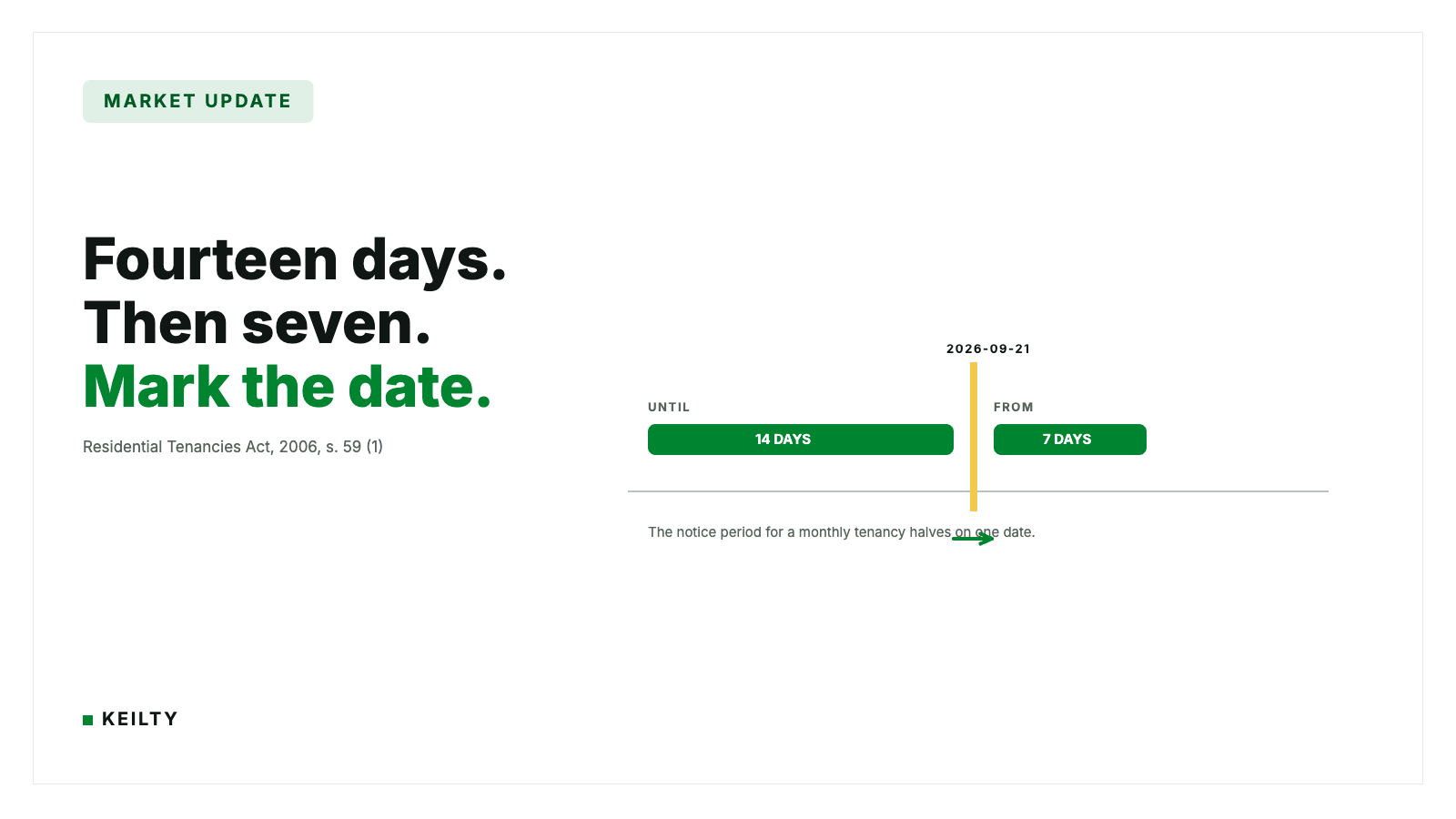
The headline change is the notice period for non-payment of rent. On 2026-09-21, subsection 59 (1) of the Residential Tenancies Act, 2006 was repealed and replaced with a single flat rule. It now reads: "If a tenant fails to pay rent lawfully owing under a tenancy agreement, the landlord may give the tenant notice of termination of the tenancy effective not earlier than the 7th day after the notice is given."
Until then that was 7 days for a daily or weekly tenancy and 14 days in all other cases, which covered every monthly tenancy. The two clauses are gone and one unclaused sentence is left in their place. On a monthly tenancy a landlord gains a week.
That is one of a set of amendments to O. Reg. 516/06 that landed the same day, alongside amendments to thirteen provisions of the Act drawn from two different statutes. Two of them deserve as much attention as the notice period. Persistent late payment now has a written test, and a tenant who wants to raise their own issues at an arrears hearing has to pay half the claimed arrears first.
Here is the whole list, what each one does, and what an owner should change on their files this week.
The short version. One date, 2026-09-21, now behind us. Four changes moved a date or a number, and one thing got harder:
Is this you? If you own this rental rather than rent it, KEILTY manages homes and buildings across Eastern Ontario and will tell you what the unit should rent for. Start with a free rental evaluation.
A batch of amendments passed in 2023 and 2025 came into force together, along with the regulations made to support them. The date was not a guess. Each of these provisions was brought into force by order of the Lieutenant Governor in Council naming September 21, 2026, and until the consolidation was rebuilt that formula appeared twenty-eight times across the Act.
Two statutes are doing the work, and treating this as one bill is the quickest way to misread it. Schedule 12 to the Fighting Delays, Building Faster Act, 2025 supplies the notice period, the persistent late payment provision, the arrears hearing changes, the eviction discretion changes, the own-use compensation change, six new regulation-making powers in subsection 241 (1) and a new section 241.5.
Schedule 7 to the Helping Homebuyers, Protecting Tenants Act, 2023 supplies the rest: sections 53, 57 and 57.1, the right of first refusal duties and the bad faith presumption. Those are three-year-old provisions that only commenced on 2026-09-21.
On the regulation side there are three instruments, not one. O. Reg. 241/26 amends O. Reg. 516/06 and does the bulk of the work. O. Reg. 240/26 is a short standalone regulation supplying the period the bad faith presumption runs on. O. Reg. 308/26 prescribes the form of a non-payment notice.
One instrument that is not part of this batch is O. Reg. 178/26, Limits on Board's Review Powers. That one has been in force since 2026-07-01 and belongs to the July changes rather than to this batch.
It does now, and for one day it did not. We flagged the gap when we published this post on 2026-09-21, and it is worth correcting in place rather than deleting.
On 2026-09-21 the e-Laws masthead on the Act still read "Consolidation period: July 1, 2026 - e-Laws currency date (September 16, 2026)", so sections 59, 82 and 83 printed the superseded wording as the main text with the law that had just come into force sitting underneath it in a grey not-yet-in-force Note. e-Laws rebuilt the consolidated text within a day.
As of 2026-09-22 the masthead reads "Consolidation period: September 21, 2026 - e-Laws currency date (September 17, 2026)" and records "Last amendment: 2025, c. 14, Sched. 12." So the consolidation now runs from 2026-09-21 to an e-Laws currency date of 2026-09-17. O. Reg. 516/06 carries the same consolidation period and records "Last amendment: 241/26."
Sections 59, 82 and 83 therefore print the law now in force as ordinary operative text, each credited to the amending statute in black letter, and none of the three carries a Note. A citation in this post can be checked against ontario.ca and will match what is on the screen.
The amendment history is still worth knowing about, because it is where a commencement date is recorded rather than inferred. The string "21/09/2026" against a provision is how you confirm the day it came into force.
One distinction inside the commencement formula matters. These provisions were named by order of the Lieutenant Governor in Council. Nine pending Notes remain on the Act, none of which commenced on 2026-09-21, and eight of them carry a different formula, a day to be named by proclamation of the Lieutenant Governor. Reading a pending Note without checking which formula it uses is how a provision that is years away gets treated as live.
Subsection 59 (1) runs on the 7th day after the notice is given, for every tenancy without exception. The daily and weekly branch and the all-other-cases branch are both gone, replaced by the single sentence set out at the top of this post, attributed in the Act to 2025, c. 14, Sched. 12, s. 4.
Nothing else in section 59 moved. Subsection 59 (2) still requires the notice to set out the amount of rent due and to specify that the tenant may avoid termination by paying, on or before the termination date, both that rent and any additional rent that has become due as at the date of payment.
Subsection 59 (3) still voids the notice entirely if, before the day the landlord applies to the Board, the tenant pays both the rent in arrears and the additional rent that would have come due had the notice not been given. The shorter period buys you a week at the front. It does not close either of those doors.
The one on the Board's website, and for the first time there is a regulation saying exactly that. O. Reg. 308/26, Notice to End Tenancy for Non-payment of Rent, was made 2026-08-13, filed 2026-09-08 and came into force on 2026-09-21.
Its operative text is a single section: "A notice of termination given by a landlord under section 59 of the Act for the failure of a tenant to pay rent lawfully owing under a tenancy agreement shall be in version 1 of the form titled “Notice to End Your Tenancy Early for Non-payment of Rent (N4)”, available on the Landlord and Tenant Board's website." The only other section is the commencement section.
Note what that does and does not do. It names a version number and a title, and it points at whatever the Board posts under that title. It does not pin the form to a date, so a document refreshed later under the same version and title is still the prescribed form. An owner who diarizes a form date here is watching the wrong thing.
The Board has already replaced the file in place. The N4 now sits at the plain path on the Board's site rather than at a versioned filename, and the earlier "NEW / for reference only" badge is gone. The live document is headed "Version 1" with the footer "N4 (2026/09)", and the instructions sit on their own page rather than inside the form.
The form itself now carries the seven days in terms. It tells the tenant, "You have seven (7) days to pay the rent as applicable to your landlord." and, on the termination date, "The date that the landlord gives you in this notice to pay or move out must be at least 7 days after the landlord gives you the notice."
The delivery arithmetic did not change, and it matters more than it did. Rule 3.9 of the LTB Rules of Procedure deems a mailed document served on the fifth day after mailing, and puts a couriered document on the day after it was given to the courier, or if that day is a holiday, the next day that is not a holiday. Five of the seven days go to the post office if you mail it.
There is also a quiet consequence for subsection 43 (1). That subsection, as amended in force on 2026-07-01, requires a notice of termination to be "in a form approved by the Board, unless the form of the notice is prescribed in which case the notice shall be in the prescribed form." O. Reg. 308/26 has now engaged that second limb for a section 59 notice, so on an N4 the prescribed form is the one you must use rather than the one you should.
Subsection 212 (1) still makes substantial compliance as to the contents of a form sufficient, and subsection 212 (2), in force since 2024-12-04, still provides that an error in contents constitutes substantial compliance as long as it does not significantly prejudice a party's ability to participate. Our reading of those two provisions together is that substantial compliance speaks to what is written in the form rather than to which form you used, so serving a superseded N4 is a different problem from filling the right one in imperfectly. Neither provision rescues a wrong termination date.
Take a monthly tenancy in Cobourg with rent due on the first. The tenant does not pay on 2026-10-01. The earliest day you can give the notice is the day after the rent was due, so 2026-10-02.
So the amendment moved the front of the process by seven days on a hand-delivered notice, and hand delivery is worth more than it was. We set the methods out one by one in how to serve a notice to a tenant in Ontario.
One practical wrinkle in that example. Both of the hand-delivery filing dates, 2026-10-10 and 2026-10-17, fall on a Saturday, and 2026-10-12 is Thanksgiving. Rule 1.1 of the LTB Rules of Procedure defines a holiday to include any Saturday, Sunday or other day on which the Board's offices are closed.
Subsection 74 (1) sets the earliest day you may apply, not a day you must apply on. So the practical answer is to work out the earliest lawful date and then plan the filing for the next day the office is open.
It made the first step shorter, and it left every later step where it was. Nothing in this batch changes the Board's scheduling, and the tenant's routes out survive intact.
Subsection 59 (3) voids the notice on payment before you apply. Subsection 74 (2) requires the application to be discontinued if, before the Board issues the eviction order, the Board is satisfied the tenant has paid to the landlord or to the Board the arrears, the additional rent that would have come due, and your application fee. Subsection 74 (4) makes an eviction order itself void if the tenant pays a defined list of amounts, arrears, additional rent, allowed NSF charges and administration charges, and ordered costs, before the order becomes enforceable. We walked the full sequence through in how long it takes to evict a tenant in Ontario.
Frankly, the change removes a week of waiting at the start. That is worth having and it is not a new remedy.
The negotiated route is still there as well, though it sits inside the process rather than outside it. Section 206 lets the Board make an order including terms of payment without holding a hearing where a landlord has already applied under section 69, and since 2026-07-01 the Board's Payment Agreement Form is mandatory when parties enter into a repayment plan under that section.
Paragraph 1 of subsection 58 (1) has always let a landlord give notice at the end of a period or term on the ground that "the tenant has persistently failed to pay rent on the date it becomes due and payable." Until 2026-09-21 nothing in the Act or the regulations defined persistently. New subsection 58 (1.1) commenced that morning, providing that what constitutes a persistent failure is to be determined in accordance with the regulations, and the regulation now exists.
New section 8.1 of O. Reg. 516/06, added by section 2 of O. Reg. 241/26, reads in full: "For the purposes of paragraph 1 of subsection 58 (1) of the Act, a persistent failure to pay rent on the date it becomes due and payable includes circumstances in which a tenant has failed to pay rent within seven days of the date it becomes due and payable on at least three occasions within any six-month period and on each of those occasions the failure to pay was not solely attributable to the landlord applying a rent payment made during that six-month period to another amount owing by the tenant, including rent arrears."
Read the two limits that come with it, because both matter more than the count.
So the regulation gives a floor an owner can plan against without closing off anything else. It sits in Part II of the regulation, whose heading changed the same day from "Rent" to "Rent, Termination and Eviction". That rename is a fair signal of what the batch is for.
It can, and the carve-out in section 8.1 deserves its own paragraph because it is an unforced error waiting to happen. If a tenant pays their October rent and the office applies it to an old arrears balance, October reads as unpaid on the ledger, and the reason for that lateness is the landlord applying a payment to another amount owing.
Read the carve-out closely, because it turns on the word "solely". An occasion drops out of the count where the failure to pay was not solely attributable to that reallocation. So a month the office created by reallocating a payment is a month you cannot rely on, while a month the tenant was genuinely late for its own reasons is not rescued by a later reallocation. Either way, a ledger that reallocates payments as a matter of routine is a ledger you cannot easily read the test off.
Two things follow, and both are bookkeeping rather than law. Record the date each payment is actually received against the period it is for, not just the balance it reduces. And decide deliberately, in writing, before applying any payment to something other than current rent.
The same discipline matters on charges that are not rent at all, which is a separate trap we covered in what you can charge a tenant for a bounced rent cheque.
Because its timing rules are untouched. Subsection 58 (2) requires the termination date in a section 58 notice to be at least the number of days after the notice that section 44 sets out, and to be the day a period of the tenancy ends or, on a fixed term, the end of the term. For a monthly tenancy section 44 (2) is 60 days, and the date has to land on a period end.
So the section 58 notice remains a 60 day, period-end instrument while the section 59 notice is now a 7 day one. That is the parallel track worth understanding.
On a tenant who is chronically a fortnight late but always pays in the end, section 59 tends to run out of road, because once the arrears and the additional rent are paid before you apply the notice is void under subsection 59 (3). Section 58 is the provision aimed at that pattern, and it now has a written test behind it for the first time. It is slower and it needs six months of clean records, and it is the only one of the two that addresses the behaviour rather than the balance.
This is the change that puts a number on the tenant's side of the file. Until 2026-09-21, subsection 82 (1) required the Board to let a tenant raise any issue that could have been the subject of their own application either where the tenant met the notice requirements in subsection 82 (2), or where the tenant provided "an explanation satisfactory to the Board explaining why the tenant could not comply with the requirements set out in subsection (2)."
That second route is gone. The replaced subsection 82 (1) now requires the Board to permit the tenant to raise any issue that could be the subject of an application made by the tenant under the Act "if the tenant complies with the requirements set out in subsection (2)." Meeting subsection 82 (2) is the only way in.
Subsection 82 (2) keeps its first three paragraphs, the advance written notice within the time set out in the Rules, and gains two more. Paragraph 4 reads: "Unless the regulations provide otherwise, the tenant shall pay the following amounts to the landlord or, if the regulations so provide, into the Board: i. Half of any rent arrears that were claimed in the application when it was filed. ii. Such other amounts as may be prescribed." Paragraph 5 reads: "The amounts specified in paragraph 4 shall be paid before the hearing and in accordance with any prescribed timelines."
New section 8.3 of O. Reg. 516/06, added by section 4 of O. Reg. 241/26, supplies the deadline: "For the purposes of paragraph 5 of subsection 82 (2) of the Act, the timeline for paying the amounts referred to in paragraph 4 of that subsection is no later than seven days before the hearing."
Read the pay-into-the-Board wording carefully, because it does not describe an option a tenant has. Paragraph 4 makes payment into the Board available only if the regulations so provide, and no regulation provides for it. Searching O. Reg. 516/06 for "half" and for "such other amounts" returns nothing, so there is no prescribed exception to the payment and no prescribed additional amount either.
What is left is bare half of the arrears claimed when the application was filed, paid to the landlord. That is the statute's own design rather than something the Board closed off, and the Board says the same thing in its operational update: "Payment must be made directly to the landlord. It cannot be paid to the LTB in trust. Tenants should keep a receipt as proof of payment."
Three different trigger events run this transition, and a reader who conflates them will get the wrong answer on a live file. They are not the same event and they do not fall on the same day.
A drafting oddity is worth flagging while you are in there. The e-Laws text of the new subsection 82 (5) reads "as it read the day before day", which is plainly a slip for a reference to the commencement day. We quote it as printed rather than correcting it silently, because the printed text is what a member will be looking at.
Clause 83 (1) (b), the Board's power to postpone enforcement of an eviction order, was amended by adding six words at the beginning. It now reads: "(b) subject to any prescribed limitations or conditions, order that the enforcement of the eviction order be postponed for a period of time."
New section 8.4 of O. Reg. 516/06, added by section 5 of O. Reg. 241/26, supplies those conditions. Enforcement may be postponed only where the landlord consents, or where the conditions the section sets out are satisfied, and those conditions now differ by application type.
On an application based on a notice under section 48, 49 or 50, the Board must be satisfied that it would not be unfair to the landlord or other tenants of the residential complex to postpone. On any other application, including an arrears application, the Board must be satisfied both of that and that "there are compelling grounds to postpone the enforcement of the eviction order."
Two points about reach. Section 84, the expedited eviction provision, is expressly subject to clause 83 (1) (b), so the new gate reaches the expedited stream as well as the ordinary one. And the standard the second tier turns on is new: the word "compelling" appears nowhere in the Act, and "compelling grounds" is not defined in O. Reg. 516/06. Where that line lands is for the Board to work out on the files in front of it.
Read the boundary of this one carefully, because it is narrower than it first looks. Clause 83 (1) (a), the power to refuse the eviction outright unless it would be unfair to refuse, is not amended. Neither is subsection 83 (2), which provides that if a hearing is held the Board shall not grant the application unless it has reviewed the circumstances and considered whether to exercise its powers under subsection 83 (1), and neither is subsection 83 (3), which lists the situations where the Board shall refuse. Only the postponement power has been fenced.
Clause 77 (8) (b) was repealed and substituted. Subsection 77 (8) says that on a tenant's motion the Board shall, after a hearing, do one of three things, and clause (b) is the set-aside option.
Until 2026-09-21 clause (b) let the Board set the order aside where it was satisfied, having regard to all the circumstances, that it would not be unfair to do so. The substituted clause instead runs on prescribed circumstances, conditions or tests, and new section 8.2 of the regulation prescribes them. The test moved from open-ended discretion to a defined one, not from permissive to mandatory.
Section 8.2 (1), added by section 3 of O. Reg. 241/26, keeps the not-unfair standard but subtracts something from it: "For the purposes of clause 77 (8) (b) of the Act, the Board shall make an order setting aside an order under subsection 77 (4) of the Act if the Board is satisfied, having regard to all the circumstances other than those set out in subsection (2) of this section, that it would not be unfair to do so."
Subsection 8.2 (2) is the carve-out that subsection (1) points at, and it takes changes in the tenant's own circumstances arising after the agreement to terminate or after the tenant's notice outside what the Board may weigh.
As of 2026-09-21, yes, by giving twice the notice. This one is from Schedule 12 rather than the Bill 97 group below.
Section 48.1 required a landlord who gives a notice under section 48 to compensate the tenant one month's rent or offer another acceptable unit, with no exceptions. The amendment puts "Subject to subsection (2)" at the front and adds a subsection (2) removing that requirement where the notice is given on or after the commencement day, the termination date is at least 120 days after the notice is given, and the termination date is the day a period of the tenancy ends or the end of a fixed term.
Three limits are worth stating before anyone plans around this.
So there is a real choice here, and it is arithmetic rather than advice. The ordinary route is 60 days notice plus one month's rent out of pocket. The new route is 120 days notice and no payment, with the unit occupied for the extra 60 days and the tenant free to leave sooner.
Which way that falls depends on what you are doing with the unit and when you need it, and it is worth running both ways on the individual file rather than adopting one as policy. Before doing either, read the next section, because the two changes were made by different statutes and they landed on the same day.
Sixty days, and this is the change likely to catch an owner who reads only the compensation section above. New subsection 57 (6.1) is headed "Presumption, prescribed period of time".
It provides that, for the purposes of an application under clause 57 (1) (a), if no person referred to in clause 48 (1) (a), (b), (c) or (d) occupied the rental unit within the prescribed period of time after the former tenant vacated, it is presumed, unless the contrary is proven on a balance of probabilities, that the notice was given in bad faith and that the unit was not occupied within a reasonable time. Those clauses are the landlord, the landlord's spouse, a child or parent of either, and a care services provider.
The prescribed period comes from a separate regulation, O. Reg. 240/26, Prescribed Period of Time, which came into force on 2026-09-21 and serves subsection 57 (6.1) alone. It is one operative section, and it sets 60 days on two branches:
Read that first branch carefully, because it does not measure from the day the unit actually emptied. A tenant who takes the early exit in subsection 48 (3) and leaves months ahead of your termination date does not start your clock early. The clock still runs from the date you put on the notice. A replaced subsection 57 (7), headed "Application of subs. (6.1)", then limits the presumption to applications made on or after the commencement day.
Now put the two changes together on one file, because the 120 day route lengthens the very date the clock runs from. Take a monthly tenancy in Belleville, rent due on the first, notice given 2026-10-01.
That arithmetic is the whole point of pairing the two sections. Taking the 120 day route to avoid a month's rent also pushes out the date the unit has to be occupied by, which is useful if the person moving in is not ready.
What it does not do is create slack. On the 120 day route the unit still has to be occupied within 60 days of the termination date, and leaving it empty past that date is what engages the presumption. Diarize the occupancy date on the day you serve the notice, not on the day the tenant leaves.
The Bill 97 half of this batch runs the other way, and an owner planning a renovation should read it before serving anything.
One further renovation change is enacted but is not part of this batch, and the distinction matters because it is the one that would change what you file. Section 2 of Schedule 7 repeals subsection 50 (3) and substitutes a version whose clause (b) requires a notice under clause 50 (1) (c), the renovation ground, to "be accompanied by a report prepared by a person who has the prescribed qualifications ..." stating that the work is so extensive that it requires vacant possession. A new subsection 50 (3.1) then provides, for greater certainty, that a failure to meet clause (3) (b) renders the notice void. Section 7 of the same Schedule adds subsection 73 (4), under which the Board "shall consider but is not bound by ..." that report.
Neither commenced on 2026-09-21. Both carry the proclamation formula rather than the order formula that this batch runs on, and both are recorded in the consolidation as not in force, with no day named.
There is a reason to expect they will not commence imminently. The report has to come from a person holding prescribed qualifications, the power to prescribe those qualifications is paragraph 3.1 of subsection 241.1 (1), and that paragraph is itself not in force with no day named. So as at 2026-09-22 the report requirement has no qualifications to point at. Watch for a proclamation and a qualifications regulation together, and do not build an N13 process around a report yet.
A great deal, and an owner working from the Board's materials as they stood a fortnight ago is working from the wrong set.
The forms page now carries a banner: "Effective September 21, 2026, the Landlord and Tenant Board (LTB) is updating some of its processes, forms, and rules as a result of amendments to the Residential Tenancies Act, 2006 introduced through the Fighting Delays, Building Faster Act (Bill 60) and the Helping Homebuyers, Protecting Tenants Act, 2023 (Bill 97). For more information, see our Operational Update. These changes are in addition to those introduced on July 1, 2026."
The operational update itself went up on 2026-09-21 and is the Board's newest item of any kind. On the notice period it says: "The notice period for an N4: Notice to End Tenancy Early due to Non-Payment of Rent is shortened from 14 to 7 days for notices given on or after September 21, 2026."
On the arrears hearing it says: "In order to raise other issues at a hearing for non-payment of rent (such as maintenance or Tenant's Rights concerns), the tenant must pay the landlord half of the rent arrears claimed in the landlord's application at least seven days before the hearing."
The update also refreshes a batch of forms, the N5, N6, N8, N12, N13, L1, L2, L9, L10 and T5, and sets a cut-off for the old ones: "Previous versions of these forms will no longer be accepted as of November 30, 2026." The N4 is not on that list, and it should not be, because the N4 rule keys off the date a notice is given rather than the date a form is filed.
The Rules of Procedure moved the same day. They now print "Effective: September 1, 2021" together with "Updated: September 21, 2026", and Rule 19.4 reads: "A tenant who intends to raise issues under sections 82(1) or 87(2) of the RTA during a hearing for a landlord's application about rent arrears must, at least 7 days before the scheduled CMH or hearing: make the payment required by subsection 82(2) of the RTA; and provide the other parties and the LTB with a written description of each issue the tenant intends to raise."
Rule 19.5 then provides that "Rule 19.4 cannot be waived except where required by the Human Rights Code." Rule 19.5.1 grandfathers applications filed before 2026-09-21 out of the payment limb, which lines up with the transition set out above.
Three interpretation guidelines moved too. Guideline 7, on refusing or delaying an eviction, now covers section 8.4 expressly and prints "Updated: September, 2026". Guideline 11, on rent arrears, prints an update date of 2026-09-21 and covers both the pay-half rule and the seven day N4. Guideline 12 prints "Updated: September, 2026" as well.
Two loose ends are worth knowing before you rely on a Board document. The operational update names Guideline 10, Procedural Issues Regarding Eviction Applications, as one of the four it updated, but Guideline 10 as posted still prints "December 15, 2018 - Updated September 2025".
And the Practice Direction on Evidence prints "Updated: September, 2026" but still tells a tenant who missed the disclosure deadline that they "must provide an explanation satisfactory to the LTB Member explaining why the tenant could not comply with the requirements ...". That is the escape hatch the legislature deleted from subsection 82 (1). Our reading is that the statute governs and the practice direction is behind, but it is the kind of gap a hearing can be lost in, so do not be caught flat if a tenant cites it.
A good deal, and knowing what stayed put is how you avoid over-reading the rest.
It has its own parallel set, and it is a different regime rather than the same one applied twice. O. Reg. 241/26 adds a new Part II.1 to the regulation, headed "Matters Related to Non-Profit Housing Co-operatives", containing section 17.1 and section 17.2.
Section 17.1 mirrors section 8.1, but it is made for the purposes of paragraph 1 of subsection 94.2 (1) of the Act, it applies to a member rather than a tenant, and it measures regular monthly housing charges rather than rent. Section 17.2 is the co-operative counterpart to section 8.4, and it is stricter: it has no split by application type, so postponing enforcement needs the co-operative's consent, or both that it would not be unfair and that there are compelling grounds, in every case.
Two co-operative provisions of the Act commenced on 2026-09-21, not one. Section 94.2 gained a new subsection (2.1), the co-operative mirror of subsection 58 (1.1) on persistent late payment. And clause 94.12 (1) (b), the power to postpone enforcement of an order terminating a member's occupancy, was amended by adding "subject to any prescribed limitations or conditions" at the beginning, mirroring the clause 83 (1) (b) change.
One asymmetry is worth knowing if you run co-operative files. The co-operative mirror of the clause 77 (8) (b) set-aside change is clause 94.10 (8) (b), which has been enacted in parallel terms but is not in this batch and is recorded in the consolidation as not in force. So the tenant-side set-aside test and the co-operative-side set-aside test are governed by different wording until that second day arrives.
If you are dealing with a member of a non-profit housing co-operative, work from Part V.1 of the Act and Part II.1 of the regulation, and do not read the tenant provisions across.
One boundary further out. Section 5 (i) takes living accommodation outside the Act altogether where the occupant must share a bathroom or kitchen facility with the owner, or the owner's spouse, child or parent, or the spouse's child or parent, and that person lives in the building. None of the notice periods in this post reach accommodation in that position, because none of the Act does.
None of this is in the Act. It is housekeeping, and it takes an afternoon.
An owner with one or two units can absolutely handle a rule change like this. It is one date, a handful of provisions, and a template to fix.
What is harder is the part with no deadline attached: keeping a payment-date record clean across every suite for six rolling months, deciding consistently how payments get applied, and having the notice served correctly on the right day by somebody who is there.
That is the work KEILTY does on an arrears file, and it is why we rebuilt our own templates and ledger rules ahead of the commencement date rather than after the first notice went out wrong. If you own a building and would rather not audit all of this yourself, our apartment communities page sets out how we run it.
Want a second set of eyes on your arrears process now that these rules have changed? Get in touch and we will walk through your notices, your ledger and your dates with you.
This post is general information about Ontario residential tenancy law as of 2026-09-22, not legal advice. Legislation, regulations and tribunal practice change. For advice on a specific property or situation, speak with a lawyer or licensed paralegal.
Ontario property management with published pricing, same-day answers, and no surprises. Since 2003.
300-80 Queen StreetNot served yet. Join a list and hear from us the day we open.