
By A.J. Keilty, President, KEILTY Realty Management
You can hand it to the tenant, hand it to an apparently adult person in the unit, leave it in the mailbox, leave it where mail is ordinarily delivered if there is no mailbox, or mail it to the last known address. Those five come straight out of section 191 (1) of the Residential Tenancies Act, 2006. The Landlord and Tenant Board's own Rules add a few more, including under the door, courier, fax, and email with written consent. What you cannot do is tape it to the door, and the method you pick moves the earliest termination date you are allowed to write on the notice.
Service is the quietest way to lose a file. The reason is on the notice itself: almost every notice period runs from the day the notice is given, not the day you signed it, so the delivery method decides the date, and the date decides whether your application is filed in time. Here is how we handle it, and what the Act, the Rules and the LTB's own forms actually say.
Is this you? If you own this rental rather than rent it, KEILTY manages homes and buildings across Eastern Ontario and will tell you what the unit should rent for. Start with a free rental evaluation.
Section 191 (1) says a notice or document is sufficiently given to a person other than the Board by one of these:
Two things about that list are worth pausing on. The section runs both ways, so a tenant giving you an N9 is working from the same seven clauses, but the individual clauses do not. Clause (b) is how a tenant serves a landlord, by handing the document to an employee exercising authority in respect of the residential complex, and there is no mirror-image clause letting you serve a tenant's employee. Clause (c) runs the other way, and clause (e) only becomes available where there is no mail box.
Clause (g) is the door to everything else. Courier, fax, under the door and email appear nowhere in subsection 191 (1). Searched on 2026-09-25, the words courier, email, e-mail, fax and facsimile do not appear anywhere in the Act at all. That is not the same as the Act being silent on electronic service. The word electronic appears 11 times, and section 213 is the provision that lets a document referred to in the Act be dealt with electronically where the regulations or the Rules provide for it. What the Act does not do is name a courier or an inbox. Those sit in the Rules, and they are only good service because clause (g) lets the Rules add them.
Rule 3.1 of the LTB Rules of Procedure, effective 2021-09-01 and updated 2026-07-01, adds service by leaving the document at the place where mail is ordinarily delivered, by sliding it under the door or putting it through a mail slot in the door of the rental unit as long as the person remains in possession of that unit, by regular or registered mail using the address for service provided by the party, by courier, by fax if the document is less than 20 pages or longer with the consent of the person receiving it, by email if the person has consented in writing, and by uploading it into the Tribunals Ontario Portal if the person has consented in writing to that.
The 20 page fax limit catches people out on damage files with photographs attached. So does the possession wording on the under the door method. Once the tenant is out, that route closes.
Only one document, and only in one direction. Rule 3.2 allows posting on the door for a notice of entry under section 27 of the Act, the 24 hour written notice you give before going in to repair, inspect or show the unit. The Certificate of Service form carries the point in a note on its face: the only document that can properly be served by posting it to the door of the rental unit is a notice of intent to enter given under section 27, unless a Member orders otherwise pursuant to the Board's Rules of Practice. So the door is closed to everything else unless a Member opens it. The N4 instructions put it in one line: "You cannot give the tenant this notice by posting it on the door of the tenant's rental unit."
Taping a notice of termination to the door feels like delivery. It is not one of the listed methods, and starting again costs you the whole notice period.
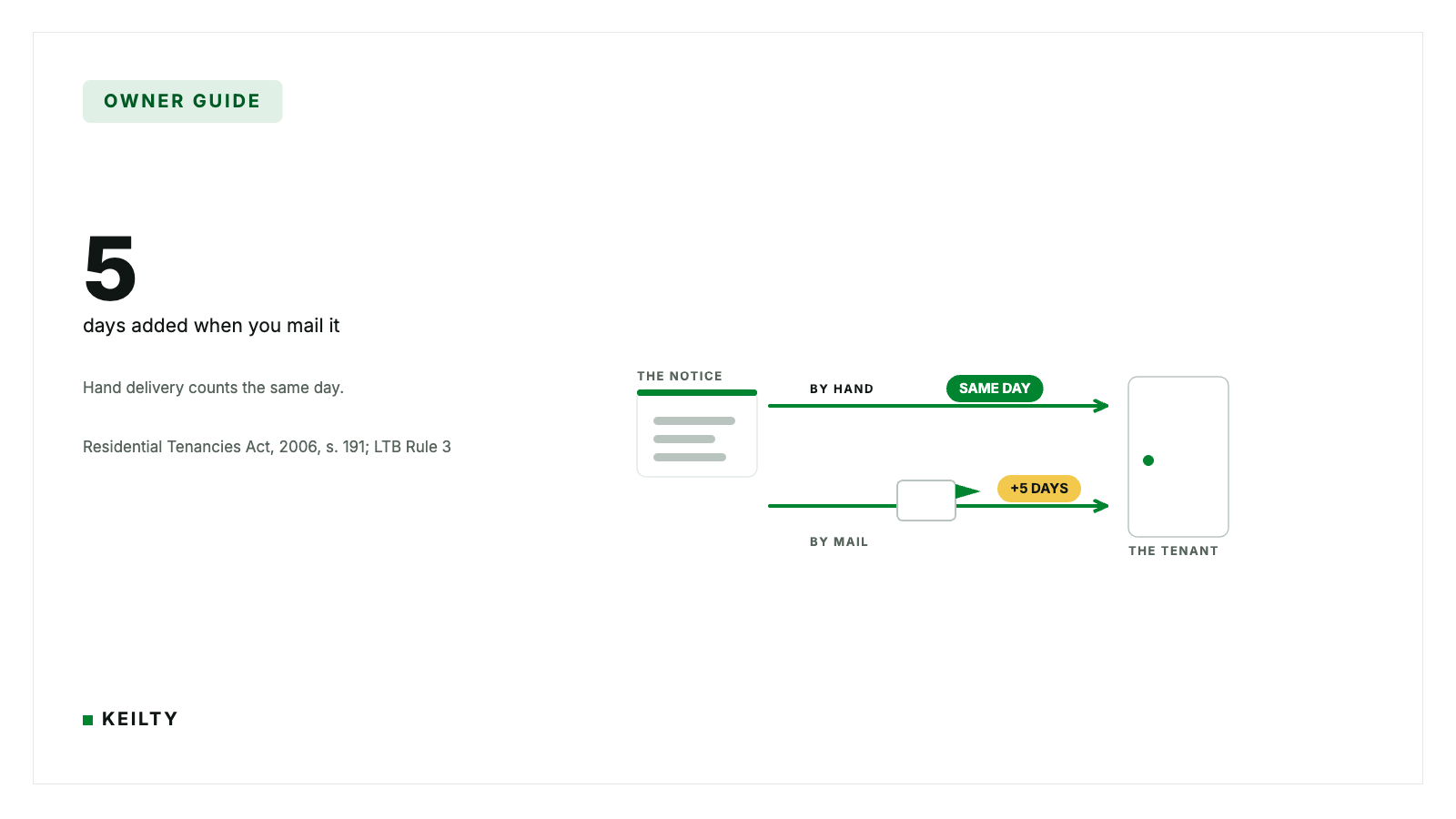
Rule 3.9 sets the deemed dates. A document is considered served on the fifth day after mailing; on the fifth day after it is sent by Xpresspost, unless actual delivery on an earlier date is established; on the date on the fax confirmation receipt when sent by fax; on the day after it was given to the courier, or if that day is a holiday, the next day that is not a holiday; on the day it was sent when sent by email; on the day it was given to the person when delivered by hand; and on the day it was uploaded into the Portal.
Three of those clocks get misread often enough to be worth spelling out. Courier is not one day. Rule 1.1 defines a holiday as any Saturday, Sunday or other day on which the Board's offices are closed, so a notice handed to a courier on a Friday is served on the Monday. And registered mail buys you evidence, not speed: Rule 3.1 lists regular and registered mail in the same breath, and Rule 3.9 gives both the same fifth day after mailing. And the mail box is not the mail. Clause 191 (1) (d), leaving the document in the mail box where mail is ordinarily delivered to the person, is a method of its own, distinct from clause 191 (1) (f), which is sending it by mail. A notice you walk to the tenant's mail box is given on the day you do it. The fifth day rule applies to a notice given by mail. Both clauses carry the word mail, and that is the only thing they share.
Mail also has its own provision in the Act. Section 191 (3) says a notice or document given by mail "shall be deemed to have been given on the fifth day after mailing." Read that as fixing the day the notice is given rather than as five spare days bolted onto a deadline. The notice period starts running on that fifth day, which is why a mailed N4 has to carry a later termination date on its face instead of the same date with an allowance kept in your head. The LTB's brochure How to Serve a Landlord or Tenant with Documents, last updated March 2022, sets the same dates out in a table. Under the Rules, days means calendar days, you count by excluding the first day and including the last day, and a notice may be delivered on a holiday and may take effect on a holiday. Rules 1.12 to 1.15 cannot be waived or varied, which is unusual in a set of procedural rules and tells you how the Board treats counting.
This is the part that costs money, so here is the arithmetic on a file we could see in Peterborough any month of the year.
Rent is due on the 1st under a monthly tenancy. Nothing arrives. Under the N4 instructions, the earliest day you can give the notice is the 2nd, because the tenant has to have missed the day it was due.
Five days of postage cost five days of rent and five days of the file. The N4 instructions were written against the old 14 day period and still work the example on their own dates to a termination date set by "14 days + 5 days for mailing," so the arithmetic printed on the form is now longer than the Act requires. Fax and hand delivery add nothing. Courier adds a day or three, depending on the day of the week, for the reason set out above. The N4 instructions say to add one business day and Rule 3.9 says the day after, or the next day that is not a holiday, and the Rule is what governs.
The N4 notice period got shorter, and that makes mail worse. On 2026-09-21 subsection 59 (1) was repealed and substituted. It now provides that where a tenant fails to pay rent lawfully owing under a tenancy agreement, "the landlord may give the tenant notice of termination of the tenancy effective not earlier than the 7th day after the notice is given." Clauses (a) and (b) are gone, so there is no longer a 14 day branch for monthly tenancies and a 7 day branch for daily and weekly ones. Seven days is the period for every tenancy. The amendment is section 4 of Schedule 12 to the Fighting Delays, Building Faster Act, 2025, S.O. 2025, c. 14.
Set the Peterborough file against the old rule to see what moved. Before 2026-09-21, handing the notice over on the 2nd gave an earliest termination date of the 16th, and mailing it on the 2nd gave the 21st. On the current wording those dates are the 9th and the 14th. The five day mail delay did not change, but the notice period it is bolted onto dropped from 14 days to 7, so postage went from a third of the wait to nearly all of it.
One group of owners can ignore all of that. The old clause 59 (1) (a) already gave daily and weekly tenancies the 7th day, so a weekly landlord counts the same seven days now as before. If your rent is weekly, nothing in this section moved.
The same package also turned the N4 into a prescribed form rather than a Board approved one. O. Reg. 308/26, made under the Act and in force on 2026-09-21, provides in section 1 that a notice of termination given by a landlord under section 59 of the Act for the failure of a tenant to pay rent lawfully owing under a tenancy agreement shall be in version 1 of the form titled Notice to End Your Tenancy Early for Non-payment of Rent (N4), available on the Landlord and Tenant Board's website. Section 43 (1) is what gives that bite, because a notice of termination has to be in a form approved by the Board unless the form of the notice is prescribed, in which case it has to be in the prescribed form. An old saved copy of the N4 is therefore not an untidy notice, it is the wrong form, and a notice in the wrong form is defective.
Two details in that regulation are worth holding onto. It pins the form to version 1, so a copy you downloaded before 2026-09-21 is not the prescribed form whatever it looks like on the page. And the words "available on the Landlord and Tenant Board's website" are a locator, not an as-amended-from-time-to-time clause: the regulation names version 1 and leaves it there rather than floating the reference forward. Pull the N4 from the Board when you need it, not from your own folder.
Note also that the LTB brochure and the N4 instructions, dated March 2022 and 2015-11-30, both still describe the 14 day period, so the published guidance lags the statute. Where the form instructions and the Act disagree, the Act is what a Member applies.
Yes, if they have consented in writing, and the consent has to exist before you send. Rule 3.1 allows email "if the person or party receiving it has consented in writing to service by email." Rule 3.5 lets parties consent in writing at any time, and Rule 3.6 says consent may be revoked at any time by giving notice in writing to the person or party, which cuts both ways: your tenant can withdraw it, and so can you. Without consent there is still a route, but it runs through the Board rather than through you, and it is covered further down. Section 213 of the Act is the enabling provision, and it reaches only a document referred to in the Act and specified in the regulations or in the Rules, which may then be dealt with electronically if that is done in accordance with the regulations or the Rules.
Getting that consent is the cheapest thing on this list. The LTB brochure points to two places it can live: the standard lease, or a signed Consent to Service by Email. Under Rule 3.9, an emailed document is served the day you send it. On every new tenancy at KEILTY we ask for that consent at signing, because it converts a five day mail delay into a same day delivery for the life of the tenancy. It is worth asking about again mid tenancy on any file where you expect to be serving something.
No. A text message is not a method of service, and this is the gap between how owners actually communicate with tenants and what the Act counts as giving a notice.
Text messaging appears in none of the seven clauses of section 191 (1) and nowhere in Rule 3.1. Searched on 2026-08-25, the phrase "text message" does not appear anywhere in the Act, and the word "text" does not appear anywhere in the Rules of Procedure. The nearest listed electronic method is email, and email only works where the person has consented in writing under Rule 3.1, with Rule 3.5 allowing that consent to be given at any time. So a texted N4 has not been served by a listed method, whatever the tenant read on their phone.
Texting has its uses. Telling a tenant a notice is on its way, or that a contractor is coming, is fine. What it cannot do is start a notice period.
It is the one page form where the person who served the document certifies when, where and how they did it. Rule 3.8 says that where the Rules require it or the Board directs it, service must be confirmed by completing a Certificate of Service signed by the person who served the document and filing it with the Board within 5 days of service.
On an application it is not optional paperwork. The L2 instructions, dated May 2022, tell you to include a copy of the notice you gave and a copy of the Certificate of Service showing how and when you gave it, and then say plainly: "Your application will be refused if any of the required items listed above are missing." The N4 instructions are gentler in tone but land in the same place for an L1: you will need to file a copy of the N4 you gave the tenant, and a Certificate of Service to tell the Board when and how you gave it. And Rule 4.5 adds a deadline of its own. If you file through the Portal and cannot upload the notice, affidavit or certificate at the same time, they must be filed within 5 calendar days, and failure to file them in time may result in administrative dismissal of the application.
Fill the certificate out on the day you serve, not the week you file. Whoever actually walked to the mailbox has to sign it, which is a real constraint if you use a contractor, a family member or a superintendent to deliver notices.
You lose the deemed date and you are left proving actual receipt. Section 191 (2) says a notice or document that is not given in accordance with the section "shall be deemed to have been validly given if it is proven that its contents actually came to the attention of the person for whom it was intended within the required time period." The LTB brochure describes the practical effect: if you serve using a method that is not permitted, you may be required to prove at the hearing when and how the other party received the document.
The Board has published what usually follows, and owners should read it before improvising. Interpretation Guideline 10, dated 2018-12-15 and updated September 2025, says that if the document given to the tenant or the method or time of service are defective, in most cases this will result in dismissal of the application or the denial of the eviction portion of the application. On method specifically, it says the notice must be given by a method set out in subsection 191 (1) and in Rule 3.1, and that where a landlord has used a different method without specific permission through a direction signed by a Member, and the tenant does not voluntarily admit to receiving the notice on time, an application for eviction may be dismissed. It also says that where the tenant acknowledges receipt by the date required, or the landlord can prove the tenant received it, that will be sufficient no matter how the notice was served.
Guidelines are not law, and every one of them carries the same line on its face: a Member is not required to follow a Guideline and may make a different decision depending on the facts of the case. Treat it as the Board's stated starting point rather than the answer.
The same Guideline closes off the obvious escape route. It says the Board has no authority to shorten the notice period required by the Act, citing section 56 of O. Reg. 516/06 and Rule 1.6, and that if a shorter notice period is given than is required, the application will be dismissed. Section 190 (2) lets the Board move time requirements in its own proceedings, other than the prescribed ones. It does not rescue a notice you dated too early.
So section 191 (2) is a real safety valve, and it is not a plan. It puts you in the position of proving what the tenant knew and when, on a file where you had a cheaper option available.
One provision that does not help here is section 212. Substantial compliance with the Act respecting the contents of forms, notices or documents is sufficient, and since 2024-12-04 subsection 212 (2) adds that an error in the contents still constitutes substantial compliance as long as the error does not significantly prejudice a party's ability to participate in a proceeding. That amendment came from Schedule 24 to chapter 28 of the Statutes of Ontario, 2024. Read the words: contents, not delivery. A typo in the arrears table and a notice taped to the door are different problems, and only the first one is what section 212 forgives.
Contents have their own short list. Since 2026-07-01, section 43 (1) requires a notice of termination to be in a form approved by the Board, unless the form of the notice is prescribed, in which case it has to be in the prescribed form. The notice must identify the rental unit, state the date the tenancy is to terminate, and be signed by the person giving it or that person's agent. Under section 43 (2), a landlord's notice must also set out the reasons and details for the termination and tell the tenant that vacating in accordance with the notice ends the tenancy on that date, that the landlord may apply to the Board if they do not vacate, and that the tenant is entitled to dispute the application. The form change came from section 1 of Schedule 12 to the Fighting Delays, Building Faster Act, 2025.
Three, and they compound.
The termination date on the notice moves with the deemed service date, as above. The filing window closes 30 days after it. Section 69 (2) says an application to terminate and evict based on a notice may not be made later than 30 days after the termination date specified in the notice, and section 69 (3) carves out only applications based on the tenant's failure to pay rent. And the waiting period at the front runs from service too. Section 70 bars applying on a notice under section 62, 64 or 67 before the seven day remedy period in the notice expires, while section 71 otherwise lets a landlord who has served a notice apply immediately, subject to section 70 and subsection 74 (1).
Get the service date wrong by five days and you can be early under section 70, late under section 69 (2), or holding a notice with a termination date the Act did not allow.
Check this before you serve anything, because getting it wrong suspends your right to collect rent. Section 12 (1) says every written tenancy agreement entered into on or after 1998-06-17 shall set out the legal name and address of the landlord to be used for the purpose of giving notices or other documents under the Act. Section 12 (2) requires you to give the tenant a copy of the signed agreement within 21 days after the tenant signs it and gives it to you. Where the agreement is not in writing, section 12 (3) requires written notice of that legal name and address within 21 days after the tenancy begins.
Then section 12 (4) does the damage. Until a landlord has complied with subsections (1) and (2), or with subsection (3), as the case may be, the tenant's obligation to pay rent is suspended and the landlord shall not require the tenant to pay rent. Read the two limbs: it is not only the address. Missing the 21 day deadline for handing over the signed copy trips the same switch. Section 12 (5) lets you require the withheld rent once you have complied, so this is a suspension rather than a forfeiture, but the sequence matters. An N4 demanding rent during a period when your own right to require it was suspended is an argument you have handed the tenant for free.
Numbered companies get caught by this most often. A lease signed "1234567 Ontario Inc." with a Gmail address and no service address, or with the agent's name in place of the corporate landlord's, is the version we see. Fix it before it becomes an arrears file, and remember that the address you put there is the address the tenant will use to serve you.
Serving a corporate landlord runs the other way through the same section. A tenant can hand a document to an employee of the landlord exercising authority in respect of the residential complex under clause 191 (1) (b), which in practice means the superintendent or the property manager, and clause 191 (1) (f) allows mail to the last known address where the person resides or carries on business, which for a corporate landlord is the business address. So the service address on the lease is not decoration.
Different list. Section 191 (1.0.1), added by Schedule 4 to the Protecting Tenants and Strengthening Community Housing Act, 2020 and in force 2021-09-01, says that despite subsection (1), a notice or document is sufficiently given to a tenant or former tenant who is no longer in possession of a rental unit by handing it to them, by mail to the address where they reside, by handing it to an apparently adult person where they reside, or by any other means allowed in the Rules.
Rule 3.3 adds leaving it where mail is ordinarily delivered at their residence, sliding it under their door or through the mail slot, courier to where they reside, and email, but only if they consented in writing during the tenancy and it can be proven the contents actually came to their attention. The mailbox at the old unit is not on either list. Neither is the under the door method at the rental unit, because Rule 3.1 ties that to a person who remains in possession.
If you are serving a former tenant with an L10 and the notice of hearing and you need permission for a different method, Rule 3.4 requires the request at least 40 days before the hearing. That deadline is easy to miss because it sits inside a rule about service rather than in the application instructions.
Ask. Rule 3.4 lets a party ask the Board to permit an alternative method of service, including service by email or service on the party's representative, either in writing before the hearing using an approved form or at the hearing. Rule 3.7 covers the specific case where a party has not consented to email: the Board may permit service by email on such terms as are just. Section 190 (2) also lets the Board extend or shorten time requirements in its proceedings, other than the prescribed time requirements, in accordance with the Rules.
Ask before you improvise. A request for alternative service is a form you fill out in advance. Proving actual receipt under section 191 (2) is an argument you make later, with evidence you may not have.
Then you are in a different subsection, and the differences are small enough to trip on. For the purposes of Part V.1, section 191 (1.1) gives its own list: handing it to the person, handing it to an apparently adult person in the member unit, leaving it in the mail box where mail is ordinarily delivered, and if there is no mail box, sliding it under the door of the member unit or through a mail slot in the door or leaving it where mail is ordinarily delivered. Mail goes to the last known address where the person resides or carries on business. Where the person being served is the co-operative itself, you deliver personally or by mail to its head office as shown on the records of the Ministry of Finance or to its business office, or hand it to a manager or co-ordinator of the co-operative exercising authority in respect of the residential complex.
Note what moved. In a member unit the under the door method is in the Act itself. In an ordinary rental unit it is not, and it only exists because Rule 3.1 puts it there. If your file is a house, a duplex or an apartment building, subsection 191 (1.1) is not the subsection you are working from.
No, and mixing them up is a common error. Section 191 covers documents given to a person other than the Board. Section 192 covers documents given to the Board, and Rule 4 sets out the methods: in person at a Regional Office or a ServiceOntario Centre that accepts service for the Board, by mail or courier to the Regional Office responsible for the area, by uploading into the Portal, or by fax or email in the narrow circumstances Rule 4.1 describes. The deemed dates are close to Rule 3.9 but not identical. Under Rule 4.8, filing by mail counts on the fifth day that is not a holiday after mailing. Subsection 192 (2) adds a wrinkle the Rule does not: a notice or document given to the Board by mail is deemed given on the earlier of the fifth day after mailing and the day it was actually received. Mail to a tenant has no earlier-of test, so the same envelope is treated differently depending on who opens it.
Both certificates. This is where service paperwork earns its keep for owners. The L2 instructions say that if this is the second N5 you have given the tenant within the last six months, you must also attach a copy of the previous notice and a copy of the Certificate of Service showing how and when you gave the tenant that previous notice.
Section 68 is the reason that matters. Where a notice of termination was already given under section 62, 64 or 67, and then, more than seven days but less than six months after that notice was given, an activity takes place, conduct occurs or a situation arises that constitutes grounds for a notice under section 60, 61, 62, 64 or 67, you may give a further notice. Subsection 68 (1) (b) carves out conduct described in subsection 61 (1) that involves an illegal act, trade, business or occupation described in clause 61 (2) (a). Subsection 68 (2) says the notice shall set out the date it is to be effective and that date shall not be earlier than the 14th day after the notice is given. Section 68 has only those two subsections, and neither one provides for the notice to be voided.
You only get there if you can prove the date of the first notice. The certificate you filled out months ago, on a notice the tenant voided and you filed nothing on, is the document that unlocks it. Keep them.
Sometimes not, and this is the lighter path when possession is not the point. The L2 instructions say there are no steps you are required to take before applying if you are applying for compensation for utility costs, damage to the rental unit or residential complex, expenses related to substantial interference, or misrepresentation of income, "and you are not applying to end the tenancy." No notice, no notice period, no certificate, no 30 day filing window under section 69 (2). One precondition survives: the same instructions say you cannot file an L2 if the tenant has already moved out, other than on abandonment, and that the tenant must still be in possession when you file.
That is a genuine choice on a damage or utilities file. Adding termination to the application adds proof of the correct notice, the correct dates, correct service, a certificate, and a filing deadline. If what you actually want is the money, the money-only application asks you to prove less. We walk owners through that trade on single-family rentals and small multi-family buildings most months of the year.
None of this is in the Act. It is what we have found holds up.
The Rules and the forms are public, and an owner with one property can follow them. What they cannot do easily is be in two cities on the day a notice has to go out, which is most of what we are actually being paid for at our locations across Ontario.
Not sure whether the notice on your file was served in a way that will hold up, or what the unit should be renting for once it turns over? Get a free rental evaluation and we will look at both.
This post is general information about Ontario residential tenancy law as of 2026-10-02, not legal advice. Legislation, regulations and tribunal practice change. For advice on a specific property or situation, speak with a lawyer or licensed paralegal.
Ontario property management with published pricing, same-day answers, and no surprises. Since 2003.
300-80 Queen StreetNot served yet. Join a list and hear from us the day we open.