
By A.J. Keilty, President, KEILTY Realty Management
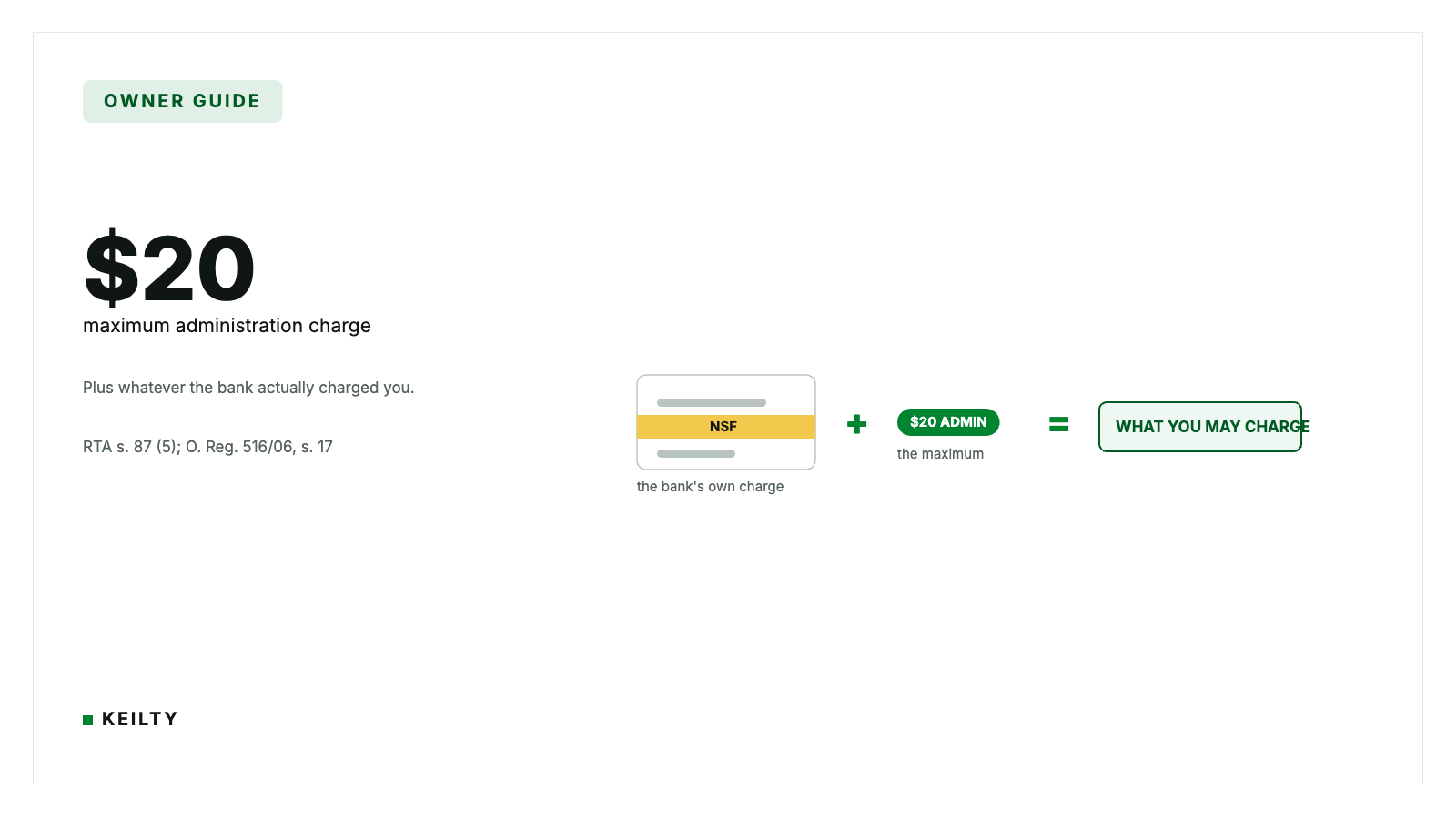
When a rent cheque comes back NSF in Ontario, you can charge the tenant two things and only two things: the NSF charge your own financial institution charged you, and an administration charge of up to $20 for that cheque. Both are prescribed by section 17 of O. Reg. 516/06 under the Residential Tenancies Act, 2006. Anything you add on top of those two for the bounced cheque is an illegal charge under section 134 of the Act. The tenant can apply to get it back, and charging it is an offence.
The word cheque is doing real work in that paragraph. When the failed payment was a pre-authorized debit or an e-transfer rather than a cheque, neither charge is available and the rent is all you claim. That is covered below, along with what happens next: what notice you give, which application collects the charge, when the tenant has to pay it, and what the number looks like on the form.
Section 134 (1) of the Act opens with the words "Unless otherwise prescribed", then prohibits a landlord from collecting, requiring, or attempting to collect or require "a fee, premium, commission, bonus, penalty, key deposit or other like amount of money whether or not the money is refundable" from a tenant, prospective tenant or former tenant. A returned cheque charge is exactly the kind of amount that opening prohibition would catch. It survives only because the regulation carves it out.
Two of the nine prescribed exemptions in section 17 of O. Reg. 516/06 do that work:
So the number has two parts. The first part is whatever your bank actually charged you, and there is no cap on it, because the exemption is written as the charge the financial institution imposed rather than a fixed figure. The second part is capped at $20 for each cheque, and it is a per-cheque cap, not a per-month or per-tenancy cap. Three bounced cheques over a tenancy means three separate bank charges and up to $60 in administration charges.
Note what is not in the number. The face amount of the cheque is not an NSF charge, it is unpaid rent, and it belongs in the rent arrears calculation instead. The LTB says so plainly in its own worked example on the Form L1 instructions, which tell you to add the bank charge and the administration charge together and "Do not include the Cheque Amount". Interest on late rent is not in the number either. Ontario's own Guide to Ontario's standard lease lists a term requiring a tenant to pay "interest on rent arrears" among its examples of terms that are void and unenforceable.
Take a monthly tenancy in Cobourg at $1,850, due on the first day of each month. The tenant's cheque for the month is returned, and eight days later the bank debits the owner's account $7.50. The owner sends the tenant a letter, updates the ledger, and re-issues the notice.
The $27.50 is the NSF claim. The $1,850 is the arrears claim. They are separate lines on the application and they behave differently, which is the point of most of what follows. The forms ask for the date of the cheque and the date the NSF charge was incurred, so keep the bank advice showing the $7.50 and the date it hit the account. That is your documentary support for the item 4 amount.
No, and it is worth saying plainly because the deposit is sitting right there on the morning a cheque comes back. Section 106 (10) says a landlord "shall apply a rent deposit that a tenant has paid to the landlord or to a former landlord in payment of the rent for the last rent period before the tenancy terminates". It is mandatory and it has one purpose. The deposit is not a float against a bad month in the middle of a tenancy.
Using it for anything else is an offence under section 234 (f), and Ontario's own rental housing offences page lists "use a tenant's rent deposit for something other than the last month's rent" among the offences it summarizes. The deposit does have a role on a bounced cheque file, but it is at the end and not the beginning: section 87 (4) requires the LTB to subtract the deposit and the interest owing on it from what it orders in a termination and arrears order.
Nothing. On a failed pre-authorized debit or a reversed e-transfer, the rent is owing and that is the end of the list.
The reason is that every provision that lets you recover the money is written around a cheque, and an electronic payment is not a cheque:
Item 4 is the one exemption that is not cheque-worded, since it permits "Payment of NSF charges charged by a financial institution to the landlord" without naming the instrument. That difference does not help much in practice, because there is no route to an order for it: section 87 (5) is how an NSF charge gets into an LTB order, and it is limited to cheques. So an owner who bills a $15 return fee on a failed pre-authorized debit is charging an amount the LTB has no power to award, in the face of a section 134 prohibition that carries an offence under section 234 (l). Bill the arrears and leave it there.
You can ask. Requiring it is a different question, and the answer is probably no.
Section 108 says neither a landlord nor a tenancy agreement shall require a tenant or prospective tenant to provide post-dated cheques or other negotiable instruments for payment of rent, or to permit automatic debiting, automatic credit card charging or any other form of automatic payment. A certified cheque and a money order are both negotiable instruments, so a demand for either runs at the words of clause (a).
There is a second problem that does not depend on section 108 at all. The method of payment is a term of the tenancy agreement, and section 4 (1) plus ordinary contract law mean you cannot rewrite a term of the agreement partway through the tenancy because you are unhappy with it. If you refuse a tender in the agreed method and then serve a notice for non-payment, the arrears on your own application are the thing that suffers.
The workable version is an agreement, not an instruction: ask, explain why, and if the tenant agrees to switch, record the change in writing. Then remember section 109 (1). A landlord shall provide free of charge to a tenant or former tenant, on request, a receipt for the payment of any rent, rent deposit, arrears of rent or any other amount paid to the landlord. Section 109 (2) extends that to a former tenant for 12 months after the tenancy ends, and failing to give one is an offence under section 234 (h). Receipts stop being automatic the moment payments stop being electronic, which is exactly when this comes up.
No. There is no prescribed exemption for a late payment fee, so section 134 catches it. The NSF exemptions are about the cost of the returned instrument, not about the lateness of the rent. We covered the late fee question on its own in what you can and cannot add to rent, and the answer has not moved.
Section 4 (1) of the Act closes the obvious workaround: "Subject to subsection 12.1 (11) and section 194, a provision in a tenancy agreement that is inconsistent with this Act or the regulations is void." A signed lease clause promising $50 per bounced cheque does not make $50 collectable. It makes the clause void and leaves the $20 cap standing.
Section 5 of the Ontario Standard Lease is where rent is set out, and the ministry guide describes that section as covering when rent must be paid, to whom, what payment methods will be used, and "any administrative charges for cheques returned by a financial institution". Fill that field in with the amount you will charge, up to $20. It does not create the right, the regulation does that, but it puts the number in front of the tenant at signing and documents it.
The Act answers this in three separate places, with three different answers depending on how far the file has travelled.
Before you file. Section 59 (3) makes the notice of termination void if, before the day you apply to the LTB based on it, the tenant pays the rent in arrears and the additional rent that would have become due had the notice not been given. NSF charges are not on that list. A tenant who pays the rent and ignores your $27.50 has voided the notice.
After you file, before the order. Section 74 (2) requires the application to be discontinued if, before the LTB issues the eviction order, it is satisfied the tenant has paid the arrears, the additional rent, and the landlord's application fee. Again, no NSF charges.
After the order, before it becomes enforceable. Section 74 (4) is the first place NSF charges appear. The order becomes void if the tenant pays to the landlord or to the LTB, before the order becomes enforceable, the arrears, the additional rent, the NSF cheque charges charged by financial institutions, the administration charges for those cheques, and the costs ordered by the LTB. Both NSF amounts are qualified the same way in the text: "as allowed by the Board in an application by the landlord under section 87". They are only in the pay-to-stay figure if you claimed them and they were allowed.
The practical consequence is that the NSF charge is not leverage early in a file. Do not tell a tenant they must pay it to void the notice, because section 59 (3) says otherwise.
A bounced cheque means the rent was not paid, so the route is the ordinary non-payment notice, the N4, under section 59 (1). As the Act now reads, the termination date must be no earlier than the 7th day after the notice is given, for every tenancy. Section 74 (1) then stops you from applying until the day after that termination date.
Serve the notice for the rent. Claim the NSF charge on the application that follows. Subsection 59 (2) requires the notice to set out the amount of rent due and to specify that the tenant may avoid termination by paying that rent, plus any additional rent that has become due, on or before the termination date. Rent is what the notice is for, so leave the NSF charge off it.
That has a consequence for how you record a partial payment, and it is the cheapest mistake on this whole topic to avoid. If the tenant pays $50 toward a file where $1,850 of rent and $27.50 of NSF charges are outstanding, credit the $50 to rent. Apply it to the NSF charges first and the rent figure you carry forward is $1,850 when the true figure is $1,800, so the amount of rent due on the notice is wrong, and a notice that overstates the rent due is a notice built on the wrong number. Keep the two running totals separate and let rent absorb everything the tenant pays.
It got shorter for monthly, yearly and fixed term tenancies, by seven days. For a daily or weekly tenancy the 7 day period is unchanged. On 2026-09-21 subsection 59 (1) was repealed and replaced by a single rule: the notice may be effective not earlier than the 7th day after it is given, with no separate 14 day branch for monthly and other tenancies. The amendment is section 4 of Schedule 12 to the Fighting Delays, Building Faster Act, 2025, and it came into force on the day named by order of the Lieutenant Governor in Council.
Two things follow. A notice given to a monthly tenant on or before 2026-09-20 is still governed by the 14th day branch, so a file opened before the change runs on its own dates. On anything you serve now, check the version of the form you are using, because a notice period is only as good as the date you put in the box.
Section 87 (5) is the operative provision, and it is better to work from the subsection than from the form. On an application by a landlord under section 87, the LTB may include in the total owing the NSF cheque charges the landlord claims and financial institutions charged in respect of cheques tendered to the landlord by or on behalf of the tenant or former tenant, "to the extent the landlord has not been reimbursed for the charges", together with unpaid administration charges the landlord claims, capped at the amount per cheque prescribed as a specified payment exempt from the operation of section 134. The words "on behalf of" matter: a cheque written by a parent or a guarantor and returned still counts. The Act sends you to the regulation for the $20. The form instructions agree, stating that the maximum administration charge allowed by the Act is $20 per cheque.
Because section 87 (5) rides on a section 87 application, the NSF charge always travels with a claim for arrears under section 87 (1) or compensation for use and occupation under section 87 (3). The forms carry the same condition: the L10 instructions state that to claim NSF charges "You must also be applying for Reason 1 to make this claim", Reason 1 being rent arrears or compensation.
Which form depends on where the tenant is:
All three sit in the same row of the LTB fee table at "$201 or $186 through the Tribunals Ontario Portal", read on the LTB fees page on 2026-08-25.
On its own, no, and it helps to say that out loud. The filing fee is many times the charge. The NSF claim earns its keep as a line on an application you were filing anyway, which is exactly how the Act structures it.
Two routes are worth reaching for before a hearing:
Settle it. Item 6 of section 17 of O. Reg. 516/06 prescribes out of subsections 134 (1) and (3) any "Payment by a tenant, former tenant, subtenant or former subtenant in settlement of a court action or potential court action or an application or potential application to the Board." A negotiated payment, documented as settling an application you could otherwise bring, is a lawful payment, and it costs no filing fee because no application gets filed.
Put it in a consent order. Where you have already filed, section 206 (1) lets the LTB make an order including terms of payment without holding a hearing, on an application under section 69 based on a section 59 notice or an application for payment of arrears, if the parties have reached a written agreement resolving the subject matter of the application, the agreement is in the form approved by the LTB, it is signed by all parties, and it is filed before the hearing has commenced. Section 206 (2) says the order may include payment of "any arrears and NSF cheque charges or related administration charges that are owing", plus the fee you paid for the application and rent falling due during the payment period.
Two limits worth knowing on any money claim. Section 207 (1) caps what the LTB can order at "the greater of $10,000 and the monetary jurisdiction of the Small Claims Court". The L10 instructions, read on 2026-08-25, put the resulting ceiling at $50,000 and tell you to go to court instead if you want more. Section 207 (3) then extinguishes your rights above that ceiling once the order issues. Separately, section 87 (4) requires the LTB to subtract any rent deposit and interest owing to the tenant from the amount owing in a termination and arrears order, so net the last month's rent before you claim, not after.
Repeated NSF cheques are a pattern, and the Act has a ground for patterns. Paragraph 1 of subsection 58 (1) allows a notice of termination where "The tenant has persistently failed to pay rent on the date it becomes due and payable". Section 58 (2) requires the termination date to be at least the number of days set out in section 44 and to fall on the day a period of the tenancy ends, or at the end of a fixed term. Section 44 sets that at 28 days for a daily or weekly tenancy and 60 days for a monthly or yearly one. For a daily, weekly or monthly tenancy the date must be the last day of a rental period. For a yearly tenancy it must be the last day of a yearly period on which the tenancy is based.
A change is coming here too, and the regulation behind it has now been made. The consolidation carries a note that on 2026-09-21, "the day named by order of the Lieutenant Governor in Council", section 58 is amended by adding subsection (1.1), under which what constitutes a persistent failure to pay rent "shall be determined in accordance with the regulations, if any". The instrument is section 3 of Schedule 12 to the Fighting Delays, Building Faster Act, 2025. Until that date the phrase is still read on the facts, with nothing in the Act or the regulations defining it.
From that date it has a written floor. New section 8.1 of O. Reg. 516/06, added by O. Reg. 241/26 and commencing the same day, provides that a persistent failure "includes circumstances in which a tenant has failed to pay rent within seven days of the date it becomes due and payable on at least three occasions within any six-month period", where on each of those occasions the failure was not solely attributable to the landlord applying a payment to another amount owing. Subsection 8.1 (2) makes clear that the test is not a ceiling. If you are running a chronic late payer, the record you need is a six-month history of the date each payment was actually received, and it is worth starting that record before the date rather than after it.
Section 135 (1) lets a tenant or former tenant apply for an order that "the landlord, superintendent or agent of the landlord" pay back money the person collected or retained in contravention of the Act. Read the list of people again. An agent can be ordered to pay personally, which is a real exposure for anyone managing units for someone else, and it is why our own charge ledgers get audited rather than trusted.
The application is a T1, which sits in the LTB's tenant row at "$53 or $48 through the Tribunals Ontario Portal". Section 135 (4) limits it: "No order shall be made under this section with respect to an application filed more than one year after the person collected or retained money in contravention of this Act or the Tenant Protection Act, 1997." Section 134 (2) extends the prohibition itself to a superintendent, property manager or other person acting on behalf of a landlord, with or without the landlord's authority.
The refund is the smaller half of the exposure. Charging beyond items 4 and 5 is also an offence. Section 234 (l) makes a person guilty of an offence who "charges or collects amounts from a tenant, a prospective tenant, a former tenant, a subtenant, a potential subtenant, an assignee or a potential assignee in contravention of section 134", and Ontario's rental housing offences page puts the penalty at a fine of up to $100,000 for an individual and up to $500,000 for a corporation. Those maximums were doubled by Schedule 7 to the Helping Homebuyers, Protecting Tenants Act, 2023, and several free copies of the Act still show the old figures, so take the numbers from ontario.ca. Prosecution runs through the Rental Housing Enforcement Unit, not the LTB. A standing $50 NSF clause is not a small housekeeping problem.
Do not. A bounced rent cheque is a debt, and saying otherwise creates a problem for you rather than for the tenant.
Section 23 is one sentence long: "A landlord shall not harass, obstruct, coerce, threaten or interfere with a tenant." Section 235 (1) then makes it an offence for a landlord, or a superintendent, agent or employee of the landlord, who knowingly harasses a tenant or interferes with a tenant's reasonable enjoyment. Both carry the same fine maximums as any other offence under the Act. Telling a tenant that the police are the next step, when the lawful next step is a notice and an application, is conduct section 23 reaches, and it collects nothing.
Where clause 5 (i) applies, it does not, and that changes the answer completely. Clause 5 (i) takes outside the Act "living accommodation whose occupant or occupants are required to share a bathroom or kitchen facility with the owner, the owner's spouse, child or parent or the spouse's child or parent, and where the owner, spouse, child or parent lives in the building in which the living accommodation is located". If the arrangement falls in that clause, the Act does not apply, so neither section 134 nor the $20 cap governs the charge. The trade is that none of the collection machinery above is available to you either. Where the answer is genuinely in doubt, an A1 application asks the LTB to decide whether the Act applies, at $53 on the same fee page.
What you have instead is an ordinary debt, and the forum is Small Claims Court. Ontario's guide to suing someone in Small Claims Court, updated 2025-10-01, names both "unpaid rent" and "NSF (non-sufficient funds) cheques" among the things you can sue for, and sets the monetary jurisdiction at $50,000, raised from $35,000 effective 2025-10-01. Filing a claim costs $108 for an infrequent claimant, meaning someone who files fewer than 10 claims in a calendar year at the same court location. What you can recover there is a matter of the agreement you made, not of item 5, so the $20 ceiling is not the governing number outside the Act.
Two other regimes have their own rules. A member of a non-profit housing co-operative is under Part V.1, where subsection 94.14 (4) carries its own NSF provision for housing charges. Mobile home parks and land lease communities have their own prescribed exemptions in items 7 and 9 of section 17. If you own in one of those, do not read the ordinary tenancy rules across.
This part is practice rather than law.
The bank's charge plus up to $20 for each cheque, only where the failed payment actually was a cheque, claimed on an application you were filing anyway, never taken out of the last month's rent deposit, and never used as a condition of voiding the notice. That is the whole of it. Track it cleanly and you can claim it. Invent a $50 clause and section 4 (1) makes the clause void, section 135 hands the tenant a T1, and section 234 (l) makes it an offence.
If a tenancy has reached the point where cheques are bouncing, the surrounding questions matter more than the $27.50. Our post on how long an eviction takes in Ontario sets out the realistic timeline, and if you are weighing whether to keep running the file yourself, that is the conversation KEILTY has every week with owners of a single rental home and of small multi-family buildings across eastern Ontario.
If you would like to know what your unit should be renting for, and what a clean rent collection process looks like on it, request a free rental evaluation and we will walk you through it.
This post is general information about Ontario residential tenancy law as of 2026-10-02, not legal advice. Legislation, regulations and tribunal practice change. For advice on a specific property or situation, speak with a lawyer or licensed paralegal.
Ontario property management with published pricing, same-day answers, and no surprises. Since 2003.
300-80 Queen StreetNot served yet. Join a list and hear from us the day we open.