
By A.J. Keilty, President, KEILTY Realty Management
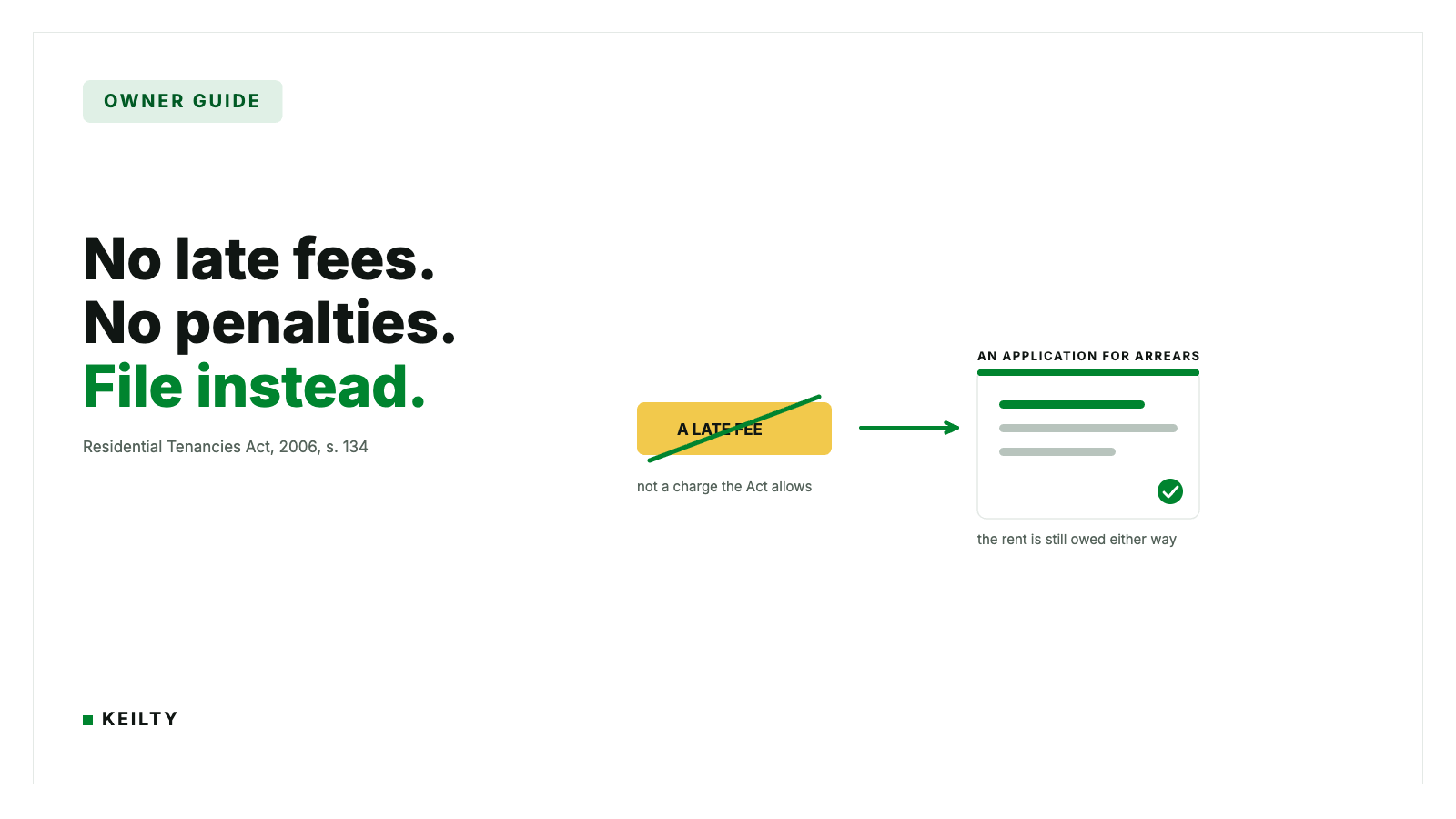
No. In Ontario you cannot charge a late fee on rent. Section 134 (1) (a) of the Residential Tenancies Act, 2006 stops a landlord from collecting, requiring, or even attempting to collect a fee, premium, commission, bonus, penalty, key deposit or other like amount of money from a tenant, prospective tenant or former tenant, and it applies whether or not the money is refundable. A late fee is a penalty. It is not on the short list of payments that regulation carves out, so it is not chargeable. A clause in your lease saying otherwise does not rescue it either, because section 4 (1) makes a provision in a tenancy agreement that is inconsistent with the Act or the regulations void.
That is the answer most owners come looking for. The more useful answer is what you can do instead, because the Act takes the fee away and hands you a different tool. Late rent is recoverable. NSF charges are recoverable. Damage is recoverable. All of it runs through the Landlord and Tenant Board rather than through a line item you add to next month's rent.
Is this you? If you own this rental rather than rent it, KEILTY manages homes and buildings across Eastern Ontario and will tell you what the unit should rent for. Start with a free rental evaluation.
Section 134 (1) is written broadly on purpose. It catches the landlord, and section 134 (2) extends the same prohibition to a superintendent, property manager or anyone else acting on the landlord's behalf. A management company cannot charge what an owner cannot charge.
The section opens with the words "unless otherwise prescribed." That phrase matters. The prohibition is the default and the exceptions live in regulation, specifically section 17 of O. Reg. 516/06, which is titled "Exemptions from s. 134 (1) and (3) of the Act." If a charge is not in that list, assume it is caught.
There is a second trap worth knowing, and it is stricter than the first. Section 134 (1.1) says no landlord shall collect or attempt to collect from a former tenant any amount purporting to be rent for a period after the tenancy has terminated and the tenant has vacated. Note what is missing from that subsection: it does not open with "unless otherwise prescribed." Sections 134 (1) and 134 (3) both do, and 134 (1.1) does not, so no regulation carves anything out of the former tenant prohibition. Owners get caught here after a bad ending, when they keep billing "rent" for months the person no longer occupied. The money may still be owed to you. It is just not owed as rent, and the route to it is an application, not an invoice.
Section 17 of O. Reg. 516/06 lists nine exempt payments. The ones that come up in ordinary residential files are:
The remaining items are narrow. One covers a transfer charge of up to $250 when a tenant asks to move between units, but only for the unit types the regulation and the Act name, so it is not a general right to bill a transfer. Two others apply to mobile home parks and land lease communities. If your file is a house, a duplex or an apartment, those three are almost certainly not yours to use.
Notice what is absent from the list. No late fee. No interest on arrears. No cleaning fee at move-in. No pet fee. No lease-signing fee. No administration fee untied to an NSF cheque.
Yes, and this is the one place a real dollars-and-cents charge survives. You can pass along what your bank charged you, and you can add an administration charge of up to $20 for that NSF cheque. Both come from section 17 of the regulation, items 4 and 5.
The Act backs this up on the collection side. Section 87 (5) says that on a landlord's application under section 87, the Board may include the NSF cheque charges claimed by the landlord and charged by the bank, to the extent the landlord has not been reimbursed, plus unpaid administration charges for those cheques up to the amount prescribed as exempt from section 134. So the $20 is not just permitted to charge, it is claimable in front of the Board.
Read the cap carefully. The $20 is per NSF cheque and it is an administration charge, not a late payment charge. A tenant who pays rent eleven days late by e-transfer has not given you an NSF cheque, so there is nothing to charge.
One drafting point decides whether you get the $20 at all. Section 5 (f) of the Ontario Standard Lease reads that if the tenant's cheque is returned NSF, the tenant will pay the landlord's administration charge of a blank dollar amount plus any NSF charges made by the landlord's bank, with a note underneath that the charge cannot be more than $20.00. The amount is a blank you fill in. Neither the form nor the province's guide says what happens if you leave it empty, so treat this as drafting practice rather than a rule: fill the blank in at lease signing, because an agreed number is easier to claim than one you assert afterwards.
On the N4. This is the one place in this post where getting it wrong costs an owner something real.
Section 59 (3) says the notice of termination is void if, before the landlord applies to the Board, the tenant pays the rent in arrears and the additional rent that would have become due had the notice not been given. NSF charges are not in that figure. Nothing in section 59 (3) requires a tenant to pay them to void the notice.
The LTB draws the obvious conclusion in its own guidance. Interpretation Guideline 11, Rent Arrears, states that although a landlord may apply for NSF charges, they cannot be claimed in an N4, and that including them on an N4 will likely invalidate the notice. The same guideline says unpaid utility costs are not rent arrears and cannot be claimed on an N4, an L1 or an L9 either, and that claiming an unpaid rent deposit on an N4 will invalidate it.
So the rule is simple. NSF charges go on the application. They never go on the notice.
Then the route is an N4 followed by an L1, not an L9. An L9 is a money-only application and does not get you possession.
Under section 59 (1) as it currently stands, an N4 can be effective no earlier than the 7th day after it is given for a daily or weekly tenancy, and the 14th day after it is given in all other cases, which is where a monthly tenancy sits. That is changing. Schedule 12, section 4 of the Fighting Delays, Building Faster Act, 2025 replaces section 59 (1) on 2026-09-21, and the replacement collapses the split entirely: a flat 7th day after the notice is given, for every tenancy. If you are giving notices around that date, check which version applies before you fill in the termination date.
That date changed something else about the N4, and it is quieter than the notice period because it has nothing to do with the termination date. Section 43 (1) of the Act now reads: "Where this Act permits a landlord or tenant to give a notice of termination, the notice shall be in a form approved by the Board, unless the form of the notice is prescribed in which case the notice shall be in the prescribed form …" For the N4, the prescribing is done by O. Reg. 308/26, in force since 2026-09-21. Section 1 of that regulation reads: "A notice of termination given by a landlord under section 59 of the Act for the failure of a tenant to pay rent lawfully owing under a tenancy agreement shall be in version 1 of the form titled …", and the form it names is the Notice to End Your Tenancy Early for Non-payment of Rent (N4), available on the Landlord and Tenant Board's website.
The practical consequence is about which copy of the form you serve. Before this, an out-of-date N4 saved on a desktop was untidy. Now the regulation names a version, so serving an old saved copy is a defective notice rather than a cosmetic problem, and a tenant or a Board member can raise it. Note also what section 1 does not do. It does not attach a dated schedule of the form to the regulation. It points at the form on the Board's website, so the reference moves as the Board posts, and the version you owe is the one there on the day you serve. The working habit that follows is a short one: download the N4 from the Board's website each time you serve one rather than reusing a file from the last tenancy, and check that it is version 1.
The L1 then evicts for non-payment and collects what is owed, and per the LTB's L1 instructions it can carry the NSF charges the N4 could not. The instructions also confirm the administration charge is capped at $20 per cheque.
Per the LTB's forms, filing and fees page, the L1, L2, L3, L9 and L10 are all $201, or $186 through the Tribunals Ontario Portal. The L9 and L10 instruction pages still print a flat $201 without mentioning the portal rate, so go by the fees page. Filing online is the cheaper of the two on every one of these forms.
The tenant's side is worth knowing too. A tenant challenging an illegal charge files a T1, which is $53, or $48 through the portal.
No, and this one catches good operators who think they are being helpful. Section 108 says neither a landlord nor a tenancy agreement shall require a tenant or prospective tenant to provide post-dated cheques, or to permit automatic debiting of their account, automatic charging of a credit card, or any other form of automatic payment for rent.
Read the verb. The section prohibits requiring it. A tenant who offers post-dated cheques, or who asks to be set up on preauthorized debit, is doing something the Act does not forbid. What you cannot do is make it a condition, write it into the lease as mandatory, or lean on an applicant for it during screening. Our guide to what you can legally ask during screening covers where that line sits.
You have to give one, and no, you cannot charge for it. Section 109 (1) requires a landlord to provide free of charge, on request, a receipt for payment of rent, a rent deposit, arrears of rent, or any other amount paid. Section 109 (2) puts a boundary on it: a former tenant only has this right if the request comes within 12 months after the tenancy terminated.
It is not, and treating it as one is a common and expensive mistake. Section 106 (1) lets you require a rent deposit if you do it on or before entering into the tenancy agreement, and section 106 (2) caps it at the lesser of one rent period and one month. Section 106 (10) then tells you what it is for: the landlord shall apply it to the rent for the last rent period before the tenancy terminates. It is last month's rent. It is not a damage deposit, and it is not a float you dip into when the 1st comes and goes. Section 105 (1) is the reason: it bars a landlord from collecting any security deposit other than a rent deposit collected in accordance with section 106, and section 105 (2) defines a security deposit as money held as security for the performance of an obligation or the payment of a liability of the tenant.
Two parts of section 106 are quietly in your favour and get skipped. Section 106 (3) lets you require the tenant to top the deposit up when the lawful rent increases, so a deposit collected years ago does not have to stay frozen at the old figure. And section 106 (7) lets you deduct from the annual interest you owe the amount by which the permitted maximum exceeds what the tenant actually paid, with the deducted amount deemed to form part of the deposit. If you have never asked for a top-up on a long tenancy, that is money sitting on the table.
On the interest itself, section 106 (6) sets the rate as the guideline determined under section 120 that is in effect at the time the payment becomes due. Write the rule, not a number, because the guideline moves each year. We went through the deposit rules in more detail in what landlords can legally collect at move-in.
The tenant can apply to the Board on a T1. Section 135 (1) lets a tenant or former tenant apply for an order that the landlord, superintendent or agent pay back any money collected or retained in contravention of the Act. Section 135 (2) extends the same right to a prospective tenant, so a fee taken from an applicant who never moved in is still exposed, and section 135 (3) lets a subtenant apply as if the subtenant were the tenant and the tenant were the landlord.
Section 135 (1.1) adds a category owners rarely see coming. A landlord is deemed to have retained money in contravention of the Act where the landlord is required to compensate a tenant under section 48.1, 49.1, 52, 54 or 55 and fails to do it. Unpaid compensation on an own-use or renovation notice is not a separate problem from illegal charges. It lands in the same section.
On timing, section 135 (4) says no order shall be made on an application filed more than one year after the money was collected or retained. The LTB's T1 instructions put it to tenants more plainly still, telling them they can only apply for illegal charges paid in the last 12 months. Do not read that as an amnesty on anything older. A charge you are still collecting every month is still being collected.
If you want the money without ending the tenancy, section 87 (1) lets a landlord apply for arrears of rent, and Form L9 is the money-only application. It can carry the NSF charges with it under section 87 (5). Section 87 (4) is worth knowing as well: where the Board orders termination and payment of arrears, it subtracts any rent deposit and interest that would be owing back to the tenant, so the deposit works against the balance rather than sitting as a liability.
After they have moved out, Form L10 is the application to collect money a former tenant owes. Per the LTB's instructions it covers rent or compensation, NSF cheque charges, unpaid utilities meaning heat, electricity and water, and damage.
Both come with a clock, and it is the deadline most owners miss. Section 87 (1.1) says an application may be made while the tenant is in possession, or no later than one year after the tenant or former tenant ceased to be in possession. That year runs from the day possession ended, not from the day the tenancy was supposed to terminate and not from the day you finally added up the file. There is a second gate on top of it: section 87 (1) (b) only reaches a former tenant who ceased to be in possession on or after the day subsection 18 (1) of Schedule 4 to the Protecting Tenants and Strengthening Community Housing Act, 2020 came into force, which was 2021-09-01.
There are two more routes owners forget. Section 88.1 (1) lets you apply for costs where the tenant's conduct, or that of an occupant or someone they permitted in the complex, substantially interfered with your reasonable enjoyment of the complex or another lawful right, privilege or interest of yours. Section 88.1 (4) defines those costs as reasonable out-of-pocket expenses you have incurred or will incur, and expressly excludes costs you may recover under section 88.2 or section 89, so you cannot claim the same expense twice through two doors. Section 88.1 (2) carries the same one year from the end of possession, and section 88.1 (1) (b) carries the same 2021-09-01 gate on former tenants. Section 88.1 (3) is the one that pays: where the Board orders payment and also terminates the tenancy, it shall set off the rent deposit and interest that would otherwise be owing back to the tenant.
Section 88.2 does the same job for utilities, and it matters because unpaid utilities cannot go on an N4, an L1 or an L9. It applies where the tenant failed to pay utility costs they were required to pay under the tenancy agreement, and it recovers your reasonable out-of-pocket expenses resulting from that failure rather than the bill as an abstract debt. It mirrors section 88.1 line for line: the same one year limit in section 88.2 (2), the same rent deposit set-off in section 88.2 (3), the same 2021-09-01 gate. If you have a current tenant and a hydro bill they were contractually on the hook for, this is the section to point at.
Not as a charge you add. Interest on arrears is caught by section 134 (1) (a) through "or other like amount of money," so you cannot bill it.
An order is different. Section 207 (7) of the Act says the Board may set a date on which payment must be made, and interest accrues on money owing only after that date, at the post-judgment interest rate under section 127 of the Courts of Justice Act. Two details owners get wrong: interest runs from the payment date the Board sets, not from the date of the order, and the rate is not something you choose.
That rate is set quarterly. Under section 127 it is the Bank of Canada bank rate at the end of the first day of the last month of the preceding quarter, rounded up to the next whole number where it includes a fraction, plus 1 per cent, and it is fixed by the quarter the order falls in. For orders dated in the third quarter of 2026 it is 4.0%. Check the province's prejudgment and postjudgment interest rate table rather than relying on a figure in an article, because it changes without notice.
The Ontario Standard Lease has been required for most residential tenancy agreements signed on or after 2018-04-30, and agreements signed on or after 2021-03-01 must use the December 2020 version, Form 2229E (2020/12). It has no late fee box, because there is nothing to put in one. What it does have is section 5 (f), the NSF administration charge line, and filling that blank in is the whole of your fee-setting discretion under this Act.
Beyond that, set the file up so late rent is visible early and acted on quickly. In practice that means a rent due date everyone understands, a payment method the tenant chose rather than one you imposed, a receipt issued on request without argument, and a fixed internal trigger, for example that any balance still outstanding on a set day of the month starts the notice process rather than a phone call and a hope. None of that is in the Act. It is operating practice, and it is the difference between a file that resolves in a few weeks and one that drags past the year mark.
A Peterborough single-family rental at $2,300 a month. Rent is due on the 1st. Section 5 (f) of the lease was completed at signing with a $20 administration charge. The tenant's cheque comes back NSF and the bank charges the owner $8. Rent lands nine days later.
What the owner may charge: the $8 bank charge plus the agreed $20 administration charge, so $28. What the owner may not charge: anything for the nine days. No per-day penalty, no percentage of rent, no flat $50 written into the lease. And if the owner had left the 5 (f) blank empty, the argument starts at $8.
Now change the ending. The same tenant leaves owing two months of rent plus the $28. The owner files an L10 at $186 through the portal, and does it inside one year of the day possession ended. Compare that to a Belleville owner who lets the file sit for fourteen months. The debt did not shrink. The route to it closed. Our vacancy loss calculator is built to put a number on that kind of gap.
Owners who self-manage tend to find this section after they have been charging something for a while. If that is you, the fix is to stop rather than argue it, and to move collection into a process that holds up. KEILTY handles this on every file we manage, at a flat monthly rate per unit that does not rise as rent rises. You can see how that works for a house or a condo on our single-family rental page.
Not sure whether what you are charging today is on the right side of section 134? Get a free rental evaluation and we will look at the lease, the rent and the charges together, or contact us and ask.
This post is general information about Ontario residential tenancy law as of 2026-09-28, not legal advice. Legislation, regulations and tribunal practice change. For advice on a specific property or situation, speak with a lawyer or licensed paralegal.
Ontario property management with published pricing, same-day answers, and no surprises. Since 2003.
300-80 Queen StreetNot served yet. Join a list and hear from us the day we open.