
By A.J. Keilty, President, KEILTY Realty Management
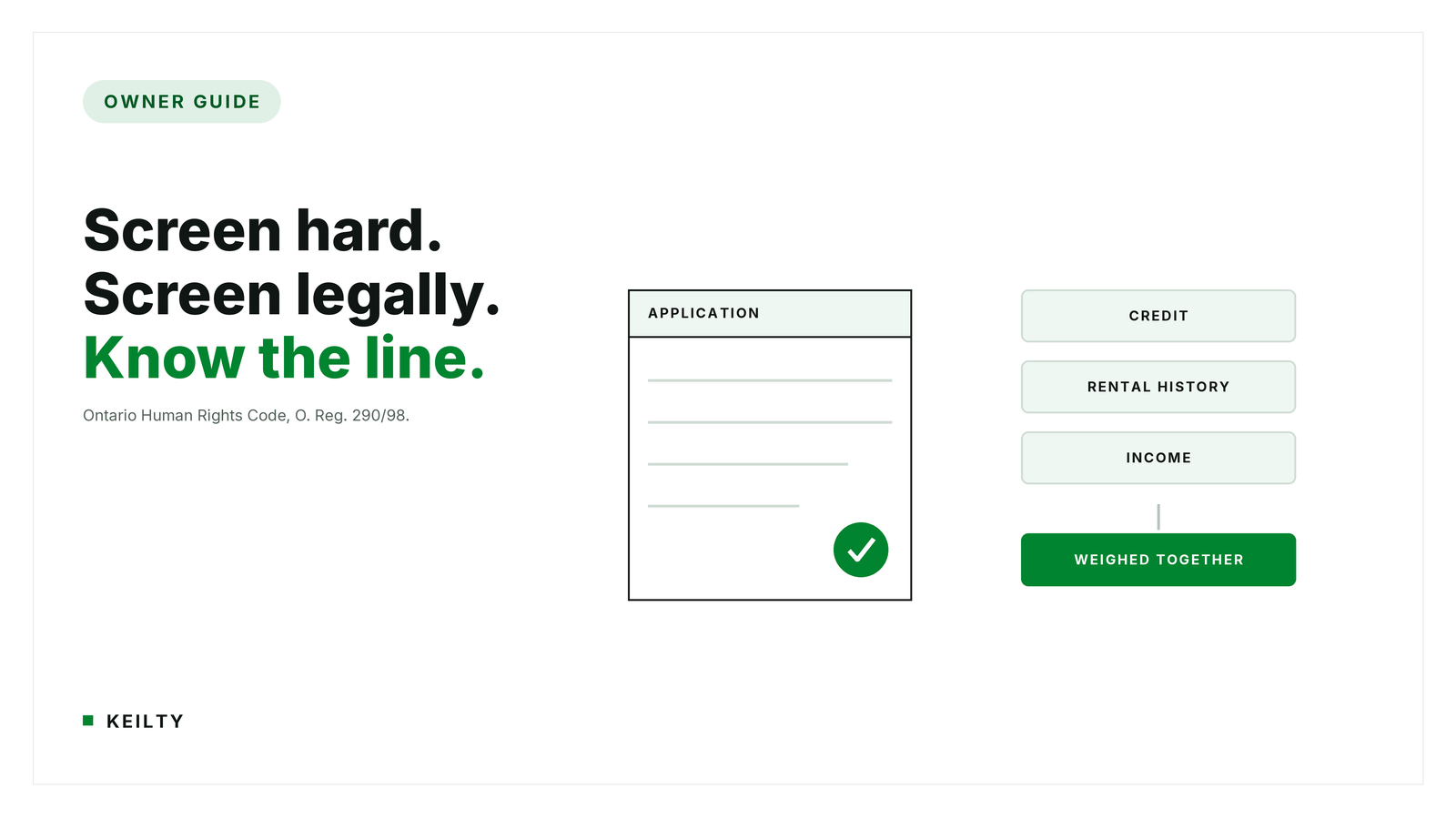
Five things: credit references, a credit check, rental history, income information, and a guarantee for the rent. You can also require the rent deposit and key deposit the Act permits. That list is not a starting point, it is the whole list. Ontario Regulation 290/98 under the Human Rights Code is a closed set of permitted practices, and the Ontario Human Rights Commission's position is that it permits no other inquiries.
The short version.
Most Ontario landlords know they cannot ask about family status or where someone is from. Far fewer know that the common "rent cannot exceed 30 percent of income" filter is not permitted at all, that a blank credit file is not a legitimate reason to pass on an applicant, or that a criminal record check sits outside the protection the Code gives you.
Is this you? If you own this rental rather than rent it, KEILTY manages homes and buildings across Eastern Ontario and will tell you what the unit should rent for. Start with a free rental evaluation.
Three sources, and it helps to keep them separate.
The Ontario Human Rights Code prohibits discrimination in accommodation on 16 grounds: race, ancestry, place of origin, colour, ethnic origin, citizenship, creed, sex, sexual orientation, gender identity, gender expression, age, marital status, family status, disability, and receipt of public assistance.
Ontario Regulation 290/98 carves out the specific business practices you are permitted to use anyway: credit references and checks, rental history, income information, a guarantee, and a deposit under sections 105 and 106 of the RTA.
The Residential Tenancies Act, 2006 governs what happens once you pick someone, including what you can collect up front and which lease you have to use.
The link between the first two is the sentence that makes this whole checklist worth following. Section 21(3) of the Code says your screening does not infringe the Code if you use those prescribed practices in the manner prescribed. Stay inside the regulation and you have a shelter. Step outside it, and you are defending an ordinary discrimination claim on the merits. Those claims go to the Human Rights Tribunal of Ontario, not the Landlord and Tenant Board, and an applicant generally has one year from the incident to file.
Yes, with a condition. Regulation 290/98 lets you request income information, defined as the amount, source and steadiness of the applicant's income, only if you are also requesting credit references, rental history and authorization for a credit check. Income cannot be the thing you look at on its own.
You are also entitled to verify that the income is real and that it is enough to pay the rent. That is the permitted question. What is not permitted is turning income into a threshold, a ratio, or a judgment about what the applicant will have left over after rent. Whether someone can afford groceries on the remainder is not your assessment to make.
Weigh the whole file. An applicant with modest income, a clean five year rental history and an 800 credit score is, on the face of the file, a stronger bet than someone earning triple who has two collections and a prior eviction.
No, and not in any form. This is the most common compliance failure we see, and the usual version of the mistake is thinking the rule is acceptable as long as it is not the only factor. It is not. The Ontario Human Rights Commission is direct: applying a minimum income criterion or a rent-to-income ratio such as a 30 percent cutoff is not permitted in the private rental market, and the leading case, Kearney v. Bramalea, found ratios breach the Code whether they are used alone or alongside other criteria.
The reasoning is that ratios screen out people on protected grounds without ever mentioning one. Recipients of public assistance, newcomers, single parents and young applicants routinely pay well above 30 percent of income in rent and pay it reliably. A ratio filters them out before anyone looks at whether they actually pay.
The one exception is rent-geared-to-income units, where the regulation expressly permits income criteria because the rent is set from income by design.
What to do instead, in writing, applied to every applicant the same way: request the permitted package, verify that income is sufficient to cover the rent, and weigh credit conduct and rental history together with it. "We verify income, credit and rental history and assess them together" is defensible. "Must earn 3x the rent" is not.
Get signed consent. Always. The reasoning is worth understanding, though, because the usual explanation is slightly wrong.
Under Ontario's Consumer Reporting Act, entering into a tenancy agreement is a permissible purpose for a consumer report in its own right, and what the Act requires of you is written notice, not written authorization. So the strict statutory position is narrower than "you cannot pull a report without written permission."
You should still get signed consent every time, for three better reasons. The credit bureaus require it contractually as a condition of your access. PIPEDA requires knowledge and consent for collecting personal information in the course of commercial activity, which is what this is. And Regulation 290/98 itself frames the permitted practice as requesting authorization to conduct a credit check, so consent is the form the permitted practice takes.
Practically: put the authorization on the application form, name what will be pulled and why, pull it only for applicants who are actually in consideration, and store the result where the rest of your team cannot browse it. Do not run a check on someone who has only enquired about the unit.
A thin file is not a negative file, and treating it as one is where landlords back into a discrimination claim. Newcomers to Canada, young people renting their first place, and people leaving a family home all have empty credit files for reasons that have nothing to do with whether they pay rent.
Regulation 290/98 permits you to require a guarantee for the rent, and the regulation attaches no conditions to that. The Code does, though, and this is where the guarantor question gets dangerous. You cannot require a guarantor because an applicant belongs to a protected group, and per the OHRC you cannot apply income ratios to the guarantor either, since you could not apply them to the applicant.
The trap is a rule like "guarantor required if no credit or rental history." It sounds neutral and it is not, because it falls almost entirely on newcomers, young applicants and people receiving social assistance. It also contradicts the point above, that a thin file is not a negative.
If you use guarantors, apply the requirement by a documented rule that is neutral on its face and neutral in effect, and apply it uniformly. Then look for the evidence that does exist: bank statements showing consistent rent payments, a letter from a previous landlord in another country, employment documentation, a larger first payment offered voluntarily.
Anything that goes to a protected ground, however conversationally it is phrased:
Employment history is not on the permitted list either. The OHRC is explicit that nothing in Regulation 290/98 lets you ask for it. You can verify income, and income verification often involves an employer, but "how long have you been at this job" as a screening criterion is not a permitted inquiry.
Your advertising copy is part of this. "Ideal for a young professional," "suits a single person," "quiet adult building" and "no children" are all evidence in a complaint. What you can set is a neutral occupancy standard tied to the actual unit and applicable by-laws, applied consistently.
Owners ask this constantly, so it deserves a direct answer. It is more complicated than yes or no.
Record of offences is a protected ground under the Code for employment, under section 5(1). It is not a ground for accommodation under section 2(1). So a criminal record check is not prohibited discrimination on that basis.
But it is also not a prescribed practice under Regulation 290/98, which means it sits outside the section 21(3) shelter entirely. You are unprotected, and still exposed to an adverse-effect claim: a record check can screen out people on grounds that are protected, particularly disability, race and receipt of public assistance, and that is the shape a complaint would take. The OHRC's position is that the Code neither permits nor prohibits record checks in rental housing, while warning they may have an adverse impact on Code-protected groups. PIPEDA consent applies as well.
Our practice is not to run them. There is no shelter, there is real exposure, and the permitted package already tells you what you need to know about whether someone pays rent and keeps a unit.
Less than most owners think. Section 105 of the RTA prohibits security deposits outright. Section 106(2) permits a rent deposit capped at the lesser of one rent period's rent and one month's rent, so a weekly tenancy means one week, not one month. It has to be collected at or before the agreement is entered into, and section 106(10) requires it to be applied to the last rent period, which means it is not available for damage or arrears. A key deposit is permitted if it is refundable and no more than the expected direct replacement cost, and it covers remote entry devices and cards as well as keys.
Damage deposits, pet deposits, cleaning fees and application fees are all prohibited. We went through this in Can You Charge a Damage Deposit in Ontario?
You also cannot require post-dated cheques or preauthorized debit as a condition of getting the unit. An applicant can offer them voluntarily, and many do, but requiring them is prohibited.
Then there is the lease. Under section 12.1 of the RTA and Ontario Regulation 9/18, the Residential Tenancy Agreement (Standard Form of Lease) is mandatory for most new residential tenancies. The current version is Form 2229E (2020/12), required for tenancies entered into on or after 2021-03-01. An earlier version applied from 2018-04-30, and if your template still says 2018/01 you are out of compliance. The requirement does not apply to care homes, sites in mobile home parks and land lease communities, most social and supportive housing, and co-operative housing.
The consequence of not providing it is specific, and worth knowing precisely. A tenant can demand the standard lease in writing once during the tenancy. If 21 days pass without it, they may withhold rent that becomes due after that 21 day period, up to a maximum of one month's rent. You can require that withheld rent back only if you provide the lease within 30 days of the first withheld payment. Miss that window and the money is gone, and because the Act only lets you require it back on that condition, it is not arrears you can pursue on an N4.
The bigger exposure is the one people miss. Under section 47.0.1, a tenant in a fixed-term or yearly tenancy who made that demand can terminate early on 60 days notice ending at the end of a rental period. That right survives even if you hand over the lease late and the tenant declines to sign it, though the tenant has to give the notice within 30 days of receiving it. A missing lease can end a fixed term you were relying on.
Carefully, and without leaning on a statistic. There is no reliable Canada-wide figure for rental application fraud, and the numbers that circulate are worth understanding before you quote them. The widely repeated "one in eight applications" line traces to a 2022 release from the US vendor Snappt, measuring documents it scanned for its own American clients. Snappt's more recent report, covering 2025, puts the rate at about 5 percent, so the publisher has more than halved its own number.
The Canadian evidence is thinner but closer to home. Menkes told STOREYS in October 2024 that it disqualified more than 90 of over 175 screened Toronto applications on discrepancies found during screening. Rent Panda, an Ontario platform, self-reports roughly 15 percent. CBC London reported a London property manager seeing more doctored pay stubs and bank statements in August 2024. Each is one company's experience on a small sample, none is a population rate, and the fair summary is that the problem is real, growing, and unmeasured.
What matters is that generative AI has made a forged pay stub or bank statement good enough that eyeballing a PDF is not a control. Five things that work, because they route around the document the applicant hands you:
That file is what turns a complaint into a short conversation. Its absence is what turns a defensible decision into an indefensible one.
An applicant can apply to the HRTO, generally within one year, and the Tribunal can order damages for injury to dignity, feelings and self-respect, along with orders to change how you screen. There is no cap on the damages figure.
The quieter cost is over-screening. Every filter that has no bearing on whether someone pays rent shrinks your applicant pool and lengthens your vacancy, and asking rents have softened and vacancy has climbed in much of Ontario. Our vacancy loss calculator prices an empty month. Weigh that against a filter that mostly makes you feel careful, and against an eviction proceeding a year later, which is the outcome real screening is meant to prevent.
The rules are provincial, so the permitted questions are identical in Kingston, Oshawa, Peterborough and Ottawa. What differs is the applicant pool, and therefore how much a marginal filter costs you. The same criteria that fill a unit in a week in one city can leave it empty for a month in another.
KEILTY screens to one written standard across every Ontario market we operate in, which is the point: consistency is the defence. If you are deciding whether to keep doing this yourself, property management versus self-management compares the two. Our pricing is a flat monthly rate per unit rather than a percentage of rent, so it does not climb as your rent does, and current numbers are on the single-family rental page.
Ontario Regulation 290/98 under the Human Rights Code permits five things: credit references, a credit check, rental history, income information, and a guarantor for the rent. You can also require the rent deposit and key deposit the Residential Tenancies Act allows. That list is closed, and the Ontario Human Rights Commission's position is that no other inquiries are permitted.
No, not in any form. The Ontario Human Rights Commission is direct that a minimum income criterion or a rent-to-income ratio such as a 30 percent cutoff is not permitted in the private rental market, and Kearney v. Bramalea found ratios breach the Code whether used alone or alongside other criteria. The one exception is rent-geared-to-income units, where income criteria are expressly permitted because rent is set from income by design.
Get signed consent every time. Under Ontario's Consumer Reporting Act, entering into a tenancy is a permissible purpose for a consumer report and the Act strictly requires written notice rather than written authorization, but the credit bureaus require consent contractually, PIPEDA requires knowledge and consent for collecting personal information, and Regulation 290/98 frames the permitted practice as requesting authorization for a credit check. Put the authorization on the application form, pull reports only for applicants actually in consideration, and store results securely.
Record of offences is a protected ground under the Code for employment, not for accommodation, so a record check is not prohibited discrimination on that basis. However, it is not a prescribed practice under Regulation 290/98, so it sits outside the section 21(3) shelter and leaves you exposed to an adverse-effect claim on grounds that are protected, particularly disability, race and receipt of public assistance. KEILTY's practice is not to run them.
Section 105 of the RTA prohibits security deposits outright. Section 106 permits a rent deposit capped at the lesser of one rent period's rent and one month's rent, which must be applied to the last rent period, plus a refundable key deposit no greater than the expected direct replacement cost. Damage deposits, pet deposits, cleaning fees and application fees are all prohibited, and you cannot require post-dated cheques or preauthorized debit as a condition of getting the unit.
If you are listing a unit and want a second set of eyes on your application form and criteria, request a free rental evaluation or get in touch. We will tell you what to cut.
This post is general information about Ontario residential tenancy and human rights law as of 2026-08-01, not legal advice. Legislation, regulations and tribunal practice change. For advice on a specific applicant, property or situation, speak with a lawyer or licensed paralegal.
Ontario property management with published pricing, same-day answers, and no surprises. Since 2003.
300-80 Queen StreetNot served yet. Join a list and hear from us the day we open.