
By A.J. Keilty, President, KEILTY Realty Management
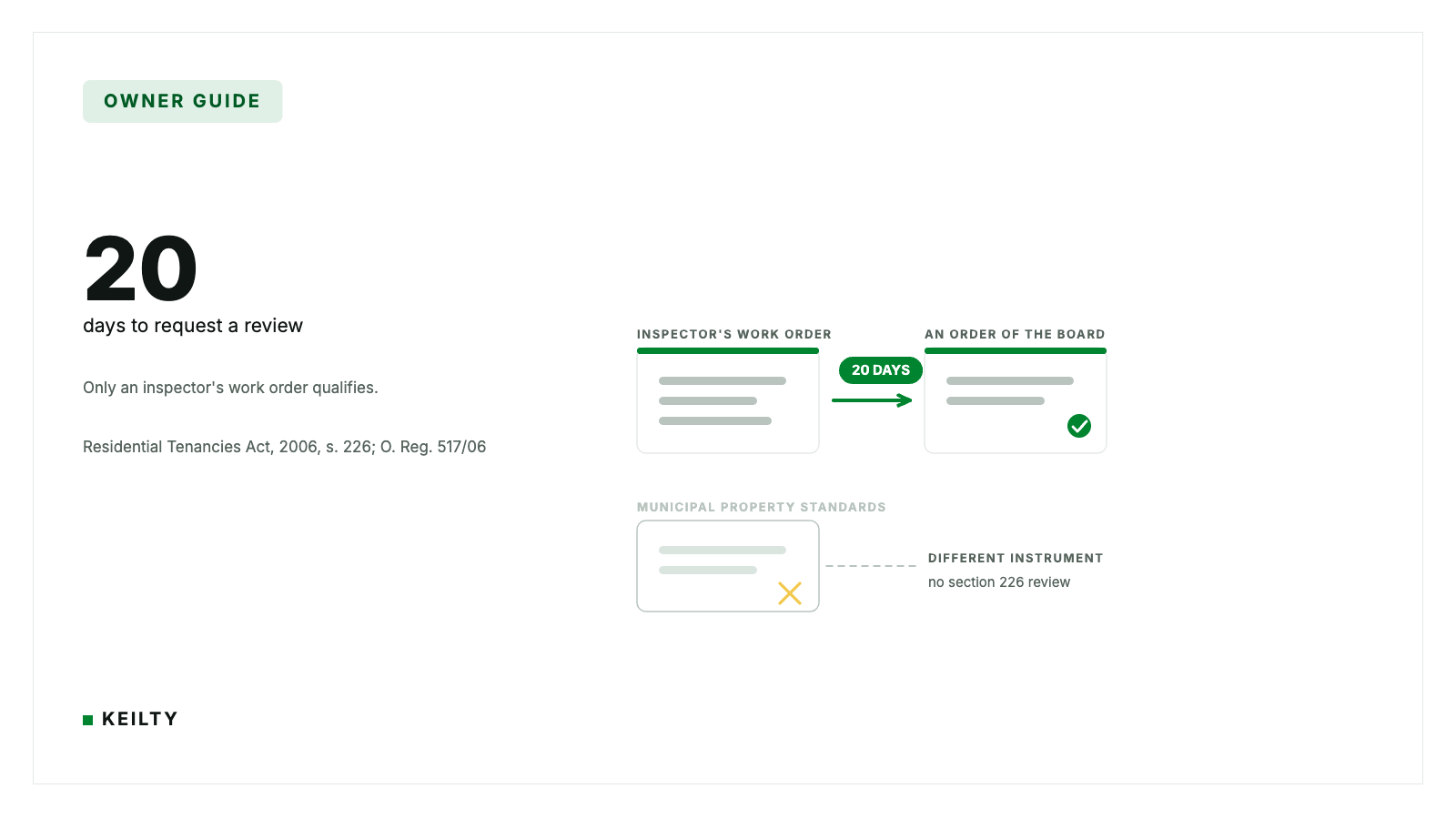
Read the top of it before you read the work. A work order issued under section 225 of the Residential Tenancies Act, 2006 enforces the provincial maintenance standards, and it is the only kind of work order the Landlord and Tenant Board will review. You have 20 days from the day it was issued to ask. A work order enforcing a municipal property standards by-law is a different instrument, and the Board cannot touch it at all.
The short version.
A work order reads like a repair list with a due date. It is that, and it is also a finding by a public official that follows the building into whatever proceeding comes next. Here is how the machinery works and what the calendar looks like.
An inspector appointed by a local municipality, under the machinery that has run since 2018-07-01. Section 226.1 provides that a local municipality may appoint inspectors for the purposes of sections 224.1 and 225. Section 226.4 keeps the older provincial machinery alive, but only for a complaint the Minister received under section 224 before that date, which is why the Act and the L6 both speak of an inspector's work order rather than a municipal one. On anything arising from a complaint made since, your counterparty is the city.
Section 224.1 (1) provides that if the prescribed maintenance standards apply to a residential complex in a local municipality, that municipality shall receive any written complaint from a current tenant of a unit in it about the standard of maintenance. Note the opening condition, because it means the section 224 question below decides whether this machinery exists for your building at all. Section 224.1 (2) requires that on receiving a complaint, the municipality "shall cause an inspector to make whatever inspection the local municipality considers necessary to determine whether the landlord has complied with the prescribed maintenance standards".
Section 225 (1) is the power itself: if an inspector is satisfied that the landlord has not complied with a prescribed maintenance standard that applies to the residential complex, the inspector may make and give the landlord a work order requiring compliance. Two things about that power. It is permissive rather than automatic, and it is triggered only by a prescribed maintenance standard, not by section 20 (1) at large. An inspector cannot issue a section 225 work order because a unit is in poor repair generally.
It is worth knowing who is not involved. Section 227 gives the Minister the job of monitoring compliance with the Act, investigating alleged failures to comply, and, where the circumstances warrant, commencing proceedings. But it opens "Except for section 224 and except as otherwise provided in sections 224.1 and 226.2". Section 226.2 puts the monitoring, the investigation of a section 234 (t) offence and the decision to prosecute on the local municipality instead. On a maintenance standards work order your counterparty is the city, not a provincial enforcement office.
This is the question that decides everything else on this page, and the answer is in section 224 (1). The prescribed maintenance standards apply to a residential complex located in a local municipality, and to the rental units located in that complex, if, "(a) there is no municipal property standards by-law that applies to the residential complex; or (b) there is a municipal property standards by-law that applies to the residential complex and the prescribed circumstances apply."
Read both limbs, because a summary that stops at the first one is only half the provision. Limb (a) is the case where there is no by-law. Limb (b) would let the prescribed standards apply alongside an existing by-law, but only where the prescribed circumstances apply, and that qualifier is where this comes apart. Section 224 contains no paramountcy rule and never says a by-law prevails.
The regulation adds one split of its own. Section 4 of O. Reg. 517/06 provides that where there is a municipal property standards by-law applicable only to the exterior of residential complexes or rental units, the provincial standards relating to the exterior do not apply in that municipality, "but the maintenance standards in this Regulation that relate to the interior of residential complexes or rental units do apply to them". A partial by-law does not switch the province off. It switches off half of it.
Section 224 (2) covers unorganized territory, and it is narrower than it looks: the prescribed standards apply there "but only for the purposes of a landlord's obligations under subsection 20 (1) with respect to maintenance standards". That makes them a civil standard the Board can measure you against. It does not import the municipal complaint, inspection and work order machinery, which is keyed throughout to a local municipality.
No, and that is the most consequential thing on this page. Paragraph 73 of section 241 (1) gives the power in one line, "prescribing circumstances for the purposes of clause 224 (1) (b)", and it has not been used. Section 2 (1) of the Act defines "prescribed" as prescribed by the regulations and "the regulations" as the regulations made under the Act, so only a regulation under this Act can supply the content, and there are eight of them. We opened and searched all eight again on 2026-09-15. The eighth is O. Reg. 308/26, NOTICE TO END TENANCY FOR NON-PAYMENT OF RENT, which is made but not yet in force and comes into force on 2026-09-21. The string 224 appears twice across the entire set, both times in O. Reg. 517/06, at section 2 (1) where it prescribes the standards themselves and at section 48 where it cross-refers to a subsection 224 (3) that no longer exists. The words prescribed circumstances appear in one regulation only, O. Reg. 394/10, and there they belong to section 137 and the suite meter rules. O. Reg. 517/06 does not contain the word circumstance at all, and its header records no amendments since its consolidation period opened on 2007-01-31.
Follow that through. On the text as it stands, limb (b) has nothing in it, so where a municipal property standards by-law applies to the residential complex neither limb of section 224 (1) is satisfied. If the provincial standards do not apply to the complex, there is no prescribed standard for an inspector to enforce under section 225, no work order to receive, and no L6 to file.
Say plainly where that reading strains, because it does. Section 4 of the regulation, set out above, assumes the regulation reaches a municipality that has an exterior-only by-law. If any by-law touching the complex defeats limb (a) outright, section 4 has nothing left to operate on. The reading that keeps section 4 alive is that an exterior-only by-law is not a by-law that "applies to the residential complex" for the purposes of limb (a). That is our reading of the two instruments together rather than something either of them says, and we have not found a decision that settles it. What is not in doubt is the direction of travel. If your municipality has a full property standards by-law, do not assume a section 225 work order and an L6 are available to you. Read which standard the order in your hand actually names, and get advice on the point rather than spending the 20 days on the assumption.
O. Reg. 517/06 is titled MAINTENANCE STANDARDS, its consolidation period opens 2007-01-31, and its header prints "No amendments." It has run unchanged for nineteen years. Section 2 (1) says it prescribes the maintenance standards for the purposes of subsection 224 (1) of the Act, and section 2 (2) says that except as otherwise provided, "the landlord shall ensure that the maintenance standards in this Regulation are complied with".
Seven Parts and fifty-one sections. The substantive standards include:
Two absences are as useful as the contents. The regulation imposes no inspection duty, no record-keeping duty and no obligation to respond to a tenant complaint in writing. And it contains no time limits at all: the word day does not appear in it. Where it needs a temporal standard it says "regularly", "whenever necessary" or "such reasonable period of time as may be required". The numbers on your file will come from the inspector under section 225 (2) (c), not from the regulation.
Four things, under section 225 (2). The municipal address or legal description of the residential complex. Reasonable particulars of the work to be performed. The period within which there must be compliance with the terms of the work order. And, in clause (d), "the time limit for applying under section 226 to the Board for a review of the work order".
That fourth item is the one to look for first. Your deadline to challenge the order is printed on the order. If it is missing, that is itself something to raise, and it is a reason to get advice quickly rather than assuming the clock has not started.
Sometimes, and the qualifier is doing real work. Section 226 (1) provides that if a landlord who has received an inspector's work order is not satisfied with its terms, the landlord may, within 20 days after the day the order is issued, apply to the Board for a review of the work order. Under section 226 (2) the Board may confirm or vary the order, rescind it if it finds the landlord has complied with it, or quash it. Note which of those is easiest to establish. Proving you have done the work is a documentary exercise; persuading the Board that the particulars in the order were unreasonable is an argument. What comes back is an order of the Board, and sections 209 and 210 speak to an order of the Board rather than to a tenancy. One more point is worth knowing if the twenty days have already run. Section 190(1) lets the Board extend or shorten the time requirements related to making an application under section 226, in accordance with its Rules. It is a closed list of three, section 126, subsection 159(2) and section 226, and an extension is something the Board may grant rather than something a landlord is entitled to. But a missed deadline does not automatically close the review route, and the request is worth making rather than assuming the door has shut.
Note also what "not satisfied with its terms" reaches, because it is the widest thing section 226 offers an owner. The application is open to a landlord who is not satisfied with the terms of the order, and section 226 (2) (a) lets the Board confirm or vary it. The period for compliance set under section 225 (2) (c) is one of those terms. So for an owner given 30 days to do something that needs a trade, a season or a permit, asking the Board to vary the period is a narrower request than asking it to quash the order. It is still an argument rather than a documentary exercise, and the Board may confirm the order as issued instead.
One thing section 226 does not do. It has two subsections and neither of them stays anything. There is nothing in the section, and nothing in O. Reg. 516/06, that pauses the compliance period the inspector set under section 225 (2) (c) while your application sits waiting for a hearing. On the face of the Act the compliance date keeps running after you file, and the section 234 (t) offence exposure runs with it. Diarize the compliance date and the hearing date as two separate things, and do not treat the filing as having bought you time on the work.
Now the qualifier on scope. The instructions to the L6, dated August 2023, put it in two sentences. "You can use this application if you want the Landlord and Tenant Board (LTB) to review a work order issued by the municipality if the work order is about enforcing the provincial maintenance standards." And then: "You cannot file this application to request a review of any other type of work order (for example, a municipal work order which is enforcing municipal property standards by-laws)."
That is the trap on this topic. Two orders can name the same building and the same deficiency, and only one of them is reviewable at the Board. Nothing on the fees page or in the form title tells you which you have, because the page ties no form to any section number. The order itself has to tell you, through the standard it names. Establish that before you spend the 20 days deciding what to do about the work.
The form is the L6, printed on the Board's forms, filing and fees page as "L6 – Application for Review of a Work Order about Provincial Maintenance Standards". The fee is $201. Unlike the L1, L2, L3, L9 and L10 row, which reads "$201 or $186 through the Tribunals Ontario Portal", the L6 row carries no portal wording and the forms table offers no portal filing for it. The page adds, in terms, "Please note that LTB fees are non-refundable." Those figures were read on 2026-08-31, and the page prints no version number or date for the L6 itself.
The L6 instructions list three things and refuse the application without them: the completed L6 form, a copy of the work order, and the fee. There is no notice to serve first and no waiting period, and the instructions carry no section on steps to take before filing. The instructions state the deadline in one line: "You must file this application no later than 20 days after the day the work order was issued."
Work an example on a Napanee file. An order is issued on Friday 2026-10-09.
Treat that roll-forward as a description rather than a plan. Rule 1.16 says Rules 1.12 to 1.15 may not be waived or varied, but the 20 days here is set by section 226 (1) of the Act rather than by a Rule, and whether the Board's counting rules reach a statutory filing deadline is not something either instrument answers on its face. File ahead of the date and the question does not arise.
One further step the instructions do not mention. Section 189.1 (1) requires an applicant under section 226 to give the local municipality a copy of the application and a copy of any notice of hearing, within the time set out in the Rules. Rule 5.10 sets that time: the landlord must serve the municipality with a copy of the application and the Notice of Hearing at least 15 days before the hearing date set in the Notice of Hearing. The L6 instructions say nothing about serving anyone, so this one has to come off the Act and the Rules.
Then the Board is closed to you and the answer lies with the municipality that issued it. The by-law that created the standard also creates the process for disputing an order made under it, and that process is local. What we can say from the Act is what is not available: section 226 is confined to an inspector's work order about prescribed maintenance standards, and the L6 instructions rule the by-law order out expressly.
Two practical consequences follow. Read the order for which standard it names before you diary anything, because the deadline printed on a by-law order is not the section 226 deadline. And do not let a fortnight go by establishing which one it is, because if it turns out to be a provincial order you will have spent most of the window.
This is where a work order stops being a maintenance problem and becomes a money problem, and it reaches three separate parts of the Act.
The first is the above-guideline increase. Section 126 (12) applies where the Board finds that the landlord has not completed items in work orders "for which the compliance period has expired and which are found by the Board to be related to a serious breach of a health, safety, housing or maintenance standard", and that the rental unit is affected by one of them. Where it applies, section 126 (13) says the Board "shall" either dismiss the application with respect to that unit, or provide in its order that the rent shall not be increased until the Board is satisfied, on a motion made by the landlord within a time the Board specifies and on notice to the tenant, that the items have been completed. Dismissal or suspension, and the choice is the Board's rather than yours.
The second is section 30 (1). Paragraphs 6, 7 and 8 let the Board, on a tenant's maintenance application, prohibit you from charging a new tenant more than the last lawful rent, from giving a notice of rent increase at all, and from taking an increase for which notice has already been given, each until the same two categories of work are completed. That is a rent freeze on the unit, not a fine.
The third is quieter. Section 117 (3) makes the section 117 authority to take an increase without a notice of rent increase available "only where the landlord" has completed the same two categories, and section 117 (4) sets its effective date at the first day of the rental period following completion. A route back to a rent you were entitled to charge is gated on the same thing.
Read the gate carefully, because it is narrower relief than it looks. The work order limbs are gated: subclause 126 (12) (a) (i) requires that the compliance period has expired and that the Board finds the item related to a serious breach, and the section 30 (1) paragraphs 6, 7 and 8 prohibitions use the same two conditions. So a live order inside its compliance period, on an item the Board has not found serious, does not by itself stop a rent increase.
But that gate does not close the subsection. Section 126 (12) (a) is a list of alternatives joined by "or", and the third of them, subclause (a) (iii), is simply that the landlord "is in serious breach of the landlord's obligations under subsection 20 (1) or section 161". No work order and no expired compliance period are needed on that limb. And section 126 (12.1) engages the same consequence where the landlord has not completed work order items whose compliance period has expired and which relate to one or more elevators, with no serious breach finding required at all. Elevators also carry a disclosure duty of their own under section 126 (3.1), which reaches an uncompleted item "regardless of whether or not the compliance period has expired". We set out the rest of the increase process in how much notice a landlord has to give to raise the rent.
Into the property, yes. Into a dwelling, only with consent or a warrant. Section 230 (1) opens "Subject to subsection (6)", and then lets an inspector appointed by a local municipality under section 226.1, "at all reasonable times and upon producing proper identification, enter any property for the purpose of carrying out his or her duty under Part XIV", and then take documents, remove them for copying, require information, be accompanied by an expert, and conduct examinations, tests and photographs. Clause (f) goes further and lets the inspector order the landlord to take and supply tests and samples at the landlord's expense.
Section 230 (6) is the limit, and it is the subsection to know. Except under a warrant issued under section 231, an inspector "shall not enter any room or place actually used as a dwelling without requesting and obtaining the consent of the occupier, first having informed the occupier that the right of entry may be refused and entry made only under the authority of a warrant". Section 231 (1) is the warrant power, section 231 (4) makes a warrant expire no later than 15 days after issue, and section 231 (5) requires execution between 6 a.m. and 9 p.m. unless the warrant provides otherwise.
Obstructing an inspector exercising a power of entry under section 230 or 231 is itself an offence under section 234 (u). Section 230 (7) carves out a slice of the power rather than the whole of it: "This section does not authorize an inspection in respect of the rights and duties of non-profit housing co-operatives or members of non-profit housing co-operatives." Read the operative words rather than the marginal note above them, which is shorter and broader than the subsection it labels.
It becomes a prosecution rather than a Board proceeding. Section 234 (t) makes it an offence to fail "to comply with any or all of the items contained in a work order issued under section 225", and section 226.2 (b) (i) puts the investigation of that offence on the local municipality.
The penalty moved recently. Section 238 (1) makes a person other than a corporation liable on conviction to a fine of not more than $100,000, and section 238 (2) makes a corporation liable to not more than $500,000. The e-Laws footnote records both as in force on 2026-07-01, via 2023, c. 10, Sched. 7, s. 9 (1, 2). The previous figures were $50,000 and $250,000, so the exposure doubled on that date. Section 237 reaches individuals behind a corporation: a director or officer who knowingly concurs in an offence is guilty of one, and is then an individual under section 238 (1).
Section 239 (2) sets the limitation for any other offence under the Act, which includes this one, at two years "after the date on which the offence was, or is alleged to have been, committed". That is a long tail on a file you thought had gone quiet.
Yes, and this is the part that outlives the repair. A tenant applies under paragraph 1 of section 29 (1) for an order determining that the landlord has breached an obligation under subsection 20 (1) or section 161, on a T6, "Tenant Application about Maintenance", at $53 or $48 through the Tribunals Ontario Portal. Section 29 (2) gives one year from the day the conduct occurred. We set that application out on its own, including the nine things the Board can order and when you have to disclose your evidence, in what happens if a tenant files a T6 against you.
Interpretation Guideline 5, Breach of Maintenance Obligations, dated 2018-12-15, sets out how the Board treats the order as evidence: "If a notice of violation, work order or other order has been issued for this complex or unit, it represents a finding by a public official that the landlord has not complied with the standard. Once the tenant files a copy of the notice or order, a Member will be entitled to accept this as evidence of non-compliance with a standard." You can dispute it, but the Guideline puts the work on you: "the landlord must raise this dispute, file the document and bring forward evidence to prove their position."
It also forecloses an argument that looks like a good one. On a work order still inside its compliance period: "A landlord may argue that the work order has not taken effect, and should not be considered, if the time for compliance has not yet expired. In fact, many work orders are issued after non-compliance with a standard has existed for some time. The fact that the landlord has been given more time by another authority to rectify the problem does not mean that there is no problem. The issue should not be dismissed on this basis." Note where that leaves you. The unexpired compliance period protects your rent increase under section 126 (12). It does not keep the order out of a T6 hearing.
The same paragraph then hands you the one argument on remedy that it has to give: "Of course, if the work order was the first way that the landlord discovered this problem existed, the fact that the compliance period has not yet expired for a non-urgent item may indicate a different remedy than a long-standing problem that was ignored." Two conditions sit inside that sentence and both of them are yours to establish. The order has to have been how you first learned of the problem, and the item has to be a non-urgent one. Where both hold, the argument moves off whether you breached and onto what the remedy should be, and it is worth making with the maintenance file in your hand.
Two things run the other way. Guideline 5 says that "In general", where there is a conflict between what a Member believes "good state of repair and fit for habitation" requires and the standard imposed by the responsible public authority, "and the landlord has met the standard, the Member should not find the landlord in breach of section 20". Keep the opening two words. It is a general approach rather than a rule. And on remedy, section 30 (2) requires the Board to consider whether the tenant advised you of the breach before applying. Guideline 5 adds that an abatement "is not appropriate" where the landlord was unaware of the problem until the application was filed, though it says in the same breath that the landlord "should be ordered to fix the problem", and that an abatement is not appropriate where the landlord has already rectified the problem within a reasonable time. Unawareness answers the money, not the repair. Guidelines are not law, and the disclaimer printed on the face of Guideline 5 says so: "a Member is not required to follow a Guideline and may make a different decision depending on the facts of the case." Its date is worth carrying too. It prints 2018-12-15 and no revision line, so it has not been visibly touched by the amendments that landed on 2026-07-01.
The underlying obligation is not something you can contract out of. Section 20 (2) provides that the repair obligation applies "even if the tenant was aware of a state of non-repair or a contravention of a standard before entering into the tenancy agreement". We went through the whole of that duty in what repairs a landlord is responsible for in Ontario.
Each of these three departs from the ordinary account in its own direction: a mobile home park or land lease community carries a larger standard rather than a smaller one, through section 161 of the Act and Part V of O. Reg. 517/06; a member unit of a non-profit housing co-operative sits outside the Act almost entirely under clause 5 (c); and unorganized territory keeps the standard under section 224 (2) but has no local municipality, so there is no inspector and no work order. We run all three out in full, Part V section by section, the clause 5 (c) exemption, and why unorganized territory produces no work order, in which maintenance standards apply to a mobile home park, a co-op or unorganized territory.
None of this is in the Act. It is process, and on a 20 day window it is what decides whether you had a choice at all.
One thing an owner should hear plainly. Winning an L6 does not repair anything, and a quashed order does not answer a tenant who files a T6 next month on the same facts. If the deficiency is real, the order is the cheapest warning you will get about it.
An owner with one or two units can run the calendar on this. Reading the order, spotting which standard it names, diarizing two dates and getting a contractor booked is administration, and 20 days is enough time for it if you start the day the order arrives rather than the day you get round to it, since the 20 days runs from the day the order was issued.
What is harder is the judgment underneath. Whether the particulars in the order are actually reasonable, whether a variation is worth $201 and a hearing, and whether the condition sitting behind the order is one deficiency or the visible end of a deferred maintenance problem that will produce three more orders and a T6. That last question is the expensive one, and it is answered by knowing the building rather than by reading the order.
Where KEILTY earns its keep is upstream of all of it. An order under section 225 begins with a tenant's written complaint to the municipality under section 224.1, and the municipality is then obliged to send somebody. Answering the maintenance request is cheaper than answering the inspector. If you own a building and the maintenance is being handled off the side of a desk, our small multi-family page sets out how we run it.
Holding a work order and not sure which kind it is, or how many days you actually have? Get in touch and we will read it with you.
This post is general information about Ontario residential tenancy law as of 2026-10-15, not legal advice. Legislation, regulations and tribunal practice change. For advice on a specific property or situation, speak with a lawyer or licensed paralegal.
Ontario property management with published pricing, same-day answers, and no surprises. Since 2003.
300-80 Queen StreetNot served yet. Join a list and hear from us the day we open.