
By A.J. Keilty, President, KEILTY Realty Management
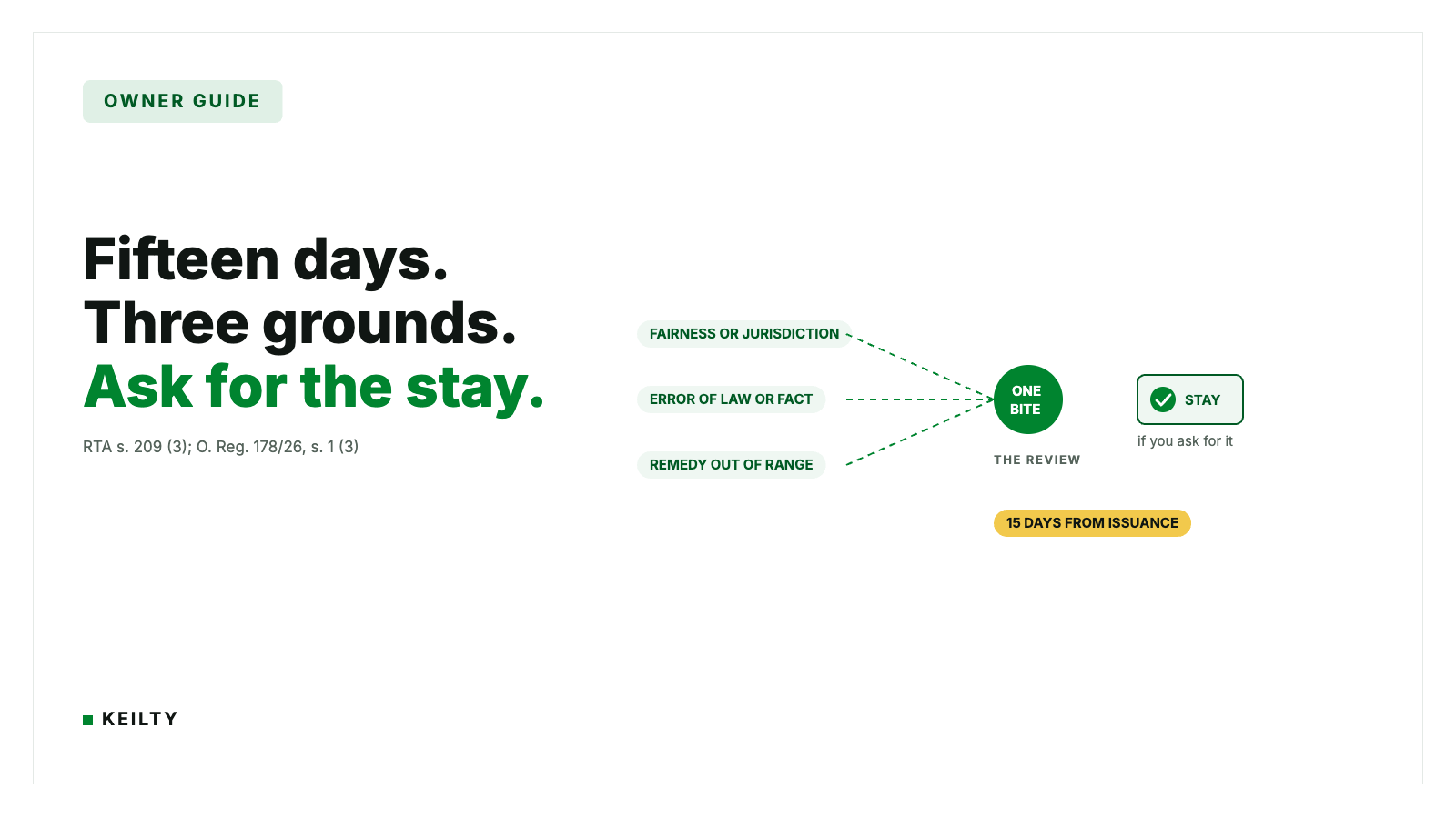
Two routes, and they are not alternatives you pick at leisure. You can ask the Landlord and Tenant Board to review its own order, which has to be done within 15 days of the day the order was issued, or you can appeal to the Divisional Court on a question of law, which has to be done within 30 days after you are given the order. Those are sections 209 and 210 of the Residential Tenancies Act, 2006.
The short version.
Both clocks start the moment the order lands, which is the practical problem. An owner who spends a fortnight deciding whether the order was fair has already spent the review window. Here is each route, what it is actually for, and the arithmetic.
Yes, but narrowly. Section 210 (1) says that any person affected by an order of the Board may appeal the order to the Divisional Court within 30 days after being given the order, "but only on a question of law". Read the closing words. An appeal is not a second hearing and it is not a way to argue that the Member weighed the evidence badly. A finding of fact, however wrong you think it is, is not a question of law.
Section 209 (1) is the reason the Board can look at its own order at all: "Except where this Act provides otherwise, and subject to section 21.2 of the Statutory Powers Procedure Act, an order of the Board is final and binding." The exception it names is doing the work. Section 21.2 (1) of the Statutory Powers Procedure Act provides that a tribunal may, if it considers it advisable and if its rules made under section 25.1 deal with the matter, review all or part of its own decision or order, and may confirm, vary, suspend or cancel it. Two conditions, both of which have to be met, and the power is permissive rather than owed to you.
Two further subsections finish that section and both are worth having. Section 21.2 (2) reads, in full: "The review shall take place within a reasonable time after the decision or order is made." No number is attached to it. Section 21.2 (3) reads: "In the event of a conflict between this section and any other Act, the other Act prevails." That third subsection is why the 15 days in section 209 (3) of the Residential Tenancies Act governs rather than anything in the Statutory Powers Procedure Act. Note its scope while you are there. It speaks to a conflict between that one section and another Act, not between the two statutes at large, and it says nothing at all about regulations.
Two things, and together they narrowed the route considerably. Section 209 was expanded by section 11 of Schedule 12 to the Fighting Delays, Building Faster Act, 2025. The e-Laws footnote records it as in force on 2026-07-01, and it added three subsections to what had been a one-sentence provision. Subsection (1) itself was left alone.
Section 209 (2) now says that the Board's power to review under section 21.2 of the Statutory Powers Procedure Act "is subject to any prescribed limitations or conditions". Section 209 (3) sets the deadline: a request to review shall be submitted within 15 days of the issuance of the decision or order, "unless the Board considers it just and appropriate in the circumstances to extend the time to request the review". Section 209 (4) is the transition, and it confines subsection (3) to a decision or order made on or after the day section 11 came into force.
The limitations contemplated by subsection (2) arrived at the same time, as O. Reg. 178/26, "LIMITS ON BOARD'S REVIEW POWERS". Its consolidation period opens 2026-07-01, it carries no not-yet-in-force banner and no amendments. It is in force now. That is the regulation that closes the list of grounds, and it is dealt with below.
Both dates matter, so state both or neither. An order issued before 2026-07-01 carries the old 30 day window. An order issued on or after that date carries 15 days. Rules 26.4 and 26.5 of the LTB's Rules of Procedure draw the line in the same place, and Rule 26.5 ties the 15 days expressly to section 209 (3). Note what the line turns on: the date the order was issued, not the date you get around to asking.
The Board has said less about this than you might expect. Its operational update of 2026-06-30 is the newest legislative item it has posted, and on the review changes it says two things. Under the heading about the deadline: "The timeline to request a review of an LTB order is shortened from 30 days to 15 days." Under the heading about requests to review a final order, in full: "Changes apply to the circumstances in which a final LTB order may be reviewed. See Rule 26 for more information." That update never names O. Reg. 178/26 and never mentions section 209. The regulation is named in Rules 26.8 and 26.9 and in Guideline 8, and nowhere else in the Board's operational material.
The same update flags a knock-on effect for owners running above-guideline applications, because the shorter review window pulled other deadlines in with it. Where a landlord has been directed to serve tenants with an above-guideline increase order, the deadline for service "has been reduced from 14 days to 7 days from the date of issuance", and the deadline to submit a certificate of service "has been revised to no later than 5 days from the date of service". If you have an application of that kind running, those two dates moved.
Fifteen days from issuance, and the LTB's Interpretation Guideline 8 adds a sentence worth taking literally: "If you intend to request a review you must do so without delay."
The instructions to the Request to Review an Order form, which print "Last updated: July, 2026", put it as a requirement twice over. A request to review an order or decision issued on or after 2026-07-01 "must be made no later than 15 days after the date the order was issued", and one issued before that date "must be made no later than 30 days after the date the order was issued". The form, the Rules and the Act agree on this one.
By the LTB's own counting rules, which are short and cannot be waived. Rule 1.12 says that a number of days means calendar days. Rule 1.13 says that when something must be done within a specific number of days, the days are counted by excluding the first day and including the last day. Rule 1.14 says that when the time for doing anything ends on a holiday as defined in the Rules, the thing may be done on the next day that is not a holiday. Rule 1.1 defines a holiday as any Saturday, Sunday or other day on which the LTB's offices are closed. Rule 1.16 then says, in one line, that Rules 1.12 to 1.15 may not be waived or varied.
Work an example on a Peterborough file. An order is issued on Friday 2026-10-02.
Do the arithmetic and then file ahead of it rather than on it. The roll-forward in Rule 1.14 is a rule about the Board's own time limits, and treating a weekend as free extra working time is how a fortnight shrinks without anyone noticing. Count the calendar days, then count the working days you actually have inside them, and remember that a statutory holiday inside the window takes one of those away too.
Section 1 (1) of O. Reg. 178/26 is the whole test, and its opening words are the ones to read. For the purposes of subsection 209 (2) of the Act, the Board's power to review on a person's request "applies only if the Board determines that one of the following circumstances applies". Three circumstances, and no residual category.
Read the words "on a person's request", because they are a limit on the limit. The Board can also review an order without anybody asking. Rule 26.3 provides that the Board may review an order on its own initiative where it considers appropriate and will issue directions to the parties with respect to the conduct of the review, and then adds, in terms: "A party or a directly affected person cannot request an LTB initiated review of an order." Two things follow. You cannot ask for one, so it is not a route to file on. And because the three grounds are drafted around a request, our reading is that they do not confine a review the Board starts itself. Be careful how much weight you put on that second point. No rule says so affirmatively. What the Rules do show is that the regulation is named twice, in Rule 26.8 on what a request must contain and Rule 26.9 on how a request is screened, and nowhere outside the request stream.
The first ground has its own closed list. Subsection 1 (2) says paragraph 1 "is limited to the following reasons": the party did not receive adequate notice of the hearing or of the issues to be decided at the hearing; the party's inability to participate was wholly or partly attributable to the Board; the party was misled by another party to the proceeding; the party was affected by a serious emergency, "such as" a serious illness, a serious injury or hospitalization, or the serious illness, serious injury, hospitalization or death of an immediate family member; the party was incarcerated or incapable; or the occurrence of a natural disaster or other similar circumstance.
Note the drafting. The six reasons are a closed list, because subsection (2) says it is limited to them. The examples of a serious emergency inside reason four are open, because that paragraph says "such as". Guideline 8 puts the burden where you would expect: "The onus is on the requestor to demonstrate they were not reasonably able to participate for one of the specific reasons contained in O. Reg. 178/26 which are set out above."
One thing to know before you go looking for case law on that first ground. Guideline 8 says of the earlier Divisional Court decisions on it that "these decisions were made before O.Reg 178/26 came into force on July 1, 2026, and therefore may no longer be applicable". A precedent from 2024 on what counts as being unable to participate may be describing a test that no longer exists.
Four things, and subsection 1 (3) of the regulation says paragraph 2 "is limited to the following serious errors": the Board acted outside of its jurisdiction or committed a material breach of procedural fairness; the Board made an error of law, fact or mixed fact and law; the Board ordered a remedy that is significantly outside of the range of usual and proportionate remedies for the type of proceeding; or the terms of the decision or order are unenforceable.
Take the second of those seriously as a route, because it is the one that overlaps with the court. An error of law is an express ground for a review here, so it does not have to go to the Divisional Court to be argued, and unlike an appeal this ground reaches findings of fact and mixed questions as well. What holds it in check is the gateway in paragraph 2 of subsection 1 (1), which requires that the decision "is the consequence of" the serious error, so the error has to have driven the result.
Guideline 8 spends most of its length explaining how tightly the Board reads it. On facts: "The original hearing Member's findings of fact and determinations are entitled to considerable deference. A request will not be granted simply because the reviewing adjudicator might have come to a different conclusion about the evidence." The Guideline sets the bar as whether the Board "must be satisfied that there appears to be no rational connection between the findings of fact and the evidence in the original hearing". On law: "the LTB will not exercise its discretion to review an order interpreting the RTA unless the interpretation conflicts with a binding decision of the Courts or is clearly wrong and unreasonable." And on either: "An error of fact or law made in the original order must have a material impact upon the outcome of the proceeding to be considered a serious error resulting in the review being granted."
Guidelines are not law, and the disclaimer printed on the face of Guideline 8 says so: "a Member is not required to follow a Guideline and may make a different decision depending on the facts of the case." What the Guideline does tell you is how the Board has said it approaches the question, which is what you are writing your request against.
All three conditions in paragraph 3, together. The evidence was not before the Board during the proceeding, it could not have been obtained by you before the decision or order was made, and it would likely have affected the result had it been before the Board. Evidence you had and did not file fails the second condition. Evidence that would not have changed anything fails the third.
Guideline 8 frames the whole process the same way, quoting the Divisional Court: "A review is not an appeal or an opportunity to change the way a case was presented. It is a discretionary process to allow parties to challenge a final LTB order in specific circumstances." Quoting an earlier Board decision, it adds that the purpose "is not to provide parties with an opportunity of presenting a better or different case than they did at first instance".
A small warning if you go and read Guideline 8 yourself. In the new evidence section it cites the regulation as "O. Reg 178/25". Every other reference in the Guideline, and both references in Rule 26, say 178/26. Treat the stray one as a typo on the published page.
Rule 26.7 sets the form requirements: the request must be in writing, must not exceed 10 double-spaced pages, must be signed by the requestor or their representative, and must be accompanied by the required fee. The 10 pages "does not include the LTB approved form and any evidence and cases being relied upon".
Rule 26.8 sets the contents, and there are ten items. The order number, the address of the rental unit or member unit, the requestor's name, address and telephone number, and, if the requestor is not a party, an explanation of their interest in the order. Then the substance: identify one of the three circumstances in O. Reg. 178/26, provide sufficient information to support a preliminary finding that one or more of them applies, and provide an explanation of how the order should be changed. Then the housekeeping items: if you are seeking a stay, explain why one is necessary and what prejudice or harm may result without it; provide information about any appeal of the order; and where there is an appeal, indicate your position on whether the Board should lift any stay resulting from it. Rule 26.8.1 lets the Board refuse to accept a request that does not comply with all of Rule 26.
The fee is $58. It sits in three places on the LTB's forms, filing and fees page, in the landlord table, the tenant table and the other fees table, at the same figure each time, and unlike the main application rows it carries no discount for filing through the Tribunals Ontario Portal. The page also states, in terms, "Please note that LTB fees are non-refundable." The form itself is called "Request to Review an Order" and carries no letter and number designation, and the forms page prints no version or date for it.
No. Nothing in Rule 26 makes a stay automatic, and the assumption that it does is expensive in both directions.
Rule 26.10 says a party may request a stay as part of the request to review or at any point in the review process, and that the request must be in writing and describe any prejudice resulting from a refusal to grant it. Rule 26.11 says the Board may stay or lift a stay at any point, on request or on its own initiative, without seeking submissions or holding a hearing, and may attach conditions. Both are permissive. Guideline 8 describes the test it applies: "The LTB will order a stay when it is satisfied a party will suffer harm that cannot be undone if the order is enforced before the review proceeding is completed." It also warns that "All submissions about the stay should be included in the request", because "The LTB rarely asks parties for more submissions or holds a hearing on this issue".
Hold the contrast with an appeal next to that, because the two routes behave in opposite ways on this exact point and it is the single most consequential difference between them. A review stays nothing by itself and you have to ask for the stay, in the request, with the harm spelled out. An appeal to the Divisional Court stays the order by default, under section 25 (1) of the Statutory Powers Procedure Act, unless another Act or a regulation that applies to the proceeding expressly provides to the contrary or the tribunal or the court or other appellate body orders otherwise. Same order, same week, opposite starting positions, and the section that supplies the appeal stay is in a different statute from the one you are reading about the review. The appeal route is set out further down.
Two consequences pull in opposite directions depending on which side of the order you are on. If you are the landlord holding an eviction order and the tenant files a review, that order is not paused by the filing alone. If you are the party asking for the review, you have to ask for the stay in the request itself, with the harm spelled out, or the enforcement carries on around you. Guideline 8 adds one more step: the party who benefits from a stay must provide a copy of the stay order to the Court Enforcement Office, the Sheriff, if the order is about eviction.
The request goes to a first stage that happens on paper, without a hearing. Guideline 8 says it "is normally conducted by a designated LTB Member, Vice-Chair or the Associate Chair", and, in a separate passage, that the Board "conducts the preliminary review by considering the contents of the review request and the LTB's record without holding a hearing".
Rule 26.9 says the Board will conduct that preliminary review and may exercise its discretion to dismiss the request because it was not filed in time, extend the time for making it, dismiss it including where not satisfied that one of the circumstances in the regulation may exist, or direct a review hearing of some or all of the issues raised and, where appropriate, make any interim orders.
Two features of that stage are worth planning around. Guideline 8 says a request "which simply alleges the order is wrong will usually be dismissed at the preliminary review". And it says that if the request is dismissed at this stage the Board "will issue an order but is not required to provide reasons for its decision". A thin request can therefore end with an unexplained dismissal and a spent fee.
Be ready to run the case again the same day. Rule 26.15 says that if the request is granted the reviewing Member will identify the issues to be re-heard, and may include issues not identified in the request but which the Member finds may amount to a serious error in the order. Rule 26.16 then says that unless otherwise directed, the re-hearing will begin immediately after the request to review is granted, and that parties must be prepared to proceed with the re-hearing.
Guideline 8 says the same thing as practical advice: parties "should disclose and file all relevant evidence prior to the review hearing and ensure their witnesses are available to testify at the review hearing in case the re-hearing proceeds on the same day". Following the re-hearing, Rule 26.17 lets the Board confirm, vary, suspend or cancel the order and lift any stay if necessary. If the request is dismissed, Rule 26.14 says the Board will lift any stay and confirm the order under review.
Rule 26.13 is worth knowing in advance so it is not a surprise on the day: any Member, including the Member whose order is the subject of the request, may be assigned to conduct the review hearing. Guideline 8 notes that in Decosse v. Miklos, 2019 ONSC 6034, the Divisional Court confirmed that there is no breach of procedural fairness or natural justice in having an LTB Member review their own decision.
Not as the same party. Rule 26.18 says the Board "will not consider a further request to review the same order or to review the review order from the same requesting party". The form instructions say it as plainly as it can be said: "A party may only file one request to review an order so it is important to include all your reasons."
Rule 26.19 carves out a different person rather than a second attempt: a party or directly affected person may request a review of the same order on different grounds, provided the requestor's interests in the proceeding are different from those of the first requestor. That is not a second bite for you. It is a first bite for somebody whose interests differ from yours.
The practical consequence is the whole reason to take the fifteen days seriously rather than filing something quickly to stop the clock. Everything you have goes in the one request.
You ask for an extension, and you have to ask for it in the same envelope. Rule 26.6 says that if the request is made after the deadline the requestor must also file a request for an extension of time and give reasons explaining the delay. Rule 16.2 lists a request to review a decision or order among the things for which, absent exceptional circumstances, an extension request "must be filed together with the motion, application or request". Guideline 8 states the consequence without hedging: "The LTB will not consider a request to extend time unless it is made together with the request for review." There is a separate form for it, and the Board lists that form under more than one name, so take it from the forms page rather than from a saved copy.
Rule 16.4 lists the factors the Board may consider on any request to extend or shorten time: the length of the delay and the reason for it, any prejudice a party may experience, whether any potential prejudice may be remedied, whether the request is made in good faith, and any other relevant factors. Guideline 8 notes that in Kim v. Leung, 2025 ONSC 6585, the Divisional Court confirmed that the Board has broad discretion on such a request and is not required to address all of the Rule 16.4 factors in every case. Rule 16.6 adds that where a request to extend time is denied, the requesting party may not make further requests to extend the same time requirement unless there has been a significant change in circumstances.
Do not assume the general waiver power rescues a late filing, and note that two different Rules are often run together here. The waive-or-vary power is Rule 1.4.2: "The LTB may vary or waive the application of any rule or procedure, on its own initiative or on the request of a party, except where to do so is prohibited by legislation or a specific rule." The time limit power is Rule 1.6, whose limb (a) lets the Board "extend or shorten any time limit except where prohibited by legislation or a specific Rule", so shortening a time limit is within it as well as extending one. Rule 16.1 opens "Except where an extension of time is prohibited by the RTA". The 15 days is now in section 209 (3) of the Act rather than only in a Rule, and the extension power it contains is the Act's own, exercisable where the Board considers it just and appropriate in the circumstances.
When the problem is the law rather than the file. Section 210 (1) is limited to a question of law, and the deadline is 30 days after being given the order, which is a different trigger from the review's 15 days from issuance. Under section 210 (4), if an appeal is brought the Divisional Court shall hear and determine it and may affirm, rescind, amend or replace the decision or order, or remit the matter to the Board with the Court's opinion. Section 210 (5) lets the Court make any other order in relation to the matter that it considers proper, and any order as to costs. Section 210 (2) requires a person appealing to give the Board any documents relating to the appeal.
The appeal carries an automatic stay, and that is the practical difference between the two routes. It does not come from section 210, which contains no stay provision at all. It comes from section 25 (1) of the Statutory Powers Procedure Act: an appeal from a decision of a tribunal to a court or other appellate body "operates as a stay in the matter unless, (a) another Act or a regulation that applies to the proceeding expressly provides to the contrary; or (b) the tribunal or the court or other appellate body orders otherwise". Note both exceptions. The stay is the default rather than an absolute, and it can be ordered otherwise.
That stay has a knock-on effect the Request to Review instructions spell out: if the order has been appealed to the Divisional Court, the order is automatically stayed and the Board "cannot consider your Request to Review an Order unless it first decides to lift the stay of the appeal". Which is why Rule 26.8 asks for your position on lifting it. Running both routes at once is possible and it is not free of consequence.
One deadline caution. The counting rules in Rules 1.12 to 1.14 are the Board's rules for the Board's time limits. A Divisional Court deadline is governed by the court's own rules, not by Rule 1.13, so do not compute an appeal date the way you would compute a review date. The 30 days is also a deadline to serve the notice of appeal rather than to file it, with filing and perfection following on their own clocks. We set the whole court side out, with the fees, the counting rule and the timetable, in whether you can appeal an LTB order to the Divisional Court. Work it out with a lawyer or licensed paralegal and file early.
No, and the difference is not academic. Guideline 8 notes that LTB orders "may also be subject to applications for judicial review at the Divisional Court", so it is a real third route.
The point that matters operationally is the stay. Section 25 (2) of the Statutory Powers Procedure Act says that an application for judicial review under the Judicial Review Procedure Act, or the bringing of proceedings specified in subsection 2 (1) of that Act, "is not an appeal within the meaning of subsection (1)". So the automatic stay that comes with an appeal does not come with a judicial review application. The statute says so expressly. This is territory for a lawyer rather than a management company, and the reason to name it here is that an appeal and a judicial review are not interchangeable words for the same thing.
Several, and reaching for the wrong one wastes the window on the right one.
Both motions are free. The fees page lists the S3, Landlord's Motion to Set Aside an Order to Void, at no charge in the landlord table, and lists a motion to set aside an ex parte order and a motion to void an eviction order for arrears of rent at no charge in the tenant table.
One dated change to keep in view. The test the Board applies on a section 77 (8) (b) set-aside is amended on 2026-09-21 by Schedule 12 to the Fighting Delays, Building Faster Act, 2025, moving from open discretion to a prescribed test. We set the whole of that day out in what changes for Ontario landlords in September 2026.
The review and appeal machinery is the same, because sections 209, 210 and 211 sit in the part of the Act that governs Board proceedings generally and speak to an order of the Board rather than to a tenancy. Rule 26.8 asks for "the address of the rental unit or member unit" for exactly that reason.
What differs is the underlying eviction machinery. Section 94.16 (1) applies subsections 74 (2) to (19) and a list of other sections to an application to and an order by the Board under Part V.1 "with necessary modifications", reading tenant as member, landlord as non-profit housing co-operative, rental unit as member unit, tenancy as occupancy and rent as the regular monthly housing charges. Section 94.16 (2) then maps the individual provisions across, so that a reference to section 78, for instance, is read as a reference to section 94.11. So a co-operative disputing an order uses the same Rule 26 and the same 15 days, but the provision it is arguing about is the Part V.1 equivalent rather than the one named in this post. Check the mapping before you cite a section number in a request.
None of this is in the Act. It is process, and it is the part that decides whether the legal question ever gets asked.
One thing an owner should hear plainly. Winning a review does not put money in your account. An order is an entitlement, not a payment, and a decision in your favour still has to be enforced afterwards. The same is true of a successful appeal.
The part you can run yourself is the calendar. Reading an order the day it arrives, diarizing two dates, and getting a request filed inside fifteen days is administration, and an organized owner with one or two units can do it. What is harder is the call underneath: whether what you are unhappy about is a serious error inside a closed statutory list, or simply a result you did not want. That is a judgment call. Since 2026-07-01 the regulation draws the line, and it draws it tightly.
There is a separate question about who is allowed to stand up for you, and the Act does not answer it. The Board's Practice Direction on Representation before the Landlord and Tenant Board, effective 2022-03-03, says that a person who is not licensed by the Law Society of Ontario as a lawyer or paralegal "may not represent a party at an LTB proceeding unless that person falls within the specific licensing exemptions established by the LSO". Read the closing words rather than the first half, because the exemptions are the operative part, and the Practice Direction sets them out. It then speaks to property managers by name: an unlicensed person seeking to represent a landlord on the basis that they are a property manager "may not be allowed to represent the landlord if they are in fact engaged in the business of providing legal services to multiple third parties and do not fall within one of the LSO exemptions". That is a two-limb test and both limbs have to be met before the door closes. If you are handing a review to anybody, ask which side of that line they sit on well before the hearing.
Where KEILTY earns its keep on this is in not needing the review in the first place. An order can only be as good as the notice, the service and the ledger it was built on, and all three are settled weeks before anybody sees a Member. Getting them right is the work, and it is a good deal cheaper than a filing fee and fifteen days of anxiety. If you run a building and want the process side handled properly, our apartment communities page sets out how we do it.
Holding an order you are not sure about, or a deadline you are not sure how to count? Get in touch and we will walk through the dates and the routes with you.
This post is general information about Ontario residential tenancy law as of 2026-10-02, not legal advice. Legislation, regulations and tribunal practice change. For advice on a specific property or situation, speak with a lawyer or licensed paralegal.
Ontario property management with published pricing, same-day answers, and no surprises. Since 2003.
300-80 Queen StreetNot served yet. Join a list and hear from us the day we open.