
By A.J. Keilty, President, KEILTY Realty Management
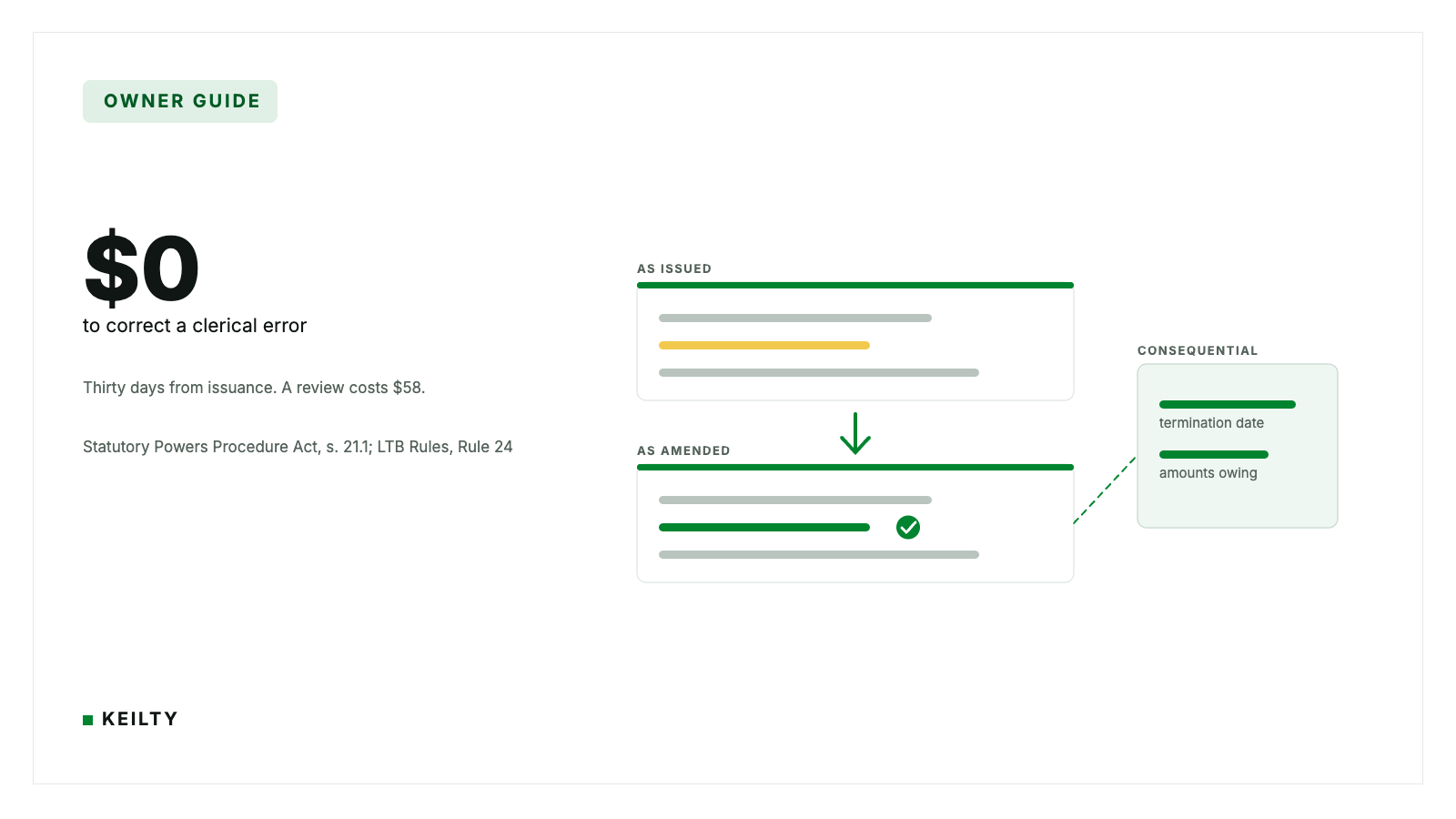
You file a Request to Amend an Order, you have 30 days from the day the order was issued, and it costs nothing. It is the cheapest and least understood of the four ways to challenge a Landlord and Tenant Board order, and it is also the narrowest: it reaches a clerical error and nothing else. If what is wrong with your order is that you disagree with it, this is not the route, and spending your 30 days finding that out will cost you the 15 day window on the route that would have worked.
The short version.
We set out the review at the Board in what you can do if you disagree with an LTB order, the court appeal in whether you can appeal an LTB order to the Divisional Court, and the fourth route in whether you can apply for judicial review of an LTB order. This page is the first of the four and the one that gets planned for last, because it is the one you need when the decision is right and the document is wrong.
A mistake in how the decision got written down, rather than a mistake in the decision.
Nothing binding defines it, and the definitions that do exist are open ended. Rule 24 uses the phrase "clerical error" three times, at Rules 24.1, 24.2 and 24.3, and never says what one is. The Statutory Powers Procedure Act, where the power lives, does not use the phrase at all: it names two error types and then extends to a "similar error". The approved form does define it, in a note inside Part 2 sitting directly beneath the opening tick box line: "A clerical error includes a typing error, an error made in calculating an amount or a similar error." Read the word "includes". That is an inclusive definition ending on a catch-all, so it tells you what is inside and not what is outside, and it is printed on a form rather than enacted in a rule. The label and the worked examples both come from Interpretation Guideline 15, Amending an Order, which is where the Board sets out its usual approach and which says of the statutory wording, "These are referred to as clerical errors."
Guideline 15 introduces its examples with "A clerical error may include any of the following", so read the four as illustrations rather than as a list. Each is a label followed by its own explanation, and they are worth having in the guideline's own words:
Read the first of those all the way through, because it has two branches and the easy one comes first. Where the name or address is wrong on the order but right on the application, the error is likely clerical, and that is the plainest case there is. The harder branch is the one where the mistake was in your own application, and it carries two conditions rather than one: the respondent must have received it and must have had an opportunity to participate in the proceeding. Both branches close on the same hedge, "likely clerical", so neither is stated as a rule.
It then gives four that are not, prefaced with "An error is not clerical if, for example", so this side is illustrative too. It is still the list to read first, because it is where a request gets refused:
Read the second and third of those together and you have the boundary. Evidence that was in front of the Member and got overlooked is not a clerical error, even though it produced a wrong result. Neither is a Member who would now decide differently. The line is not how badly the order is wrong. It is whether the wrongness is in the expression or in the decision, and that is our reading of those examples rather than a distinction Guideline 15 draws in those words.
One thing runs the other way, and it works in your favour. Guideline 15 says a clerical error "may be a Board error, or an error made by a party in documentation submitted to the Board that ends up being transcribed into an order or decision". Note the tail of that sentence, because it is the limit on it. Party error counts only where it actually reached the order. So a unit number you got wrong on your own application, which then appeared in the order, can be within the rule, on the two conditions set out above and with "likely" doing real work. The mirror image is the first exclusion: if the mistake means the other side may never have received the application, it stops being clerical and becomes something else entirely. The Board's brochure says the same thing in plainer words, that the clerical error "could have been made by the applicant in the application".
A different Act, and the chain is worth following because it explains why the 30 days is softer than it looks.
Start with section 184 (1) of the Residential Tenancies Act, 2006: "The Statutory Powers Procedure Act applies with respect to all proceedings before the Board." Section 184 has two further subsections, both captioned Exception, and they do different jobs: subsection (2) switches off subsection 5.1 (2) of that Act for an application under section 132 or 133 or an application solely under paragraph 1 of subsection 126 (1), and subsection (3) switches off subsection 5.1 (3) for an application under section 126, 132 or 133. Neither reaches anything here.
Then section 21.1 of the Statutory Powers Procedure Act, which is one sentence with no subsections: "A tribunal may at any time correct a typographical error, error of calculation or similar error made in its decision or order." The Section Amendments table printed beneath it on e-Laws carries a single entry and nothing after it, "1994, c. 27, s. 56 (36) - 1/04/1995", so on the publisher's own record the section has been in force since 1995-04-01 and has not been amended since. Guideline 15 confirms the attribution in its opening line: "The Board's authority to amend an order comes from section 21.1 of the Statutory Powers Procedure Act."
Three things follow from the wording, and each one matters on a real file.
Do not over-read that last point. The 30 days is a procedural limit on your request rather than a limit on the Board's power, which is consistent with Rule 24.2 letting the Board amend on its own initiative with no deadline attached, and with Rule 16.4 contemplating an extension of "any time requirement under the RTA or these Rules". So a late filer is asking the Board to exercise a discretion it has, rather than asking it to do something the statute forbids. That is where the comfort stops. Rule 16.1 does not apply where an extension is prohibited by the Residential Tenancies Act, Rule 16.2 requires the request to come in with the amendment absent exceptional circumstances, and Rule 16.6 gives you one attempt at it. A rule-made deadline is a real deadline, and a late request can simply fail.
It is worth separating section 21.1 from its neighbour while you are here. Section 21.2 is the review power, it lets a tribunal "confirm, vary, suspend or cancel" its decision, and it only operates "if its rules made under section 25.1 deal with the matter". Section 21.1 needs no rule to exist and does not touch the substance of the order. Two powers, one section apart, doing different jobs.
The Residential Tenancies Act confirms that split from the other side, and this is the sharpest support on the page for it. Section 209 (1) is the provision that makes an order stick: "Except where this Act provides otherwise, and subject to section 21.2 of the Statutory Powers Procedure Act, an order of the Board is final and binding." Read what it carves out. It names the review power at section 21.2 and says nothing at all about the correction power at section 21.1. So an order can be final and binding and still have its typing corrected, because correcting the typing is not a departure from what the Board decided. Note both opening qualifiers while you are there, because the section is not absolute in either direction.
Thirty days, from issuance, which is the same event the review runs from and a different one from the appeal.
Rule 24.1 reads: "A party to an order or any person directly affected by the order may request the LTB to correct a clerical error in an order within 30 days from the date the order or decision is issued." Note who can ask. It is a party to the order or any person directly affected by it, which is wider than the parties named on the application.
Work it on a Brockville file. Suppose the order was issued on Monday 2026-10-05.
Those two dates are the whole reason this page exists. Both clocks start on the same day and one is half the length of the other. An owner who spends three weeks arguing that a finding was wrong, files an amendment request on day twenty-five, and is told the error is not clerical, has lost the review by a fortnight and can get it back only by asking the Board to extend the deadline under section 209 (3). Diagnose first, then file.
There may be one way out of that, and it depends on the answer rather than on you. Rule 26.5 reads: "A request to review an order or an amended order issued by the LTB on or after July 1, 2026, must be made within 15 days of the order being issued in accordance with section 209(3) of the RTA." Because the rule names an amended order alongside an order and then fixes the clock to the order being issued, our reading is that where an amendment is granted and an amended order issues, a fresh 15 days runs from it. That is our reading rather than what the rule says. Rule 26.5 does not state it, and nothing in Rule 26 or Rule 24 says whether a review of an amended order would reach the whole order or only the amended part. Where the request is refused, what you get is a letter or a denial order rather than an amended order, so there is nothing for the reading to work on.
Do not plan around it. An owner who lets the first 15 days lapse on the strength of that reading has one thing left, and it is a discretion rather than an entitlement. Section 209 (3) provides that a request to review "shall be submitted within 15 days of the issuance of the decision or order, unless the Board considers it just and appropriate in the circumstances to extend the time to request the review". So file the review inside its own 15 days if the error might be a serious one, and treat any fresh window as a bonus rather than as the plan.
The asymmetry is also newer than it looks. The amendment deadline has stayed at 30 days while the review deadline dropped to 15 with effect from 2026-07-01, so guidance written before that date has them both at 30 and is out of date on the shorter one. The Board's own brochure now carries the split expressly, telling readers that where the order "was issued before July 1, 2026, the deadline to file the form is 30 days after the order was issued".
You ask for an extension, in writing, at the same time, and you get one attempt at it.
Rule 16 is the extension rule, and its opening words are the gate rather than an afterthought. Rule 16.1 provides that "Except where an extension of time is prohibited by the RTA", the Board "may consider" a request to extend or shorten time for doing anything, if the request is in writing, provides reasons in support of the request, and is filed as required by the Rules. Note the two soft spots. It is a power to consider rather than a power to grant, and it yields to any prohibition in the Residential Tenancies Act.
Rule 16.2 does two things. It names a "request to amend an order" at clause (f) and a request to review at clause (g) as separate items in a list of seven, and it requires the extension request to be filed "together with the motion, application or request". It opens with "Absent exceptional circumstances", so it is a strong default rather than an absolute, and because that phrase sits in the stem it governs all seven items on the list. Rule 16.3 is the safety net, and it is a conditional one: where an extension is granted and the document was not filed with the request, the Board "will direct that the document be filed, and any filing fee be paid, by a specific date failing which the document will be refused".
Rule 16.4 gives the factors: "the length of the delay, and the reason for it", any prejudice a party may experience, whether that prejudice can be remedied, whether the request is made in good faith, and any other relevant factors. Five things, the last of which keeps the list open, and the first two are the ones you actually have control over, because they are about your own conduct after you saw the order.
Two further sub-rules carry real consequences. Rule 16.5 lets the Board decide an extension request "without requesting submissions from other parties", so it can be dealt with on your paper alone. And Rule 16.6 is the one that bites: where a request to extend time is denied, you "may not make further requests to extend or shorten the same time requirement, unless there has been a significant change in circumstances". One attempt, and a second one needs a changed world rather than a better argument. Read the scope of it, though. The bar runs only against "the same time requirement" and only against the requesting party.
Rule 16 also ends on something useful, which is easy to miss because the rule looks finished at 16.6. Rule 16.7 provides that "If the request to extend or shorten time is granted, the document is deemed to be received on the date on which the party filed it." So where a late amendment request gets its extension, the request is treated as received on the day you filed it rather than on the day the extension came through. On a file where a termination date is close, that deeming can be the whole difference.
Rule 24 itself carries no cap at all, and that is worth saying plainly on a page comparing four routes. Rule 16.6 gives you one attempt at an extension, and Rule 26.18 provides that the Board "will not consider a further request to review the same order or to review the review order from the same requesting party". There is no equivalent anywhere in Rule 24. We read all six of its sub-rules looking for further, second, another, again, only one, shall not and may not, and none of them appears. So a refused amendment request does not bar a second one inside the 30 days, which the review and the extension both would. That is not a licence to guess, because a second request goes to the same Member who refused the first one, but it does mean a request that was refused for being imprecise can be filed again properly.
There is a practical trap here that is the Board's rather than yours, and it sits in the amendment half of the Board's own brochure. The brochure Amendments, Reviews and Appeals tells a late amendment filer, "If you make a request after the 30 day deadline, you must also file a Request to Extend or Shorten Time", and the link under those words resolves to a file called Request_to_Shorten_Time.pdf, with no extending in the name. The review section of the same brochure is the clean one: it names a Request to Extend a Deadline and links to Request_to_Extend_Deadline.pdf. So it is the amendment section that misdirects, and a late filer following the brochure is the reader most likely to download the wrong thing.
The naming is loose more widely. The brochure calls it a Request to Extend or Shorten Time in one section and a Request to Extend a Deadline in the other, the Board's Application and hearing process page calls it a Request to Extend Deadline form, and the amendment form itself names no form at all, telling you only that if you are late "you must also ask for an extension of time in writing". Three names across three documents and a fourth document declining to pick one. The safe course is the form's own: ask in writing, get the extension form from the same page you got the amendment form from, and check the title printed on the file you have actually downloaded before you fill it in.
There is a form. It carries no number, which is why a search for an L form or a T form turns up nothing.
It is called Request to Amend an Order, it runs to three pages, the version printed on its face is v. 01/04/2022, and it sits under Other Forms rather than with the N, L and T forms. It is listed for both landlords and tenants on the Board's forms page, which gives the filing route as the Tribunals Ontario Portal.
Part 1 asks who you are, and it offers five requester types rather than the two you would expect: Landlord, Co-op, Tenant, Co-op Member and Other Party. That last one is not boilerplate. It pairs with an instruction in Part 2 telling anyone who is not a party to the order to "explain how you are affected by it", which is the form's version of the wider class of requesters in Rule 24.1.
The form is Rule 24.5 turned into fields, and Rule 24.5 is the better checklist if you are drafting anything yourself. A request to amend must be in writing and signed by the person making it, and must include the Board file number, the address of the rental unit, member unit or residential complex, the requestor's name and complete contact information, and must "identify precisely the amendment requested".
That last requirement is the one that decides how fast this goes. Identify precisely means the paragraph, the line and the correct text, not a description of your dissatisfaction. Write out what the order says now and what it should say, and attach the document that proves it, which on a name or address error is the lease or the application and on an arithmetic error is the ledger.
Part 3 is one question, and it asks you to "Indicate below if you have also filed either of the following for this order:", with tick boxes for a Request for Review and a Notice of Appeal to Divisional Court. Answer it accurately. Those routes interact. An appeal operates as a stay under section 25 (1) of the Statutory Powers Procedure Act, subject to the two exceptions set out in clauses (a) and (b) of that subsection, and the Board's own instructions to the Request to Review an Order say that where an order has been appealed it "is automatically stayed and the LTB cannot consider your Request to Review an Order unless it first decides to lift the stay of the appeal". That is about a review rather than an amendment, but it is the reason the question is on the form.
One thing to know about that stay, because it is where owners lose a unit they thought was protected. The stay under section 25 (1) is automatic; the document that stops a sheriff is not. Rule 63.03 (5.1) of the Rules of Civil Procedure provides that where an order of the Board is stayed under section 25 (1), the registrar of the court to which an appeal has been taken "shall issue, on requisition by a party to the appeal, a certificate of stay (Form 63B) and, when the certificate has been filed with the sheriff, the sheriff shall not commence or continue enforcement of the order until satisfied that the stay is no longer in effect". Two things in that sentence. Form 63B is the certificate written for a Board order, and the general certificate of stay under Rule 63.03 (4) is Form 63A. And the prohibition on the sheriff switches on when the certificate is filed, not when the notice of appeal is delivered, so the certificate is a step somebody has to take. We go through the whole of that machinery on the appeal page.
Nothing, and that is the argument for taking it seriously.
The Board's Application and hearing process page states it in the singular: "There is no fee to make this request." The brochure Amendments, Reviews and Appeals puts it in the plural, "There is no fee to make these requests", and it sits at the end of the brochure's amendment section immediately after the extension sentence, so the plural reaches the amendment request and the extension request. Neither sentence reaches the review, which does carry a fee. Amendment appears in the forms tables on the Board's forms, filing and fees page and in none of its fee tables, which is consistent rather than an omission.
Set that against the other three routes on the same order:
On the published fees that is $888 for the appeal and $1,227 for the judicial review against nothing for the amendment. Those figures move when the fee regulation moves, so read the rule rather than memorizing the number, and the Board's fee page also states that "LTB fees are non-refundable."
The Member who wrote the order, and a hearing is the exception rather than the starting point.
The brochure states it directly, where the other documents only imply it: "A Request to Amend an Order is reviewed by the LTB Member who made the decision." That is worth knowing before you write it, because the reader of your request is the person whose order you are saying is wrong, and a request that identifies a line and a figure will land better than one that relitigates the hearing.
Guideline 15 sets out how it can go. Where the Member "determines there is an obvious clerical error that should be corrected, and the amendment will not cause prejudice to the other party", the order may be amended without seeking submissions at all, and the guideline adds that the Member "can also make any consequential amendments without seeking submissions". Where a party may be prejudiced, the Member "may invite submissions or hold a hearing", and the guideline says a direction letter should enclose your request and direct the parties to make submissions within a prescribed time, adding that "Generally a period of 10 to 15 days will be sufficient". Where submissions come in, the Member may decide on the paper without a hearing.
If it is refused, what you get depends on how far it went. Guideline 15 says that where the Member determines there is no clerical error, a letter goes to the party who asked. Where the request is denied after a hearing, "an order will be issued explaining why the request to amend has been denied". That difference is not cosmetic: an order is a document you could then ask to have reviewed, and a letter is not.
Rule 24.2 is the other way this happens, and it needs nothing from you: the Board "may amend an order to correct a clerical error on its own initiative without seeking submissions from the parties or holding a hearing". A slip you have noticed may already be in hand.
You can ask, and on an eviction order you should.
Rule 24.6 is the route: a party may ask the Board to stay its order pending a decision on the request to amend, and "the request to stay must be in writing and identify the prejudice the party will experience if the order is not stayed". Read the second half as an instruction. The prejudice is the content of the request, so say what happens if the order is carried out before the error is fixed.
On the form this is a step rather than an argument. Part 2 carries a tick box reading "I am requesting that the Board stay the order I want amended. An order that is stayed cannot be enforced.", and directly beneath it a separate free text field prompted "Explain why the order should be stayed:". Tick the box and fill the field. A stay you meant to ask for and did not tick is a stay you did not ask for.
Rule 24.4 is the Board's own version, and it runs both ways: on its own initiative the Board may stay an order pending the resolution of a request to amend, or revoke a stay at any time, without submissions or a hearing.
Guideline 15 says when to expect one, and the paragraph has a hinge in the middle of it. A stay "will not always be necessary". Then: "However, where the request to amend concerns an alleged error in an eviction order, and the Member determines that it may be necessary to seek submissions or hold a hearing, a stay will generally be issued." A stay may also be issued where the request arrives close to the effective date of the order. The stay comes as an interim order, and the guideline is precise about its end: if the request is denied, an order must issue lifting the stay, and if it is granted, the stay is lifted in the amended order.
One caution on what a stay does. A stay pauses enforcement of the order; it does not decide anything, and the arrears or the termination date it pauses are still there when it lifts.
More than the line you asked about, which is the part worth planning for.
Rule 24.3 provides that if an order is amended to correct a clerical error, the Board "may also amend or update other provisions of the order as necessary". Guideline 15 explains the idea: an amendment to one part "may require an amendment to another part", and in some cases it may be necessary to "update" the order to reflect any amounts that have been paid or have become owing since the original order was issued.
The form is more concrete than either, and it is the sentence to read before you file: "Where an order is amended to correct a clerical error, amendments may also have to be made to other parts of the order, such as the termination date and/or any amounts owing."
So a corrected arithmetic error does not simply reduce or increase one figure. It can move the termination date and it can refresh the balance to the date of the amended order. Guideline 15 says the amended order will explain "why the order is being changed and what the changes are, including any consequential amendments", and the brochure adds that the amended order "replaces the original order". Read the amended order end to end when it arrives rather than checking only the line you complained about.
Then it is one of the other three, and the guideline draws that line harder than anything else on it.
Guideline 15 says: "A member cannot amend an order to correct a serious error. A serious error can only be corrected by way of review under Rule 26 and Guideline 8." It also sets out what happens if the Member thinks that is what they are looking at: they may deny the request to amend "if the order does not contain a clerical error", or "in exceptional cases, refer the matter to the Vice Chair who can initiate a review of the order".
Do not treat that referral as a plan. It is described as exceptional, it is somebody else's discretion, and it does not stop your own 15 days running.
So match the problem to the instrument before you file anything:
Two of those four run from issuance and two do not, which is why the first thing to write down is both dates.
The appeal deserves a second look, because two instruments set its clock and they do not agree on the trigger. Rule 61.04 (1) opens "An appeal to an appellate court shall be commenced by serving a notice of appeal" and runs its 30 days from "the making of the order appealed from", but it says so "unless a statute or these rules provide otherwise", and section 210 (1) is such a statute, because it runs from being given the order. So the statute supplies the trigger and the Rule supplies the mechanics. Section 210 (1) itself says neither serve nor file; it says only that a person may "appeal the order to the Divisional Court within 30 days after being given the order, but only on a question of law". The consequence is that you can be well inside section 210 (1) and still be out of time, if you spent the 30 days preparing to file rather than serving.
No, and the reason is that the power is not in the Residential Tenancies Act at all.
Section 21.1 of the Statutory Powers Procedure Act applies to the Board's orders because section 184 (1) makes that Act apply to all proceedings before the Board, and the exemption machinery in the Residential Tenancies Act works by disapplying named sections of itself. Three checks bear that out. Section 7 (1) disapplies a long list of provisions from social housing, the highest section number on it is 167, and neither section 184 nor section 209 nor section 210 is on it. Part X, the mobile home park and land lease community rules, runs from section 152 to section 167 and touches none of it. And on a non-profit housing co-operative under Part V.1, section 94.16 maps provisions across with necessary modifications because they are drafted around tenants and landlords, which section 21.1 is not.
The Rules and the form go further and name the co-operative case directly. Rule 24.5 requires "the address of the rental unit, member unit or residential complex", and the form's first part offers Co-op and Co-op Member as requester types alongside Landlord, Tenant and Other Party. So a co-op or a member uses the same route and the same form.
The work order case is worth naming because it looks different and is not. A landlord's review of an inspector's work order under section 226 ends in an order of the Board like any other, so it can be amended on the same 30 days for the same clerical errors. We go through that route in what to do if you get a work order on an Ontario rental property. The municipal property standards order sitting behind it is a different instrument and none of this reaches it.
One caution about the guideline itself, since this page leans on it. Guideline 15 carries a bare date of 2018-12-15, with no effective or updated label, and the Rules it explains now print an effective date of 2021-09-01 and an update of 2026-07-01. Its cross-reference to the review rule predates the current grounds and the current 15 day deadline. The disclaimer printed on its face is the right way to read it: guidelines are "intended to assist the parties in understanding the Board's usual interpretation of the law", and "a Member is not required to follow a Guideline and may make a different decision depending on the facts of the case".
Two dates and one diagnosis, before you write anything.
One thing to hear plainly. An amended order is not money and it is not a win. It corrects what the order says, and if the order said you were owed an amount, the amendment is at best the document you needed before you could collect it. That is worth weighing against the amount in dispute before anybody files anything, and it is the reason this route is worth using quickly and cheaply rather than treated as a second hearing.
This one you can run yourself, and it is the only one of the four we would say that about.
A request to amend is a signed letter or a three page form, on a 30 day window, with no fee, capable of being decided on the paper by the Member who wrote the order, and open to a second attempt if the first one was refused for being imprecise. Rule 24.5 tells you exactly what it has to contain. An owner with one or two units who reads the order carefully in the first week can do this without help, and doing it quickly is worth more than doing it elegantly.
What needs judgment is the step before it, which is deciding whether the error is clerical at all. Get that wrong in the direction of an amendment and you lose the review window. Get it wrong in the direction of a review and you have spent $58 and your one attempt on something the Board would have fixed for nothing.
Where KEILTY earns its keep on a file like this is earlier again. A clerical error that reaches an order was often already in the application, and the ones that hurt are the unit number, the name on the tenancy agreement and the arrears arithmetic. A file where the ledger is dated, the notices were served with proof of service and the application was checked against the lease before it went in is a file where the order comes out right the first time. If you own a building and it is being run off the side of a desk, our small multi-family page sets out how we run it.
Holding an order with something wrong in it and not sure whether it is a clerical error or a serious one? Get in touch and we will work through the dates with you.
This post is general information about Ontario residential tenancy law as of 2026-09-11, not legal advice. Legislation, regulations and tribunal practice change. For advice on a specific property or situation, speak with a lawyer or licensed paralegal.
Ontario property management with published pricing, same-day answers, and no surprises. Since 2003.
300-80 Queen StreetNot served yet. Join a list and hear from us the day we open.