
By A.J. Keilty, President, KEILTY Realty Management
Yes, and it is a different proceeding from an appeal, with a different ground, a different form, and no automatic stay. Judicial review of a Landlord and Tenant Board order goes to the Divisional Court under the Judicial Review Procedure Act, on 30 days from the day the decision was made, and of the two court routes it is the only one that reaches a finding of fact. It is also the route that leaves an eviction order enforceable while you run it, unless you go and ask a judge to hold it.
The short version.
We set out the appeal route, the review at the Board and the request to amend an order in whether you can appeal an LTB order to the Divisional Court. This page is the fourth route, and it is the one whose name gets borrowed for the other three.
It is also the one you will not find explained by the tribunal whose order you are challenging. We swept the Board's published material on 2026-09-09. Its Application and hearing process page, which is the page an owner or a tenant lands on first, carries no occurrence of the phrase judicial review at all: it runs amendment, review and appeal and stops. The words appear once in its public-facing guidance, in the Amendments, Reviews and Appeals brochure, and there only as a hedge, "You may also be able to file an application for judicial review at the Divisional Court", immediately followed by the statement that "The LTB does not provide information regarding the Divisional Court appeal process." Interpretation Guideline 8 mentions judicial review four times, but every one of them is addressed to its own adjudicators deciding what to do about a stay, not to a party wondering how to begin. Nowhere does the Board explain how to bring one. So here is what it is actually for, what it costs, and the timetable once it starts.
Yes, and that is worth saying because the existence of an appeal right can read as though it closes everything else off. It does not.
Section 2 (1) of the Judicial Review Procedure Act opens: "On an application by way of originating notice, which may be styled “Notice of Application for Judicial Review”, the court may, despite any right of appeal, by order grant any relief that the applicant would be entitled to" in proceedings for mandamus, prohibition or certiorari, or in an action for a declaration or an injunction in relation to the exercise, refusal to exercise, or proposed or purported exercise of a statutory power.
Read the three words in the middle. The section 210 appeal is a right of appeal, and section 2 (1) says the court's power operates despite one. Section 7 reinforces the point from the other direction, deeming an application for mandamus, prohibition or certiorari to be an application for judicial review, so the old prerogative labels do not open a separate door and do not close this one.
What that does not mean is that the two routes are interchangeable, or that running both is free. They differ on the ground, on the trigger, on the stay and on the cost, and the differences all cut the same way: judicial review is the harder, later, more expensive route with the narrower ground and no protection while you run it. There is a reason to take it, and the reason is in the next section.
A finding of fact, on one narrow footing, and that is the whole answer to why anybody takes this route.
Section 210 (1) of the Residential Tenancies Act, 2006 confines an appeal to a question of law. So an owner who lost because the Member believed the other side has no appeal on that. Section 2 (3) of the Judicial Review Procedure Act is the provision that reaches it, and it is worth having in full, opening qualifier included: "Where the findings of fact of a tribunal made in the exercise of a statutory power of decision are required by any statute or law to be based exclusively on evidence admissible before it and on facts of which it may take notice and there is no such evidence and there are no such facts to support findings of fact made by the tribunal in making a decision in the exercise of such power, the court may set aside the decision on an application for judicial review."
Read that slowly, because it is drafted much more narrowly than a first reading suggests, and the qualifiers are the whole of it.
Section 2 (2) sits alongside it and gets quoted as though it were a second fact route. It is not. It extends the court's power "to set aside a decision for error of law on the face of the record on an application for an order in the nature of certiorari" so that it applies on judicial review of any decision made under a statutory power of decision, and it closes with a real limit: "to the extent it is not limited or precluded by the Act conferring such power of decision." That is error-of-law currency, the same as an appeal, with an extra qualifier attached.
So, frankly, the summary is this. Judicial review gives an express statutory no-evidence route that section 210 does not spell out. It is not a way to argue the facts again. If what you want is a different view of the evidence, the route that actually reaches that is the review at the Board, where paragraph 2 of section 1 (3) of O. Reg. 178/26 makes "an error of law, fact or mixed fact and law" a ground, and we set that out in what you can do if you disagree with an LTB order. It costs $58 and it closes in 15 days.
Thirty days, and the trigger is not the same as the appeal's.
Section 5 (1) reads: "Unless another Act provides otherwise, an application for judicial review shall be made no later than 30 days after the date the decision or matter for which judicial review is being sought was made or occurred, subject to subsection (2)." Keep the opening five words and the closing four. The period yields to another Act that says otherwise, and it is subject to the extension power.
That limitation period was added by the Smarter and Stronger Justice Act, 2020 and came into force 2020-07-08. What the amendment did was replace a standalone extension power with the present section 5, folding the extension into subsections (2) and (3) and putting a hard 30 days in front of it. Guidance written before mid-2020 will tell you there is no limitation period on judicial review in Ontario, and on that point it is out of date. Section 5 (4) is the transition, and it confines the limit to a decision made or a matter occurring on or after 2020-07-08, so it reaches any Board order you are looking at now.
Work it on a Belleville file. Suppose the order was made on Thursday 2026-10-15.
Then a wrinkle that is worth more than the arithmetic, and it is worth naming where the confusion comes from, because we now publish both counting regimes on the same subject. A reader who has just come from our page on appealing an LTB order to the Divisional Court has learned to count a court deadline under Rule 3.01 of the Rules of Civil Procedure, where Rule 1.03 defines a holiday to include any Saturday. That is correct for an appeal, whose 30 days is a step in a court proceeding. It is the wrong instrument here. Rule 3.01 (1) is expressed to govern "the computation of time under these rules or an order", and the 30 days in section 5 (1) is neither: it is a limitation period in a statute. The list that applies instead is in section 88 (2) of the Legislation Act, 2006, and Saturday is not one of the days it lists.
So take the roll-forward provisions in order. Section 89 (1) extends a limit that "would otherwise expire on a holiday" to "the next day that is not a holiday". Go and read the definition before relying on it. Section 88 (2) lists the holidays, beginning with Sunday, and Saturday is not among them. Section 89 (1) on its own therefore does not move 2026-11-14.
What may move it is section 89 (2), and it is wider than the fragment of it that gets quoted: "Time limits for registering or filing documents or for doing anything else that expire on a day when the place for doing so is not open during its regular hours of business are extended to include the next day the place is open during its regular hours of business." The words "or for doing anything else" are doing real work, because they carry the subsection past registration and filing and onto making the application at all, which is what section 5 (1) requires you to do. A court office is not open on a Saturday, so on our reading the limit runs to Monday 2026-11-16. That is still our reading of two subsections taken together rather than something a single provision settles, which is exactly why we would not build a filing plan on it. Work to Friday 2026-11-13 and the question never arises, and that is the whole of our advice on it.
Section 5 (2) is the extension power, and it is conditional on two things together: the court must be "satisfied that there are apparent grounds for relief and that no substantial prejudice or hardship will result to any person affected by reason of the delay". Section 5 (3) then extends that same power to "any limitation of time for the bringing of an application for judicial review under any other Act, unless that Act expressly provides otherwise."
One more frank note. "Made or occurred" is not the phrase the Residential Tenancies Act uses for either of its own clocks, which are issuance in section 209 (3) and being given the order in section 210 (1). Neither the Act nor the regulation tells you which event "made" picks up on a Board order. We read it as the date the order was made, because that is the ordinary sense of the words and it produces the earlier date. That is our reading rather than something the statute settles, and the direction of the risk is why we take the earlier one.
The Divisional Court, three judges, and the fast route exists but you do not get to choose it.
Section 6 (1) sends an application for judicial review to the Divisional Court. Section 6 (2) allows it to be made "to the Superior Court of Justice with leave of a judge thereof", but only "where it is made to appear to the judge that the case is one of urgency and that the delay required for an application to the Divisional Court is likely to involve a failure of justice". Two conditions, both required, and leave on top of them. Section 6 (3) lets a judge who refuses leave order the application transferred to the Divisional Court. Section 6 (4) allows an appeal to the Court of Appeal with leave, and note how narrow it is: it reaches a final order of the Superior Court of Justice disposing of an application brought with leave under subsection (2). It is not the appeal route out of a Divisional Court decision. There is one of those, and it is in a different statute; we come to it below.
Which of the two courts you end up in decides more than the size of the panel. It also decides which timetable governs, and the two are close to opposites. That is in the timetable section further down, and it is the single most consequential thing on this page to get wrong.
The Divisional Court itself is not a separate court. Section 18 (1) of the Courts of Justice Act describes it as "The branch of the Superior Court of Justice known as the Divisional Court", and section 18 (3) makes every Superior Court judge a judge of it. Section 21 (1) sets the default: "A proceeding in the Divisional Court shall be heard and determined by three judges sitting together."
Section 21 (2) sets three exceptions, and clause (c) is the only one that could reach a tenancy matter. It covers a proceeding that "is in a matter or class of matters that the Chief Justice of the Superior Court of Justice or a judge designated by the Chief Justice is satisfied, from the nature of the issues involved or the necessity for expedition, can and ought to be heard and determined by one judge." Note who decides, note that the test is disjunctive, and note the standard, which is "can and ought to be" rather than merely could be. A party cannot elect a single judge.
Section 21 (2) was amended by 2025, c. 24, Sched. 7, s. 1, in force 2025-12-11, and the amendment did two things rather than one. It replaced "and" with "or" between the nature of the issues and the necessity for expedition, which is what makes the test disjunctive. It also inserted the words "or class of matters", which the version in force to 2025-12-10 did not contain; that version read only "is in a matter that". The second half is the more consequential one, and it is the real answer to the question in this heading. A class designation is how a whole category of proceedings could be routed to a single judge without any party asking, and a residential tenancy judicial review is the kind of category that could be designated. The phrase "class of matters" appears exactly once in the whole Act, and nothing published says a class has been designated. It is worth watching rather than assuming in either direction.
With a notice of application, in a prescribed form, in the right court office.
Rule 68.01 (1) of the Rules of Civil Procedure provides that an application for judicial review "shall be commenced by notice of application, and where the application is to the Divisional Court the notice of application shall be in Form 68A". Read the conditional. Form 68A is prescribed for the Divisional Court. On the section 6 (2) route to a single Superior Court judge, the rule requires a notice of application and prescribes no form for it.
Rule 68.01 (2) handles the geography. If the application is made to the Divisional Court and is not commenced at a regional centre, the local registrar "shall forthwith transfer a copy of the notice of application and of any material filed in support" to the court office in the regional centre for the region where it is to be heard, and everything after that is filed there. Rule 68.03 then says the notice "shall state that the application is to be heard on a date to be fixed by the registrar at the place of hearing", so you are not choosing a hearing date when you draft it.
Rules 68.01 (3) to (6) deal with the case where some other statute requires leave. Nothing in the Residential Tenancies Act does, so a judicial review of a Board order does not need leave. If you meet a precedent that includes a leave motion, it is from a different statutory context.
One drafting point carries over from the appeal side. It is section 210 (1) of the Residential Tenancies Act that sends a Board order to the Divisional Court on an appeal, and section 6 (1) of the Judicial Review Procedure Act that sends a judicial review there. Neither is section 19 of the Courts of Justice Act, which lists appeals from Superior Court judges, Family Court judges and associate judges and says nothing about tribunals. Getting the jurisdictional provision right in the originating document is now expected rather than optional.
The Attorney General, as of right, and the Board can be a party but is not made one by the statute. Serve it anyway, for a reason that has nothing to do with courtesy.
Section 9 (4) is easy to overlook and expensive to overlook: "Notice of an application for judicial review shall be served upon the Attorney General who is entitled as of right to be heard in person or by counsel on the application." That is service rather than a courtesy copy, the entitlement is as of right, and the Act attaches no time period to it, which means it is governed by the ordinary service timetable rather than by a special rule.
Section 9 (2) deals with the decision-maker, and it is permissive: for the purposes of an application in relation to a statutory power, "the person who is authorized to exercise the power may be a party to the application". Section 9 (3) then deems a collectively titled body, a board or commission, to be a person under that collective title. So the Board may be a party.
Set that against the appeal side and the asymmetry is sharper than a single comparison suggests, because the Act gives the Board two separate things there. Section 210 (3) entitles the Board "to be heard by counsel or otherwise upon the argument on any issue in an appeal". Section 211 then goes further: "The Board is entitled to appeal a decision of the Divisional Court on an appeal of a Board order as if the Board were a party to the appeal." Section 211 is a single section with no subsections, it is a deeming provision rather than a grant of party status, and it does not dispense with any leave requirement. On judicial review there is no equivalent to it. So it is not simply mandatory language against permissive language: on an appeal the Act both entitles the Board to be heard and deems it able to carry the case further, and on judicial review the Judicial Review Procedure Act says the decision-maker "may be a party" and leaves it there.
Section 9 (1) is worth reading as a small relief. It provides that it is sufficient if the applicant "sets out in the notice of application the grounds on which the applicant is seeking relief and the nature of the relief". Grounds and relief, and no prescribed elaborate pleading beyond that.
The obligation that runs the other way is section 10, and it is the one that makes judicial review workable at all. Once notice has been served on the person who made the decision, that person "shall forthwith file in the court for use on the application the record of the proceedings in which the decision was made". Note two things. The duty sits on the decision-maker, not on you, and it is triggered by service rather than by a request. Note also what the section does not do: it does not define the record. Neither does section 1, which defines only application for judicial review, court, licence, municipality, party, statutory power and statutory power of decision. What "the record of the proceedings" contains on a Board file is therefore a question to raise early rather than to discover late.
Now put section 9 (2) and section 10 side by side, because there is a trap in the gap between them. Section 9 (2) does not require you to make the Board a party. Section 10 is triggered only once notice has been served on the person who made the decision. An applicant who serves the Attorney General and not the Board has therefore triggered nobody's duty to file a record, and since your own 30 days for the record and factum runs from the day the record is filed, that clock never starts either. The clock that does start is the one in Rule 68.06 (2), which runs from the day the application was commenced and does not care whether a record exists. Serving the Board is not a nicety on this route. It is what makes the proceeding move at all.
Thirty days each way for the records and factums, and a certificate that puts the matter in the queue. On the other court it is a different timetable entirely.
Rule 68.02 (1) is the provision that supplies the rest of the procedure: "Rule 38, except as provided in subrule 38.01 (2), and rules 68.03 to 68.07 apply to applications to the Divisional Court for judicial review." That exception matters, because Rule 38.01 (2) says Rules 38.02 and 38.09 do not apply to Divisional Court applications. Rule 38.09 is the general seven-days-before-the-hearing rule for an application record and factum, and it is the wrong rule for a Divisional Court judicial review. Anybody working from a general applications precedent will reach for it, and it does not apply.
The rule that does apply is Rule 68.04 (1). The applicant delivers an application record and a factum "(a) where the nature of the application requires a record of the proceeding before the court or tribunal whose decision is to be reviewed, within thirty days after the record is filed; or (b) where the nature of the application does not require such a record, within thirty days after the application is commenced." On a Board order the first branch is the live one, so your thirty days runs from the day the Board files the record under section 10, not from the day you started. Rule 68.04 (4) then gives the respondent thirty days after service of yours.
Everything in the two paragraphs above is the Divisional Court position, and on the urgent route it reverses. Rule 68.02 (2) reads: "Rule 38 applies to applications to the Superior Court of Justice for judicial review under subsection 6 (2) of the Judicial Review Procedure Act." There is no "except as provided in subrule 38.01 (2)" in it, and it does not carry rules 68.03 to 68.07 across either. Rule 38.01 (2) is confined by its own words to "applications to the Divisional Court", so on the section 6 (2) route it is never engaged, Rule 38 applies whole, and Rule 38.09 is the timetable rather than Rule 68.04. Rule 38.09 (1) requires the application record and factum served on every respondent who has served a notice of appearance and filed "at least seven days before the hearing". That is counted backwards from a hearing date instead of forwards from a filing, the respondent's side is four days rather than seven under Rules 38.09 (3.1) and (3.2), and Rule 38.09 (4) lets a judge "dispense with compliance with this rule in whole or in part", which Rule 68 has no equivalent of. So the choice of court changes the shape of the schedule and not merely its length.
Rule 38.06 (3) is carried across on the Divisional Court route and does apply: the notice of application "shall be served at least ten days before the date of the hearing of the application", or twenty days where it is served outside Ontario. Rule 38.06 (4) requires proof of service filed at least seven days before the hearing date.
Rule 68.05 (1) is the step that closes the file-building phase. The applicant files a certificate of perfection with the application record, stating that everything required has been filed and setting out contact details for every party and for anyone else entitled to be heard. Rule 68.05 (2) then requires the registrar, once it is in, to place the application on a list for hearing and send a notice of listing in Form 68B. That certificate is the trigger for a hearing date, so an application that is never perfected is an application that is never heard.
Six things in one and seven in the other, and this is the largest piece of work in the whole proceeding.
Rule 68.04 (2) sets the application record, "in consecutively numbered pages arranged in the following order". There are six clauses and the order is prescribed rather than suggested: a table of contents describing each document, including each exhibit, by nature and date; a copy of the notice of application; then clause (b.1), a copy of the reasons of the court or tribunal whose decision is to be reviewed, with a further typed copy where the reasons are handwritten; a copy of all affidavits and other material served by any party for use on the application; a list of all relevant transcripts of evidence in chronological order, "but not necessarily the transcripts themselves"; and a copy of any other material in the court file that is necessary for the hearing.
Rule 68.04 (3) sets the factum, which "shall meet the requirements of rule 4.06.1", must be signed, and consists of seven clauses. Four of them are the numbered Parts. Part I identifies the applicant and the court or tribunal whose decision is under review and states the result there. Part II is "a concise summary of the facts relevant to the issues on the application, with specific reference to the evidence". Part III is a statement of each issue raised, "immediately followed by a concise statement of the law and authorities relating to that issue". Part IV is a statement of the order the court will be asked to make, including any order for costs.
Then three more, and they are the ones an owner working from a template will leave out. Clause (d.1) requires a certificate, signed by whoever signs the factum, stating the estimated time for oral argument "expressed in hours or fractions of an hour" and not including reply, on top of the statement rule 4.06.1 (2.1) already requires. Clause (e) is Schedule A, "containing a list of the authorities referred to". Clause (f) is Schedule B, "containing the text of all relevant provisions of statutes, regulations and by-laws".
Two notes on Schedule B, because the two sides of the case are not symmetrical. On the applicant's factum there is no carve-out in it, so the text of every provision relied on goes in. The respondent's mirror provision, Rule 68.04 (6) (f), does carry one, for the text of provisions "that are not included in Schedule B to the applicant's factum". And if the applicant is acting in person, Rule 68.04 (3.1), added by O. Reg. 275/26, requires the applicant to sign the factum personally in accordance with subrule 15.01.1 (1).
Assembling that is why the thirty days is short rather than generous, and it is the step that decides whether a certificate of perfection can be filed at all.
It gets dismissed, on two separate timers, and one of them runs without anybody doing anything.
Rule 68.06 (1) lets a respondent move to the registrar, on ten days notice, to have the application dismissed for delay where the applicant has not delivered a record and factum in time or has not filed a certificate of perfection. Rule 68.06 (2) lets the registrar start the same process without a respondent, where a year has passed since the application was commenced with no record, factum or certificate, by serving notice that it will be dismissed unless the default is cured within ten days.
Rule 68.06 (3) then requires the registrar to dismiss where the applicant "does not cure the default within ten days after service of a notice under subrule (1) or (2) or such longer period as a judge of the Divisional Court allows", by an order in Form 68C, "with costs fixed at $750, despite rule 58.13". Read where the judge's power sits in that sentence. It lengthens the time to cure. It is not a discretion to decline to dismiss once the extended period has run, and the registrar's duty is expressed as "shall". The route to undo a dismissal that has already happened is separate, in Rule 68.06 (4), which sends you to a motion under subrule 61.16 (5). The $750 is a fixed number rather than a discretionary award.
Rule 68.07 (1) is the long stop and it needs nobody to start it: unless the court orders otherwise, the Registrar "shall dismiss an application to the Divisional Court for delay if the application is not set down for hearing or terminated by any means before the later of the fifth anniversary of the filing of the notice of application under subrule 68.01 (1) and January 1, 2021". Keep the words "the later of", which are doing nothing in 2026 but are part of the rule. Rule 68.07 (2) carves out an applicant who is under a disability at the point the Registrar would otherwise have to act. Rule 68.07 (6) provides a route to set that dismissal aside, so it is not final on its face, but it costs time you did not plan to spend.
More than the appeal, which is the opposite of what the ground would suggest.
The court fees are in section 1 (1) of O. Reg. 293/92 under the Administration of Justice Act, on a consolidation period running from 2025-12-19. Its opening words carve out proceedings governed by the Family Law Rules and touch nothing here.
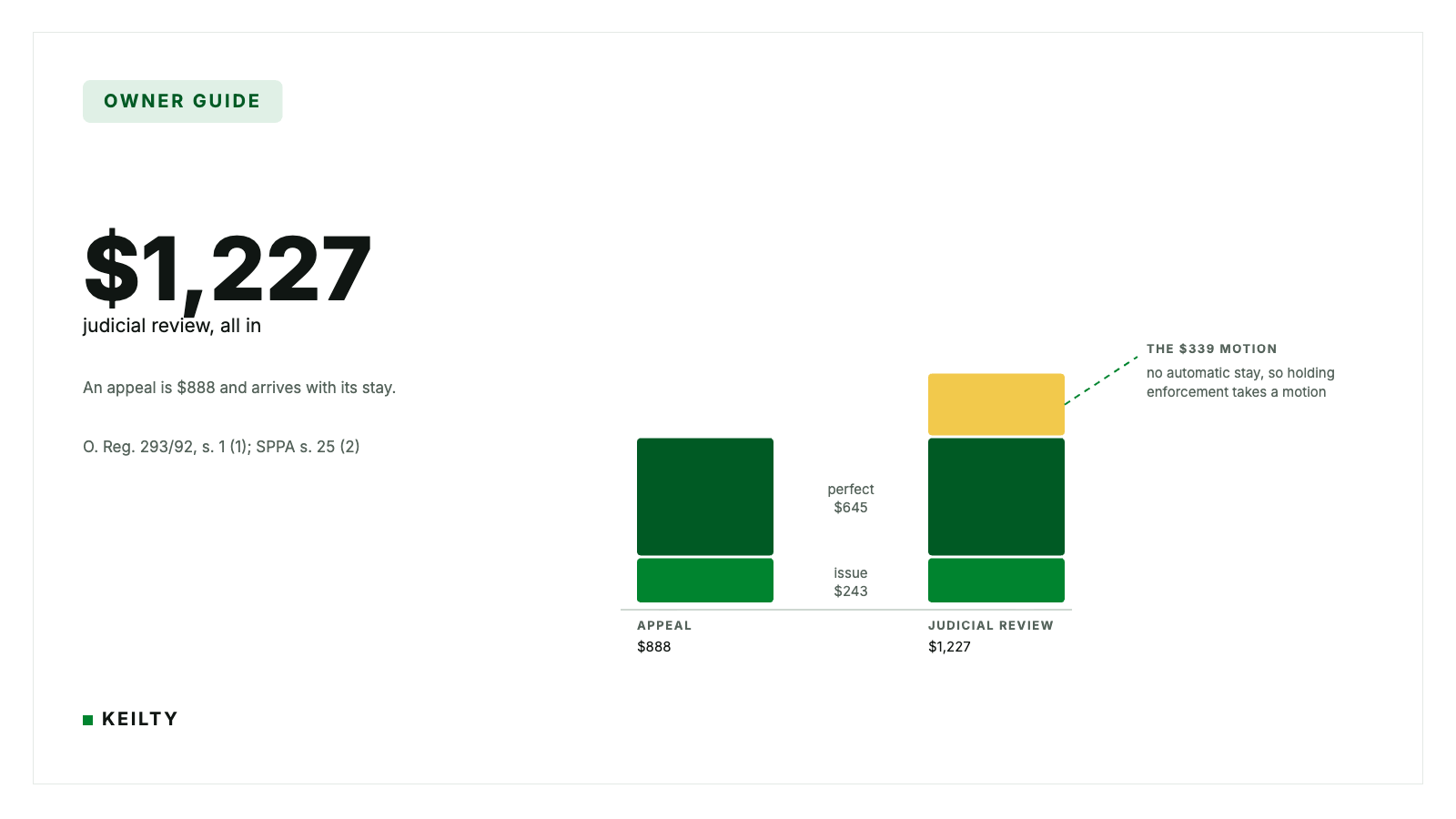
Set those against the alternatives. A request to amend an order at the Board is free. A request to review is $58. An appeal is $243 and $645, and its stay arrives with the filing rather than with a motion, although as the next section explains that is not the same thing as enforcement stopping by itself. A judicial review is the same $243 and the same $645, and then, because there is no automatic stay at all, the interim order motion you would need in order to hold enforcement is a further $339. On the published fees that is $888 for the appeal against $1,227 for the judicial review, and the ground you are arguing on the dearer one is narrower.
Those figures move when the regulation moves, so read the formula rather than memorizing the number. The fee is whatever O. Reg. 293/92 says on the day you file.
By motion, and only by motion. This is the part that catches an owner or a tenant who has read about appeals.
Start with why another statute reaches a Board order at all, because it is one line and it is easy to skip. Section 184 (1) of the Residential Tenancies Act says: "The Statutory Powers Procedure Act applies with respect to all proceedings before the Board." Section 184 has two further subsections, both captioned Exception. Subsection (2) switches off subsection 5.1 (2) of that Act for an application under section 132 or 133, or an application solely under paragraph 1 of subsection 126 (1), and subsection (3) switches off subsection 5.1 (3) for an application under section 126, 132 or 133. Neither reaches anything on this page. That one line is the hook for everything that follows.
Section 25 (1) of the Statutory Powers Procedure Act gives an appeal from a tribunal decision an automatic stay, subject to two exceptions. Section 25 (2) then takes judicial review out of it by name: an application for judicial review under the Judicial Review Procedure Act, or the bringing of proceedings specified in subsection 2 (1) of that Act, "is not an appeal within the meaning of subsection (1)". Nor does the Judicial Review Procedure Act supply a stay of its own. We searched the whole Act for the word stay and it does not appear once.
What you get instead is section 4: "On an application for judicial review, the court may make such interim order as it considers proper pending the final determination of the application." Every word of that is discretionary. There is no test written into it, no presumption in your favour, and no relief until a judge grants some.
Now the part that has to be said about the other route before the contrast means anything, because an automatic stay is not the same thing as enforcement stopping by itself. What binds a sheriff is a document somebody has to go and get, and it lives in Rule 63 of the Rules of Civil Procedure. Rule 63.03 (1) states the general position, that where an order is stayed "no steps may be taken under the order or for its enforcement", except by order of a judge or as provided in subrules (2) and (3). Rule 63.03 (3) is one of those exceptions and both halves of it matter: a stay "does not prevent the issue of a writ of execution or the filing of the writ in a sheriff's office or land registry office, but no instruction or direction to enforce the writ shall be given to a sheriff while the stay remains in effect." So the writ can exist while the stay does. What cannot happen is an instruction to act on it.
Rule 63.03 (5.1) is the provision written for this Board. If an order of the Landlord and Tenant Board is stayed under subsection 25 (1) of the Statutory Powers Procedure Act, the registrar of the court to which the appeal has been taken "shall issue, on requisition by a party to the appeal, a certificate of stay (Form 63B) and, when the certificate has been filed with the sheriff, the sheriff shall not commence or continue enforcement of the order until satisfied that the stay is no longer in effect." Read the conditions in that sentence. The certificate issues on requisition, so somebody has to ask for it. The prohibition on the sheriff attaches once the certificate has been filed with the sheriff. And it lifts when the sheriff is satisfied the stay has ended, which is a second condition rather than an automatic expiry. Rule 63.03 (5.2) requires the requisition to state "that there is no order of the Landlord and Tenant Board that would prevent the automatic stay pending appeal". Note that there are two certificates in the rule rather than one: Rule 63.03 (4) prescribes Form 63A as the general certificate of stay, issued on requisition where an order is stayed, and Rule 63.03 (5.1) prescribes Form 63B as the one written for a stayed Landlord and Tenant Board order.
That is worth setting beside what the Board tells people. Its Application and hearing process page says that on an appeal "the order is automatically Stayed, and cannot be enforced unless the Divisional Court or the LTB lifts (or removes) the stay at the request of a party". The stay is automatic and that much is right. What the sentence leaves out is the machinery for making a sheriff stand down, which runs through a requisition and a Form 63B certificate, and the practical course on an appeal is to requisition the certificate and file it rather than to rely on the stay being evident to everybody who might act on the order.
There is also a second and more specific automatic stay on the appeal side. Rule 63.01 (3) provides that the delivery of a notice of appeal from an interlocutory or final order made under the Residential Tenancies Act, 2006 stays, until the disposition of the appeal, any provision of the order "(a) declaring a tenancy agreement terminated or evicting a person; or (b) terminating a member's occupancy of a member unit in a non-profit housing co-operative and evicting the member." Note the trigger, which is delivery of a notice of appeal, and note the words "tenancy agreement" rather than tenancy. Note also what it leaves out: a money provision in the same order, for arrears say, is within neither clause. Rule 63.01 (5) lets a judge of the court to which the appeal is taken order, "on such terms as are just", that the stay "does not apply".
Here is why all of that belongs on a judicial review page rather than only on the appeal one. The word application does not appear anywhere in Rule 63. Every automatic stay in Rule 63.01 is keyed to "the delivery of a notice of appeal", and Rule 63.03 (5.1) requires "the court to which an appeal has been taken". A notice of application for judicial review triggers none of it. There is no Form 63B on this route, because there is no stay for a certificate to certify. Section 4 is the whole of what is on offer, and you have to go and ask for it.
The operational consequence is worth stating without hedging. On the day a judicial review application is issued, an eviction order remains enforceable. If holding enforcement is the point of the exercise, the motion is not a follow-up step, it is part of the filing, and it needs its own evidence about what cannot be undone if the order is executed first.
Refuse everything, without needing a reason grounded in the merits.
Section 2 (5), added in 2020, is one sentence with no condition attached: "The court may refuse to grant any relief on an application for judicial review." Section 3 adds a specific version of the same idea. Where the sole ground established is "a defect in form or a technical irregularity", and the court finds that no substantial wrong or miscarriage of justice has occurred, it may refuse relief and, where the decision has already been made, may make an order validating it despite the defect.
Section 2 (4) points the other way and is worth having: where an applicant is entitled to a declaration that a decision under a statutory power of decision is unauthorized or otherwise invalid, the court may set the decision aside instead of granting the declaration.
Put those together with section 2 (3) and the picture is consistent. Judicial review is discretionary at nearly every stage, and a technically good point about the paperwork is the weakest thing you can bring to it. That is the same lesson section 212 of the Residential Tenancies Act teaches on the Board side, and it holds in both forums.
There is one more step, it needs leave, and it is not the provision in the Judicial Review Procedure Act that looks as though it should be.
Section 6 (4) of the Judicial Review Procedure Act allows an appeal to the Court of Appeal with leave, and we set out above how narrow it is: it reaches a final order of the Superior Court of Justice disposing of an application brought with leave under section 6 (2), which is the urgent single-judge route. It is not the way out of a decision of the Divisional Court.
The way out of a decision of the Divisional Court is in the Courts of Justice Act. Section 6 (1) (a) provides that an appeal lies to the Court of Appeal from "an order of the Divisional Court, on a question that is not a question of fact alone, with leave of the Court of Appeal as provided in the rules of court". Three limits in one clause. It has to be an order of the Divisional Court, which is where a judicial review of a Board order is heard. The question cannot be one of fact alone, which on a route whose only fact provision is a no-evidence rule is a smaller constraint than it first sounds. And leave is required, which is the real gate.
The leave rule is Rule 61.03.1 of the Rules of Civil Procedure, and its deadline is shorter than anything else on this page. Rule 61.03.1 (3) requires the notice of motion for leave to appeal to be served "within 15 days after the making of the order or decision from which leave to appeal is sought, unless a statute provides otherwise", and filed with proof of service in the Registrar's office "within five days after service". Fifteen days, running from the making of the order rather than from your receiving it or from reasons arriving. The motion record and factum follow within 30 days after filing the notice of motion, under Rule 61.03.1 (6).
One structural point about how that motion gets decided, because it changes what the work is. Rule 61.03.1 (1) provides that where an appeal to the Court of Appeal requires leave, "the motion for leave shall be heard in writing, without the attendance of parties or lawyers". Rule 61.03.1 (15) lets the court order an oral hearing where, on considering the written materials, it determines that one is warranted, but that is the court's decision rather than something a party can insist on. So leave is decided on the paper you file, which puts the weight on the factum.
Rule 61.03.1 (16) adds the step behind it: "Where leave is granted, the notice of appeal shall be delivered within seven days after the granting of leave." Winning leave starts another clock, and it is a short one.
No, and the reason is that none of it is in the Residential Tenancies Act.
Judicial review reaches "any decision made in the exercise of any statutory power of decision", in the words of section 2 (2), and the exemption machinery in the Residential Tenancies Act works by disapplying named sections of that Act. Three checks bear it out. Section 7 (1) disapplies a long list of provisions from social housing, and nothing on this page is on it, because nothing on this page is in that Act. Part X, the mobile home park and land lease community rules we set out in what rules apply to a mobile home park or land lease community in Ontario, runs from section 152 to section 167 and touches none of it. And on a non-profit housing co-operative under Part V.1, section 94.16 maps provisions across with necessary modifications because they are drafted around tenants and landlords; the Judicial Review Procedure Act is drafted around statutory powers, so there is nothing to map.
One qualifier, and it runs the other way. The Rules of Civil Procedure do draw a distinction the Judicial Review Procedure Act does not: Rule 63.01 (3) (b) gives a co-operative member unit its own automatic stay clause on an appeal, separate from clause (a) for a tenancy agreement. That changes nothing on this route, because neither clause is triggered by a notice of application, but it is worth knowing that the stay provision names the two situations separately.
One neighbouring decision is worth naming. An inspector's work order is not a decision of the Board, and the route against it is the section 226 review, which produces a Board order that is then reviewable and appealable like any other. We go through that in what to do if you get a work order on an Ontario rental property. A municipal property standards order behind it is a different instrument again.
Decide which of four routes you are on, and do it before the shortest one closes.
One thing to hear plainly, because it applies to every route here. An order is not money, and a set-aside is not money either. Section 2 (3) at its best sets the decision aside; it does not decide the case in your favour, and what follows is the matter being decided again. That is worth weighing against the amount actually in dispute before anybody issues anything.
The diary is yours. This one is not.
Working four dates off the face of an order and getting advice inside the shortest of them is administration, and an owner with one or two units can do it. This page is the substance of that step.
What follows is a court proceeding on a discretionary remedy, with a limitation period that guidance written before mid-2020 gets wrong, a form prescribed only for one of two possible destinations, two opposite timetables depending on which of those you are in, a service obligation to the Attorney General, a record keyed to somebody else's filing, a factum in seven prescribed parts, two dismissal timers and a costs exposure that is not bounded the way the Board's is. The Board's Practice Direction on Representation governs who may appear at the Board and does not reach the court at all. Frankly, the advice is that this is a matter for a lawyer, and that the decision worth taking care over is the one before it, which is whether this is the right route.
Where KEILTY earns its keep on a file like this is well upstream of it. A no-evidence argument only exists because there was no evidence, and the way an owner avoids ever needing one is a file built while the events were happening: dated ledgers, notices served with proof of service, and a maintenance record that exists before anybody asks for it. That is cheaper than any of the four routes, and it is the ordinary work. If you own a building and it is being run off the side of a desk, our small multi-family page sets out how we run it.
Holding an order and not sure whether you are looking at an amendment, a review, an appeal or a judicial review? Get in touch and we will work through the dates with you.
This post is general information about Ontario residential tenancy law as of 2026-09-12, not legal advice. Legislation, regulations and tribunal practice change. For advice on a specific property or situation, speak with a lawyer or licensed paralegal.
Ontario property management with published pricing, same-day answers, and no surprises. Since 2003.
300-80 Queen StreetNot served yet. Join a list and hear from us the day we open.