
By A.J. Keilty, President, KEILTY Realty Management
The ordinary ones, plus fourteen more that apply nowhere else. A rented site in a mobile home park or a land lease community is a rental unit under the Residential Tenancies Act, 2006 even though the tenant owns the home standing on it, and Part X of the Act adds a separate layer of rules on top of the ordinary ones. Those extra rules are where park operators lose money, because two of them cap what you can charge, a third caps what you have to pay to close the park, and one of them can suspend rent altogether.
The short version.
Part X runs from section 152 to section 167. Sections 152 through 166 have never been amended since the Act was passed in 2006, and the two provisions that would modernize the rent rules have been awaiting proclamation since 2020. Here is what applies, what it caps, and where the money is.
To the permanently occupied sites, yes. To seasonal and vacation sites, no, and a single park can contain both.
Start with section 2 (4), which is one sentence and closes the obvious argument: "A rented site for a mobile home or a land lease home is a rental unit for the purposes of this Act even if the mobile home or the land lease home on the site is owned by the tenant of the site." Owning the dirt and not the dwelling does not put you outside the Act.
The exemption that does bite is in section 5 (a), and the qualifier at the front of the clause is doing all the work. It disapplies the Act from living accommodation "intended to be provided to the travelling or vacationing public or occupied for a seasonal or temporary period" in a list of places that includes a campground and a trailer park. Read the opening words rather than the list. A mobile home is defined in section 2 (1) as a dwelling "that is designed to be made mobile and that is being used as a permanent residence", so a permanently occupied home is not reached by section 5 (a) whatever the sign at the gate says.
The Board's brochure Mobile Home Parks and Land Lease Communities, released 2007-06-22 and modified 2022-04-29, says the same thing and adds the mixed-park case in terms: "A mobile home park may have a mix of dwellings built without wheels or trailers built with wheels on sites that are covered by the RTA. The RTA may apply whether the site is used permanently or seasonally. However, the RTA does not apply to a site that is:" and then two conditions, "intended for use by a person who is travelling or on vacation, or" "in a resort, tourist camp, campground, or trailer park that is occupied for only a seasonal or temporary period." And then the practical point: "A mobile home park or land lease community may have a mix of sites, some covered by the RTA and other sites that are not covered."
If you cannot tell which you have, there is an application for exactly that question. The brochure points at it: "To apply to the LTB for this reason, you must use form A1 - Application About Whether the Act Applies." On the Board's forms, filing and fees page it is printed as "A1 – Application about Whether the Act Applies", and it costs $53 in both the landlord and the tenant fee tables, with no Tribunals Ontario Portal wording on either row. Those figures were read on 2026-09-03.
One narrow exemption sits nowhere near Part X. Section 5.2 takes a land lease site outside the Act entirely where the site is owned by an employer and provided to an employee, or to an employee and their spouse, under a tenancy first entered into on or after the day the Protecting Tenants and Strengthening Community Housing Act, 2020 received Royal Assent. Section 5.2 (3) keeps the exemption alive even if the employee stops working for you, or dies, the second of those provided the employee's spouse is a tenant of the rental unit. There is no mobile home equivalent. It is a land lease provision only.
It is the other thing, and Part X reaches it by a deeming provision rather than directly.
The two definitions in section 2 (1) exclude each other on their face. A "mobile home" is "a dwelling that is designed to be made mobile and that is being used as a permanent residence". A "land lease home" is "a dwelling, other than a mobile home, that is a permanent structure where the owner of the dwelling leases the land used or intended for use as the site for the dwelling". So a land lease home is defined by three things: it is not a mobile home, it is a permanent structure, and the leasing relationship is built into the definition itself.
Section 152 (1) applies Part X "with respect to tenancies in mobile home parks". Section 152 (2) then reaches land lease communities the long way round: "This Part applies with necessary modifications with respect to tenancies in land lease communities, as if the tenancies were in mobile home parks." Note what is being deemed. It is the tenancies, not the communities, and a deeming provision presupposes that the two are different rather than merging them. Section 153 reinforces the asymmetry by defining a reference to "a tenant's mobile home" as a reference to a home owned by the tenant and sitting in the landlord's mobile home park.
That matters more than it sounds, because several Part X sections say "mobile home" and mean it literally. Where they do, a land lease operator is relying on section 152 (2) to carry the provision across, and how far the necessary modifications reach is not something the Act answers on its face.
The conflict rule is section 3 (3), and it is the provision to remember when Part X and the rest of the Act give different answers: "In interpreting a provision of this Act with regard to a mobile home park or a land lease community, if a provision in Part X conflicts with a provision in another Part of this Act, the provision in Part X applies." Part X wins. That is how, for example, the abandonment machinery in section 162 displaces the general property rules, because neither section says "despite" the other.
One drafting gap worth flagging before you rely on anything below. The word "site" is used throughout the Act, in the definitions of rental unit and residential complex, in section 2 (4), in section 5.2 and across Part X, and it is nowhere defined. We searched the consolidation for a definition on 2026-09-03 and there is not one.
Six things, and they are additional rather than substitutional. Section 161 opens "In addition to a landlord's obligations under section 20, a landlord is responsible for," and then lists:
Clause (f) is the one with no equivalent elsewhere in the Act, because it makes a landlord responsible for repairing the tenant's own property, and in a park the tenant's property is a house.
O. Reg. 517/06, the maintenance standards, adds Part V on top. Its consolidation period opens 2007-01-31 and its header prints "No amendments." Section 30 (1) applies sections 31 to 36 to parks and communities, and section 30 (2) confirms that "The other sections of this Regulation also apply to mobile home parks and land lease communities." Additional, again, not instead of. The park-specific standards are:
Part V imposes no numeric frequency anywhere. We searched it for "day", "days", "week", "month", "year" and "annual" on 2026-09-03 and every one of those returned nothing. The only quantity in the whole Part is the three metres in section 34. Where it needs a temporal standard it says "regularly" or "whenever necessary", which means the schedule is yours to set and yours to defend.
The enforcement route is a tenant application. Paragraph 1 of section 29 (1) lets a tenant apply for an order determining that the landlord has breached an obligation "under subsection 20 (1) or section 161", and section 30 (1) then names section 161 four more times, including inside paragraphs 6, 7 and 8. Those three prohibit charging a new tenant under a new tenancy agreement more than the last lawful rent, giving a notice of rent increase at all, and taking an increase for which notice has already been given, each until certain work is done.
Read the gate on those three before treating them as automatic, because it is narrower than the summary above. Each of paragraphs 6, 7 and 8 is expressed as something the Board "may" do rather than something that follows from a breach, and each is then conditional on two cumulative limbs, joined by "and", which are not the same thing as each other. Subparagraph (i) requires that you have not completed "the items in work orders for which the compliance period has expired and which were found by the Board to be related to a serious breach of a health, safety, housing or maintenance standard". Subparagraph (ii) requires that you have not completed "the specified repairs or replacements or other work ordered under paragraph 4 found by the Board to be related to a serious breach of the landlord's obligations under subsection 20 (1) or section 161". So limb (i) is about outside work orders whose time has run out, limb (ii) is about work the Board itself ordered, and each needs its own finding of a serious breach measured against its own standard. An unremedied park maintenance breach can stop your rent increases on that site, and it does not do so on its own: it takes an order, a finding that the breach was serious, and work still outstanding.
Here is the part worth knowing before you go looking for guidance on any of it. Interpretation Guideline 5, Breach of Maintenance Obligations, which carries no dated or updated line and only a bare footer stamp of 2018-12-15, excludes section 161 from its own scope in a footnote: "This guideline does not discuss the additional responsibilities under section 161 for mobile home parks or land lease communities. For a mobile home park or land lease community, the landlord has additional specific responsibilities under section 161, such as garbage removal, park roads maintenance and sewage disposal, etc. Although these obligations may also be enforced under subs. 29(1), they are not specifically addressed in this Guideline." The Board's own maintenance guideline says in terms that it is not about you.
At the municipal boundary, and in a full by-law municipality they may not start at all.
Section 2 (1) of O. Reg. 517/06 says the regulation prescribes the maintenance standards for the purposes of subsection 224 (1) of the Act. Section 224 (1) then applies those standards to a complex in a local municipality in two cases only: "(a) there is no municipal property standards by-law that applies to the residential complex; or (b) there is a municipal property standards by-law that applies to the residential complex and the prescribed circumstances apply."
Limb (b) has nothing in it. The power to fill it is paragraph 73 of section 241 (1), "prescribing circumstances for the purposes of clause 224 (1) (b)", and it has not been used. The word circumstance does not appear anywhere in O. Reg. 517/06, which is the regulation prescribed for section 224 (1), and O. Reg. 516/06 does not mention section 224 at all. We searched both again on 2026-09-07. So where a full municipal property standards by-law applies to your park, neither limb of section 224 (1) is satisfied on the face of the Act, and the provincial standards, including the whole of Part V, are not the instrument that governs it. That is a firmer answer than the hedge this page carried until today, and it is the same answer we give on the work order page, because it is the same provision.
Say plainly where that reading strains. Section 4 of the regulation, which follows, assumes the regulation still reaches a municipality that has an exterior-only by-law. If any by-law touching the complex defeats limb (a) outright, section 4 has nothing left to operate on. The reading that keeps section 4 alive is that an exterior-only by-law is not a by-law that "applies to the residential complex" for the purposes of limb (a). That is our reading of the two instruments together rather than something either of them says, and section 4 has never been amended since 2007, which is eleven years before the current section 224 (1) came into force in 2018.
Section 4 itself cuts across Part V hard. Where a municipality has a property standards by-law "applicable only to the exterior" of residential complexes or rental units, the regulation's exterior standards do not apply there, "but the maintenance standards in this Regulation that relate to the interior of residential complexes or rental units do apply to them". Roads, hydrants, mailboxes, sewage connections and home spacing are all outside the walls. In an exterior-only by-law municipality, the practical answer is that your park standards come from the by-law rather than from Part V.
If your park is outside any municipality, there is a third answer and it is narrower than it looks. Section 224 (2) applies the prescribed standards to a complex in unorganized territory "but only for the purposes of a landlord's obligations under subsection 20 (1) with respect to maintenance standards". Keep those closing words. In unorganized territory the standards become a measure of your civil obligation to the tenant, and nothing more: the complaint, inspection and work order machinery in sections 224.1, 225 and 226 is keyed throughout to a local municipality, so there is no inspector to complain to and no work order to receive. The consequence arrives at the Board on a tenant application instead. Parks are disproportionately affected by this, because a good many of them sit outside a municipal boundary.
Read all of that alongside section 161, which is unaffected by any of it. Section 161 is a provision of the Act, not a maintenance standard under a regulation, and no municipal by-law switches it off and no municipal boundary limits it. Your civil obligation to the tenant on park roads and snow survives whatever the local standards regime says, and it is enforced at the Board on a tenant application rather than by an inspector.
The rent stops, and it stops by operation of the Act rather than by anyone's decision.
Section 154 (1) is conditional on its face: "If a landlord establishes rules for a mobile home park, (a) the landlord shall provide a written copy of the rules to each tenant; and (b) the landlord shall inform each tenant in writing of any change to the rules." Nothing obliges you to have rules. Once you do, both duties attach, and the second one attaches to every change you ever make.
Section 154 (2) is the consequence: "Until a landlord has complied with clause (1) (a) or (b), as the case may be, (a) the tenant's obligation to pay rent is suspended; and (b) the landlord shall not require the tenant to pay rent."
Both halves matter. The tenant's obligation is suspended, so an arrears application on that period is standing on nothing, and you are separately barred from requiring the rent. The switch is thrown by the failure itself, not by a tenant raising it, and there is no materiality threshold in the subsection. A rule change communicated verbally at a residents' meeting is a change not communicated in writing.
The relief is in section 154 (3): once you comply, "the landlord may require the tenant to pay any rent withheld by the tenant under subsection (2)." So the money is deferred rather than lost, provided you fix it. The Board's brochure puts the same point from the tenant's side and closes the loop: "once the landlord gives the information to the tenant, the tenant must pay back any rent that they withheld. If they don't, the landlord can give the tenant a notice to end the tenancy for non-payment of rent."
Which produces a simple operational rule. Keep a dated distribution record for the rules and for every amendment, per site, signed or acknowledged where you can get it. That record is the whole defence, and it costs nothing to build as you go.
Yes, and the same shape of switch sits behind it.
The Act treats this as separate from rent. The definition of "rent" in section 2 (1) expressly excludes "an amount paid by a tenant to a landlord to reimburse the landlord for property taxes paid by the landlord with respect to a mobile home or a land lease home owned by a tenant". Section 17 of O. Reg. 516/06 then exempts that same payment from the prohibition on additional charges, at paragraph 9. Separately, paragraph 12 of section 16 (1) of the regulation prescribes "Property taxes with respect to a site for a mobile home or a land lease home" as a thing for the purposes of subsection 123 (1) and section 125 of the Act.
The condition is section 155, and it has two independent limbs. Under section 155 (2) the tenant's obligation to reimburse is suspended, and you are barred from requiring payment, if either "(a) the landlord has failed to comply with subsection (1) with respect to the most recent information obtained by the landlord from the Municipal Property Assessment Corporation; or (b) the landlord has not, in the previous 12 months, obtained written information from the Municipal Property Assessment Corporation with respect to the value of the mobile home for assessment purposes."
Limb (a) is about passing on what you have. Section 155 (1) requires that where you obtain MPAC information about the value of a tenant-owned home, you "shall promptly provide the tenant with a copy of that information". Limb (b) is about going and getting it, on a twelve month cycle.
Section 155 (3) is an exception to limb (b) only, and it is narrower than it first reads. It rescues you where you "made reasonable efforts in the previous 12 months to obtain written information" and were unable to get it. Efforts have to exist and have to be evidenced. It does not rescue a failure under limb (a).
Section 155 (4) restores the money once you cure, on the same deferred rather than forfeited pattern as the park rules. And the tenant's remedy if you overcharge is a T1, which the brochure names: "If a tenant believes that their landlord has overcharged them for taxes on their home, they can file a Tenant Application for a Rebate (form T1) with the LTB." The T1 sits in the fee row reading "$53 or $48 through the Tribunals Ontario Portal".
So this is a diarized annual task, not a background one. Request the assessment information from MPAC every year, keep the request as well as the answer, and send the tenant a copy the day it arrives.
No. Section 156 (1) is one line: "A tenant has the right to sell or lease his or her mobile home without the landlord's consent."
Read what that covers and what it does not. It is the home. The site is a separate question and it runs through the assignment provisions two headings below. A tenant can sell the structure to anybody at any price, and your consent has nothing to do with it.
Interfering with that right is one of the few things in Part X that is a prosecutable offence. Clause (q) of section 234 makes it an offence to interfere "with a tenant's right under section 156 to sell or lease his or her mobile home". Under section 238 (1) an individual is liable on conviction to a fine of not more than $100,000, and under section 238 (2) a corporation to not more than $500,000, both in force on 2026-07-01 via 2023, c. 10, Sched. 7, s. 9 (1, 2). The previous figures were $50,000 and $250,000.
You acquire a second tenancy on your site with an occupant you never screened, and section 156 (1) is why you cannot stop it.
The word doing the work is "lease". Section 156 (1) gives the tenant the right to "sell or lease" the home without your consent, and the whole of the assignment machinery below is about the site rather than the home. So a site tenant who rents their own home out is exercising a statutory right, and the person who moves in is not your tenant and has no tenancy agreement with you.
The Board's brochure states the consequence directly. Describing the ways a park can be structured, it says that "the person who owns the home and rents the site from the landlord may rent out the home, in which case they become a landlord to the tenant who occupies the home." Your site tenant becomes a landlord inside your park, and the occupant's tenancy is with them.
Three things follow that are worth planning for rather than discovering. Your rent, your park rules and your section 161 obligations still run to the site tenant, who is the person you have an agreement with. The occupant is not somebody you screened, cannot be made to take an assignment, and is not somebody you can serve a notice on as though they were your tenant. And section 160 (1) limits what you can require the site tenant to buy, so you cannot solve this by tying the arrangement to services you supply. The park rules under section 154 are the lever that does exist, provided they are reasonable and provided you have distributed them in writing.
Not the first. Sometimes the second, and only if it is already in the agreement.
On agency, section 156 (2) permits you to act as the tenant's agent "only in accordance with a written agency contract entered into for the purpose of beginning those negotiations", and section 156 (3) voids a tenancy agreement provision "requiring a tenant who owns a mobile home to use the landlord as an agent for the sale of the mobile home". A voluntary written agency contract is fine. A lease clause compelling it is void, and coercing one is a knowledge offence in its own right under clause (l) of section 233, which reaches a person who knowingly "coerces a tenant of a mobile home park or land lease community to enter into an agency agreement for the sale or lease of their mobile home or land lease home or requires an agency agreement as a condition of entering into a tenancy agreement".
On the right of first refusal, note the opening words of section 157 (1): "This section applies if a tenancy agreement with respect to a mobile home contains a provision prohibiting the tenant from selling the mobile home without first offering to sell it to the landlord." The right is not conferred by the Act. It exists only where you put it in the agreement. Where it does exist, section 157 (2) gives you a right of first refusal "at the price and subject to the terms and conditions in the offer", and section 157 (3) requires the tenant to give "at least 72 hours notice of a person's offer to purchase a mobile home before accepting the person's offer".
Section 157 (4) then removes the discount. Where the clause would let you buy at less than the price in the prospective purchaser's offer, you may still exercise the option, "but the provision is void with respect to the landlord's right to purchase the mobile home at the lesser price". You get the right to match. You do not get a discount for holding it.
On signage, section 158 (1) bars you from preventing a for sale sign in the window of the home unless you meet section 158 (2), and that subsection requires that "all of the following conditions are met": the prohibition applies to all tenants in the park, you provide a bulletin board for for sale advertisements, the board is free to all tenants, and it "is placed in a prominent place and is accessible to the public at all reasonable times". Four conditions, all of them, including the public access one. A board inside a locked residents' clubhouse does not satisfy the fourth.
Only what the Board agrees is reasonable, and you have 15 days to ask.
This is where a park departs from an apartment building. Ordinarily, section 95 (3) (c) lets a landlord refuse consent to the assignment outright, without reference to who the assignee is. Section 159 (1) (a) switches that clause off. Section 159 (1) (b) then provides that the landlord "may not refuse consent to the assignment unless, on application under subsection (2), the Board determines that the landlord's grounds for refusing consent are reasonable."
Read the shape of that. Refusal is not something you do and then defend. It is something you have to go and get.
Section 159 (2) sets the window: the landlord may apply to the Board "within 15 days after the tenant asks the landlord to consent to the assignment". Section 159 (3) requires the grounds to be set out in the application. Section 159 (4) is the consequence of doing nothing: if you do not apply in accordance with subsections (2) and (3), or the Board finds your grounds unreasonable, "the landlord shall be deemed to have consented to the assignment."
The form is the A2, printed as "A2 – Application about a Sublet or an Assignment". Watch the fee, because it differs by who files. In the landlord fee table the A2 is $201. In the tenant fee table it is $53. Neither row carries portal wording. The brochure states the route plainly: "A landlord who wants to refuse an assignment to a purchaser must file an Application about a Sublet or Assignment (form A2) to the LTB within 15 days of the tenant's request."
Work an example on a Brighton park. A tenant asks for consent on Monday 2026-10-05.
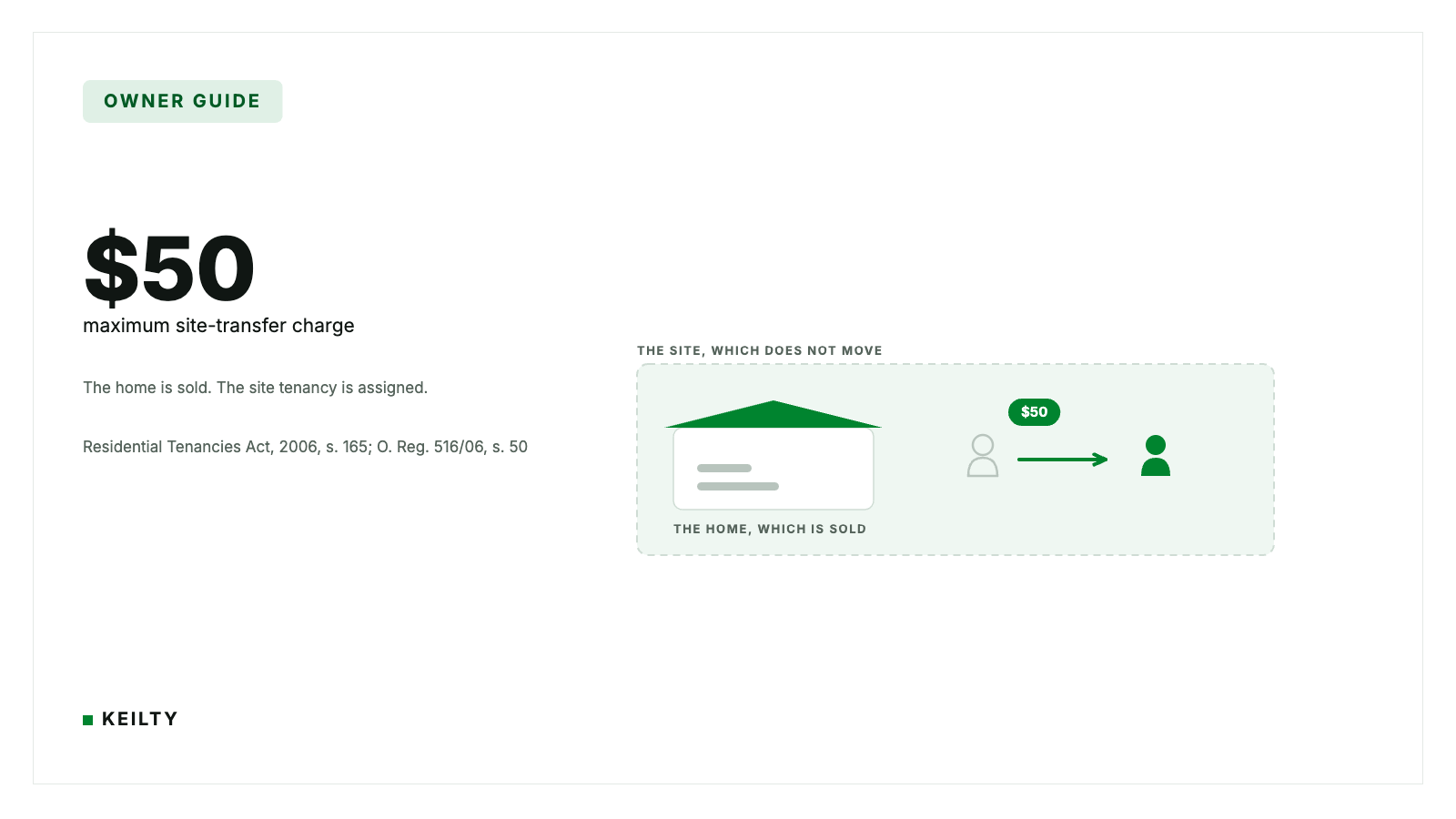
Fifty dollars a month, in the ordinary case. This is where a park's economics diverge from every other kind of rental you own.
Section 165 reads: "Despite subsection 95 (8), if a tenancy agreement for a site for a mobile home is assigned and the assignee purchases or enters into an agreement to purchase the former tenant's mobile home, the landlord may increase the rent payable by the assignee under the tenancy agreement by not more than the prescribed amount."
Section 50 of O. Reg. 516/06 supplies the amount: "For the purpose of section 165 of the Act, the prescribed amount is the greater of, (a) $50 per month; and (b) the amount, including the guideline, that the landlord would have been entitled to take as a rent increase under an order under subsection 126 (10) of the Act before the first anniversary of the commencement of the new tenancy had the former tenant remained the tenant."
Limb (b) only produces a figure if you have an above-guideline increase order running under section 126 (10). Without one it produces nothing, so the greater of the two is $50 a month.
Work it on a Quinte West park. The site rents for $700 a month.
Why the ordinary vacancy route is not available here is worth spelling out, because it is the reasoning an owner has to follow before buying a park. Section 113 sets the lawful rent for "a new tenant under a new tenancy agreement". An assignment is not that. The existing tenancy agreement continues with a new party to it, which is why section 165 has to open "Despite subsection 95 (8)" in order to permit any increase at all. A sale of a home in your park is not a vacancy event, and a rent roll modelled on turnover uplift will not behave the way an apartment rent roll does.
The brochure states the same cap in round terms and hedges it the way we would: "If a tenant who rents a site in a mobile home park or land lease community sells their home and assigns their tenancy for the site to the person who purchased the home, the landlord cannot, in most cases, increase the rent by more than $50.00 above the rent the tenant paid."
On 90 days written notice, on a form approved by the Board, exactly as you would take any other increase. This is the step the $50 discussion above does not contain, and leaving it out is how an owner turns a small increase into no increase.
Section 165 is a ceiling on the amount. It is not a power to take the amount, and it says nothing about notice. The power and its conditions are in section 116 (1): "A landlord shall not increase the rent charged to a tenant for a rental unit without first giving the tenant at least 90 days written notice of the landlord's intention to do so." Section 116 (3) requires the notice to be in a form approved by the Board and to set out the intention to increase and the amount of the new rent. Section 116 (4) is the consequence of getting it wrong: "An increase in rent is void if the landlord has not given the notice required by this section, and the landlord must give a new notice before the landlord can take the increase."
Three reasons that applies to an assignee. Section 95 (8) provides that on an assignment the tenancy agreement "continues to apply on the same terms and conditions", so the assignee is a tenant of yours for the purposes of section 116 (1). Section 116 appears on none of the exemption lists that strip other Part X provisions: it is not in the section 7 (1) social housing list, which runs "111 to 115" and stops short of it, and it is not in the section 6.1 (2) list that takes a post-2018 park outside rent control. And paragraph 12 of section 56 of O. Reg. 516/06 puts "The 90-day notice period required by sections 116 and 150 of the Act" on the list of time requirements the Board may not extend or shorten, so there is no route to a shorter notice even by application.
One narrow exception exists and it will not help on an assignment. Section 6 (5) of O. Reg. 516/06 disapplies sections 116 and 118 from increases due to increases in a tenant's income, where the unit is exempt under section 6 (1) or (3) and the tenant pays rent geared to income because of public funding. That is a rent-geared-to-income adjustment in subsidised housing, not a turnover increase.
So the sequence on a sale is: the tenant asks for consent, you consent or apply under section 159 inside 15 days, the assignment happens, and then you serve a section 116 notice at least 90 days before the increase is to take effect, for no more than $50 a month. Take the $50 without the notice and section 116 (4) voids it, you have to start again with a fresh notice, and the money you collected in the meantime was rent charged above the lawful rent. The rest of the increase machinery, including how the guideline works and what a notice has to contain, is in how much notice a landlord has to give to raise the rent.
One further question the assignment raises, and we are setting out both readings rather than picking one. Section 119 (1) allows an increase "only if at least 12 months have elapsed, (a) since the day of the last rent increase for that tenant in that rental unit, if there has been a previous increase; or (b) since the day the rental unit was first rented to that tenant, if clause (a) does not apply." It is keyed to "that tenant", not to the tenancy. On one reading an assignee is a different tenant, clause (a) has no previous increase to point at, and clause (b) starts a fresh twelve months from the assignment. On the other, section 95 (8) continues the same agreement, the increase history travels with it, and there is nothing for a fresh period to attach to. The drafting cuts against the first reading, because section 120 (1) one section later reaches "a tenant, or to an assignee under section 95" expressly, and section 119 (1) does not, which suggests the drafters knew how to name an assignee when they meant to. We prefer the second reading and we are telling you it is a preference. The same question, on the same words, arises when a spouse is brought into the definition of tenant, and we set it out there too in does a tenant's spouse become the tenant in Ontario.
Your out-of-pocket costs on five listed matters, and nothing you sell yourself.
Section 166 caps rather than bans: "A landlord shall not charge for any of the following matters, except to the extent of the landlord's reasonable out-of-pocket expenses incurred with regard to those matters:" and then a closed list of five. The entry of a mobile home into the park, the exit of one from it, the installation of one in it, the removal of one from it, and the testing of water or sewage in the park. Read it as a closed list, because it is one, and note that a sale in which the home stays where it is triggers none of the five.
Here is the trap, and it is a real one. Interpretation Guideline 11, Rent Arrears, effective 2021-09-01 and updated 2026-07-01, says of charges of this kind, including "the cost of installing a mobile home under section 166 of the RTA", that "Although the RTA allows a landlord to levy these charges, the RTA does not provide for their recovery in an application to the LTB." Lawful to charge, and on the Board's own reading of the Act not recoverable at the Board.
The Guideline then goes one sentence further, and it is the sentence that costs money: "A landlord should therefore not include such charges in a N4 notice or an application for non-payment of rent." That is the Board saying what to do rather than what the law is, and it is a "should" rather than a "must", but the risk it is pointing at is real. A section 166 charge is not rent. An N4 that adds one is an N4 stating an amount of rent that is not owing, and an owner who does it can lose the notice and the application as well as the charge, on a file where the arrears themselves were sound. Keep the charge off the notice, and collect it before you incur the cost or take security for it, because an unpaid section 166 charge is not an arrears application.
One charge runs in your favour, and it is not in Part X at all. Paragraph 7 of section 17 of O. Reg. 516/06 exempts from the prohibition on additional charges a "Payment to a landlord or tenant of a mobile home park or land lease community at the commencement of a tenancy as consideration for the rental of a particular site." A premium for a particular site, taken at the start of the tenancy, is expressly carved out. It is not rent, so it does not enter the rent history and it is not subject to the increase rules.
On tied purchasing, section 160 (1) provides that a landlord "shall not restrict the right of a tenant to purchase goods or services from the person of his or her choice, except as provided in subsection (2)", and section 160 (2) is the whole of the exception: "A landlord may set reasonable standards for mobile home equipment." Standards for equipment, not a supplier list, and not services. Breaching section 160 is the second Part X offence, under clause (r) of section 234.
A year, and it is a year whatever the ordinary notice period would have been.
Section 164 (1) applies where a notice of termination is given under section 50, the demolition, conversion and extensive repair route, "with respect to a tenancy agreement between the landlord and a tenant who owns a mobile home". Read that qualifier before you rely on anything under this heading. Where the tenant rents the home from you as well as the site, section 164 does not engage, and the ordinary section 50 notice periods and the ordinary section 52, 54 and 55 compensation apply instead.
Where it does engage, the termination date "shall, despite subsection 50 (2), be at least one year after the date the notice is given and shall be the day a period of the tenancy ends or, where the tenancy is for a fixed term, the end of the term." Two conditions, both of which have to be satisfied, so the date is at least a year out and it also has to land on a period end.
Section 164 (2) carries the same home ownership qualifier and is further conditional on the tenant being "entitled to compensation under section 52, 54 or 55", and where they are, the amount "shall, despite those sections, be equal to the lesser of the following amounts: 1. One year's rent. 2. $3,000 or the prescribed amount, whichever is greater."
Nothing has been prescribed for paragraph 2. We searched O. Reg. 516/06 on 2026-09-03 for any reference to section 164 and for the figure itself and found neither. So the paragraph resolves to $3,000, and the compensation is the lesser of one year's rent and $3,000. On a $700 site that is $3,000 against $8,400, so $3,000. Interpretation Guideline 12, Eviction for Personal Use, Demolition, Repairs and Conversion, dated 2021-09-01, states the combined rule under a heading it shares with care homes: the landlord must give "(a) a minimum of one year's notice; and (b) compensation equal to one year's rent, or $3,000, whichever is less."
Now read the condition in section 164 (2) against the carve-out lists further down this page, because on three groups of unit it empties the subsection while leaving the year's notice standing. Section 164 (2) only produces money where the tenant "is entitled to compensation under section 52, 54 or 55". Section 7 (1) of the Act disapplies sections 52, 54 and 55 from social housing. Section 6 (1) and section 6 (3) of O. Reg. 516/06 disapply the same three from the five named affordable housing initiatives and from the Rural and Native Rental Housing Program. On all three of those, section 164 itself is not disapplied and section 50 is not disapplied, so you owe the year's notice under section 164 (1) and the compensation condition can never be satisfied. Budget the year, not the $3,000.
One group works the other way and takes both. Section 6 (1) of the Act disapplies "149 to 167" from accommodation under the Homes for Special Care Act and from a supported group living residence or intensive support residence, and that range contains section 164 itself. There, neither the year's notice nor the compensation applies, because the whole of Part X has gone.
Take the planning consequence seriously. The year runs per tenancy from the date each notice is given rather than from a project start date, so the real timetable is a year plus however long it takes to prepare and serve every notice in the park.
There is one, and it is the only place in the Act where the above-guideline ceiling can be lifted.
Section 167 (1) provides that if the Board "finds that a capital expenditure is for infrastructure work required to be carried out by the Government of Canada or Ontario or a municipality or an agency of any of them, despite subsection 126 (11), the Board may determine the number of years over which the rent increase justified by that capital expenditure may be taken." Section 126 (11) is the ordinary constraint on an above-guideline increase, so section 167 lifts the ceiling on the spread rather than on the amount.
Keep the gate, because it is the whole provision. The work has to be required to be carried out by a level of government or one of its agencies. A capital program you decided on yourself does not qualify however necessary it was.
Section 167 (2) defines "infrastructure work" as work "with respect to roads, water supply, fuel, sewage disposal, drainage, electrical systems and other prescribed services and things provided to the mobile home park", and section 51 of O. Reg. 516/06 extends it: the definition "includes work with respect to fire hydrants and related systems, poles for telephone service, walkways, garbage storage and disposal areas, fencing, retaining walls and flood control systems."
The Board's two documents disagree about who has to require the work, and an owner should know which one they are reading. The brochure says the exception applies where the cost is "for infrastructure work that is required by the Government of Canada, or one of their agencies", which is narrower than the Act. Interpretation Guideline 14, Applications for Rent Increases Above the Guideline, dated 2018-02-07, says it applies where the work is "required to be carried out by any level of government or agency of government", which matches the Act. Our reading is that Guideline 14 has it right and the brochure has dropped the provincial and municipal limbs, because section 167 (1) names Ontario and a municipality expressly. That is our reading of the three documents together, and it is the Act rather than either publication that governs. Note the Guideline's date while you are relying on it: 2018-02-07 makes it the oldest source on this page and older than the 2020 amendments that put section 165.1 and a replacement section 167 (1) on the books, neither of which it can tell you anything about.
Guideline 14 also supplies a second lever that has nothing to do with capital work: "The rent increase in a mediated agreement is limited to an amount equal to the guideline plus 3% of the previous year's lawful rent. This limit does not apply to mobile homes or land lease sites." The provision it points to is section 194 (3). Where an increase is settled by agreement at the Board rather than ordered, the guideline plus 3 per cent cap that constrains everybody else does not constrain a park.
Two provisions that would change this picture are drafted, passed and still not law. Section 165.1, which would take prescribed park services and facilities outside the definition of rent altogether, and a replacement for section 167 (1) that would drop the government-mandate gate and let the Board set the percentage per year expressly untethered from three years and 3 per cent. Both come from 2020, c. 16, Sched. 4, both are footnoted "not in force", and each carries a Note opening "On a day to be named by proclamation of the Lieutenant Governor". No day has been named in six years. Do not plan around either.
Section 162 governs, not the general property rules, and it is slower and noisier than the ordinary route.
Section 162 (1) lists the triggers: the tenant vacated in accordance with a notice of termination of the landlord or the tenant, an agreement to terminate, or a Board order terminating the tenancy or evicting the tenant, or you applied under section 79 and the Board made an order terminating the tenancy.
Section 162 (2) is framed as a prohibition rather than a duty, which is the safer way to read it: "The landlord shall not dispose of a mobile home without first notifying the tenant of the landlord's intention to do so, (a) by registered mail, sent to the tenant's last known mailing address; and (b) by causing a notice to be published in a newspaper having general circulation in the locality in which the mobile home park is located." Both, joined by "and". Newspaper publication is not an alternative to the mail and there is no electronic substitute in the section.
Section 162 (3) is not a bare waiting period either. You may sell, retain or dispose "beginning 60 days after the notices referred to in subsection (2) have been given if the tenant has not made a claim with respect to the landlord's intended disposal." A claim inside the 60 days stops it.
Then two six month windows, and both run from the same date as the 60 days rather than from anything you did. Under section 162 (4), a tenant who claims within six months after the day the notices were given, for a home you have already sold, is owed the amount by which the proceeds exceed your reasonable out-of-pocket expenses and their arrears. Under section 162 (5), where you retained the home for your own use, you return it. Section 162 (6) lets you require payment of arrears and "any reasonable expenses incurred by the landlord with respect to the mobile home" before returning it, which is wider than the equivalent power on an ordinary unit. Section 162 (7) is the liability shield, and it is conditional: "Subject to subsection (4) or (5), a landlord is not liable to any person for selling, retaining or otherwise disposing of a tenant's mobile home in accordance with this section."
Neither six month window can be moved. Section 56 of O. Reg. 516/06 lists twenty-one time requirements the Board may not extend or shorten under subsection 190 (2) of the Act, and paragraph 5 is "The six-month periods referred to in subsections 42 (7), 92 (3) and (4) and 162 (4) and (5) of the Act." The 60 days in section 162 (3) is not on that list.
Now the number that should make you slow down. A mobile home can be worth more than the Board can order anybody to pay. Section 207 (1) lets the Board order payment "up to the greater of $10,000 and the monetary jurisdiction of the Small Claims Court", which is $50,000 under section 1 (1) of O. Reg. 626/00 on a consolidation period running from 2025-10-01. Get a disposal wrong on a home worth more than that and the claim against you is not confined to the Board at all, because section 207 (2) lets a person whose claim exceeds the Board's jurisdiction go to court instead. Photograph, inventory, keep the registered mail receipt and keep the newspaper tearsheet with its date. The general property rules for everything that is not the home itself are in can a landlord throw out a tenant's belongings in Ontario.
The ordinary death machinery switches off completely, and the Act puts nothing in its place.
Section 163 reads in full: "Sections 91 and 92 do not apply if the tenant owns the mobile home."
Follow what that removes. Section 91 (1) is the provision that deems a tenancy terminated 30 days after the death of a tenant where there are no other tenants of the unit. Section 91 (2) is the duty to preserve the deceased tenant's property and give the executor reasonable access. Section 92 is the disposal power that follows, with its six month estate claim window in section 92 (3). None of it is available. So there is no 30 day deemed termination, no landlord power of sale over the home, and no estate claim window. The home is an asset of the estate and the tenancy does not end by operation of section 91.
That is a longer road than the one on an apartment, and the practical answer is to identify the executor or administrator early and deal with the estate rather than with the site. Do not clear a site on a death file in a park on the strength of anything in sections 91 and 92, because section 163 has taken them away from you. The ordinary death process, for a park tenant who rents the home from you as well as the site and is therefore outside section 163, is in what happens when a tenant dies in Ontario.
One drafting point we will flag rather than resolve. Section 163 says "the mobile home". It does not say a land lease home. On a literal reading, sections 91 and 92 survive for a tenant-owned land lease home and are switched off only for a mobile home, and the route to the opposite answer is the necessary modifications in section 152 (2). That is our reading of an ambiguity rather than something the Act settles, and on a land lease death file it is worth advice before acting either way.
Three different carve-outs, and they switch off different things.
Social housing. Section 7 (1) disapplies a long list of provisions from, among others, a complex "owned, operated or administered by or on behalf of the Government of Canada or an agency of the Government of Canada", a designated housing project under the Housing Services Act, 2011, and a non-profit housing project developed or acquired under a government program. Three Part X sections are on that list: 159, 165 and 167. So the assignment machinery, the $50 turnover cap and the infrastructure increase all fall away. Sections 52, 54 and 55 are on it too, which is what empties section 164 (2) as set out above. Section 161 is not on the list, so the park maintenance obligations themselves survive in social housing, and neither is section 116, so the 90 day notice requirement survives as well. Paragraphs 6, 7 and 8 of section 30 (1) are on it, though, so the rent consequences of breaching those maintenance obligations do not.
Care-related. Section 6 (1) disapplies "149 to 167" from accommodation subject to the Homes for Special Care Act and from a supported group living residence or intensive support residence under the Services and Supports to Promote the Social Inclusion of Persons with Developmental Disabilities Act, 2008. That range swallows the whole of Part X, including section 164. Sections 6 (1) and 6 (3) of O. Reg. 516/06 do something narrower for units developed or acquired under five named affordable housing initiatives and under the Rural and Native Rental Housing Program, naming 159, 165 and 167 but not 164.
New parks and expansions. Section 6.1 (2) disapplies sections 120, 121, 122, 126, 127, 129, 131, 132, 133, 165 and 167 where the rental unit is in a park or community no part of which "was occupied for residential purposes on or before November 15, 2018", or is entirely located in an addition to one where no part of the addition was so occupied. Section 6.1 (1) defines "addition" for a park as "an expansion beyond the boundaries of the mobile home park or land lease community". So a park built after that date, or the new phase of an older one, is outside rent control and outside the $50 assignment cap. Section 116 is not on that list either, so even there the 90 days and the approved form still apply to every increase.
Two qualifiers on that last one, because it is the widest of the three and the onus is yours. Section 6.1 (4) removes the exemption for a unit subject to a tenancy agreement entered into on or before 2018-11-15, but it opens "Subject to subsection (5)", and section 6.1 (5) confines that removal to the tenancy described and "does not apply with respect to any subsequent tenancy". So the exemption revives on the next tenancy of the same site. And section 6.1 (6) puts the burden squarely on you: "For greater certainty, in an application to the Board in which the application of subsection (2) or (3) is at issue, the onus is on the landlord to prove that the subsection applies." Occupancy history by phase, with dates, is the evidence, and it is worth assembling before you need it rather than after.
Three things are. The rest of Part X is not, and the gap runs in both directions.
We searched the offence provisions, sections 233 to 239, for every section number in Part X on 2026-09-03. Sections 161, 162, 163, 164, 165, 166 and 167 return nothing. So breaching the park maintenance duties, mishandling an abandoned mobile home, getting the one year notice wrong or exceeding the $50 assignment cap is not, in itself, a provincial offence.
What is prosecutable:
One qualification on the negative half, and it matters on the $50 cap. Clause (x) of section 234 is a general offence of charging "rent in an amount greater than permitted under this Act". An increase above the section 165 prescribed amount is rent charged above what the Act permits, and so is an increase taken without the section 116 notice, because section 116 (4) makes it void. So the absence of section 165 from the offence provisions does not mean the conduct is unreachable. It means it is reached by the general clause rather than a specific one.
And the civil exposure is the larger number in any event. Everything in Part X that is not an offence is still enforceable on a tenant application, and the rent freeze and increase prohibitions in paragraphs 6, 7 and 8 of section 30 (1) reach section 161 directly.
None of this is in the Act. It is process, and on a portfolio of sites it is what turns the law above into a file you can defend.
One thing an owner should hear plainly. A park is a rental business in which the tenant owns the expensive part, and the Act is built around that fact. You cannot reset rent on turnover, you cannot control who buys, and you are responsible for infrastructure that behaves like a small municipality's. The trade is that your return rests on operating the park well rather than on turnover, which is a different discipline and not a worse one.
An owner with a handful of sites can run the paperwork on this. The rules distribution, the MPAC letters and the assignment consents are administration, and this page sets out the order to do them in.
What is harder is that a park is two businesses at once. One is a tenancy business governed by Part X, with capped increases and long notice periods. The other is an infrastructure business, with roads, water, sewage, drainage, electrical and hydrants that are yours under section 161 whatever the municipality does or does not do. The second one is where the capital goes and where the section 30 (1) rent freezes come from, and it needs a maintenance program and a record rather than a contractor called when something fails.
Where KEILTY earns its keep on a park is in that second business and in the evidence trail around the first. Dated rules distribution, an annual MPAC cycle that actually runs, a hydrant and roads schedule that exists on paper before anybody asks for it, and consent decisions taken inside fifteen days rather than after. If you own a park or a land lease community and it is being run off the side of a desk, our apartment communities page sets out how we run multi-site portfolios.
Own a mobile home park or land lease community and not sure which of these rules is costing you money? Get in touch and we will go through it with you.
This post is general information about Ontario residential tenancy law as of 2026-09-07, not legal advice. Legislation, regulations and tribunal practice change. For advice on a specific property or situation, speak with a lawyer or licensed paralegal.
Ontario property management with published pricing, same-day answers, and no surprises. Since 2003.
300-80 Queen StreetNot served yet. Join a list and hear from us the day we open.