
By A.J. Keilty, President, KEILTY Realty Management
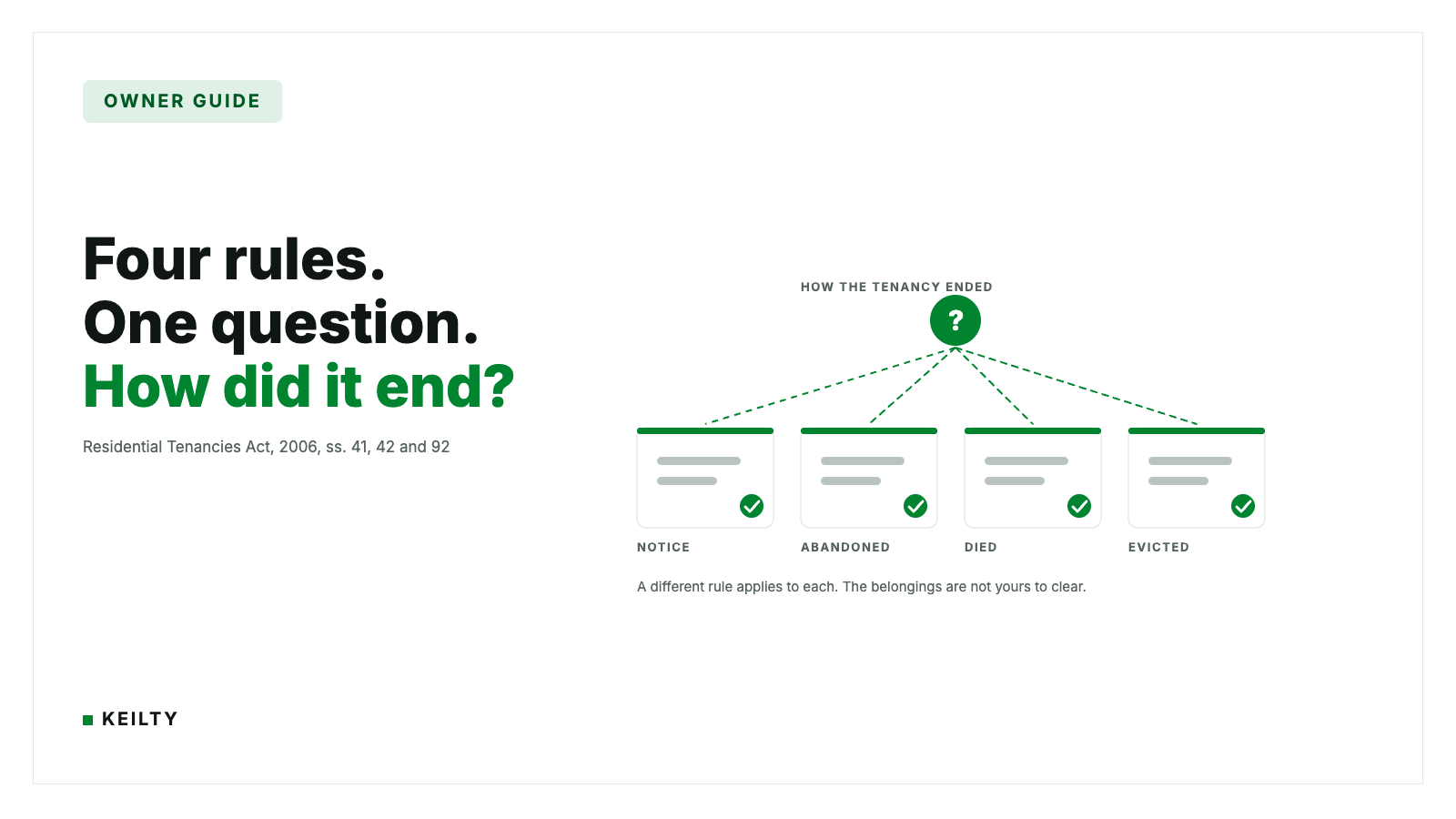
Sometimes, and which rule you are under depends entirely on how the tenancy ended. There are four separate regimes in the Residential Tenancies Act, 2006, they carry different waiting periods, and getting the wrong one is what turns a cleared unit into an application against you. If the unit was vacated in one of four listed ways, section 41 lets you sell, keep or discard. If the unit was abandoned, section 42 makes you clear two gates first and then wait 30 days. If the tenant died, sections 91 and 92 govern. If the tenant owned the mobile home, section 162 does, and sections 91 and 92 are switched off entirely.
The short version.
The words belongings and personal property appear nowhere in the Act. It says property, items, and a tenant's property, and it means chattels in the unit and in the residential complex around it. Here is each regime, the arithmetic, and the three places the Board's published guidance does not match the Act.
Is this you? If you own this rental rather than rent it, KEILTY manages homes and buildings across Eastern Ontario and will tell you what the unit should rent for. Start with a free rental evaluation.
Answer this before you touch anything, because the four regimes do not overlap and the waiting periods run from different events.
Two consequences follow immediately. A tenant who moved out on their own 60 day notice and left a sofa behind is a section 41 file with no waiting period at all. A tenant who stopped paying and vanished is a section 42 file with two gates and 30 days. The sofa looks identical in both cases and the law about it does not.
A note on the count, because our four and the Board's five are the same law read two ways. The Board's brochure on this topic says "The RTA contains five different sets of rules." It splits section 41 in two, separating the three routes that carry no waiting period from the sheriff route that carries 72 hours, which is the same split we use across the next two headings. Four sections, five clocks.
No, and the provision is one sentence. Section 40 is headed Distress abolished and reads: "No landlord shall, without legal process, seize a tenant's property for default in the payment of rent or for the breach of any other obligation of the tenant."
Note the breadth of the closing words. It is not limited to rent. Any obligation of the tenant, breached in any way, is covered. And note "without legal process", which is what the rest of this page is about: the disposal powers in sections 41, 42, 92 and 162 are the legal process, and outside them there is no self-help remedy over a tenant's goods.
Section 39 sits immediately before it and does the same job for the unit itself. A landlord "shall not recover possession of a rental unit subject to a tenancy unless, (a) the tenant has vacated or abandoned the unit; or (b) an order of the Board evicting the tenant has authorized the possession." Both sections carry no amendment footnote on e-Laws. They are original 2006 text.
One of the four things in section 41 (1), and nothing else. Where one of them applies, section 41 (1) gives you the power in full: a landlord "may sell, retain for the landlord's own use or otherwise dispose of property in a rental unit or the residential complex". No notice, no waiting period, no duty to store.
That is a wide power, and the reason is that each of the four routes involves the tenancy having ended in a way the tenant either chose or had adjudicated. The one qualification is in the next subsection, and it applies to only one of the four.
Note also what section 41 (1) covers. Property "in a rental unit or the residential complex", so a bicycle in the shared garage and boxes in a locker are in scope, not only what is inside the four walls.
Seventy-two hours, and only on the eviction route. Section 41 (2) opens with the qualifier that decides it: "Despite subsection (1), where an order is made to evict a tenant, the landlord shall not sell, retain or otherwise dispose of the tenant's property before 72 hours have elapsed after the enforcement of the eviction order."
Three things to take off that. The trigger is the enforcement of the order, not the order, not the eviction date on its face, and not the day you got the keys. Section 81 provides that an eviction order expires six months after the day it takes effect if it is not filed within those six months with the sheriff who has territorial jurisdiction where the rental unit is located, so on a file that went to enforcement there is a documented enforcement event to count from. And it is hours rather than days, which matters because it starts at whatever time of day the enforcement finished rather than at midnight.
The other three routes in section 41 (1) carry no 72 hour hold on the face of the section. A tenant who vacated on notice, an agreement to terminate, and a superintendent under subsection 93 (2) are all outside subsection (2)'s opening words.
Two lines in the Board's brochure are worth having, because both run in an owner's favour and neither is in the Act. On what happens at the end of the window: "Unless the landlord and tenant agree to other terms, if the tenant doesn't come to get their property during the 72 hour period, they no longer have any claim to it and they lose all rights to it." And on where the property may sit while the clock runs: "During the 72 hours after the Sheriff has evicted the tenant, the landlord may leave the property in the rental unit, or they can move it to a safe location that is close to the unit." That second one answers a real question, because the alternative reading is that you are obliged to leave a unit full of somebody else's furniture untouched for three days. Take both as the Board's wording rather than the Act's, and note where they sit: both lines are printed under the brochure's sheriff-eviction heading rather than as general rules, and the first carries its own opening qualifier about the parties agreeing other terms. Section 41 (6) still gives a former tenant an application, and the brochure is not what the Board would be applying.
Between 8 a.m. and 8 p.m., set by regulation, and no, the Board cannot change the 72 hours.
Section 41 (3) is the positive duty and it carries a qualifier that is easy to drop: a landlord "shall make an evicted tenant's property available to be retrieved at a location close to the rental unit during the prescribed hours within the 72 hours after the enforcement of an eviction order." The prescribed hours are in section 46 of O. Reg. 516/06, which reads in full: "For the purposes of subsection 41 (3) of the Act, a landlord shall make an evicted tenant's property available between the hours of 8 a.m. and 8 p.m." One sentence, no subsections, no weekend or holiday variation, no exception.
Work it on a Cobourg file. The sheriff enforces at 10 a.m. on Wednesday 2026-10-07.
Do not compute that deadline with the Board's counting rules. Rules 1.12 to 1.15 of the Rules of Procedure govern the Board's own time limits and there is no filing here. What the regulation does say is stronger. Section 56 lists "time requirements that the Board may not extend or shorten under subsection 190 (2) of the Act", and paragraph 4 is "The 72-hour period referred to in subsection 41 (2) of the Act." Paragraph 5 does the same for the six month periods in subsections 42 (7), 92 (3) and (4), and 162 (4) and (5). Those periods are fixed against everybody, including the Board.
One publisher error worth knowing if you go and check this yourself. Interpretation Guideline 6, dated 2018-12-15 and updated 2026-07-01, attributes the availability duty and the 8 a.m. to 8 p.m. window to subsection 41 (2). The duty is in subsection 41 (3) and the hours are in the regulation. The Guideline's substance is right and its citation is not. That is the first of the three mismatches promised at the top of this page.
Abandonment is a factual conclusion, and the Act supplies one hard negative rather than a definition. Section 2 (3) reads: "For the purposes of this Act, a tenant has not abandoned a rental unit if the tenant is not in arrears of rent."
That single sentence answers a whole category of file before it starts. Rent is paid to the end of the month, the unit looks empty, the furniture has gone, and the owner wants to clear it and re-let. On the Act, that unit has not been abandoned, and section 42 is not available. Interpretation Guideline 4, Abandonment of a Rental Unit, puts the same point operationally: "Even if there is evidence of abandonment, such as the furniture being removed, the landlord cannot treat the unit as abandoned before the end of the rental period if the rent is fully paid."
The L2 instructions say it a third time from the form side. On the abandonment reason, "The tenant must also be in arrears of rent."
What the Act does not supply is a test for the positive case, and that gap is where an owner loses a file they thought was straightforward. Guideline 4 supplies one, and it sets a bar that sits in front of both of the gateways below: "If there is rent due, there must still be substantial evidence of abandonment before the landlord can re-rent the unit or deal with the tenant's property that is remaining in the unit." It then says what the effort is expected to look like: "The landlord should make reasonable efforts to contact the tenant to determine if they have left the unit (for example, by writing the tenant or calling them at different times each day). The landlord should give the tenant a reason to reply to a letter and should keep notes of the times and dates that they telephoned." Note which record it asks for. The notes are of the calls, and of the times as well as the dates. And note the standard it is measuring against: the tenant's silence "should be consistent with the abandonment of a unit and not with a tenant who is on vacation or out of town on business". You can clear both statutory gateways and still fail on this one, so do the contacting first and write down what you did while you are doing it.
There is a date on Guideline 4 that you should carry. It prints 2007-01-31 and no updated line, no revised line and no amendment note. It is the only Guideline in the published set on abandonment and it has not been restamped in nineteen years, while its neighbours have been: Guideline 6 prints an updated line of 2026-07-01. Guidelines are not law in any event. On abandonment you are reading a document from 2007 and checking it against a statute that has moved since.
Here is what that age costs you in one concrete place, and it is the second of the three mismatches. Guideline 4 tells its reader that "it should be noted the Board has no jurisdiction to issue an order for rent or compensation if a tenant is no longer in possession of the rental unit (see section 87). In this case, the landlord may seek a remedy by applying to Court." That was right when it was written and it is not right now. Clause 87 (1) (b) and subsection 87 (1.1) were added by 2020, c. 16, Sched. 4, s. 18 (1), in force 2021-09-01, and they are what opened the Board to a claim against a former tenant no longer in possession. The Guideline still sends you to court for money the Board can now order, which is the route set out at the foot of this page.
Two, and they are alternatives. Section 42 (1) lets a landlord dispose of property in an abandoned unit, and of property of persons occupying the unit that is in the residential complex, "in accordance with subsections (2) and (3) if, (a) the landlord obtains an order terminating the tenancy under section 79; or (b) the landlord gives notice to the tenant of the rental unit and to the Board of the landlord's intention to dispose of the property."
Gateway (a) is an application. Section 79 reads: "If a landlord believes that a tenant has abandoned a rental unit, the landlord may apply to the Board for an order terminating the tenancy." The form is the L2, printed on the Board's forms, filing and fees page as "L2 – Application to End a Tenancy and Evict a Tenant or Collect Money", at "$201 or $186 through the Tribunals Ontario Portal". Its instructions, dated August 2023, ask for less than you might expect on an abandonment: there are no steps you are required to take before applying, the tenant need not still be in possession, and the 30 day filing limit in those instructions is expressly tied to filing after a notice of termination, so it does not bite here. The required package is the form and the fee.
Gateway (b) is the self-help route, and it is cheaper and faster. Guideline 4 adds a content requirement the statute does not spell out, that the notice state the landlord intends to dispose of the property "if the tenant does not claim the property within 30 days of the notice being given". The Board's brochure on the topic adds the address point: if the landlord does not know the tenant's new address, the notice "can be sent to the tenant's last known address or to the tenant's business address (if the landlord knows it)". We set out the service methods in how to serve a notice to a tenant in Ontario.
Then the wait. Section 42 (3) lets you sell, keep or otherwise dispose of anything else "if 30 days have passed after obtaining the order referred to in clause (1) (a) or giving the notice referred to in clause (1) (b) to the tenant and the Board." Work it on a Brockville file, with notice given on Tuesday 2026-10-06.
Note which list the 30 days is not on, because the omission is pointed. Regulation section 56 runs to twenty-one paragraphs of periods the Board may not extend or shorten. It reaches the 72 hours in section 41 (2) at paragraph 4, the six month claim periods in sections 42 (7), 92 (3) and (4) and 162 (4) and (5) at paragraph 5, and three other 30 day periods: paragraph 6 is "The 30-day period referred to in subsection 46 (1) of the Act", paragraph 9 is "The 30-day period referred to in subsection 91 (1) of the Act", the death file below, and paragraph 19 is "The 30-day period referred to in subsection 206 (6) of the Act". The 30 days in section 42 (3) is on none of them, and we searched the whole regulation for a reference to subsection 42 (3) on 2026-09-03 without finding one.
Two things hold that argument in check, and an owner should have both. Paragraphs 1 and 2 of section 56 are catch-alls rather than named periods, reaching notice-related time requirements and deadlines for filing applications generally, so the list is not a purely closed enumeration and an absence from it proves less than it would on a closed list. And we have found nothing anywhere saying the Board may extend the 30 days in section 42 (3). What we are saying is the narrow version: the drafter fixed twenty-one periods expressly, including three other 30 day periods, and did not name this one.
Guideline 4 makes one further point about gateway (a) that cuts against relying on the informal route for the unit rather than the goods. It says an order is "not mandatory for this type of order to be issued for the landlord to treat the unit as abandoned", but that there is "a substantial risk in re-renting the unit without such an order unless it is clear that the tenant has vacated and does not intend to continue the tenancy". The gateways in section 42 are about the property. Re-letting the unit is a separate exposure, and we go through it in what happens if a tenant abandons a rental unit in Ontario.
No. The Act requires you to give a notice to the Board and the Board publishes nothing to give it on.
This is worth stating carefully, because it sounds like an exaggeration and it is not one. We read the forms page in full. The strings property, abandon, dispose and belonging appear zero times in its visible text. The Rules of Procedure are silent too: abandon appears once, at Rule 9.4 about an application dismissed as abandoned, property appears once, at Rule 13.10 about mediated agreements, and dispose does not appear at all. No rule tells you how to deliver a section 42 (1) (b) notice to the Board, and none tells the Board what to do when one arrives.
The clearest source is the Board's own brochure, Property Left Behind When a Tenant Moves Out, last updated July 2026, which describes the step and then concedes the gap in parentheses: the landlord may "serve a notice on the tenant, with a copy to the LTB, stating that they intend to sell, keep or dispose of the tenant's property. (There is no LTB form to use in this situation.)"
So write your own, and treat it as evidence rather than as paperwork. Put the address of the unit, the date, the fact of the arrears, what you intend to do with the property, and the 30 day claim window on its face. Keep proof of how and when you gave it to the tenant and how and when you gave it to the Board, because the six month clock in section 42 (7) runs from the date the notice was given and you may be asked to prove that date many months later. That brochure is not linked from the forms page, so a reader who goes looking for this route where the forms are will not find it.
Unsafe or unhygienic items, on the abandonment route and on the death route. Section 42 (2) provides that if the tenant has abandoned the unit, "the landlord may dispose of any unsafe or unhygienic items immediately". Section 92 (1) (a) does the same on a death file.
Two cautions. The test is unsafe or unhygienic, which is not the same as worthless, broken, or not worth storing, and the Act nowhere draws a line by value. Photograph what you dispose of under this power and record why, because the immediacy is the whole benefit and there is no order behind it. And note where the power sits. Section 42 (2) is conditioned on its own face only on the tenant having abandoned the unit, but section 42 (1) is the framing subsection and it permits disposal "in accordance with subsections (2) and (3)" only where a gateway is met. Our reading is that the immediate power is gated the same way the 30 day power is, and that reading is the cautious one rather than the only one available.
Which produces a trap on the eviction route. Section 41 contains no equivalent of section 42 (2). There is no unsafe or unhygienic carve-out anywhere in it, and section 41 (2) bars you from disposing of "the tenant's property" for 72 hours without qualifying the word. Read the two sections against each other and the 72 hour hold appears to cover a fridge full of rotting food as fully as it covers a television. That is our reading of an absence rather than something the Act says. The Board's brochure gets you part of the way out of it, by saying you may move the property to a safe location close to the unit while the clock runs, and the safe course on anything genuinely hazardous is to secure and store rather than to discard and argue about it afterwards.
Arrears plus your out-of-pocket costs of dealing with it, and the tenant can claim the property back inside the 30 days by asking for it.
Section 42 (4) lets a tenant who notifies you before the 30 days have passed remove the property within that 30 day period, and section 42 (5) then requires you to make it available "at a reasonable time and at a location close to the rental unit". Note that this is a reasonable time rather than the 8 a.m. to 8 p.m. window, which belongs to the eviction route only. Two regimes, two different availability standards.
Section 42 (6) is the money. You "may require the tenant to pay the landlord for arrears of rent and any reasonable out-of-pocket expenses incurred by the landlord in moving, storing or securing the tenant's property before allowing the tenant to remove the property." Three heads of expense, moving, storing and securing, and the word selling is not among them. Selling appears in the next subsection instead. Arrears are recoverable here without any cap tied to the expenses, though section 88 (3) can cap the arrears themselves once you re-let, which is set out further down.
There is one pot of money you cannot reach for, and it is the one nearest to hand. The last month's rent deposit is not available for any of this. Section 106 (10) provides that "A landlord shall apply a rent deposit that a tenant has paid to the landlord or to a former landlord in payment of the rent for the last rent period before the tenancy terminates." That is mandatory and it is single purpose. The arrears and the moving, storage and securing costs under section 42 (6) are amounts you require from the tenant, not amounts you net off a deposit you are holding.
On a mobile home the equivalent is section 162 (6), which is drafted more widely on the expenses and more narrowly on the timing. Before returning a mobile home "to a tenant who claims it within the 60 days referred to in subsection (3) or the six months referred to in subsection (5)", the landlord "may require the tenant to pay the landlord for arrears of rent and any reasonable expenses incurred by the landlord with respect to the mobile home". Not out-of-pocket, and not limited to three heads, but confined to a claim made inside one of those two windows.
You owe them the surplus for six months, and the six months does not run from the sale.
Section 42 (7) provides that if within six months "after the date the notice referred to in clause (1) (b) is given to the tenant and the Board or the order terminating the tenancy is issued" the tenant claims property you have sold, you "shall pay to the tenant the amount by which the proceeds of sale exceed the sum of, (a) the landlord's reasonable out-of-pocket expenses for moving, storing, securing or selling the property; and (b) any arrears of rent." Selling is on this list even though it is not on the section 42 (6) list.
Read the trigger. The six months runs from the notice or from the order, whichever gateway you used, not from when you sold anything and not from when the tenant left. Sell on day 31 and you carry the exposure for another five months.
The protection this buys you is real but conditional. Section 42 (8) provides that "Subject to subsections (5) and (7), a landlord is not liable to any person for selling, retaining or otherwise disposing of the property of a tenant in accordance with this section." Note both halves of the condition: subject to the availability duty and the surplus duty, and only where you acted in accordance with the section. Section 41 (4) is the same shape on the eviction route, protecting a landlord who disposed "in accordance with this section".
Keep the sale records. If you cannot show what the property fetched and what the moving, storage, securing and selling cost, you cannot show there was no surplus.
A different section, a different clock, and a duty to preserve rather than a power to clear.
Section 91 (1) deems the tenancy terminated 30 days after the death of the tenant where there are no other tenants of the unit. Section 91 (2) then imposes two obligations "until the tenancy is terminated under subsection (1)": preserve any property of the deceased tenant in the unit or the complex "other than property that is unsafe or unhygienic", and afford "the executor or administrator of the tenant's estate, or if there is no executor or administrator, a member of the tenant's family reasonable access" to the unit and the complex for the purpose of removing the property. Carry the fallback in the middle of that clause. Where nobody has been appointed, a family member gets the access.
Section 92 (1) is then the disposal power: unsafe or unhygienic property immediately, and otherwise "after the tenancy is terminated under section 91". There is no separate waiting period in section 92. The wait is the 30 days in section 91 (1).
The claim window is six months after the tenant's death, not six months after anything you did. Under section 92 (3), if within that period the executor or administrator, or a family member where there is none, claims property you have sold, you pay the surplus over your reasonable out-of-pocket expenses and arrears to the estate. Under section 92 (4), if the claim is for property you retained for your own use, you return it to the estate. Section 92 (5) lets a landlord and the executor or administrator agree different terms about both the termination and the disposal.
Then most of the section above does not apply to you, and this is the gate to read before anything else on a death file.
Section 91 (1) engages only where a tenant dies "and there are no other tenants of the rental unit". Where there is a co-tenant named on the agreement, section 91 never engages at all. The tenancy runs on, the 30 days never starts, and clearing the unit is a seizure of a tenant's property under section 40 rather than an exercise of a power under section 92.
The second route into the same problem catches the owner who has checked the agreement and found only one name on it. Section 3 (1) of O. Reg. 516/06 provides that if a tenant dies and the rental unit is the principal residence of the spouse of that tenant, "the spouse is included in the definition of “tenant” in subsection 2 (1) of the Act unless the spouse vacates the unit within the 30-day period described in subsection 91 (1) of the Act". So a surviving spouse who was only an occupant becomes a tenant by operation of the regulation, without signing anything and without your agreement. The 30 days in section 91 (1) is the period in which that is settled, rather than a countdown to an empty unit. Section 3 (4) switches the rule off for three kinds of unit only: a rental unit described in section 7 of the Act, one in a care home to which Part IX applies, and one to which section 6 of the regulation applies.
The Board flags the same thing at the top of its brochure, and the warning is blunter than that document usually is: "The rules in this brochure may not apply to situations where a tenant moves out or dies and their spouse remains in the unit. In these situations before you proceed, you should get more information from the Landlord and Tenant Board (LTB). You may also want to get legal advice before you take any action." Treat a surviving spouse or a co-tenant as a reason to stop rather than as a detail on the file. On either route the property in the unit belongs to somebody who still lives there.
Two practical points fall out of the drafting on the ordinary death file. The claim goes to the estate rather than to the person who asked, and disposal on day 31 still leaves five months of exposure. We go through the whole of a death file in what happens when a tenant dies in Ontario.
Then a different section governs and two of the ones above are switched off. Section 163 reads, in full: "Sections 91 and 92 do not apply if the tenant owns the mobile home." We go through the whole of that route, the two notices, the 60 days and the six month claim window, in whether you can sell or dispose of a tenant's mobile home in Ontario.
Section 162 is the replacement and it is not a copy of section 41. Its opening words are "This section applies if," followed by a list: the tenant vacated the mobile home in accordance with a notice of termination of the landlord or the tenant, an agreement to terminate, or an order of the Board terminating the tenancy or evicting the tenant, or the landlord applied under section 79 and the Board made an order terminating the tenancy. A termination deemed under section 91 is not on that list, and neither is it on section 41 (1)'s list, so the omission is not a difference between the two sections. Section 163 is what actually decides the death question here.
Four differences from section 41 are worth having. Section 162 covers a mobile home, not property generally. Section 162 (2) requires notice before disposal by two means together, "by registered mail, sent to the tenant's last known mailing address" and "by causing a notice to be published in a newspaper having general circulation in the locality in which the mobile home park is located". Section 162 (3) then sets the wait at 60 days after those notices have been given, and only "if the tenant has not made a claim with respect to the landlord's intended disposal". And there is no 72 hour rule in section 162 at all. Sections 162 (4) and (5) carry the six month claim window, for a home sold and a home retained respectively.
Section 152 (1) applies Part X to tenancies in mobile home parks, and section 152 (2) applies it with necessary modifications to land lease communities as if the tenancies were in mobile home parks.
Then you are on one of the three routes in section 41 that carry no waiting period at all, and the Act does not spell it out on the face of the section.
Clause (c) of section 41 (1) is a bare cross-reference to subsection 93 (2), and the substance sits in section 93. Section 93 (1) provides that where a landlord has entered into a tenancy agreement for superintendent's premises, unless otherwise agreed the tenancy terminates on the day the tenant's employment is terminated. Section 93 (2) then requires the tenant to "vacate a superintendent's premises within one week after his or her tenancy is terminated", and section 93 (3) bars you from charging or receiving rent or compensation for that one week.
Once they vacate under that one week rule, section 41 (1) gives you the disposal power immediately. No 72 hours, because subsection (2) is confined to where an order is made to evict, and no retrieval hours, because subsection (3) is confined to an evicted tenant. Whether an owner should use a power that wide on a former employee is a separate question from whether the Act gives it, and on this one the Act gives it.
On the eviction route, an offence and an application. On the death and mobile home routes, an application only. And on any file where the reason you cleared the unit was the arrears, a third offence that sits outside all of that.
Section 234 (b) makes it an offence to fail "to make an evicted tenant's property available for retrieval in accordance with subsection 41 (3)". Section 234 (y) (iii) makes it a further offence to contravene a Board order that "orders a landlord not to breach an obligation under subsection 41 (2) or (3) again". Under section 238 (1) an individual is liable on conviction to a fine of not more than $100,000 and under section 238 (2) a corporation to not more than $500,000, both in force on 2026-07-01 via 2023, c. 10, Sched. 7, s. 9 (1, 2).
The third offence is the one that reaches an arrears file, and it sits outside both of the two above. Section 233 is headed Offences requiring knowledge and opens "A person is guilty of an offence if the person knowingly,". Clause (d) then reads, in full: "seizes any property of the tenant in contravention of section 40;". Section 40 is the distress provision at the top of this page. Disposing of a tenant's goods because they owe you rent is a section 40 seizure, so doing it knowingly is a section 233 (d) offence carrying the same section 238 fines. It does not depend on which of the four regimes you thought you were on, and it does not depend on a prior Board order.
Now the asymmetry, which is a real feature of the Act rather than an oversight we are alleging. Neither section 91, section 92 nor section 162 is referenced anywhere in the offence provisions. Disposing of a deceased tenant's property in breach of section 92, or a mobile home in breach of the section 162 notice requirements, is not an offence under the Act. Nor is a breach of the 72 hour hold in section 41 (2), taken on its own, caught by either limb of section 234, because clause (b) reaches subsection (3) rather than subsection (2) and clause (y) (iii) needs a prior Board order. Do not read that as safety. If the reason you disposed of the property was the arrears, section 233 (d) is the provision to worry about, whatever paper you were holding.
The Board's brochure reads the offence provisions more broadly than we do, and that is the third of the three mismatches. Its enforcement section tells a tenant to contact the Ministry's Investigation and Enforcement Unit "if their landlord has not followed these rules, because it is an offence under the RTA not to follow them", and it sets that up with a sentence that expressly covers the landlord who "sells, keeps or disposes of the property before the 72 hours has passed". On our reading of section 234 (b) and section 234 (y) (iii), disposal inside the 72 hours is not by itself the offence those two clauses create. That is our reading of the clauses against the brochure rather than a defect we can prove, and on an arrears file the practical answer is the same either way, because section 233 (d) is standing behind it.
The civil route is section 41 (6), and it is the one with the money in it. On application by a former tenant, where the Board determines a landlord has breached an obligation under subsection 41 (2) or (3), it may order the landlord not to do it again, order the property returned, order payment of the reasonable costs of repairing or replacing property damaged, destroyed or disposed of, order payment of other reasonable out-of-pocket expenses, order the landlord to pay the Board "an administrative fine not exceeding the greater of $10,000 and the monetary jurisdiction of the Small Claims Court", and make any other order it considers appropriate. That fine is payable to the Board rather than to the tenant, and it is not compensation.
The ceiling is a formula rather than a fixed figure, so read the formula first and then compute it. Section 1 (1) of O. Reg. 626/00 under the Courts of Justice Act provides that "The maximum amount of a claim in the Small Claims Court is $50,000", on a consolidation period running from 2025-10-01. So as at 2026-09-03 the greater of $10,000 and the Small Claims Court jurisdiction is $50,000, and the Board's brochure prints the same number against this application. The figure moves when that regulation moves and the formula does not, which is why the formula is the thing to remember.
On the tenant side the applications are the T1 and the T2. The T1 instructions, dated August 2023, carry a reason for a landlord who "sold my personal property and did not pay me the proceeds from the sale", covering abandonment and death. The T2 form carries a reason for a landlord who "Did not give me 72 hours to remove my property from the rental unit or from someplace close to it, after the Sheriff evicted me". Different forms for the two failures.
One thing to hold in view alongside all of that. Section 88 governs arrears where a tenant abandons or vacates without proper notice, and section 88 (3) caps them: if you enter into a new tenancy agreement for the unit, the departing tenant is not liable for arrears exceeding the lesser of the amount determined under section 88 (1) or (2) and the arrears owing to the date the new tenant is entitled to occupy. Section 88 (4) requires consideration of whether you took reasonable steps to minimize losses in accordance with section 16. Re-letting quickly reduces your claim and is still the right thing to do.
On this topic, yes, and the Act says so expressly.
Section 41 (5) provides that "A landlord and a tenant may agree to terms other than those set out in this section with regard to the disposal of the tenant's property." Section 92 (5) does the same for a landlord and the executor or administrator of a deceased tenant's estate. A provision that expressly invites the parties to agree something different is worth noticing.
Two cautions before you draft anything on the strength of it. Section 41 (5) says nothing about when the agreement may be made, and an agreement signed at the start of a tenancy about what happens to somebody's possessions after an eviction is a different animal from one reached the week the unit empties. And the interaction with section 234 (b) is not addressed anywhere: the offence is failing to make property available in accordance with subsection 41 (3), and whether an agreement under subsection (5) displaces subsection (3) for that purpose is not something either provision answers on its face. Our reading is that a same-week written agreement on the mechanics of retrieval sits comfortably inside subsection (5), and that a lease clause signing away the 72 hours in advance is the version we would not rely on. That is our reading, not the Act's words.
None of this is in the Act. It is process, and on a 72 hour or 30 day clock it decides whether the legal answer ever gets used.
One thing an owner should hear plainly. None of the four regimes on this page gets you paid, and there is a separate application that does. Section 42 (6) lets you require arrears and costs before releasing property to a tenant who wants it back, which is a bargaining position rather than recovery, and if the property is worth less than the arrears then clearing the unit properly costs you money and always did. The money route is section 87 (1), which lets a landlord apply to the Board for an order requiring "a tenant or former tenant to pay arrears of rent", with clause 87 (1.1) (b) allowing that application "no later than one year after the tenant or former tenant ceased to be in possession of the rental unit". That is the L10, printed on the forms page as "L10 – Application to Collect Money a Former Tenant Owes", in the same fee row as the L1, L2, L3 and L9 at "$201 or $186 through the Tribunals Ontario Portal". One qualifier to carry with it: where the person is no longer in possession, clause 87 (1) (b) confines the application to somebody who ceased to be in possession on or after the day subsection 18 (1) of Schedule 4 to the Protecting Tenants and Strengthening Community Housing Act, 2020 came into force, which was 2021-09-01. An owner diarizing only the six months in section 42 (7) can let that year run out without noticing it was ever there.
An owner with one or two units can run this, and the part that is hardest is not the law.
Reading which of the four regimes applies is a careful desk exercise, and this page is most of it. What is harder is the timing. The 72 hour window opens the moment the sheriff finishes and runs across nights and weekends, and the availability duty is on you whether or not you were there. The 30 day route needs a notice written and given twice, to the tenant and to the Board, with proof of both dates kept for six months. Neither is difficult. Both are the kind of thing that can go wrong when a unit empties on a Friday and the owner is three hours away.
Where KEILTY earns its keep is in the inventory and the paper. A dated room-by-room record, a storage arrangement that produces invoices, a notice that says what the Guideline says it should say, and a file that can still prove the date six months later. That file is what you would answer a section 41 (6) application with, and assembling it as you go costs less than assembling it afterwards. If you own a house or a condo and it is being handled off the side of a desk, our single-family rental page sets out how we run it.
Holding a unit full of somebody else's property and not sure which clock you are on? Get in touch and we will work out which regime you are in and what the dates are.
This post is general information about Ontario residential tenancy law as of 2026-09-11, not legal advice. Legislation, regulations and tribunal practice change. For advice on a specific property or situation, speak with a lawyer or licensed paralegal.
Ontario property management with published pricing, same-day answers, and no surprises. Since 2003.
300-80 Queen StreetNot served yet. Join a list and hear from us the day we open.