
By A.J. Keilty, President, KEILTY Realty Management
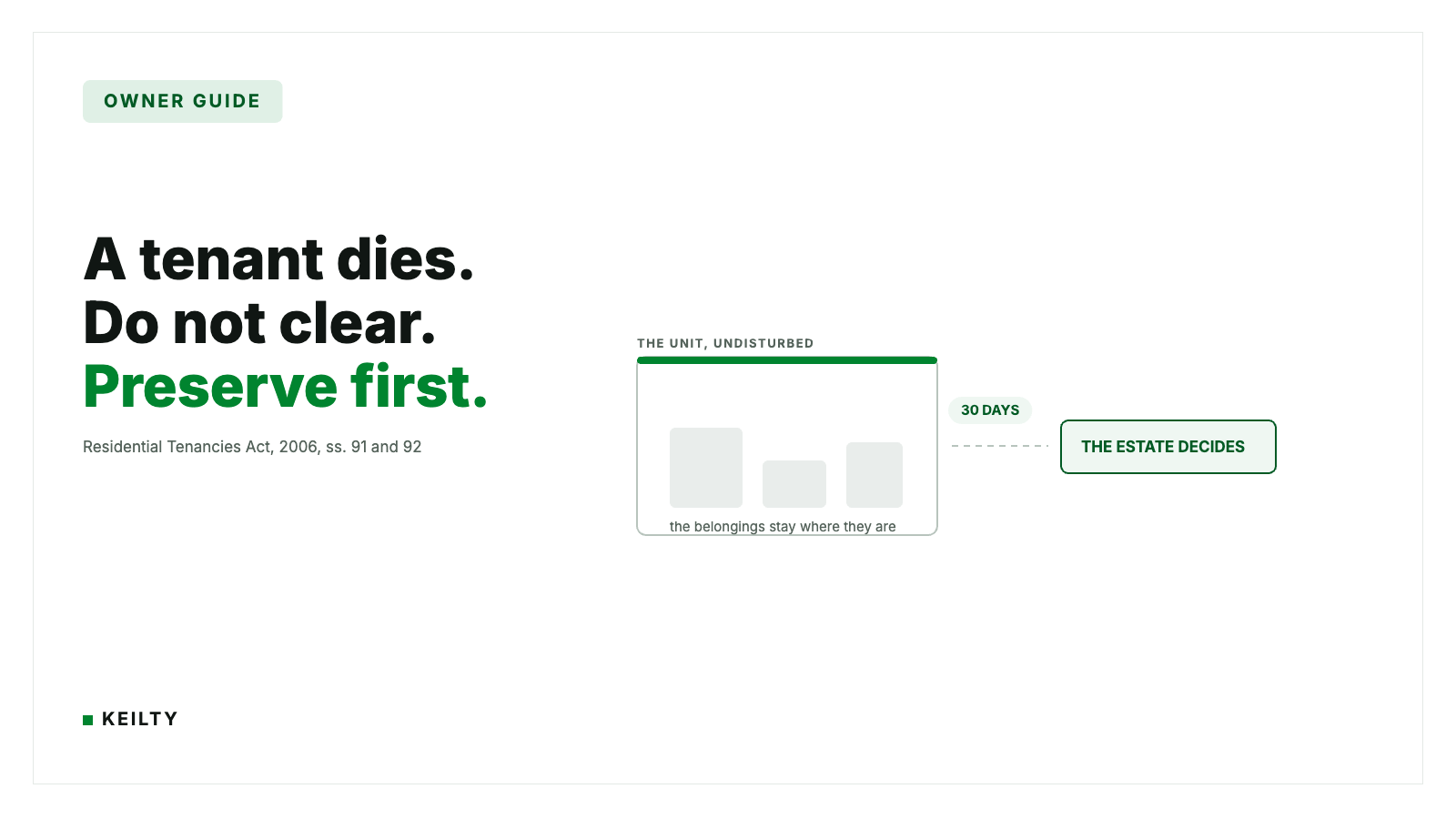
If a tenant dies and there are no other tenants of the unit, the tenancy is deemed to end 30 days after the death. That is section 91(1) of the Residential Tenancies Act, 2006. You do not serve a notice, you do not file anything, and you do not need an order. The clock runs on its own. What you owe during those 30 days is preservation and access, not a cleanout. And there is one situation where section 91 never engages at all: if the unit was the principal residence of the tenant's spouse, the spouse becomes a tenant.
Two mistakes are worth naming up front. An owner clears the unit too early, or an owner assumes the rent simply stops on the date of death. Both are expensive. Here is how the Act actually handles it.
Is this you? If you own this rental rather than rent it, KEILTY manages homes and buildings across Eastern Ontario and will tell you what the unit should rent for. Start with a free rental evaluation.
Yes, but only on a narrow set of facts. Section 91(1) reads: "If a tenant of a rental unit dies and there are no other tenants of the rental unit, the tenancy shall be deemed to be terminated 30 days after the death of the tenant."
Two conditions do the work. There must be a death, and there must be no other tenants of the rental unit. If two people signed as tenants and one dies, section 91 does nothing. The surviving tenant's tenancy continues on the same terms, and if that tenancy was a joint tenancy, LTB Interpretation Guideline 21, dated 2022-03-08, describes joint tenants as "jointly and severally (individually) liable for the payment of the entire rent for the rental unit." That is a useful thing to know before you start writing off arrears.
Guidelines are not law, and the LTB prints that on the face of each one: "a Member is not required to follow a Guideline and may make a different decision depending on the facts of the case." Read them for the Board's usual interpretation, not for the rule itself.
Section 91(2) gives you two duties, and they run until the tenancy is terminated under section 91(1). You must preserve any property of the deceased tenant that is in the rental unit or the residential complex, other than property that is unsafe or unhygienic. And you must give the executor or administrator of the estate, or if there is no executor or administrator a member of the tenant's family, reasonable access to the unit and the complex to remove the tenant's property.
Note what section 91(2) does not say. It does not give you a right to inventory, photograph or dispose of anything beyond the unsafe and unhygienic carve-out, and it does not let you decide who in the family gets access. The executor or administrator comes first. A family member is the fallback where there is no executor or administrator.
Then section 91 is the wrong section. Section 3(1) of O. Reg. 516/06 reads: "If a tenant of a rental unit dies and the rental unit is the principal residence of the spouse of that tenant, the spouse is included in the definition of “tenant” in subsection 2 (1) of the Act unless the spouse vacates the unit within the 30-day period described in subsection 91 (1) of the Act."
Read that test precisely, because it is not the test most owners expect. The trigger is not whether the spouse was named on the lease. It is whether the unit was the spouse's principal residence. If it was, and the spouse stays past the 30 days, you have a tenant, with full security of tenure, at the same rent. Guideline 21 paraphrases this as applying to a spouse "who is only an occupant and not a tenant." That is a looser description than the regulation's own words, so work from the regulation.
Section 3(4) of the regulation switches subsections 3(1) and 3(2) off for three categories: a rental unit described in section 7 of the Act, a rental unit in a care home to which Part IX of the Act applies, and a rental unit to which section 6 of the regulation applies. If your unit might fall into any of those three, read section 3(4) against your own building before you assume the spouse extension applies.
"Spouse" is defined in section 2(1) of the Act and, as Guideline 21 sets it out, covers a married partner and also a person living in a conjugal relationship outside marriage where the two have cohabited for at least one year, are together the parents of a child, or have entered into a cohabitation agreement under section 53 of the Family Law Act. A long-term partner who was never on the lease can very easily be a spouse.
Section 3(1) of the regulation reaches only a spouse, so a child, a sibling, a friend or a caregiver does not inherit the tenancy through it. But do not treat that as the end of the question, because section 2(1) of the Act defines "tenant" to include "the tenant's heirs, assigns and personal representatives," and Guideline 21 says the Divisional Court in Jemiola v. Firchuk, [2005] O.J. No. 6085, stated that the definition of tenant "is broad and inclusive and should be broadly and liberally construed." On the facts of that case the Court went the other way: the Guideline records that it noted a child who was an occupant of their mother's unit, who wanted to remain after her death, and who made a single payment of rent after the death, was not a tenant. Whether a particular occupant is a tenant is a finding of fact, not a rule you can apply from a blog post.
Guideline 21 also cites Dupont and Pecoski v. Weir and Weir, an unreported Divisional Court decision of 2010-10-13, where a deceased tenant had purported to transfer his leasehold interest to his daughter. As the Guideline puts it, the Court stated that irrespective of the provisions of the Act relating to a deceased tenant, where no assignment or sublet of the premises had been consented to in writing by the landlord, the lease was at an end.
On what an occupant can do at the LTB, Guideline 21 is blunt: "a finding that a person is an occupant means that the occupant has no protection or rights in proceedings at the LTB under the RTA," and "Any rights that the person may have outside the RTA must be sought in a court." As for getting the unit back, the Guideline addresses the closely related case of an occupant who stays after the tenant vacates, and says the occupant becomes an unauthorized occupant and the landlord "may apply" under section 100 of the Act, and that if the landlord does not apply within 60 days after discovering the unauthorized occupancy, the occupant becomes a tenant. Section 100(2) is the source of the 60 days: "An application under subsection (1) must be made no later than 60 days after the landlord discovers the unauthorized occupancy."
Two cautions on that route. The Guideline is written about a tenant who vacates, not one who dies, and section 100(1) is drafted around a tenant who "transfers the occupancy of a rental unit," which is not literally what happens when someone simply stays put after a death. Get advice on the pleading rather than assuming the fit is clean. And do not let the 60 days run out while you decide.
Section 92(1) is the disposal power, and it has two speeds. If the property is unsafe or unhygienic, you may sell it, keep it for your own use or otherwise dispose of it immediately. For everything else, you may do so only after the tenancy is terminated under section 91, meaning after the 30 days.
Section 92(2) then protects you: subject to subsections (3) and (4), a landlord is not liable to any person for selling, retaining or otherwise disposing of the tenant's property in accordance with subsection (1). Read the qualifier. The protection attaches to a process followed, not to a unit cleared out.
Those two carve-outs matter. Under section 92(3), if within six months after the death the executor or administrator, or a family member where there is no executor or administrator, claims property you sold, you must pay the estate the amount by which the sale proceeds exceed the sum of (a) your reasonable out-of-pocket expenses for moving, storing, securing or selling the property, and (b) any arrears of rent. Under section 92(4), if within the same six months they claim property you retained for your own use, you must return the property to the estate. Holding on to the tenant's fridge and calling it cost recovery is exactly what section 92(4) reverses.
Section 92(3) is also a lever most owners never use. It lets you net your moving, storage, securing and selling costs, and your arrears, out of the proceeds before anything goes back. Keep the receipts.
This is the number an owner actually has to write on a form, so here is the arithmetic.
Take a two-bedroom in Peterborough at $1,850 a month, with a rent deposit of $1,850 collected at the start. Rent is paid up to 2026-01-31. The tenant dies on 2026-03-14. There are no other tenants and no spouse. Under section 91(1) the tenancy is deemed terminated on 2026-04-13, which is 30 days after the death.
Three rent periods are in play, and February and March are both unpaid:
Now the deposit. Section 106(10) says a landlord "shall apply a rent deposit that a tenant has paid to the landlord or to a former landlord in payment of the rent for the last rent period before the tenancy terminates." The deposit is not yours to hold against the February and March arrears. The Act directs it to the last rent period, and you have to decide which period that is.
That is where a mid-month termination date bites, and the Act does not resolve it for you. Section 91(1) fixes the date and nothing more. It contains no formula for prorating rent across a final period that ends part way through the month. So there are two defensible ways to complete the form, and they produce different numbers:
Pick one, and be able to explain it. The L10 instructions tell you that "in the last row of the table that you complete, you must show the rent charged, rent paid and rent owing for the last rent period for which the former tenant owes rent," so the form makes you commit to a position. Set out the deposit and how you applied it on the application either way, rather than quietly keeping it. This is arithmetic and a stated position, not a forecast of what an order will say. If the whole disagreement is worth less than a hearing, the agreement route further down this post is the cheaper answer.
One thing runs the other way regardless of which reading you take. Section 106(6) requires a landlord to pay interest to the tenant annually on the rent deposit "at a rate equal to the guideline determined under section 120 that is in effect at the time payment becomes due." That interest is owed to the tenant, now the estate. Write the rule rather than last year's percentage, because the guideline changes every year.
If the unit was damaged, that is a separate head. Section 89(1) lets a landlord apply for "reasonable costs that the landlord has incurred or will incur for the repair of or, where repairing is not reasonable, the replacement of damaged property." Read the conduct limb carefully, because it is wider than the tenant alone: under section 89(1)(a) the damage can have been caused by the tenant or former tenant, by another occupant of the rental unit, or by a person the tenant or former tenant permitted in the residential complex, and it must have been wilful or negligent, undue, and caused while the tenant or former tenant was in possession. In a death file the damage is often done by someone other than the tenant, so that limb matters. Section 89(1.1)(b) gives you one year from the day possession ceased.
Because the tenancy has ended and nobody is in possession, the money claim is a Form L10, Application to Collect Money a Former Tenant Owes. The LTB fee table puts the L10 at "$201 or $186 through the Tribunals Ontario Portal." The Act's own limit on timing is section 87(1.1)(b), which allows an application no later than one year after the tenant or former tenant ceased to be in possession, and the L10 instructions agree: "You cannot file this application more than one year after the date the tenant moved out."
Service is the part that catches people, and the duty comes from the Act before it comes from the form. Section 189.0.1 applies to an application under section 87, 88.1, 88.2 or 89 where the tenant or former tenant is no longer in possession. Subsection 189.0.1(2) requires the applicant, "within the time set out in the Rules," to give the tenant or former tenant a copy of the application and a copy of any notice of hearing, and subsection 189.0.1(3) requires the applicant to file a certificate of service "in the circumstances set out in the Rules." The L10 instructions supply the numbers: give the application and the Notice of Hearing to each former tenant at least 30 days before the hearing, file the Certificate of Service at least 20 days before the hearing, and note that "Because the former tenant no longer lives in the rental unit you cannot leave the tenant's copy at the rental unit."
In a death file that means serving the estate through the executor or administrator, at an address you can explain at the hearing. Where none of the listed methods will work, the instructions point to a Request to use Alternative Service, submitted at least 40 days before the scheduled hearing. Sort out who the executor is early, because the 40 days is not a lot of runway.
One more practical point on which route to take. An L10 is the lighter burden of the two ways to get paid. There is no notice to draft, no notice period to count, and no certificate of service on a notice to prove, because nothing was terminated by notice. The file is arithmetic plus evidence that possession ended and when. A court claim against the estate carries all the usual civil machinery instead.
Note also the ceiling. Section 207(1) lets the Board, where it otherwise has the jurisdiction, order payment to any given person of an amount of money "up to the greater of $10,000 and the monetary jurisdiction of the Small Claims Court." Take the formula first and the figure second: ontario.ca states that "Effective October 1, 2025, the monetary jurisdiction of Small Claims Court will increase from $35,000 to $50,000," on a page last updated 2025-10-01, so as at 2026-08-21 the Board's ceiling is $50,000. The L10 instructions state the same figure. Above that, section 207(2) lets a person whose claim exceeds the Board's monetary jurisdiction commence a proceeding in court instead. And section 207(3) is worth reading before you decide to stay at the Board: if a party claims a sum equal to or less than the Board's monetary jurisdiction, all rights in excess of that jurisdiction are extinguished once the order issues. There is a floor too. Section 207(4) says the Board shall not order payment of an amount of money if the amount is "less than the prescribed amount," and section 58 of O. Reg. 516/06 sets that at five dollars.
Often, yes, and the Act builds one in. Section 92(5) says a landlord and the executor or administrator of a deceased tenant's estate "may agree to terms other than those set out in this section with regard to the termination of the tenancy and disposal of the tenant's property." That is a real exception in a statute that otherwise voids side deals: section 4(1) provides that "Subject to subsection 12.1 (11) and section 194, a provision in a tenancy agreement that is inconsistent with this Act or the regulations is void." Section 92(5) is an agreement with an estate, not a clause in a tenancy agreement, and the Act expressly permits it.
In practice that means you can agree an earlier handover date, an agreed cleanout, and a payment, all in one document, and skip the hearing. On the money side, item 6 of section 17 of O. Reg. 516/06 exempts from subsections 134(1) and (3) of the Act a "Payment by a tenant, former tenant, subtenant or former subtenant in settlement of a court action or potential court action or an application or potential application to the Board." Section 134(1) is the Act's general bar on collecting amounts it does not allow, and it opens with "Unless otherwise prescribed." A negotiated payment, documented as settling an application you could otherwise bring, is prescribed out of the bar and costs no filing fee.
Four things, and it is better to know them before you file than after.
No, and mixing them up is how owners end up outside the protection section 92(2) offers. Abandonment runs on a different track. Section 79 lets a landlord who believes a tenant has abandoned a unit apply to the Board for an order terminating the tenancy. Section 42(1) then permits disposal of property in an abandoned unit in accordance with subsections 42(2) and 42(3), and only if the landlord either obtains a section 79 order or gives notice to the tenant and to the Board of the intention to dispose of the property. Section 42(2) allows immediate disposal of unsafe or unhygienic items, and section 42(3) requires 30 days to pass after the order or the notice before other items can be sold, retained or disposed of.
Section 41(1) is the other disposal power, and it lists exactly four gateways: a notice of termination from the landlord or the tenant, an agreement to terminate, subsection 93(2), or a Board order terminating the tenancy or evicting the tenant. A tenancy deemed terminated under section 91 is not on that list. That is precisely why section 92 exists as its own regime. If the tenant has died, do not reach for section 41 or section 42.
Part X of the Act applies to tenancies in mobile home parks under section 152(1), and under section 152(2) it applies with necessary modifications to land lease communities as if they were mobile home parks. Where the tenant owns the mobile home, sections 91 and 92 are switched off. Section 163 reads: "Sections 91 and 92 do not apply if the tenant owns the mobile home." Tenant ownership of the home is the only condition, and it turns off both sections in full. So on a tenant-owned mobile home there is no deemed 30 day termination under section 91 (1), no landlord power to deal with the property under section 92, and no section 91 (2) duty either, meaning no duty to preserve the property and no duty to afford the executor or administrator, or a member of the tenant's family where there is no executor or administrator, reasonable access. Our reading is that section 163 puts nothing in the place of what it removes, which makes a tenant-owned mobile home the hardest case in Part X. We work through it in more detail in can you sell a tenant's mobile home in Ontario.
But note what section 162 does. It sets out a separate disposal process for a mobile home, including notice by registered mail to the tenant's last known mailing address and a notice published in a local newspaper. Section 162(1) is keyed to specific events: the tenant vacating in accordance with a notice of termination, an agreement to terminate or a Board order, or a section 79 abandonment order. A termination deemed under section 91 is not among them. Selling a deceased tenant's mobile home is not a decision to make from a blog post. Get legal advice on that one specifically.
Then none of the above applies. Section 5(i) takes living accommodation outside the Act where the occupant is "required to share a bathroom or kitchen facility with the owner, the owner's spouse, child or parent or the spouse's child or parent, and where the owner, spouse, child or parent lives in the building in which the living accommodation is located." A room in the owner's own house with a shared kitchen is a common example. If the Act does not apply, section 91 does not give you a 30-day rule and section 92 does not give you a disposal power, and your rights come from elsewhere. Confirm coverage first.
None of this is in the Act. It is practice, and it is what actually protects the asset while the 30 days run.
A death in a unit is one of the few situations where a landlord's instinct and the statute point in opposite directions. The instinct is to clear the unit and re-rent. The statute says preserve, give access, wait 30 days, and check whether a spouse has just become your tenant. Doing that well is mostly about getting unglamorous things done on time.
KEILTY handles this for owners across our service area, from single houses to small multi-family buildings and apartment communities. The same discipline applies at every size: get the dates right, keep the records, and talk to the estate early. If you are weighing whether to run a file like this on your own, frankly, the answer is that the law is not the hard part. The calendar is.
If you want a straight read on what your unit should rent for once it is ready, book a free rental evaluation and we will give you a number and the reasoning behind it.
This post is general information about Ontario residential tenancy law as of 2026-09-16, not legal advice. Legislation, regulations and tribunal practice change. For advice on a specific property or situation, speak with a lawyer or licensed paralegal.
Ontario property management with published pricing, same-day answers, and no surprises. Since 2003.
300-80 Queen StreetNot served yet. Join a list and hear from us the day we open.