
By A.J. Keilty, President, KEILTY Realty Management
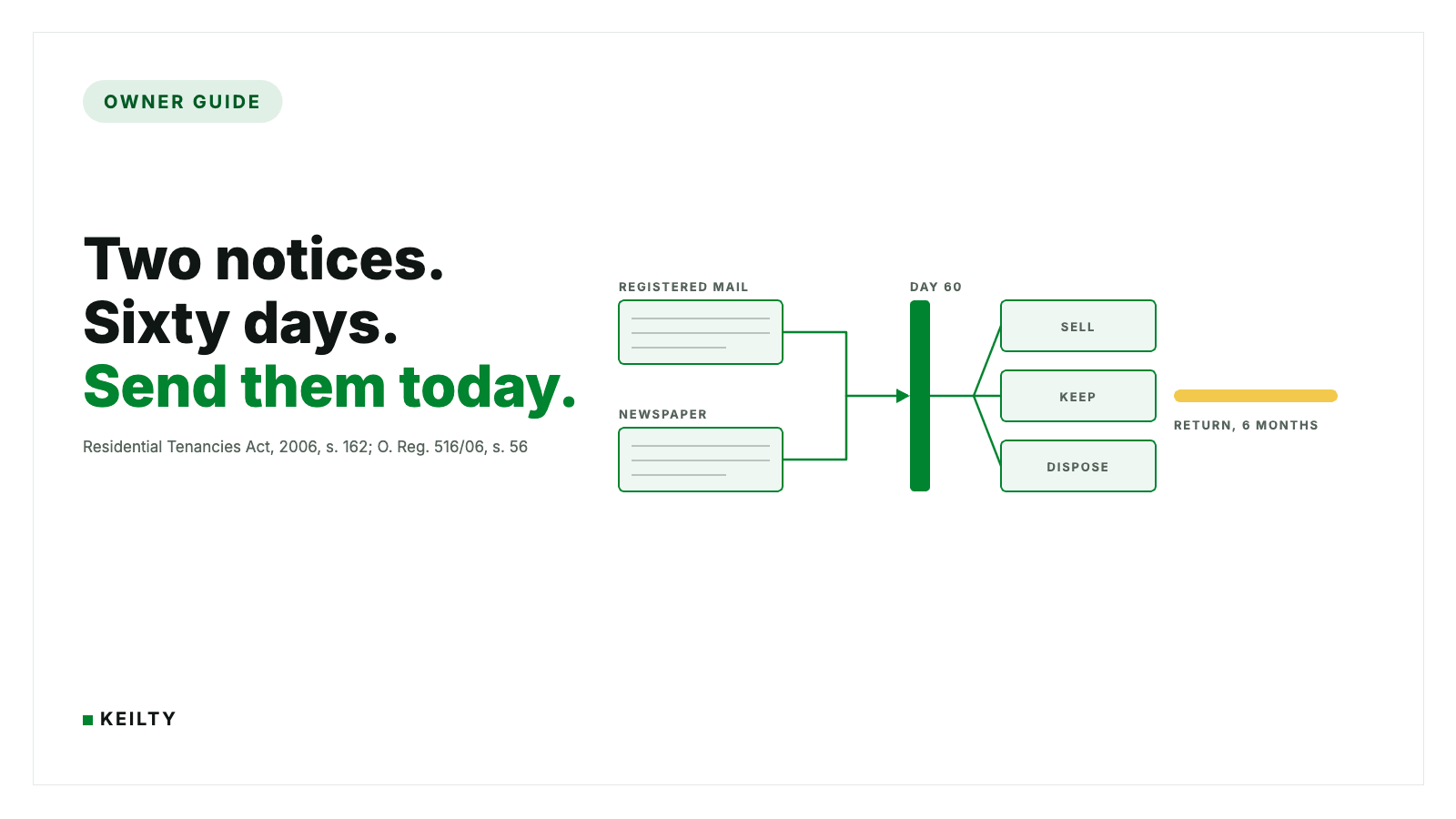
You can, and the route is section 162 of the Residential Tenancies Act, 2006, not the rules that govern ordinary belongings. You give the tenant two notices, one by registered mail and one published in a newspaper, you wait 60 days from the day those notices are given, and then you may sell the home, keep it for your own use, or dispose of it. For six months after the notices the tenant can still claim the home or the sale proceeds. There is no form, no fee and no application to the Landlord and Tenant Board anywhere in that sequence, which is the part park owners find hardest to believe. What it does not give you is money: section 162 clears the site, and the arrears are a separate problem on a separate clock.
The short version.
We set out the four regimes for property left behind generally in whether a landlord can throw out a tenant's belongings in Ontario. This page is the park owner's version of that question, because a tenant-owned home on a rented site is the one case where none of those four regimes does the work. The wider Part X rules on rent, selling and assignment sit in what rules apply to a mobile home park or land lease community in Ontario.
Three things, beginning on the sixtieth day after the notices go out.
Section 162 (3) is the operative subsection: "The landlord may sell, retain for the landlord's own use or dispose of a mobile home in the circumstances described in subsection (1) beginning 60 days after the notices referred to in subsection (2) have been given if the tenant has not made a claim with respect to the landlord's intended disposal."
Read the three powers separately, because they lead to different places six months later. If you sell, and the tenant claims inside six months, you owe them money. If you retain the home for your own use, and the tenant claims inside six months, you have to give the home back. If you dispose of it, the tenant gets nothing, and the Board's own brochure says so in terms, its table recording that in that situation the tenant "cannot claim the mobile home or claim compensation."
Note also what the subsection does not say. It does not require the Board's permission, it does not require a hearing, and it sets no outer limit on how long you may wait before acting. The 60 days is a floor rather than a window.
Before any of that, section 162 (1) has to be satisfied. It reads: "This section applies if, (a) the tenant has vacated the mobile home in accordance with, (i) a notice of termination of the landlord or the tenant, (ii) an agreement between the landlord and tenant to terminate the tenancy, or (iii) an order of the Board terminating the tenancy or evicting the tenant; or (b) the landlord has applied for an order under section 79 and the Board has made an order terminating the tenancy."
So there are four gateways: three flavours of vacating, plus a section 79 order. Section 79 is the abandonment application, and the form for it is the L2 – Application to End a Tenancy and Evict a Tenant or Collect Money. Its fee row reads "$201 or $186 through the Tribunals Ontario Portal", and that row covers the L1, L2, L3, L9 and L10 together. Check the two tables against each other if you are quoting the form back to anybody, because the Board's fee table prints a shorter L2 title than its forms table does.
No, and it is the point on this page worth reading twice.
The marginal heading above section 162 reads "Mobile home abandoned". The seven subsections underneath it never use the word. That matters because abandonment is a hard thing to establish and it carries a statutory gate that catches park owners out. Section 2 (3) provides: "For the purposes of this Act, a tenant has not abandoned a rental unit if the tenant is not in arrears of rent." The Board's own L2 instructions put the same point as an operational requirement on the abandonment ground: "The tenant must also be in arrears of rent."
Now put those together. If your tenant gave you a notice to end the tenancy, moved out on the termination date and left the home on the site, they have vacated in accordance with a notice of termination. That is gateway (a)(i). You do not need to prove abandonment, you do not need arrears, and you do not need a section 79 order or an L2. You can go straight to the notices.
The section 79 route is there for the case where nobody terminated anything and the site simply went quiet. That is where abandonment has to be established, and that is where section 2 (3) bites. If the rent is paid up and the home is sitting there, you are not on the abandonment route, whatever it looks like from the road.
There is a third way to reach a gateway, and it is the one to know if what you actually want is the site back rather than the arrears. A notice under section 50, for demolition, conversion, or repairs or renovations extensive enough to require vacant possession, leads to a termination order, and a termination order is gateway (a)(iii). Section 164 (1) changes the terms of that notice in a park: the termination date "shall, despite subsection 50 (2), be at least one year after the date the notice is given and shall be the day a period of the tenancy ends or, where the tenancy is for a fixed term, the end of the term". That is one sentence and it sets two requirements, and the second one is where notices go wrong. An owner who counts a year forward from the date of the notice and lands on a day in the middle of a rental period has given a defective notice, which means no termination order, and no gateway under subclause (a) (iii) of section 162 (1). Count the year first, then move the date forward to the day the period ends, or to the end of the term on a fixed term tenancy. A year is a long time, but the trade is that the cost is capped and known in advance. Section 164 (2) provides that where the tenant owns a mobile home and is entitled to compensation under sections 52, 54 or 55, the compensation "shall, despite those sections, be equal to the lesser of the following amounts: 1. One year's rent. 2. $3,000 or the prescribed amount, whichever is greater." Nothing has been prescribed for that paragraph, so on the current regulations the ceiling is $3,000. The Board's own L2 instructions put it operationally, telling a landlord terminating for those reasons on a tenant-owned mobile home site that "you must give the tenant either an amount equal to one year's rent, or $3,000, whichever is less."
One caution on how the Board describes this. The brochure Property Left Behind When a Tenant Moves Out has a whole section headed "Tenant Abandons Their Mobile Home", and it lists five ways the tenancy can have ended before the section applies, including a notice from either side and an agreement. So the Board uses the word abandoned as a label for the section rather than as a test. Take the test from section 162 (1) and not from the heading.
You cannot. Section 162 (2) joins them with an "and".
The subsection reads: "The landlord shall not dispose of a mobile home without first notifying the tenant of the landlord's intention to do so, (a) by registered mail, sent to the tenant's last known mailing address; and (b) by causing a notice to be published in a newspaper having general circulation in the locality in which the mobile home park is located."
Four things to take from that.
That last point is why the file matters more here than almost anywhere else. Keep the registered mail receipt, the tracking record, a copy of what you sent, the tear sheet or the publisher's affidavit for the newspaper notice, and a note of the date each went out. The 60 days runs off those dates and your protection under section 162 (7) depends on having acted "in accordance with this section".
There is a cheap fix if you get it wrong, and it is worth knowing before you need it. Nothing in section 162 caps the number of times you may give the notices, and nothing sets an outer limit on when you may give them. So if you discover on day fifty that the registered letter went to a stale address, or that the paper you used is not one of general circulation in the locality of the park, you can serve both notices again properly and start a fresh 60 days. That costs you two months. Acting on defective notices and losing the section 162 (7) protection costs you the home.
From the day the notices have been given, which is almost never the day the tenant left.
Work it on a Picton file. Suppose the tenant gave you notice and the tenancy ended on Saturday 2026-10-31, leaving the home on the site. You post the registered letter and the newspaper notice runs on Monday 2026-11-09.
Two things about the counting. This is a statutory period rather than a Board deadline, so it is not counted under the Landlord and Tenant Board's Rules of Procedure, and it is not counted under the Rules of Civil Procedure either. The instrument is the Legislation Act, 2006, where "holiday" is defined at section 87, the list of holidays sits in section 88 (2), section 89 (3) is the days rule that counts the 60 days, section 89 (6) is the months rule that produces the six month date, and section 89 (1) is the holiday extension. Getting the instrument right is the whole of it, because the three regimes give different answers and only one of them applies here.
The other point is that where both notices do not go out on the same day, the prudent reading is that the clock starts when the later of the two has been given, because section 162 (3) says "the notices ... have been given" in the plural. That is our reading rather than something the subsection states. Sending both on the same day removes the question.
The power does not arise, and you may charge for what you have spent before you hand it back.
Section 162 (3) is conditional on the tenant not having "made a claim with respect to the landlord's intended disposal". A claim inside the 60 days therefore stops the power from arising at all, rather than interrupting something already underway.
Section 162 (6) is what you get in exchange: "Before returning a mobile home to a tenant who claims it within the 60 days referred to in subsection (3) or the six months referred to in subsection (5), the landlord may require the tenant to pay the landlord for arrears of rent and any reasonable expenses incurred by the landlord with respect to the mobile home."
Read that as a lever rather than a claim. It is a right to require payment before returning, which means you hold the home until you are paid. It is not a judgment and it does not create a debt you could enforce anywhere. If the tenant walks away rather than paying, you are back on the disposal route and the arrears are a separate problem.
Note the wording drift inside section 162 itself, because it is the Legislature's rather than ours. Subsection (6) says "reasonable expenses incurred by the landlord with respect to the mobile home". Subsection (4) (a) says "reasonable out-of-pocket expenses incurred with respect to the mobile home". One says out-of-pocket and the other does not. We would not build a charge on the difference, and neither does the Board: its brochure glosses the subsection (6) right as covering "reasonable out-of-pocket expenses related to the mobile home (for example, the landlord's costs to move the home off the site)", reading the narrower words into the wider ones.
It depends entirely on which of the three powers you used, and that is the decision worth thinking about on day sixty.
If you sold it, section 162 (4) applies: "If, within six months after the day the notices have been given under subsection (2), the tenant makes a claim for a mobile home which the landlord has already sold, the landlord shall pay to the tenant the amount by which the proceeds of sale exceed the sum of, (a) the landlord's reasonable out-of-pocket expenses incurred with respect to the mobile home; and (b) any arrears of rent of the tenant."
If you kept it, section 162 (5) applies, and it is much blunter: "If, within six months after the day the notices have been given under subsection (2), the tenant makes a claim for a mobile home which the landlord has retained for the landlord's own use, the landlord shall return the mobile home to the tenant." The word is "shall", and there is no proceeds arithmetic to soften it. Subsection (6) lets you require payment first, but the home goes back.
If you disposed of it, neither subsection is engaged, because both are drafted around a home the landlord "has already sold" or "has retained". The brochure's table says the same thing from the tenant's side.
So the practical ranking, on the text, runs like this. Selling converts the home into a number and caps your exposure at the excess of the proceeds over your expenses and arrears. Retaining it for your own use is the worst of the three on the text, and worse than it first looks. Subsection (5) says "shall return", there is no proceeds arithmetic to soften it, and there is no sale price to set your expenses against, so every dollar you spent on storage, securing or repair in the meantime is recoverable only if the tenant chooses to pay under subsection (6). If you have already put a new tenant on the site, you are returning a home you no longer have anywhere to put. Disposing of it ends the tenant's claim but also ends any recovery, and it is the option with the least room for error if the notices turn out to have been defective.
Section 162 (7) is the protection: "Subject to subsection (4) or (5), a landlord is not liable to any person for selling, retaining or otherwise disposing of a tenant's mobile home in accordance with this section." Read both halves. It is subject to the two claim subsections, and it protects you only where you acted "in accordance with this section", which takes you straight back to the two notices. The Board's brochure closes its mobile home section by attaching a further condition to that protection, to the effect that the landlord must take reasonable care to keep the tenant's property safe while it is being stored. Nothing about reasonable care while storing appears anywhere in section 162. On our reading that is the Board's gloss rather than a statutory requirement, and what subsection (7) turns on is still whether you acted in accordance with the section. Taking care of a home you are holding is sound practice on any view, and it is a separate thing from the test the subsection sets.
No, and that is expressly provided rather than merely absent.
Section 56 of O. Reg. 516/06 lists "time requirements that the Board may not extend or shorten under subsection 190 (2) of the Act", and paragraph 5 names ours: "The six-month periods referred to in subsections 42 (7), 92 (3) and (4) and 162 (4) and (5) of the Act."
Read the stem of that section before you rely on it, because it restricts one extension power and not both. The Board's other power is subsection 190 (1), and it reaches only an application under section 126, subsection 159 (2) or section 226. None of those is section 162. So both routes are closed and the six months is genuinely fixed. Two of the twenty-one paragraphs in section 56 are catch-alls rather than named periods, paragraph 1 on notice requirements for terminating tenancies and paragraph 2 on deadlines for filing applications, so an argument built on absence from that list would need checking against them. This one is not built on absence. Paragraph 5 names subsections 162 (4) and (5) expressly.
That is worth knowing in both directions. A tenant who surfaces at seven months cannot ask the Board for more time. Equally, you cannot ask the Board to close the window early so that you can give clean title to a buyer at four months. The six months is fixed and you should price a sale inside it accordingly, because a purchaser who understands section 162 (5) will want to know which of the three powers you used and when the notices went out.
Section 162 is the only place in the Act where that six-month window attaches to a mobile home, and the one reference to section 162 anywhere in O. Reg. 516/06 is the paragraph just quoted. Nothing in section 162 is left to be prescribed, which on our reading means the section is complete on its face. That is not true of its neighbours: sections 41 (3), 164 (2) and 165 all turn on a prescribed figure or a prescribed period.
Two things, and one of them is drafted more generously here than for ordinary belongings.
Section 162 (4) lets you keep, out of proceeds, "the landlord's reasonable out-of-pocket expenses incurred with respect to the mobile home" and "any arrears of rent of the tenant". Compare the equivalent words for ordinary belongings in section 42 (7) (a), which allow only "the landlord's reasonable out-of-pocket expenses for moving, storing, securing or selling the property", and the same narrowing in section 92 (3) (a) on a death.
Give the two forms of words side by side, because the difference is the whole point. On ordinary belongings the expense has to be a moving, storing, securing or selling expense. On a mobile home it has to be an expense "with respect to the mobile home". The first is a closed list of four purposes. The second is a relationship to a thing. On a file where you paid to disconnect services, to have the home inspected before sale, or to secure it against weather over a winter, the mobile home wording reaches expenses the belongings wording would not.
Two limits on that, both real.
And the thing that gets forgotten. Section 162 gives you a home, or proceeds, or an empty site. It does not give you a judgment for the arrears. If the arrears exceed the proceeds you are not left with a balance you can take anywhere under this section, and the route for money owed by a former tenant is a separate application on a separate clock, which we go through in what happens if a tenant abandons a rental unit in Ontario.
Because section 162 creates a self-help power rather than an application, and the Board's own paperwork confirms it by omission.
We read the Board's forms, filing and fees page and enumerated all forty-one form rows across its five form tables. The codes are N1 to N15, L1 to L10 with the L1/L9 information update, A1, A2, A4, S3, and T1 to T7. None of them corresponds to section 162, none of them mentions a mobile home in its title, and the word mobile does not appear anywhere on that page. There are three fee tables and section 162 is in none of them.
That is a genuine advantage over every other route on this topic and it is worth stating as two totals rather than as a comparison. A section 79 abandonment application costs $201, or $186 through the Tribunals Ontario Portal. A section 162 disposal costs nothing, because there is nothing to file.
Do not over-read the absence of a form, though. It means no application is required, not that no Board proceeding can ever touch section 162. The generic forms are still there: an A1, Application about Whether the Act Applies, could carry a dispute about whether Part X reaches a given site at all, and a tenant who says you disposed of a home outside the section is not left without a forum.
It is also the reason the discipline has to come from you. On an L2 the Board checks your paper before it makes an order. On a section 162 disposal the Board checks nothing, and the first review of your notices happens when a tenant claims the home five months later and asks whether the registered letter went to the right address.
The A2, and it is on a fifteen day clock that starts before you have seen the paperwork.
This is not about a home left behind, but it is the other side of the same coin, because the other way a home leaves a park is by being sold to somebody who wants the site. Section 156 (1) gives the tenant the right: "A tenant has the right to sell or lease his or her mobile home without the landlord's consent." What you control is the site.
Section 159 (1) is conditional, and the conditions are the part to read first. It applies only where the tenant "has sold or entered into an agreement to sell the tenant's mobile home" and then asks you to consent to the assignment of the site to the purchaser. Where it does apply, clause 159 (1) (b) provides that you "may not refuse consent to the assignment unless, on application under subsection (2), the Board determines that the landlord's grounds for refusing consent are reasonable." So this is not a general prohibition on refusing an assignment. It is a prohibition that switches on when a sale of the home is done or agreed. Clause 159 (1) (a) does a second thing in the same breath, and it narrows your options before you get to the reasonableness question: it provides that clause 95 (3) (c) does not apply. Clause 95 (3) (c) is the landlord's power, on a request to consent to an assignment to a named potential assignee, to refuse consent to the assignment of the unit outright. Take that away and what is left of subsection 95 (3) on a park sale is consent to the assignment to that purchaser under clause (a), or refusal of that particular purchaser under clause (b), and it is a refusal under clause (b) that clause 159 (1) (b) then makes reviewable for reasonableness. Reading the two provisions together, that is our reading of what section 159 leaves a park owner with: no blanket refusal, only a purchaser-specific one you may have to justify.
Section 159 (2) sets the clock: "The landlord may apply to the Board, within 15 days after the tenant asks the landlord to consent to the assignment, for a determination of whether the landlord's grounds for refusing consent are reasonable." Fifteen days, running from the tenant's request rather than from the sale. Section 159 (3) requires the grounds to be set out in the application, and section 159 (4) is the sting: if you do not apply in accordance with both subsections, or the Board finds the grounds unreasonable, "the landlord shall be deemed to have consented to the assignment."
Fifteen days is not the only clock running, and it is not the first one to bite. Clause 95 (4) (d) lets the tenant give a notice of termination under section 96 where the tenant has asked the landlord to consent to an assignment to a potential assignee and the landlord does not respond within seven days after the request is made, and paragraph 10 of section 56 of O. Reg. 516/06 puts that seven day period on the same list of time requirements the Board may not extend or shorten as paragraph 5. Two refinements on that. There are two seven day non-response triggers in subsection 95 (4), not one: clause (b) where the tenant asks for consent to an assignment generally, and clause (d) where the tenant asks for consent to an assignment to a named potential assignee. And paragraph 10 of section 56 names only the clause (d) period, so the clause (b) seven days is not on the unalterable list. The whole of subsection 95 (4) then sits under an outer limit of 30 days from the date the request is made, and section 96 (2) fixes the termination date at the lesser of the notice period otherwise required under the Act and 30 days. So a week of silence while you decide whether to refuse can put the tenancy itself in the tenant's hands, well before the fifteen days for your application has run out.
That is not quite the end of it, and this is the one place on this topic where a missed deadline is recoverable. Section 190 (1) expressly lets the Board "extend or shorten the time requirements related to making an application under section 126, subsection 159 (2) or section 226 in accordance with the Rules", and paragraph 2 of section 56 of O. Reg. 516/06 carves that power out of the periods the Board may not move. So fifteen days missed is a request for an extension rather than an automatic loss. It is still a request you have to win, and the default while you are asking is deemed consent.
The form is A2 – Application about a Sublet or an Assignment, and there is a fee trap on it. The A2 appears in two of the Board's fee tables with two different amounts. In the landlord table it is $201. In the tenant table it is $53. A park owner filing under section 159 (2) is in the landlord table, so the figure is $201. The Board's fee page also states that "LTB fees are non-refundable."
If the assignment does go through and the assignee is buying the home, section 165 lets you increase the rent "by not more than the prescribed amount", and section 50 of O. Reg. 516/06 sets that amount as the greater of $50 per month and the amount, including the guideline, you could have taken under an order under subsection 126 (10) before the first anniversary of the new tenancy. What you cannot do is price the consent itself. Section 95 (7) provides that a landlord "may charge a tenant only for the landlord's reasonable out-of-pocket expenses incurred in giving consent to an assignment to a potential assignee", so the giving of consent is a cost recovery and nothing more.
On five points, and each one is a place where applying the wrong regime costs you.
And the loose contents are a separate question from the home. Section 162 is drafted around "a mobile home". Furniture, a shed, a car and the contents of the home are the tenant's property on a rental unit, and nothing in Part X takes them out of sections 41 and 42. It is entirely possible to be on section 162 for the home and on section 42 for what is inside it, on two different clocks, off two different triggers.
The usual rules are switched off and nothing replaces them, which makes this the hardest case in Part X.
Section 163 is one sentence: "Sections 91 and 92 do not apply if the tenant owns the mobile home." Sections 91 and 92 are the death provisions. Section 91 (1) deems a tenancy terminated 30 days after the tenant's death where there are no other tenants, and section 92 gives the landlord the power to deal with the deceased tenant's property. Section 91 (2) goes with them, and it is the limb to look at twice, because it is the one that deals with the home itself. It obliges the landlord, until the tenancy is terminated under subsection (1), to preserve the deceased tenant's property in the unit or the complex other than property that is unsafe or unhygienic, and to afford the executor or administrator of the tenant's estate, or a member of the tenant's family where there is neither an executor nor an administrator, reasonable access for the purpose of removing the property. Section 163 removes all three, on one condition, and puts nothing in their place.
So there is no deemed 30 day termination, no statutory disposal power, and no statutory right of access to the home for anybody on a death in a park. The Board's own brochure fills the gap with a proposition the Act does not state: under the heading "Death of a mobile home tenant" it says the estate takes over the tenancy agreement after the tenant's death, and that the tenancy then continues until it is ended in a way the Act allows. That is the Board's reading rather than a provision you can point at, and the brochure carries the usual caution that it is not a substitute for the legislation.
The practical consequence is that a death does not start any clock you can rely on. Getting to section 162 means getting to one of its four gateways first, which in this situation means a termination agreement with the estate, a notice, or an order. Rent keeps accruing against the estate in the meantime. This is the one scenario on this topic where we would tell an owner to get advice early rather than late, and it is a different question from the general position we set out in what happens when a tenant dies in Ontario.
No, and this is where a park owner can turn a vacancy into an offence.
Section 40 abolished distress: "No landlord shall, without legal process, seize a tenant's property for default in the payment of rent or for the breach of any other obligation of the tenant." A mobile home is the tenant's property. Section 2 (4) puts it beyond argument by providing that "A rented site for a mobile home or a land lease home is a rental unit for the purposes of this Act even if the mobile home or the land lease home on the site is owned by the tenant of the site." You rent out the site. You do not own the home.
Section 233 makes a person guilty of an offence if they knowingly, at clause (d), "seize any property of the tenant in contravention of section 40". The maximums on conviction under section 238 rose on 2026-07-01 to $100,000 for an individual and $500,000 for a corporation, from $50,000 and $250,000. Those are maximums rather than tariffs, and prosecution is somebody else's decision, but the exposure is real and it does not require a prior Board order against you.
There is one limit on how long that exposure lasts. Section 239 (2) provides: "No proceeding shall be commenced respecting any other offence under this Act more than two years after the date on which the offence was, or is alleged to have been, committed." It opens with "any other offence" because it is the residual rule. It sits behind subsections 239 (1), (1.1) and (1.2), which run their own two years from discovery for offences under clauses 234 (v) and 234 (l). A seizure under clause 233 (d) is outside those carve-outs, so section 239 (2) is the subsection that governs here, and its two years runs from the date of the seizure rather than from the day anybody found out about it.
The point is not that you can never move a home. It is that the lawful route to moving it runs through section 162's gateways and notices, or through an order, and that moving it because the rent is three months behind and the site is wanted is exactly the conduct section 40 is aimed at. Section 166 then caps what you can charge for the removal at your reasonable out-of-pocket expenses, so moving it early does not even improve the arithmetic.
Section 162 survives the social housing exemptions and does not survive two narrower ones, and the difference is worth checking before you rely on it.
Section 7 (1) is the social and public housing exemption, and it works by disapplying named sections of the Act from six classes of unit, including a federal government complex, a designated housing project under the Housing Services Act, 2011, and a non-member unit of a non-profit housing co-operative. Of the whole of Part X it names only sections 159, 165 and 167. Sections 162, 163, 164 and 166 are not on it. So in a unit caught by section 7 (1) the disposal route at section 162 and the death carve-out at section 163 are fully available, while the assignment machinery at section 159 and the assignment rent increase at section 165 are not.
Section 164 needs one more step, though, and it completes that thought. Section 7 (1) also disapplies sections 52, 54 and 55, along with sections 95 to 99. Section 164 (2) engages only where the tenant "is entitled to compensation under section 52, 54 or 55", so in a unit caught by section 7 (1) the $3,000 ceiling has nothing left to cap: the entitlement it caps has already been disapplied. Section 164 (1) still does its work in that unit, setting the one year termination date on a section 50 notice. It is subsection (2) that is left with nothing to bite on. That is our reading of the two provisions together rather than something either says outright.
Section 6 (1) goes the other way and takes out far more. It disapplies, among other provisions, "sections ... 149 to 167", which is the whole of Part X, but only with respect to accommodation subject to the Homes for Special Care Act and to a supported group living residence or an intensive support residence under the Services and Supports to Promote the Social Inclusion of Persons with Developmental Disabilities Act, 2008. That is a narrow class and a mobile home park will not be in it, but it is the answer to anyone who says section 164 appears on no exemption list. It does, inside a range rather than by its own number.
Three neighbouring regimes are worth naming so nobody reaches for the wrong one. A care home is a defined thing under the Act with its own Part IX, sections 139 to 151, and a mobile home park is not one, so do not read the sections 149, 150 and 151 on the section 7 (1) list as Part X provisions. They are Part IX. Long-term care and hospital accommodation are outside the Act altogether under section 5 (e) rather than exempted from part of it. And the co-operative case comes in two versions that are easy to run together: a member unit of a non-profit housing co-operative is outside the Act under section 5 (c) except for Part V.1 and what is needed to give effect to it, while a non-member unit in the same co-operative stays inside the Act and appears as paragraph 4 of the section 7 (1) list. Only the second of those is the one discussed above.
Two further scope points. Section 152 (2) extends Part X to land lease communities "with necessary modifications ... as if the tenancies were in mobile home parks", so a land lease home on a rented site is inside this regime too, subject to section 5.2, which takes the whole Act off certain employer-provided land lease home sites and has no mobile home equivalent. And section 153 defines the reach of the phrase: a reference in Part X to a tenant's mobile home "shall be interpreted to be a reference to a mobile home owned by the tenant and situated within a mobile home park of the landlord with whom the tenant has a tenancy agreement". Two conditions in that sentence, ownership and location, and a home parked on land you do not rent to that tenant is not within it.
On rent, a site in a park is not exempt as a class. Section 6.1 (2) exempts the rent rules only where no part of the park, or of the addition the site sits in, was occupied for residential purposes on or before 2018-11-15, and section 6.1 (4), subject to subsection (5), preserves the old rules for a tenancy agreed on or before that date and not for any tenancy after it. An ordinary pre-2018 park is fully inside the guideline. Section 6.1 (6) then settles who has to prove it: "For greater certainty, in an application to the Board in which the application of subsection (2) or (3) is at issue, the onus is on the landlord to prove that the subsection applies." That lands harder in a park than elsewhere, because subsection (2) names mobile home parks and additions to them expressly, so it is the park owner asserting the exemption who has to make out the occupation history of the park or of the addition the site sits in.
Less than you would expect, and it is worth knowing before you go looking.
There is one section of one brochure. Property Left Behind When a Tenant Moves Out, footer date "Last Updated: July, 2026", carries a top-level heading "Tenant Abandons Their Mobile Home" and sets out the two notices, the 60 days and the six months in plain language, including a three-row table of what a tenant can ask for depending on whether the landlord kept, sold or disposed of the home. Its ISBN copyright line reads 2024 against that 2026 update date.
What does not exist is more striking. There is no Interpretation Guideline on Part X at all. The Board publishes twenty guidelines, numbered 1 to 19 and 21, and not one of their titles mentions a mobile home, a mobile home park, a land lease home or a land lease community. Guideline 4, Abandonment of a Rental Unit, bare date 2007-01-31, mentions a mobile home zero times. The Board's dedicated park publication, Mobile Home Parks and Land Lease Communities, release date 2007-06-22 and modified 2022-04-29, contains no reference to abandonment, to property left behind, or to section 162 anywhere in it. There is no form and no fee. Across thirteen public-facing pages we found a single section of a single brochure.
So on this topic the Act is the guidance. That cuts both ways: there is no interpretive gloss to argue about, and there is nothing to fall back on if your own reading of section 162 (1) is wrong.
Establish the gateway, then send both notices, in that order and in the same week.
One thing to hear plainly. Section 162 is a disposal power, not a collection remedy. At the end of it you have an empty site and possibly some proceeds, and if the arrears were larger than the home was worth you are still short. Weigh that before you spend money on storage or repairs you are hoping to recover, because the ceiling on recovery is the sale price and your exposure on a claim is the excess over your expenses and the arrears.
The notices you can do yourself. The gateway is where we would want to see the file.
The mechanics of section 162 are not complicated. A registered letter, a newspaper notice, two diary dates and a schedule of expenses. An owner with one park and a handful of vacant sites a year can run that, and running it promptly is worth more than running it elegantly, because every week before the notices go out is a week added to the front of the 60 days.
What needs judgment is the step before it. Section 162 (1) is the whole of your authority, and there are four ways into it and no way around it. A file where the tenant's notice is on paper, the termination date is recorded and the move-out was documented is a file where the power is obvious. A file where somebody stopped answering the phone in July and the site was quiet by September is a file that needs a section 79 application, arrears, and an order, and taking the shortcut there is how section 40 gets engaged.
Where KEILTY earns its keep on a park is upstream of all of it. The sites that go empty without paper are the ones where the tenancy agreement was thin, the ledger was not dated and no forwarding address was ever asked for. Getting those three things right turns a six month problem into a sixty day one. If you own a community and it is being run off the side of a desk, our apartment communities page sets out how we run one.
Holding a site with a tenant's mobile home still on it and not sure which route you are on? Get in touch and we will work through the gateway and the dates with you.
This post is general information about Ontario residential tenancy law as of 2026-09-16, not legal advice. Legislation, regulations and tribunal practice change. For advice on a specific property or situation, speak with a lawyer or licensed paralegal.
Ontario property management with published pricing, same-day answers, and no surprises. Since 2003.
300-80 Queen StreetNot served yet. Join a list and hear from us the day we open.