
By A.J. Keilty, President, KEILTY Realty Management
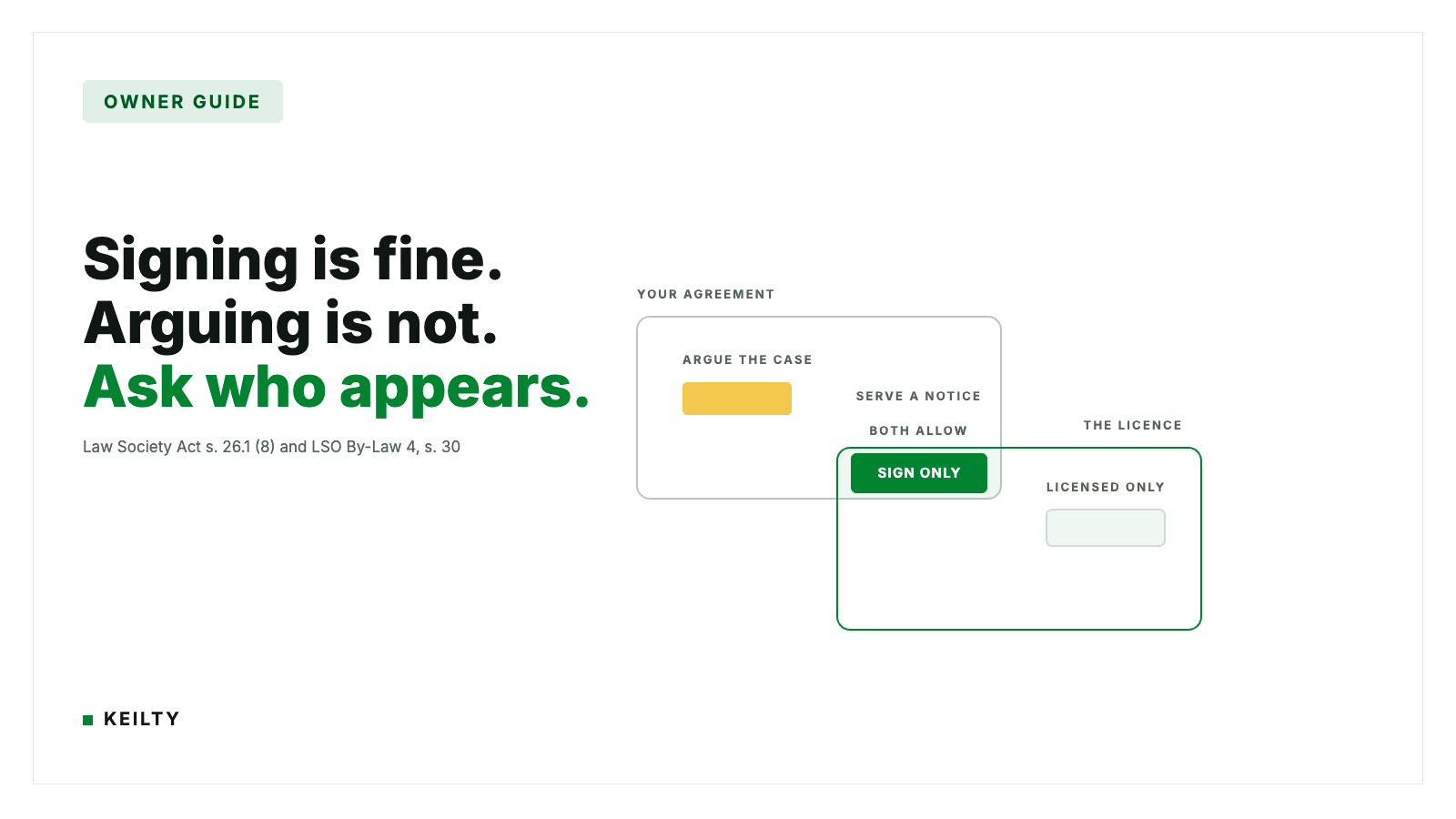
Sometimes, but not because they are your property manager. Being your manager is not by itself a permission to appear at the Landlord and Tenant Board, and on the Board's own published position it can be the reason a person is turned away. The permission comes from somewhere else entirely, and it is worth knowing where before you sign a management agreement.
This matters to an owner in a plain, practical way. If your manager cannot appear, somebody has to: you, a licensed paralegal or lawyer you pay separately, or nobody, in which case the Board may proceed without you or dismiss your application as abandoned. Below is where the permission actually comes from, which of the seven unlicensed routes a manager could realistically fit, what your manager can still do for you either way, and the questions to ask before you hire.
The short version.
The Board's Rules of Procedure answer this in one sentence. Rule A9.1 reads: "Parties may be self-represented, represented by a person licensed by the Law Society of Ontario or by an unlicensed person where permitted by the Law Society Act and its regulations and by-laws."
Read that again for what it does not say. It does not create a category of permitted representative. It points outward, at the Law Society Act and the by-laws made under it. The Board is telling you that it does not decide who may appear; the Law Society regime does, and the Board applies the answer.
So there are three doors. You appear yourself. A licensed lawyer or paralegal appears. Or an unlicensed person appears because a specific by-law exemption lets them. There is no fourth door marked "property manager", and the reason there is no fourth door is that the by-law does not contain one.
The Rules that carry Rule A9 are published as "Effective September 1, 2021" and "Updated July 1, 2026", read at the Board on 2026-09-18.
Because the Act says so in terms, and the route is short.
Section 1 (6) of the Law Society Act lists things that amount to providing legal services. Paragraph 3 of that list reads, in full: "Represents a person in a proceeding before an adjudicative body." That is the complete paragraph, and paragraph 4 follows it.
Then "adjudicative body" is defined in section 1 (1) as "any body that, after the presentation of evidence or legal argument by one or more persons, makes a decision that affects a person's legal interests, rights or responsibilities", and the definition expressly includes "(b) a tribunal established under an Act of Parliament or under an Act of the Legislature of Ontario". The Landlord and Tenant Board is a tribunal established under an Act of the Legislature. It is in.
Section 1 (7) then widens paragraph 3 rather than narrowing it. It provides that "doing any of the following shall be considered to be representing a person in a proceeding", and its first item is "Determining what documents to serve or file in relation to the proceeding, determining on or with whom to serve or file a document, or determining when, where or how to serve or file a document."
That first item is worth sitting with, because it is the one an owner would not guess at. Deciding which application to file and when to serve it is, on the face of the statute, part of representing you. It is not confined to standing up and talking.
One thing the Act does not do is define practising law. It uses the phrase throughout and never defines it. "Provides legal services" is defined; "practise law" is not. Where a distinction between the two matters to your situation, that is a question for a lawyer or paralegal on your facts, not something the statute settles.
No, and this is the subsection that decides it.
Section 26.1 (8) of the Law Society Act reads, in full: "This section applies to a person, even if the person is acting as agent under the authority of an Act of the Legislature or an Act of Parliament."
Subsections (1) to (4) of section 26.1 carry the prohibitions. Subsection (1) reads: "Subject to subsection (5), no person, other than a licensee whose licence is not suspended, shall practise law in Ontario or provide legal services in Ontario." Subsection (8) then closes the agency route to all of it.
Owners reach for agency instinctively, and the instinct is understandable, because agency is exactly what a management agreement creates. The agreement makes your manager your agent for rent, repairs, notices and a great deal else. Section 26.1 (8) says that authority does not extend to appearing for you at a tribunal. The agreement cannot give what the statute withholds.
Subsection (5) is the way out of the prohibition, and it is a pure delegation: "A person who is not a licensee may practise law or provide legal services in Ontario if and to the extent permitted by the by-laws." The Act itself grants nothing. Everything turns on the by-law.
One route sits earlier than that and is worth naming. Section 1 (8) paragraph 1 deems a person not to be practising law or providing legal services at all where the person is "acting in the normal course of carrying on a profession or occupation governed by another Act of the Legislature, or an Act of Parliament, that regulates specifically the activities of persons engaged in that profession or occupation". Where that applies, the prohibition never engages and no by-law exemption is needed.
Whether general residential property management in Ontario is such an occupation is not a question the Act answers, and we are not going to assert an answer to it. It is one for a lawyer or paralegal on your facts.
These readings were taken from the consolidation of the Law Society Act covering December 4, 2024 to the e-Laws currency date of September 15, 2026.
Section 30 of Law Society of Ontario By-Law 4 opens: "The following may, without a licence, provide legal services in Ontario that a licensee who holds a Class P1 licence is authorized to provide under subsection 6 (2):" and then sets out seven categories.
Taken in order, they are: an in-house provider employed by a single employer; a person employed by a legal clinic funded through Legal Aid Ontario; a person employed by a not-for-profit funded by a government; a friend or neighbour acting without compensation in no more than three matters a year; a related person within the meaning of the Income Tax Act (Canada), also without compensation; a member of Provincial Parliament or designated staff acting for a constituent; and a person acting only occasionally and ancillary to another profession or occupation, which the seventh category then limits to members of the Human Resources Professionals Association of Ontario in the Certified Human Resources Professional category.
Six of the seven are closed to a commercial property manager on their face. Two of those six, the friend-or-neighbour and the family categories, also require that no compensation be received, which a manager does receive. One is confined to members of the Human Resources Professionals Association of Ontario in the Certified Human Resources Professional category. That leaves the first.
Category 1 reads: "An individual, other than a Canadian law student or an Ontario paralegal student, who, i. is employed by a single employer that is not a licensee or a licensee firm, ii. provides the legal services only for and on behalf of the employer, and iii. does not provide any legal services to any person other than the employer."
The three limbs are joined by "and", so all three must hold. Limb iii is the limb that does the work, and it is absolute. An individual employed by a management firm who represents one of the firm's clients at the Board has already run against limbs ii and iii on the first file, because the client is not the employer. Failing the test removes the exemption for everything, not only for the matter that broke it.
One licence does not stand in for another, and this is where an owner of a condominium unit can go wrong. The manager of a condominium corporation is licensed under section 34 (1) of the Condominium Management Services Act, 2015, which provides that "No person shall provide condominium management services unless licensed as a condominium management provider or as a condominium manager." That licence comes from a different regulator for a different purpose. It says nothing about whether the person may appear at the Landlord and Tenant Board, and it is not one of the seven categories in By-Law 4.
The words "property manager" appear nowhere in By-Law 4. We searched the whole by-law on 2026-09-18 and the count is zero, as is "property management". The by-law's amendment history on the page ends at May 28, 2026.
It addresses them directly, in one sentence, in its Practice Direction on Representation before the LTB. The sentence reads:
"An unlicensed person seeking to represent a landlord at an LTB proceeding on the basis that they are a property manager may not be allowed to represent the landlord if they are in fact engaged in the business of providing legal services to multiple third parties and do not fall within one of the LSO exemptions."
That is one sentence with two limbs joined by "and", so on its own words both have to be true before the person is barred: engaged in the business of providing legal services to multiple third parties, and outside the exemptions. A manager who acts for one owner only, and who satisfies category 1, is not caught by it.
That sentence is an illustration, though, not the test. The general rule sits above it in the same document and is not discretionary in the manager's favour: "A person who is not licensed by the Law Society of Ontario as a lawyer or paralegal may not represent a party at an LTB proceeding unless that person falls within the specific licensing exemptions established by the LSO." The Practice Direction then adds: "If the adjudicator is not satisfied that an exemption may apply, the unlicensed person may not represent the party." The onus is on the person who wants to appear, and it is discharged at the hearing.
The Practice Direction also lists unlicensed persons who may act, and the list is open rather than closed. It opens "The current exemptions permit the following unlicensed persons, among others, to act as a representative:" and closes "A complete list of approved exemptions is on the LSO's website." The words "among others" do real work. An argument that runs "my situation is not on the Board's list, so it is not permitted" is not available, because the Board has said the list is not complete and has pointed at the Law Society for the full one.
The Practice Direction is published as "Effective as of March 3, 2022", read on 2026-09-18.
Yes to the notice. The application is narrower than it looks. These are the two facts an owner can act on whichever way the licensing question lands, because they describe what a manager can and cannot do for you either way.
On the notice, the Practice Direction records the point plainly: "In Rivera v. Eleveld, 2022 ONSC 446, the Divisional Court confirmed that an agent signing a notice of termination on behalf of a party does not need to be licensed to provide legal services." So an unlicensed manager signing an N4 or an N5 on your behalf is not, on that authority, doing something they need a licence for.
On the application, the Residential Tenancies Act has its own provision. Section 185 (1) is the form and signature rule: "An application shall be filed with the Board in the form approved by the Board, shall be accompanied by the prescribed information and shall be signed by the applicant." Section 185 (2) is the separate power: "An applicant may give written authorization to sign an application to a person representing the applicant under the authority of the Law Society Act and, if the applicant does so, the Board may require such representative to file a copy of the authorization."
Two things follow for an owner. The authorization has to be in writing. And the words "under the authority of the Law Society Act" are doing work inside section 185 (2) as well, so it is not a free-standing route around the licensing question. The Board reads it that way too, describing the power as one to give "a licensed legal representative" written authorization to sign.
There is a wrinkle worth knowing if you go looking for that passage. The Practice Direction attributes the signing power to section 185 (1). On the consolidation we read, section 185 (1) is the form and signature rule and the authorization power is section 185 (2), a separate subsection. The practical instruction is the usual one: check the subsection number against the Act rather than against a summary of it.
The Board also distinguishes the two senses of the word agent, which is where a good deal of owner confusion starts. The Practice Direction says: "The term “Landlord’s Agent” only refers to persons who are acting for the Landlord with respect to an LTB proceeding. There may be different persons acting as the Landlord's agents for non-hearing related purposes. For example, a superintendent may be a Landlord's agent for the purpose of discharging the Landlord's maintenance and repair responsibilities."
Service runs on the same distinction. Section 191 (1) (b) of the Residential Tenancies Act lets a notice or document be given to a landlord "by handing it to an employee of the landlord exercising authority in respect of the residential complex to which the notice or document relates". So an on-site person who is your employee can receive service for you without any of this arising.
Read the limb closely, though: it says employee of the landlord. If your manager works for a management firm rather than for you, clause (b) is not the route, and service runs on the other clauses of section 191 (1) or on the Board's Rules instead. Receiving a document and arguing about it are different acts, and the law treats them differently. If you want the service rules on their own, we have written about what to ask before signing a management agreement, which covers the notice clocks in more detail.
The Board has a power to remove a representative, and it is worth reading the two sources on it together, because they do not say the same thing.
Rule A9.4 is short: "The LTB may disqualify a representative from appearing before it where the representative's continued appearance would lead to an abuse of process." One ground, and the verb is disqualify.
The Practice Direction is wider. It says: "The LTB may exclude a representative from a proceeding where necessary to prevent an abuse of process (for example, because the representative has a conflict of interest) or, in the case of unlicensed representatives, where the LTB finds the representative is not competent to properly represent or to advise the party or witness, or does not understand and comply with the duties and responsibilities of a representative."
Count them and there are three grounds in the Practice Direction against one in the Rule: abuse of process, which reaches every representative; and then two that are expressly confined to unlicensed representatives, being a finding of incompetence to represent or advise, and a failure to understand and comply with the duties of a representative.
Both extra grounds come from a statute the Rule does not have to repeat. Section 184 (1) of the Residential Tenancies Act provides that "The Statutory Powers Procedure Act applies with respect to all proceedings before the Board." Section 23 (1) of that Act carries the abuse of process power, and section 23 (3) lets a tribunal exclude from a hearing "anyone, other than a person licensed under the Law Society Act, appearing on behalf of a party or as an adviser to a witness if it finds that such person is not competent properly to represent or to advise the party or witness, or does not understand and comply at the hearing with the duties and responsibilities of an advocate or adviser."
So the Practice Direction is not adding grounds to Rule A9.4. It is restating a statutory power the Board already has, and its citation line points at Rule A9 and at Hansen v. Toronto (City), 2010 HRTO 13. A Rule cannot subtract a power the Legislature gave.
What an owner should take from this is that the two grounds an unlicensed representative is uniquely exposed to are statutory rather than discretionary housekeeping, and that they are assessed at the hearing, by the member, on the day. Note the carve-out in the words of section 23 (3) itself: it reaches any such person other than one licensed under the Law Society Act.
There is a related divergence worth knowing if your representative may need to give evidence as well as argue. The Practice Direction describes Rule 1.6 (q) as permitting "a licensed representative" to give evidence where appropriate. The Rule itself reads "exercise its discretion to permit a party's legal representative to give evidence where appropriate". Those are not the same word. The Practice Direction resolves it elsewhere in its own text, though.
Unless the Board is given evidence of an express limitation on an Agent's authority, the Agent may act in lieu of the party for all purposes, "including conducting examinations and making submissions, giving evidence and entering into consent orders and mediated agreements that are legally binding upon the party". "Agent" there means the unlicensed representative. So the wording gap in Rule 1.6 (q) is not the obstacle it first looks like.
One more practical rule. A9.3 requires that "Where a representative begins or ceases to act for a client, the representative must immediately advise the LTB and the other parties in writing, and provide up-to-date contact information for the party and any new representative." If you change managers mid-file, that notification is an obligation, and the Board may issue directions to prevent delay.
The statutory exposure sits on the person who provides the service, not on the owner who hired them. Section 26.2 (1) of the Law Society Act provides that every person who contravenes section 26.1 is guilty of an offence and on conviction is liable to a fine of "not more than $25,000 for a first offence" and "not more than $50,000 for each subsequent offence". The section draws no distinction between an individual and a corporation.
A prosecution must be commenced within two years of the date the offence is alleged to have been committed, under section 26.2 (8). Section 26.3 sits outside that clock: it lets the Superior Court, on the Law Society's application, prohibit a person from contravening section 26.1 "whether or not the person has been prosecuted for or convicted of the offence".
The provision an owner should actually read is subsection (3), which is not a fine at all: "The court that convicts a person of an offence under this section may prescribe as a condition of a probation order that the person pay compensation or make restitution to any person who suffered a loss as a result of the offence." The person who suffered the loss, in a case about a rental file gone wrong, could be the owner.
But the real cost to an owner is earlier and duller than any of that. It is a hearing date. If your representative is disqualified or excluded on the morning, you are unrepresented on a file you paid to file. The Board's fee for an L1, L2, L3, L9 or L10 application is published as "$201 or $186 through the Tribunals Ontario Portal", read on 2026-09-18, and the Board's forms page states that "LTB fees are non-refundable."
Three things in Rule 23 of the Board's Rules change that arithmetic, and two of them are in your favour. Rule 23.1 lets the Board order a successful applicant's application fee paid by the respondent as costs, so the fee is recoverable from the tenant even though the Board will not refund it. Rule 23.2 caps what the Board may order for a paid representative's services at $100 per hour to a maximum of $700. And Rule 23.4 lets the Board order its own costs against a party or a paid representative, with Rule 23.5 confining a paid representative's share to costs resulting from that representative's own conduct.
One consequence of an unpaid costs order is worth knowing before it happens. Rule 6.1 bars an applicant who has not paid a fine, fee or costs owed to the Board from filing a new application until it is paid, unless the issues in the new application are urgent, and Rule 6.2 does not treat an arrears and eviction application as urgent.
If an order goes against you because of how the representation question was handled, there is a route and it is short. Section 209 (3) of the Residential Tenancies Act gives you 15 days from the issuance of the order to request a review, unless the Board considers it just and appropriate to extend the time, and Rule 26.5 says the same for an order issued on or after 2026-07-01. The Board's published fee for a request to review an order is $58. Fifteen days is not long to be working out for the first time who your representative actually was.
One more exposure runs the other way, and it is the only provision in the Residential Tenancies Act that names a property manager in a prohibition. Section 134 (2) reads: "No superintendent, property manager or other person who acts on behalf of a landlord with respect to a rental unit shall, directly or indirectly, with or without the authority of the landlord, do any of the things prohibited under clause (1) (a), (b) or (c) or subsection (1.1) with respect to that rental unit." The words "with or without the authority of the landlord" mean your instructions are neither a defence for your manager nor a requirement.
A contravention of section 134 is an offence under clause 234 (l), and section 238 sets the fine at not more than $100,000 for a person other than a corporation and not more than $500,000 for a corporation. Those are larger numbers than the Law Society Act fines above. On a whole-Act search run on 2026-09-18, "property manager" appears four times in the Residential Tenancies Act, and only twice in operative text: here, and in section 47.4 (5). The other two are marginal headings.
The Board raises this itself and then gives it a narrow answer. The Practice Direction says: "In the event of a conflict between the RTA and the LSO rules respecting who may represent a party, the relevant section of the RTA must be applied (RTA section 3(4))."
Section 3 (4) reads: "If a provision of this Act conflicts with a provision of another Act, other than the Human Rights Code, the provision of this Act applies." So the Residential Tenancies Act does prevail over a conflicting provision of another Act, with the Human Rights Code carved out by name.
These readings of the Residential Tenancies Act were taken from the consolidation covering July 1, 2026 to the e-Laws currency date of September 15, 2026. That currency line is load-bearing rather than decorative here, because both the section 238 fines and the 15 day review deadline changed on 2026-07-01.
Two limits on how far that carries an owner. A conflict has to exist before the rule engages, and a statute being silent is not a conflict with one that speaks. And section 3 (4) is about a provision of another Act. By-Law 4 is a by-law, and the Board's own Practice Direction is neither. Whether section 3 (4) reaches them is not something either source works through, and we are not going to assert an answer.
Two other provisions are worth knowing here, because they cut against an owner who assumes structure will solve this. Section 202 (1) requires that "In making findings on an application, the Board shall ascertain the real substance of all transactions and activities relating to a residential complex or a rental unit and the good faith of the participants", and in doing so the Board may, under clause 202 (1) (a), "disregard the outward form of a transaction or the separate corporate existence of participants", and may, under clause (b), "have regard to the pattern of activities relating to the residential complex or the rental unit".
So arranging for the manager to be an employee of a numbered company that owns the building is a structure the Board is expressly empowered to look through. Section 202 (2) switches subsection (1) off for applications under Part V.1 only.
And section 194 (2) provides that "Despite subsection 3 (1) and subject to subsection (3), a settlement agreed to under this section may contain provisions that contravene any provision under this Act."
Whoever stands up for you at mediation can agree to terms the Act would otherwise forbid, subject to the cap in subsection (3), which limits an agreed rent increase to the guideline plus 3 per cent of the previous year's lawful rent and applies to units that are not mobile homes or land lease homes. That is the strongest reason to know exactly who is holding your authority, and what the limits on it are. The Practice Direction also hands you the lever: an Agent acts in lieu of the party for all purposes "unless the LTB is provided with evidence of any express limitation placed upon an Agent's authority". A limitation that lives only in your management agreement does not do the work. It has to reach the Board. Our post on what goes into a property management agreement deals with how that authority should be written down.
You own a fourplex in Trenton and live in Ottawa. A tenant falls behind. Your manager serves an N4, files an L1, and the hearing is set for Tuesday 2026-12-08.
Work through the questions in order.
Did the manager need a licence to sign and serve the N4? On Rivera v. Eleveld as the Board describes it, no.
Did they need your written authorization to sign the L1? Section 185 (1) requires the applicant's signature, so if you did not sign it yourself, section 185 (2) is the route, and it requires written authorization given to a person representing you under the authority of the Law Society Act. The Board may require a copy to be filed.
Can the manager argue it on 2026-12-08? Only if a by-law exemption reaches them. If the person is employed by the management firm rather than by you, category 1 fails before the number of owners matters at all. Their employer is the firm. Limb ii requires the legal services to be provided only for and on behalf of the employer, and limb iii forbids any legal services to any person other than the employer. Representing you, the firm's client, runs against both. A long list of other owners only makes it more visible. The firm's answer then is a licensed paralegal, either in-house or retained.
If nobody appears with standing, the outcomes run from an adjournment, to an unrepresented hearing, to dismissal as abandoned under Rule 9.4. The Board will not refund the $201 or $186, and if the application is dismissed as abandoned you will not recover it from the tenant either, because Rule 23.1 only lets the Board order the fee as costs where the applicant is successful. The arrears keep running. That is the whole cost of not having asked the question in the first week.
Change one fact and the answer changes. If you are an owner with a portfolio large enough to employ someone directly, and that person provides legal services only for you and for nobody else, category 1 can be satisfied on its own terms. The exemption is real. It is just narrow, and it is narrow in a way that a firm managing small multi-family buildings for many owners cannot meet.
Five questions, and they are all answerable in a sentence by a firm that has thought about it.
Who will attend the hearing, by name and by status? The answer is a licensed paralegal, a licensed lawyer, an employee relying on category 1, or you. If the answer is "we handle that", it is not an answer yet.
If it is a licensee, what is the licence number and is it current? The Law Society publishes a directory and it takes a minute to check.
Is representation included in the management fee, or billed separately? Firms differ, and the difference is real money on a file that runs to a hearing.
What written authorization will I be asked to sign, and when? If the answer involves section 185 (2), you want to see the wording before a tenant is in arrears rather than the week of the hearing.
If an unlicensed person is going, which exemption will they name? The Practice Direction requires an unlicensed representative to "be prepared to explain which exemption they believe is applicable", and says that if the adjudicator is not satisfied that an exemption may apply, that person may not represent the party. It separately requires written authorization from you where you are not present. Both of those are the firm's job to have ready, not yours to discover on the morning.
We manage residential and commercial rentals across Eastern Ontario, and we answer those four questions in writing before an owner signs anything, because an owner who finds out the answer on the morning of a hearing has found out too late.
Self-representation is open to you. Section 1 (8) paragraph 3 of the Law Society Act deems a person not to be providing legal services where they are "acting on his or her own behalf, whether in relation to a document, a proceeding or otherwise". No licence, no exemption, no authorization. If you own the property personally and you are willing to take the day, you can appear.
If the owner is a corporation, the Board answers the point directly. Under its heading "Self-Represented", the Practice Direction says: "If the party is a corporation, an employee, or any other person with authority to bind the corporation may participate on behalf of the corporation." So a corporate owner is not shut out. What matters is whether the person has authority to bind the corporation, which is a different question from whether they are your property manager.
Section 1 (8) paragraph 2 of the Law Society Act points the same way for paperwork, deeming an employee or officer of a corporation not to be providing legal services where they select, draft, complete or revise a document "for the use of the corporation or to which the corporation is a party".
What does not get easier is the day. If you live three hours from the building, a Tuesday hearing costs a day whether it takes twenty minutes or four hours.
That is the actual decision. Not whether a manager is worth it in the abstract, but whether you want to be the person on the screen at 9:00 a.m. explaining a rent ledger, and what the alternative costs when you are not.
Can my property manager represent me at the Landlord and Tenant Board? Only if they are licensed by the Law Society of Ontario, or if a specific exemption in By-Law 4 reaches them. Being your property manager is not itself a permission, and the words "property manager" appear nowhere in By-Law 4.
Does a management agreement make my manager my agent for a hearing? No. Section 26.1 (8) of the Law Society Act applies the prohibition to a person even when they are acting as an agent under an Act. The agreement cannot give an authority the statute withholds.
Can an unlicensed manager still sign an N4 or an application? Yes to the notice: the Board records Rivera v. Eleveld, 2022 ONSC 446 as confirming that an agent signing a notice of termination need not be licensed. The application is narrower. Section 185 (2) of the Residential Tenancies Act lets you authorize signature in writing, but only to "a person representing the applicant under the authority of the Law Society Act", and the Board reads that as a licensed legal representative. If your manager is unlicensed and outside every exemption, sign the application yourself.
What can the Board do if my representative should not be there? Rule A9.4 lets it disqualify a representative whose continued appearance would lead to an abuse of process. The Practice Direction adds two further grounds that apply to unlicensed representatives only, being a finding of incompetence to represent or advise, and a failure to understand and comply with a representative's duties.
What is the penalty for representing without a licence? Section 26.2 (1) of the Law Society Act sets a fine of not more than $25,000 for a first offence and not more than $50,000 for each subsequent offence, and subsection (3) lets a court order compensation or restitution to a person who suffered a loss.
If you own a rental in Eastern Ontario and you would like a straight answer on who would attend a hearing for you, tell us about the property and A.J. Keilty will call you within 20 minutes in business hours.
This post is general information about Ontario residential tenancy law as of 2026-09-18, not legal advice. Legislation, regulations and tribunal practice change. For advice on a specific property or situation, speak with a lawyer or licensed paralegal.
Ontario property management with published pricing, same-day answers, and no surprises. Since 2003.
300-80 Queen StreetNot served yet. Join a list and hear from us the day we open.