
By A.J. Keilty, President, KEILTY Realty Management
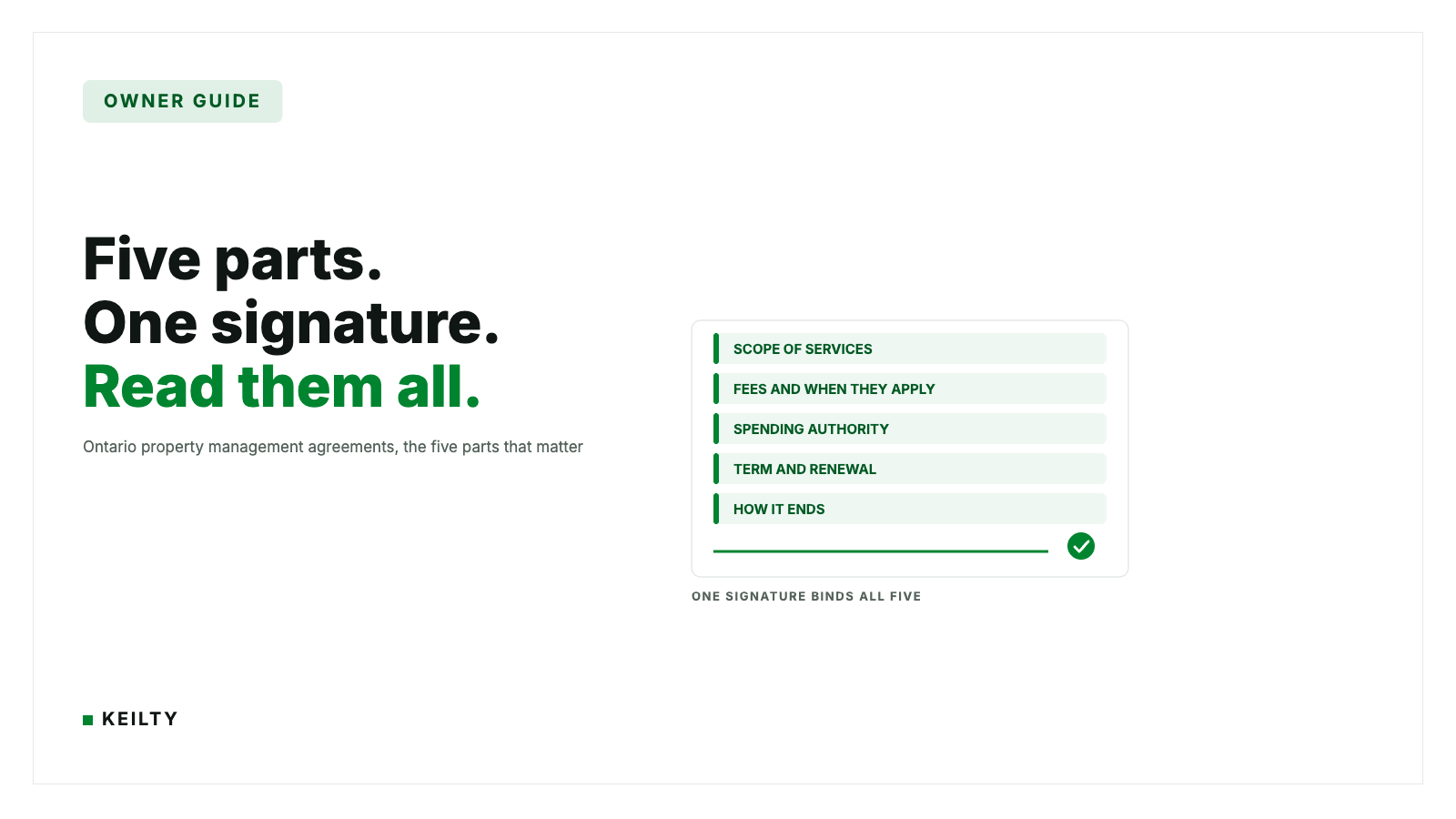
A property management agreement does five things, and everything else in it is detail. It sets out what your manager can do without asking you, what needs your approval first, how your money is held and reported, who is responsible when something breaks or a tenancy goes wrong, and how either side ends the relationship. If you can find those five things in a draft agreement and understand each one, you have read the agreement.
Most owners do not read it that way. They skim for the fee, sign, and discover the rest of it eighteen months later during an argument about a furnace. Below is what each part does, what is worth negotiating before you sign, and the handful of places where Ontario law reaches into the arrangement whether the agreement mentions it or not.
Work, money, and decisions. That is the whole of it.
Here is the point that surprises most owners: the Residential Tenancies Act, 2006 says almost nothing about the contract between an owner and a property manager. The words "property management" do not appear in the Act at all. It names a property manager in only two operative places. Section 134(2) is about how a manager treats a tenant. Section 47.4(5) is narrower still, permitting a landlord who receives a tenant's notice under section 47.1(1) or 47.2(1) to pass it to a superintendent or property manager who needs it to do their job, with section 47.4(6) then applying the same confidentiality duty to that manager. The Act reaches the owner to manager contract itself in one place only: section 214, which stops an agent who represents or assists a landlord in a proceeding from charging a fee based on a proportion of what is recovered, gained or saved above the prescribed proportion, and voids an agreement that provides for such a fee.
That near-silence matters. The Act prescribes no form of management agreement and, apart from that contingency fee rule, no term that fills a gap you left open. Where your manager is a registered brokerage, Ontario's real estate legislation supplies a few default rules about trust money, set out below. Outside those, whatever the agreement says is the arrangement. Whatever it does not say is a conversation you will have later, under pressure, with a vacancy or a flood as the backdrop.
Nearly every agreement asks an ownership group to name one primary decision-maker. At KEILTY we ask for this too, and the reason is unglamorous: a manager holding two contradictory instructions from two co-owners cannot act on either, so the property sits still while the owners sort it out.
Two things to add before you sign. Name an alternate, because the primary contact will eventually be on a plane when a roof opens up. And get clarity on what actually counts as a decision requiring the named contact, as against routine operating choices the manager makes daily. A vague clause here produces either a manager who calls you about light bulbs or one who replaces a boiler without asking.
This is the clause that generates the most friction, and it usually has two parts. There is a routine spending threshold, and there is separate emergency authority.
Emergency authority exists because some situations cannot wait for an email reply. Anything touching safety, habitability, or your insurance coverage should fall in that category. A manager who has to wait forty-eight hours for approval before responding to a burst pipe is a manager who will cost you far more than the repair.
What to look for in the drafting: the routine threshold should be an actual number, not a phrase like "reasonable amounts". The definition of an emergency should be tied to stated conditions instead of left to judgment. And the obligation to report back afterwards should carry a timeframe. "We will report back promptly" is not a timeframe. "Within two business days, with the invoice" is.
Rent collected on your behalf is money held for you. Whether it is held in trust, where it sits, and on what terms are all questions the agreement has to answer, and the answer depends partly on what kind of firm your manager is.
If your manager operates as a brokerage registered under Ontario's Trust in Real Estate Services Act, 2002, which was renamed from the Real Estate and Business Brokers Act, 2002 by section 1 of the Trust in Real Estate Services Act, 2020, then section 27 of that Act governs the trust account. Section 27(1) requires the brokerage to maintain a designated trust account in Ontario at a bank, a loan or trust corporation, or a credit union, to deposit into it all money that comes into its hands in trust for other people, to keep that money "separate and apart from money belonging to the brokerage", and to "disburse the money only in accordance with the terms of the trust".
Two more subsections are worth money to you. Section 27(2) requires a brokerage to "fully and clearly disclose in writing to a person depositing trust money the terms on which the brokerage deposits the money, including whether the money is deposited in an interest bearing account and the interest rate that the brokerage receives on the money." Note who that duty runs to, a person depositing the money, which in a rent collection arrangement is often the tenant and not you. Section 27(3) then reads: "Unless otherwise provided by contract, all interest on the trust money referred to in subsection (1) shall be paid to the beneficial owner of the trust money."
Read those two together. Section 27(2) assumes an account that may or may not bear interest, so the Act does not require an interest bearing trust account at all. But where there is interest, it goes to the beneficial owner, meaning you, unless the contract says otherwise. So the interest on your money is a term of your management agreement, not a fixed rule, and it is one of the few negotiable line items most owners never look at.
Whether a residential property manager has to be registered with RECO in the first place depends on what else that firm does, and the exemptions in the Act are specific enough that it is worth asking outright instead of assuming. Ask who holds your money, in what kind of account, and who receives the interest. Any manager should answer all three without hesitating.
Because a property with no operating float cannot pay a vendor on a Friday. The float exists so trades get paid on time, emergencies get handled without a funding call, and your building does not acquire a reputation among local contractors as the one that pays late.
Negotiate the number, not the concept. A float sized for a twelve-unit building is wrong for a single condominium unit, and the agreement should say how the balance is topped up, from what, and what happens if it runs short.
Many agreements provide that certain items are treated as approved if the owner does not respond within an agreed period. Owners often read that as a manager grabbing authority. It is usually the opposite: it is what stops operations from freezing when an owner is unreachable for three weeks.
It is still a clause to negotiate. Ask which categories of item are subject to it, how long the window is, and how the request is delivered. A deemed approval on a budget line after ten business days is one thing. A deemed approval on a capital project after five is another.
No. This is the single most important thing to understand about the document you are signing.
Section 20(1) of the Act puts the repair obligation on the landlord: "A landlord is responsible for providing and maintaining a residential complex, including the rental units in it, in a good state of repair and fit for habitation and for complying with health, safety, housing and maintenance standards." Section 20(2) adds that this applies even where the tenant was aware of the state of non-repair, or of a contravention of a standard, before entering into the tenancy agreement.
Your agreement with a manager allocates who does that work and who pays for it, as between the two of you. It does not move the obligation off you as far as your tenant and the Landlord and Tenant Board are concerned. Section 4(1), subject to subsection 12.1(11) and section 194, voids a provision inconsistent with the Act or the regulations, but note carefully what instrument it names: a provision "in a tenancy agreement". A management agreement is not a tenancy agreement, so section 4(1) does not even reach it. It does not need to. Your tenant is not a party to your management agreement, and section 20(1) puts the repair obligation on you whatever you and your manager agreed between yourselves. Section 202(1) then directs the Board, in making findings on an application, to ascertain the real substance of all transactions and activities relating to a residential complex or a rental unit and the good faith of the participants, and it may disregard the outward form of a transaction or the separate corporate existence of participants.
The obligations run in the other direction too, and a good manager will tell you so. Section 134(1) opens "Unless otherwise prescribed", which is what allows the narrow list of permitted charges in O. Reg. 516/06, section 17 to survive. Subject to that opener, section 134(2) provides that no superintendent, property manager or other person who acts on behalf of a landlord with respect to a rental unit shall, directly or indirectly, "with or without the authority of the landlord", do any of the things prohibited under clause 134(1)(a), (b) or (c) or subsection 134(1.1). Under paragraphs 2 to 6 of section 29(1) and section 31(1), the Board may make orders against a superintendent or an agent of the landlord, not only against the landlord, so your manager's exposure there turns on their being an agent of yours. Section 235(1) makes it an offence for a landlord, superintendent, agent or employee of the landlord to knowingly harass a tenant or interfere with a tenant's reasonable enjoyment, with section 235(2) providing that carrying out repairs, maintenance and capital improvements does not count unless the timing or manner was intended to harass or the work was done "without reasonable regard for the tenant's right to reasonable enjoyment". Your manager carries real exposure of their own, and you want a manager who knows it.
Get this one in writing, because owners routinely assume their manager will simply appear for them, and the rules are narrower than that.
Rule A9.1 of the LTB's Rules of Procedure, effective 2021-09-01 and updated 2026-07-01, says parties "may be self-represented, represented by a person licensed by the Law Society of Ontario or by an unlicensed person where permitted by the Law Society Act and its regulations and by-laws." The LTB's Practice Direction on Representation, effective 2022-03-03, is more direct: a person not licensed as a lawyer or paralegal "may not represent a party" unless they fall within a Law Society exemption. One listed exemption is an employee employed by a single employer who provides legal services only for and on behalf of that employer.
The Practice Direction then addresses property managers by name. An unlicensed person seeking to represent a landlord on the basis that they are a property manager "may not be allowed to represent the landlord if they are in fact engaged in the business of providing legal services to multiple third parties and do not fall within one of the LSO exemptions." It also requires an unlicensed representative to file written authorization from the party where that party is not present.
So you have three routes, and they carry different burdens. You can attend yourself, self-represented, which needs no licence and no authorization from anyone. If you hold title in a corporation, the Practice Direction allows an employee, or any other person with authority to bind the corporation, to participate on its behalf. Or your manager coordinates the file and a licensed paralegal appears, which costs money but does not turn on an exemption analysis holding up on the hearing date. The last is usually the right answer for an owner with a job, and the agreement should say who arranges it, who instructs the paralegal, and who pays. On fees, section 214(1) caps what an agent representing or assisting a landlord in a proceeding may charge as a proportion of an amount recovered, gained or saved, and section 214(2) voids an agreement that provides for a prohibited fee. O. Reg. 516/06, section 60 sets that allowed proportion at 10 per cent of the amount recovered, gained or saved over a one-year period through the agent's efforts.
An underrated clause, and an expensive one to get wrong. Section 191(1) sets out how a notice or document is sufficiently given, and clause (b) provides that where the person is a landlord, it can be given "by handing it to an employee of the landlord exercising authority in respect of the residential complex to which the notice or document relates". Section 191(2) then deems a notice validly given, even where the method was wrong, "if it is proven that" its contents actually came to the attention of the intended person within the required time period. Note who carries that burden. Section 191(3) deems a mailed notice given on the fifth day after mailing.
Whether your particular manager's staff are caught by clause (b) turns on the arrangement, so do not assume either way. What you can do is make the agreement say how anything served on the manager reaches you, and how quickly. Deadlines under the Act run in days, and a tenant application that sits in someone's inbox over a long weekend is a deadline you are burning without knowing it.
Standard agreements exclude legal, accounting, engineering, and environmental advice, and they should. A manager who coordinates operations is not the right party to give you an opinion on any of those, and one who offers to is telling you something. A good agreement says the manager can arrange qualified third parties and that those decisions remain yours.
Additional services usually sit outside the base scope as well: capital project oversight, insurance claim coordination, enhanced or lender-format reporting. That is a reasonable structure, since you should not pay for capital project management in a year with no capital project. Get the list and its pricing in writing before you sign, not after you need it. For what monthly reporting should contain in the first place, we set that out in what should be in a monthly property management report.
Condominium units get their own clause, and it is not boilerplate. Management operates inside the condominium's declaration, by-laws, and rules, and the clause will normally leave the condominium fees, special assessments, fines, and compliance costs levied by the corporation with you. If you own a condominium unit, read that clause twice.
Structure matters more than the number, because the structure tells you what the manager is being paid to do.
For single-family and small residential, KEILTY charges a flat monthly rate per unit plus a placement fee when a unit is leased. Flat is the part to pay attention to: a flat rate per unit does not rise when your rent rises, so a manager on a flat rate has no reason to prefer a higher rent over a better tenant, and no reason to prefer a fast lease-up over the right one. For buildings and communities the fee is a share of effective gross income, which is the standard for that asset class, and where a building has site staff, those are KEILTY employees whose employment cost is recoverable at cost with no markup added. Current rates for single-family sit on our single-family rental page.
Whatever the structure, the questions are the same. What triggers the placement fee, and is it payable again if a tenant renews? Is the monthly fee charged on rent collected or rent billed, because those differ in a month with arrears? And what is charged on a vacant unit? An agreement that bills a full management fee on a unit producing nothing is a defensible position, but you should know it before you sign, not in month two.
No, and be wary of an agreement that appears to. Screening lowers risk and does not remove it. Market conditions, tenant behaviour, and tribunal scheduling are outside any manager's control, and the Act itself contemplates that things go wrong, which is why it contains an application process.
What an agreement can commit to is process: active marketing, consistent screening, prompt enforcement steps when rent is late, compliance with the Act, and reporting you can audit. Judge a draft agreement on how specifically it describes those, not on optimism about outcomes.
The same five parts, with the weight redistributed. On one door the spending threshold is the clause you argue about. On a 200-unit community the clauses that matter are budget-to-actual reporting, the capital plan approval path, and who employs the site staff, because at that scale operating decisions are a staffing and systems question rather than a series of individual approvals. Our terms for buildings and communities sit on apartment communities, and if you own a building or a portfolio, start there instead.
Read the exit clause before the fee clause. You want a notice period you can live with, and a transition process that names what transfers: final accounting, keys, tenant files, the rent ledger, vendor contacts and equipment documentation, and any LTB matters in progress with their next hearing dates.
Two items go missing in real handovers. The first is last month's rent deposits together with the interest accrued on them, which is your liability to the tenant under section 106(6) and has to arrive with a calculation you can check. We covered how that interest works in whether you have to pay interest on a last month's rent deposit. The second is the tenant communication history, which is the evidence base for any file that later goes to the Board.
None of this is law. It is what a manager would look for reading someone else's agreement.
Ask about insurance separately, and ask your broker rather than your manager. Vacancy conditions, coverage during a turn, and the notice a policy requires when a unit sits empty vary by insurer, and it is your policy.
A good management agreement leaves both sides knowing what happens next, so the awkward conversations happen at signing instead of during a flood. If you cannot find the five parts in a draft you have been handed, that is the question to take back to the manager who wrote it.
Not sure what your property should be renting for before you talk terms with anyone? A free rental evaluation gives you the number and the comparables behind it, with no obligation.
This post is general information about Ontario residential tenancy law as of 2026-08-25, not legal advice. Legislation, regulations and tribunal practice change. For advice on a specific property or situation, speak with a lawyer or licensed paralegal.
Ontario property management with published pricing, same-day answers, and no surprises. Since 2003.
300-80 Queen StreetNot served yet. Join a list and hear from us the day we open.