
By A.J. Keilty, President, KEILTY Realty Management
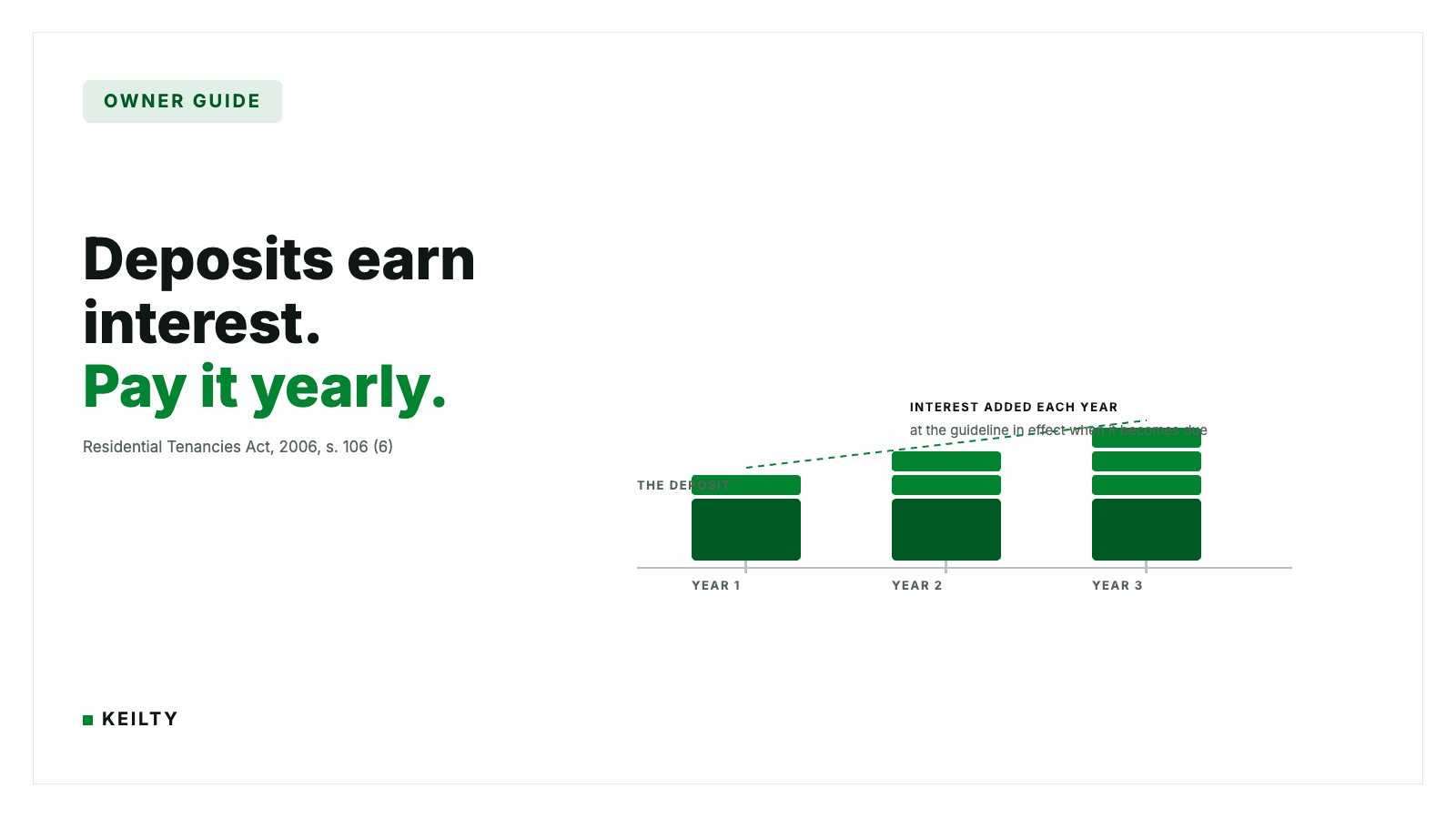
Yes. If you hold a rent deposit in Ontario, you owe your tenant interest on it once a year, every year, whether or not the tenant ever asks for it. The rate is not a fixed historical number. Section 106(6) of the Residential Tenancies Act, 2006 ties it to the rent increase guideline in effect at the time the payment becomes due. Skip it and the tenant is entitled to deduct it from a later rent payment without asking you first.
The part most owners miss is that the same section which creates the obligation also gives you two ways to settle it without writing a cheque. Almost everyone we talk to knows the first half of section 106 and has never used the second.
It is. Section 106(6) says a landlord "shall pay interest to the tenant annually on the amount of the rent deposit." There is no threshold and no exemption for small deposits. Nor can you contract out of it: section 4(1) makes a provision in a tenancy agreement that is inconsistent with the Act or the regulations void, subject only to subsection 12.1(11) and section 194. A clause saying the tenant waives deposit interest is worth nothing.
Worth being precise about what you are holding. Section 105(1) is blunt: the only security deposit a landlord may collect is a rent deposit collected in accordance with section 106. Ontario has no damage deposit and no pet deposit. We covered that ground in what landlords can legally collect. Section 106(2) caps the deposit at the lesser of one rent period and one month of rent, and section 106(1) lets you require it only on or before entering into the tenancy agreement. So you cannot decide in month four that you would like a deposit after all. Two later routes do exist, and they are narrow: section 106(3) for an additional amount once the lawful rent has increased, and section 106(5) for a new landlord who bought from a person deemed to be a landlord under subsection 47(1) of the Mortgages Act.
Take the amount of the rent deposit and multiply it by the guideline percentage in effect when the payment becomes due. That is the whole calculation. The rate has nothing to do with your mortgage or a bank posted rate, and note that the deposit you multiply is whatever the deposit stands at that year, which can grow if you use the section 106(7) route below.
Write the rule down rather than the number, because the number moves every year. Ontario publishes the guideline annually on its residential rent increases page. As of 2026-08-17 that page lists 2.1% for 2026 and 1.9% for 2027, following 2.5% in 2025. If you hard-coded a figure into a spreadsheet three years ago, your spreadsheet is wrong now.
The Landlord and Tenant Board sets out the same method in its Form T1 instructions, using a deposit of $1,000 paid on 2013-08-01 with the interest cheque issued on 2014-07-31. Because the payment came due in 2014, the landlord used the 2014 guideline of 0.8%, which produced $8.00. The year the money is owed governs, not the year the deposit was taken.
Annually. The Act says only that, and it does not name a calendar date. The LTB's example measures the year from the date the deposit was paid: a deposit paid on 2013-08-01, with the interest cheque handed over on 2014-07-31 for one year's worth. So the useful date to track is when the deposit was actually paid, which is not always the day the tenancy began, since section 106(1) allows the deposit to be taken before the agreement is entered into.
That date drives the rate, not just the timing. Two tenancies in the same building can attract different guideline percentages in the same twelve months, because the guideline changes at the calendar year boundary and their payments come due on either side of it. If you manage more than a handful of units, the deposit date belongs in your rent roll next to the lease end date.
Two things, and neither is good for you.
First, section 106(9) lets the tenant self-help. Where the landlord has failed to make the payment when it came due, the tenant may deduct the amount from a subsequent rent payment. No application, no hearing, no notice to you. If your accounting treats that deduction as arrears and you file on the shortfall, you are filing on money the tenant was entitled to keep back, and you have paid a filing fee to find out.
Second, the tenant can apply under section 135(1) for an order that you pay money collected or retained in contravention of the Act. Unpaid deposit interest is one of the eight listed reasons on the LTB's Form T1, which a tenant can file online through the Tribunals Ontario Portal or by mail or courier. Section 135(4) bars an order on an application filed more than one year after the money was collected or retained. Do not read that as a clean one-year amnesty on a long tenancy. The reading that treats each missed annual payment as its own event, so that only the older ones fall away, is Board practice rather than words on the page, and practice is not something you want to bet a hearing on.
The arithmetic is small and the exposure is not. On a $1,800 deposit at roughly two percent, one missed year is about $36. Six missed years on a long-standing tenancy is a few hundred dollars, a T1, a hearing date, and a tenant who now reads everything you send with suspicion.
Yes, and this is the part that gets left out of almost every article on the subject. Section 106(3) says that if the lawful rent increases after a tenant has paid a rent deposit, you may require the tenant to pay an additional amount to bring the deposit up to the maximum permitted by section 106(2). That maximum is the lesser of one rent period and one month of the current lawful rent, so for the ordinary monthly tenancy it is one month at today's rent.
A deposit frozen at the rent from 2016 on a unit renting for meaningfully more today is money sitting on the table. It is also your thinnest cushion at the end of the tenancy, because section 106(10) requires you to apply the deposit to the last rent period. If the deposit is short, the last month is short.
Then section 106(7) earns its keep. You may deduct, from the interest you owe under section 106(6), the amount by which the maximum permitted deposit exceeds the deposit the tenant actually paid. The deducted amount is deemed to form part of the rent deposit paid by the tenant. So instead of mailing interest out one door and invoicing a top-up through the other, you apply one to the other.
Take a Belleville townhouse. The tenant paid a $1,600 rent deposit at the start of the tenancy. The lawful rent has since reached $1,750, and this year's payment comes due in a year when the guideline is 2.1%.
You pay no cash. The $33.60 is deemed part of the deposit, which now stands at $1,633.60. Under section 106(3) you may require the tenant to pay the remaining $116.40 to reach $1,750. Your last-month cushion has moved from $1,600 to as much as $1,750, and the interest obligation for that year is discharged.
Do it in writing and keep the letter. Show the deposit held, the guideline applied, the interest calculated, the deduction taken, and the balance requested. Section 109(1) requires you to give a receipt free of charge, on request, for rent, a rent deposit, arrears, or any other amount paid, and section 109(2) extends that to a former tenant who asks within twelve months of the tenancy ending. A clear annual letter answers that request before it arrives.
Section 134(1)(a) is where owners get caught. Unless otherwise prescribed, no landlord shall collect, require, or attempt to collect or require from a tenant, prospective tenant, or former tenant "a fee, premium, commission, bonus, penalty, key deposit or other like amount of money whether or not the money is refundable". A late fee is a penalty and an administration fee is a fee, so both are caught by name, and the closing words "or other like amount of money" sweep up whatever you decide to call it instead. Note the opening qualifier though: the prohibition yields to anything prescribed by regulation, which is how the narrow permitted charges below survive. Our post on what you can and cannot add to rent works through the consequences.
Two narrow things do survive. The LTB's T1 instructions confirm that requiring a tenant to pay your reasonable cost of having replacement keys made, when the tenant lost the keys, is not an illegal charge, and equally confirm that you cannot charge for replacement keys where you decided to change the locks. That exception turns on who caused the change.
The other is the returned cheque. Section 5 of the Ontario Standard Lease sets out when rent is paid, to whom, by what method, and any administrative charge for cheques returned by a financial institution, as Ontario's guide to the standard lease describes. If you want to recover a bank charge, the number belongs in section 5 at signing. It will not appear by implication later.
No, and read the verb carefully before you write the rule down. Section 108 says neither a landlord nor a tenancy agreement shall require a tenant or prospective tenant to provide post-dated cheques, or to permit automatic debiting, credit card charging, or any other form of automatic payment. It bars requiring. It does not stop a tenant who offers.
Plenty of residents prefer preauthorized debit and set it up gladly. That is fine. Making it a condition of the tenancy, or printing it as mandatory on your application, is not.
Section 106(10) requires you to apply the deposit to the rent for the last rent period before the tenancy terminates. You do not return it as cash and you do not hold it against damage. It becomes the final month's rent, which is why keeping it topped up under section 106(3) matters more than it first appears.
There is also a case where the deposit goes back. Section 107(1) says you must repay the amount received as a rent deposit if vacant possession is not given to the prospective tenant. Section 107(2) carves out one situation: if that person agrees to rent a different unit from you before they would have taken possession, you may apply the deposit to the other unit and repay only the excess, if any, over what section 106 permits for that unit. Useful when a unit is not ready and you move an incoming resident down the hall.
Pull your rent roll and run four columns: deposit held, the date the deposit was paid, current lawful rent, and the date interest was last paid. Any row where the deposit is below one month of current rent is a section 106(3) opportunity. Any row where the last payment is more than a year old is a section 106(9) deduction waiting to happen.
At KEILTY we treat deposit interest as a scheduled annual task rather than something a tenant reminds us about, because the version where a tenant raises it first is always more expensive. A single missed payment is small. A portfolio of them, discovered all at once at a hearing, is not.
If you are not sure what your units should be renting for, or whether your deposits have kept pace with your rents, our management fee is a flat monthly rate per unit rather than a percentage, so it does not climb as your rent does. You can see how that works for houses and condos on single-family rentals. If a rent increase is on your mind for next year, our post on the 2027 guideline covers the notice timing.
Want a straight answer on what your rental should earn and whether your paperwork is holding up? Book a free rental evaluation and we will look at the actual unit.
This post is general information about Ontario residential tenancy law as of 2026-08-17, not legal advice. Legislation, regulations and tribunal practice change. For advice on a specific property or situation, speak with a lawyer or licensed paralegal.
Ontario property management with published pricing, same-day answers, and no surprises. Since 2003.
300-80 Queen StreetNot served yet. Join a list and hear from us the day we open.