
By A.J. Keilty, President, KEILTY Realty Management
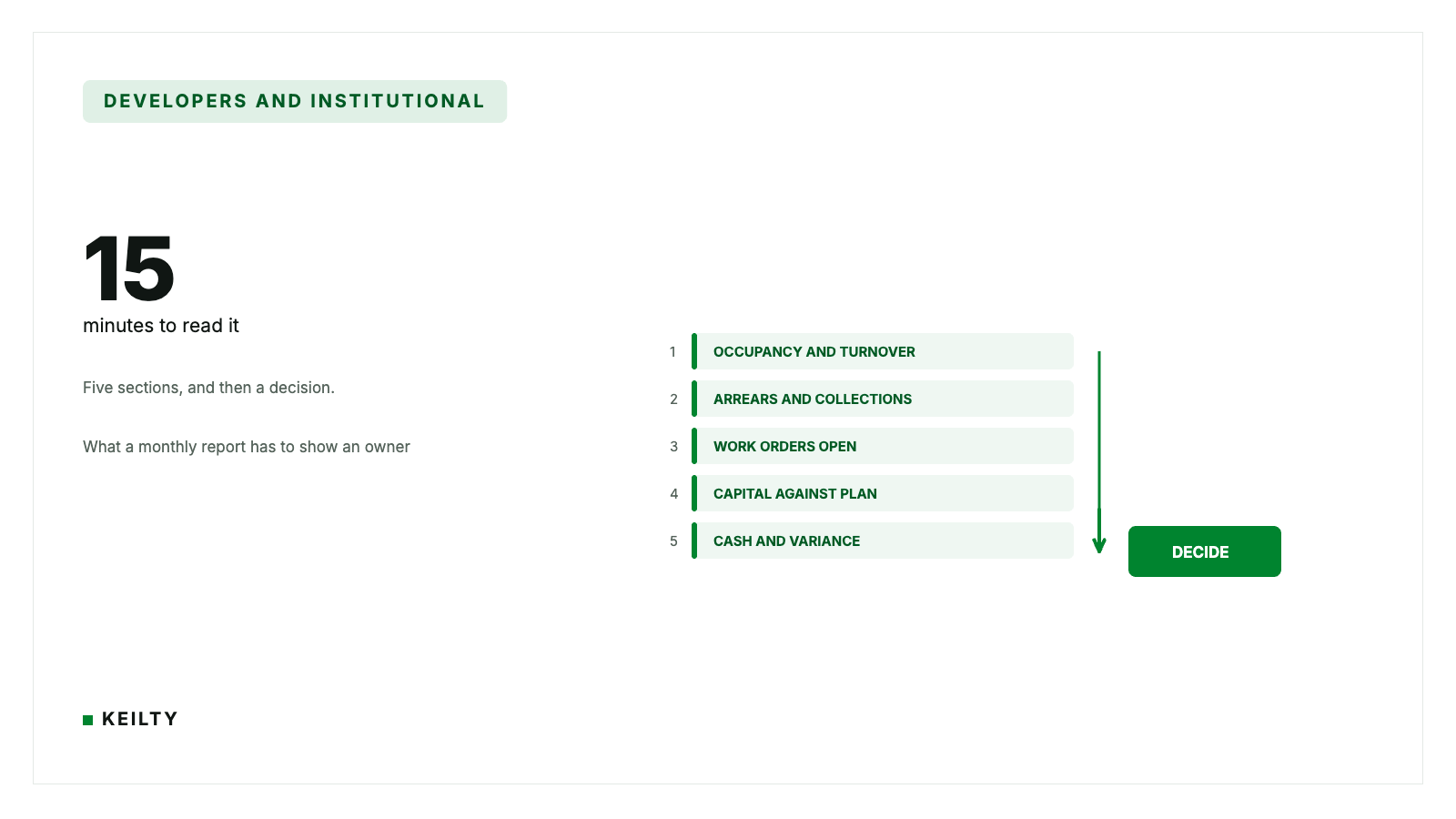
A monthly report on an apartment building should let you answer three questions without picking up the phone: did the building make its budget, which money is at risk right now, and what is the manager doing about it. That takes five sections. A budget-to-actual operating statement, a rent roll with arrears aging, a leasing and vacancy page, a maintenance and capital page, and a compliance page for whatever your lender, insurer or municipality requires. Most packages we inherit have the first one and half of the second.
Below is what each section should contain, and the line items owners tell us were missing until the year they needed them.
It should make you useful in a fifteen minute read. You are not auditing the manager. You are deciding what to fund, what to escalate, and what to leave alone for another month. A report that requires you to build your own spreadsheet before you can form a view has failed, no matter how many pages it runs.
The test we use at KEILTY is simple. If an owner has to email us to ask a question the report should have answered, the report is short a line. Over a few hundred doors that email traffic is the real cost of a weak package, not the reporting itself.
Budget-to-actual, at the account level, for the month and year to date, with a variance column in dollars and in percent. Not a bank summary. Not a cash-in cash-out list. The comparison to budget is the whole point, because a number without a plan beside it tells you nothing.
Two definitions worth pinning down, since managers use them loosely. Effective gross income, or EGI, is gross potential rent at the rents on the rent roll, plus parking, laundry, storage and other ancillary income, less vacancy loss and less bad debt. Net operating income, or NOI, is EGI less operating expenses, before debt service and before capital. If a report shows you NOI with a roof replacement buried in it, you are not looking at NOI.
The single most useful normalizing figure is operating expense per suite. Take a 180 suite community in Kingston with annual operating expenses of $1,431,000. Divide 1,431,000 by 180 and you get $7,950 per suite per year, or $662.50 per suite per month. That figure is what lets you compare this building to the one you bought in Peterborough, compare this year to last, and sanity-check a manager's budget before you approve it. Ask for it on the statement rather than working it out yourself every month.
Set a threshold and put it in the management agreement, otherwise you get commentary on everything or commentary on nothing. A workable rule is the greater of a fixed dollar amount and a percentage of the line, tested against the budget for the period you are reporting. Take a grounds and snow line budgeted at $96,000 a year, which is $8,000 a month. Under a rule of the greater of $1,000 and 5 per cent of the monthly budget, 5 per cent of 8,000 is $400, so the trigger is the $1,000. A $1,400 overrun in the month needs a paragraph. A $600 one does not.
The written explanation matters more than the number. "Repairs and maintenance over budget $6,200" is not commentary. "Repairs over budget $6,200, of which $4,900 was the two rooftop unit compressor failures in the north block, quoted replacement in the capital plan for next year, deferred once already" is commentary. You can act on the second one.
A rent roll by suite, with market rent, actual rent, lease start, lease end and whether the tenancy has gone month to month. Then arrears, aged into buckets: current, 1 to 30 days, 31 to 60, 61 to 90, and over 90. Aging is what turns a total into a decision. A $38,000 arrears balance that is almost all inside 30 days is a collections week. The same balance sitting past 90 days is a different problem with a different answer.
Three lines get left out of almost every package we inherit, and all three are money.
The first is former tenant receivables, with a clock on them. Once a tenant is out, your window to apply to the Landlord and Tenant Board for arrears does not stay open. Section 87(1.1)(b) of the Residential Tenancies Act, 2006 allows an arrears application to be made no later than one year after the tenant or former tenant ceased to be in possession of the rental unit. Section 87(1)(b) adds a condition on that route, that a tenant or former tenant no longer in possession must have ceased to be in possession on or after the day subsection 18(1) of Schedule 4 to the Protecting Tenants and Strengthening Community Housing Act, 2020 came into force. If nine suites turned over in the year carrying an average balance of $2,340, that is $21,060 riding on a date nobody is tracking. Nine multiplied by 2,340 is 21,060. Ask for the schedule with the possession-ended date on every row.
The second is the rent deposit liability and the interest running on it. Section 106(6) requires a landlord to pay interest to the tenant annually on the rent deposit, at a rate equal to the guideline determined under section 120 that is in effect at the time payment becomes due. Write the rule down, not the year's number, because the guideline changes annually. The report should carry the deposit balance per suite and the date interest was last paid. We wrote about the mechanics in detail in our post on rent deposit interest.
The third is deposits that have fallen behind the rent. Section 106(3) says that if the lawful rent increases after a tenant has paid a rent deposit, the landlord may require the tenant to pay an additional amount to bring the deposit up to the amount permitted by subsection (2). Subsection (2) caps the deposit at the lesser of one rent period and one month. On a building with long tenancies, the gap between the deposit on file and the current rent can be real money sitting unrequested. No report shows this unless you ask for it, so ask for a column comparing the deposit held to the current lawful rent.
Occupancy on its own is a lagging number. What you want is the pipeline that produced it: notices received, suites available, applications, approvals, signed leases, and move-ins, for the month and the two months ahead.
Then the operating metrics. Days-to-lease is the average number of days from a suite becoming available to a signed lease. Turn cost is what it costs to get a vacated suite ready to show, split between routine make-ready and anything chargeable. A concession is rent or value given away to sign a lease, a free month or a parking credit, and it needs its own line because it does not show up in the face rent.
Convert the vacancy into a daily figure so it competes properly with the cost of fixing it. Six vacant suites in that same 180 suite building at an average rent of $1,780 is $10,680 a month of income you are not collecting. Six multiplied by 1,780 is 10,680. Divided by 30, that is $356 a day across the six, or about $59 a day per suite. Now price a request properly. When a manager asks for $4,000 to accelerate three turns, those three suites carry about $178 a day between them, so the spend only pays for itself if it pulls roughly 22 days out of each of the three.
If the building is new or repositioned, the package also needs an absorption curve, meaning leases signed per week against the plan, and a stated stabilization date. Stabilization is the point at which occupancy and rents hold at the underwritten level rather than at the lease-up level. We covered realistic timelines for this in our post on lease-up timelines for new Ontario buildings.
Work orders opened, closed, and still open, aged. Open counts on their own hide the problem. Four work orders open for 40 days is a worse building than forty open for two days.
Separate operating repairs from capital. Then show the capital plan as a live document: what was approved for the year, what has been spent, what is committed but not yet invoiced, and what has slipped. Slippage is the number owners find out about last, usually in a year-end package when it is too late to move the money.
Three practical items belong here too, and they are practice rather than anything the legislation imposes. Insurance certificate and policy expiry dates should be tracked on the report, and any question about what a policy actually requires of you during a vacancy or a major capital job should go to your broker, since wordings differ. Utility accounts and consumption should be shown month over month, because a consumption spike is often the first sign of a leak or a failed control. And access records, meaning who holds keys and fobs and when they were last reconciled, should be reported at least twice a year.
This is the section that separates a building-scale package from a scaled-up single-family report, and it is the one that gets built after the first request rather than before it.
If the asset is financed under CMHC's MLI Select, your commitments are not one-time. CMHC's MLI Select product page, read on 2026-08-18, states that affordability criteria apply for a minimum of 10 years, and that borrowers who commit to 20 years receive an additional 30 points. For the full length of that commitment, base affordable rents on the designated affordable units must not increase by more than the annual increase permitted under applicable legislation or regulations, and where no legislation or regulation applies, increases are limited to the applicable consumer price index. CMHC also states that beginning in 2027 it will require the use of the lowest CPI for applicable properties.
CMHC publishes an Affordability Criteria Annual Certificate of Compliance for this. That form is the reason your monthly rent roll needs a flag on every designated affordable suite and a record of the last increase taken on it. Reconstructing ten years of increases on designated suites from a filing cabinet is a bad week. Carrying the flag monthly costs nothing.
On the energy side, CMHC's page states that within 60 days of the final advance the Approved Lender must obtain from the borrower a signed attestation stating that the Energy Efficiency Criteria has been satisfied. That is a construction and closing obligation rather than an operating one, but the operating report is where the underlying consumption data has to come from, which is another reason to put utilities on the monthly.
Filings are a real operating line at building scale and they are almost never budgeted. The Tribunals Ontario fee table on the forms, filing and fees page, read on 2026-08-18, puts Forms L1, L2, L3, L9 and L10 in a single row at $201, or $186 through the Tribunals Ontario Portal.
Run that at portfolio scale. Assume twenty-four L1 applications in a year on the 180 suite building, filed through the Portal at $186. That is $4,464. Twenty-four multiplied by 186 is 4,464. Divided by 180 suites, that is $24.80 per suite per year in filing fees alone, before any staff time. If that line is not in your budget, it is coming out of something else.
The report should also show which collection route each balance is on, because the two carry different records. Where the tenant is still in possession, the file rests on the rent ledger. Where the tenant has gone, the claim is a Form L10, and it must be brought within the one year limit in section 87(1.1)(b), which makes the date possession ended a fact you need on file. Same money, different work, and only one of them has a deadline that expires quietly.
Ask for a redacted sample package from a live building of similar size. Not a template. A real one, with commentary written by the person who would be writing yours. You will learn more from the variance narrative than from any pitch deck.
Then confirm four things in writing: the delivery date each month, the variance threshold that triggers written commentary, who signs off on the package, and what happens to the reporting cadence during a lease-up or a major capital project when you need it more often than monthly.
At a smaller count the same principles apply with less apparatus. On a ten or twenty suite building you still want budget-to-actual, arrears aging and a former tenant schedule, but the capital plan and the lender compliance page compress into a page each. The small multi-family side of our business runs the same reporting spine at a lighter weight.
If you own or are building an apartment community in Ontario and your current reporting leaves you emailing for answers, we are happy to walk through what a KEILTY package looks like against what you get today. Start on our apartment communities page, or reach out and we will set up a portfolio conversation.
This post is general information about Ontario residential tenancy law as of 2026-08-18, not legal advice. Legislation, regulations and tribunal practice change. For advice on a specific property or situation, speak with a lawyer or licensed paralegal.
Ontario property management with published pricing, same-day answers, and no surprises. Since 2003.
300-80 Queen StreetNot served yet. Join a list and hear from us the day we open.