
By A.J. Keilty, President, KEILTY Realty Management
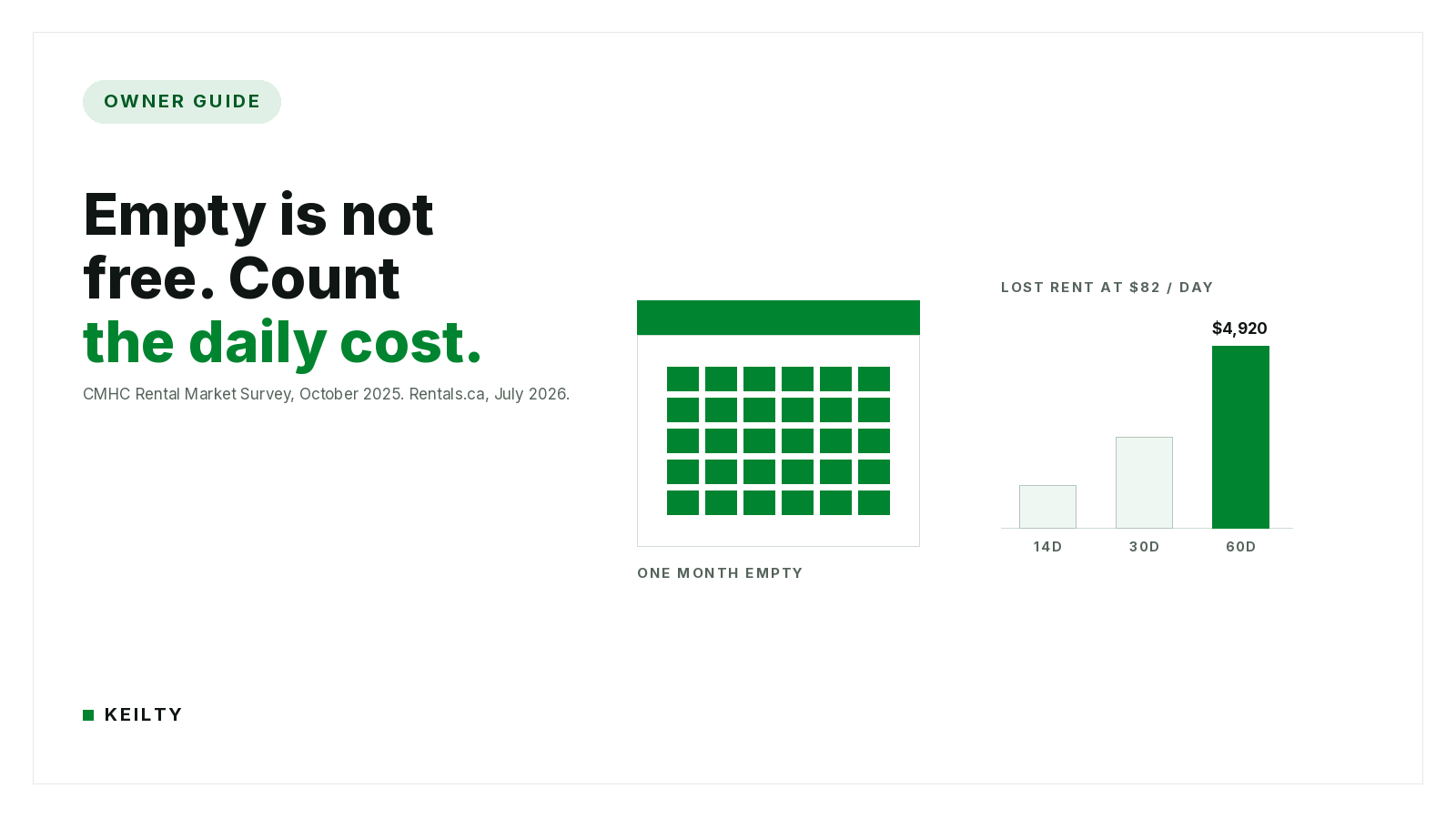
Take the annual rent and divide it by 365. A unit at $2,100 a month is $25,200 a year, which is $69 a day. A house at $2,500 a month is $82 a day. That lost rent is the cost of the vacancy, and it is the number to plan around.
What vacancy adds on top is smaller than most owners expect: the utilities that revert to you, the heat you have to keep on in an Ontario winter, and the turnover work. Your mortgage, taxes and insurance are not part of it, and the reason why is worth a section of its own.
The part that does not come back is the rent. Rent you did not collect in August does not reappear in September. There is no catch-up month, no arrears order, no payment plan. The only variable you control is how many days it keeps disappearing.
Because you owe them either way. A vacant unit does not generate a property tax bill that a full unit would have avoided. The mortgage payment is the same in a month with a tenant and a month without one. Those costs are caused by owning the property, not by the vacancy.
What the vacancy does is remove the income that was paying them. That is the loss, and counting it twice, once as missing rent and again as a mortgage payment, inflates the number and makes the arithmetic impossible to check.
The distinction matters in practice. If you tell yourself an empty unit costs $172 a day when the rent is $82, you will overpay to avoid vacancy, take a weaker tenant, or accept a rent that is below market for years. Use the real number.
One caveat on the mortgage. If you are looking at the cash you have to find from your own pocket during the vacancy, the full payment is relevant, because that is what leaves your bank account. If you are measuring the economic loss, only the interest is gone; the principal portion is still yours as equity. Two different questions, two different numbers.
Three things, and only the first two are daily.
Utilities revert to you. In a tenant-pays arrangement, the accounts come back to the owner between tenancies. On a detached house in eastern Ontario this runs a few dollars a day in summer and considerably more in winter. Keeping a house at 15 degrees through January so the pipes do not freeze can cost $200 to $350 for the month on its own, and you cannot simply shut the heat off. Most insurers require heat and periodic inspections on a vacant dwelling, and many policies restrict coverage after 30 days of vacancy unless you tell them.
Municipal minimums keep billing. Most Ontario municipalities charge a water and sewer base rate that applies at zero consumption.
Turnover work. Paint, cleaning, small repairs and a lock change. Across the units KEILTY turns in eastern Ontario, this typically lands between $900 and $2,500 depending on how the unit was left. That is a one-time cost rather than a daily one, but it falls in the same window and belongs in the same budget line.
Put it together for a three-bedroom house in Oshawa renting at $2,500. Rent is $82 a day. Reverted utilities in a cold month add roughly $10 a day. Call it $92 a day, plus a turnover bill once. That is the whole picture, and every piece of it can be checked.
Our vacancy loss calculator runs this for a specific address, and the rental income calculator shows what the same unit produces once it is occupied.
Asking rents are falling across most of the province, which changes the arithmetic in both directions. As of July 2026, average asking rent in Canada was $2,037, down 4.0 per cent year over year and the twenty-second consecutive month of annual decline, according to the Rentals.ca national rent report. Ontario was down 3.7 per cent.
Thirty days empty on a Kingston two-bedroom at $2,200 is about $2,170 of rent you will never bill. Sixty days is $4,340. That is more than most owners spend on maintenance in a year.
Longer than it was two years ago, and the pricing side has moved further than the vacancy side.
The current vacancy figures come from CMHC's Rental Market Survey, which is run each October and released in December. The 2025 Rental Market Report, published 2025-12-11 on October 2025 fieldwork, put the national purpose-built vacancy rate at 3.1 per cent, up from 2.2 per cent a year earlier. Toronto reached 3.0 per cent, the first time it has hit that level since before the pandemic. Ottawa also came in at 3.0 per cent, with newly built units at 6.7 per cent, more than double the city average. CMHC does not run a mid-year vacancy survey, so anything published between December and the following December is still describing the October reading.
What that means for a specific unit is less tidy. A well-priced unit marketed on the first day of vacancy leases quickly; an overpriced one can sit for two months. Across the units KEILTY manages in eastern Ontario, the gap between those two outcomes is routinely six weeks. At $82 a day, 46 days is $3,772.
We wrote more about the shift in what rising vacancy and falling asking rents mean for landlords.
Not on vacancy, and this is worth knowing if you own here.
Vacancy rose almost everywhere in Ontario in the October 2025 survey. Kingston went the other way. The Kingston CMA rate came in at 2.4 per cent, down half a point from 2.9 per cent the year before, according to the City of Kingston's summary of the CMHC data. Three-bedroom units were tightest at 1.2 per cent. The rate is still above Kingston's ten-year average of roughly 1.8 per cent, but the direction was down while the province loosened.
Asking rents did fall. Statistics Canada put Kingston's two-bedroom asking rent down close to 6 per cent in the first quarter of 2026 against the same quarter a year earlier, the largest year-over-year decline of any census metropolitan area in the country. So Kingston owners are looking at a market that is competitive on price but not especially loose on supply. Those two facts pull in different directions and both are true.
Run the break-even, and run it over the same horizon as the alternative.
Say the unit is worth $2,100 and you list at $2,200 because a neighbour got it. The extra $100 a month buys back the lost rent in 21 months. Over a 24-month tenancy you are ahead by about $200 before carrying costs, and behind once you add the reverted utilities from the extra vacant month. You are also betting that the $2,200 tenant shows up at all, because if you take $2,100 after the extra month you have simply lost the month.
Same discipline, and here is the part owners miss.
Drop $75 below your target and suppose it fills the unit 21 days sooner. The gain is one-time: 21 days at $69 is $1,449. The cost is not one-time. Under rent control the discount is baked into the tenancy for as long as it lasts, and every guideline increase after that compounds off the lower base. At the 2026 guideline of 2.1 per cent, a $75 gap becomes a $76.57 gap after the first increase and keeps widening.
The break-even lands at about 19 months. Under that, the discount wins. Over it, the discount costs you, and on a five-year tenancy it costs you badly.
So both moves, holding out and discounting, break even somewhere around 20 months, which is close to a typical Ontario tenancy. That is the real finding. Price gymnastics in either direction are close to a coin flip, and the reliable gains are somewhere else: marketing before the unit is empty, showing it often, and screening fast. Those cost nothing and they do not compound against you for years.
The math changes if the unit is exempt from rent control, where you can reprice annually and the discount is not permanent.
Price is first and it is not close. After that:
November through February. Enquiry volume drops, the applicant pool thins, and the heating bill arrives anyway. A unit that goes vacant in early November often does not lease until the new year, which is 60 days at full cost during the most expensive season to hold a property.
May through September is when the market is deepest. If you have any control over when a tenancy ends, that is the window to aim for. We laid out the timing in the September turnover playbook.
Yes, and this is where owners give away most of their runway.
Under section 26(3) of the Residential Tenancies Act, 2006, once you and the tenant have agreed the tenancy is ending, or either of you has given notice of termination, you can enter to show the unit to prospective tenants without written notice. Three conditions apply: the tenancy has to be ending, you have to enter between 8 a.m. and 8 p.m., and before entering you must inform the tenant or make a reasonable effort to do so.
The 24 hours' written notice rule that gets quoted constantly is section 27, and for showings it covers prospective purchasers, not prospective tenants. Different provision, different trigger. Getting it backwards is how landlords end up with a T2 application over an entry they were entitled to make.
A tenant on a monthly or yearly tenancy who gives proper notice gives you 60 days. Owners who wait until the keys come back have thrown away most of that.
Five lines. Do it once and keep it on the first page of the property file.
Separately, and only if you are checking cash flow rather than economic loss, add up the mortgage payment, property taxes and insurance for the same period. That is the money you have to fund yourself while the unit is empty. Do not add it to line 3 and call it the cost of the vacancy.
The vacancy loss calculator handles lines 1, 4 and 5 today.
Mostly through speed. Same-day enquiry response, showings six days a week, screening turned around in 24 hours, and trades booked before the unit empties. On the turns KEILTY takes over from self-managing owners, cutting a six-week vacancy to under three weeks is a common result, and at $2,200 a month that is about $1,500 of rent that would otherwise have gone.
The fee structure matters here too. KEILTY charges a flat monthly rate per unit rather than a percentage of rent, plus a placement fee when we lease the unit. A flat rate does not climb as your rent climbs, so the gain from a rent increase stays with the owner. Current rates for houses and small portfolios are on the single-family rental page, and buildings are priced on the small multi-family and apartment communities pages.
If you want the comparison side by side, we broke down the trade-offs in property management versus self-management.
Annual rent divided by 365, plus the utilities that come back to you. On a $2,500 house in a cold month that is about $92 a day. When you are deciding whether to hold out for another $75, whether to spend $400 on paint, or whether to drive across town for a Tuesday evening showing, that number tells you what the delay is worth.
It is usually more than owners assume, and it is usually less than the inflated version they were quoted.
If you want the daily carrying cost for a specific address, along with a current market rent and a realistic view of how long it should take to lease, request a free rental evaluation. KEILTY manages residential and commercial rentals across Ontario, from Kingston and Belleville through Peterborough, Oshawa and Ottawa, and we are happy to look at your numbers before you commit to a plan. You can also just get in touch.
This post is general information about Ontario residential tenancy and human rights law as of 2026-08-07, not legal advice. Legislation, regulations and tribunal practice change. For advice on a specific applicant, property or situation, speak with a lawyer or licensed paralegal.
Ontario property management with published pricing, same-day answers, and no surprises. Since 2003.
300-80 Queen StreetNot served yet. Join a list and hear from us the day we open.