
By A.J. Keilty, President, KEILTY Realty Management
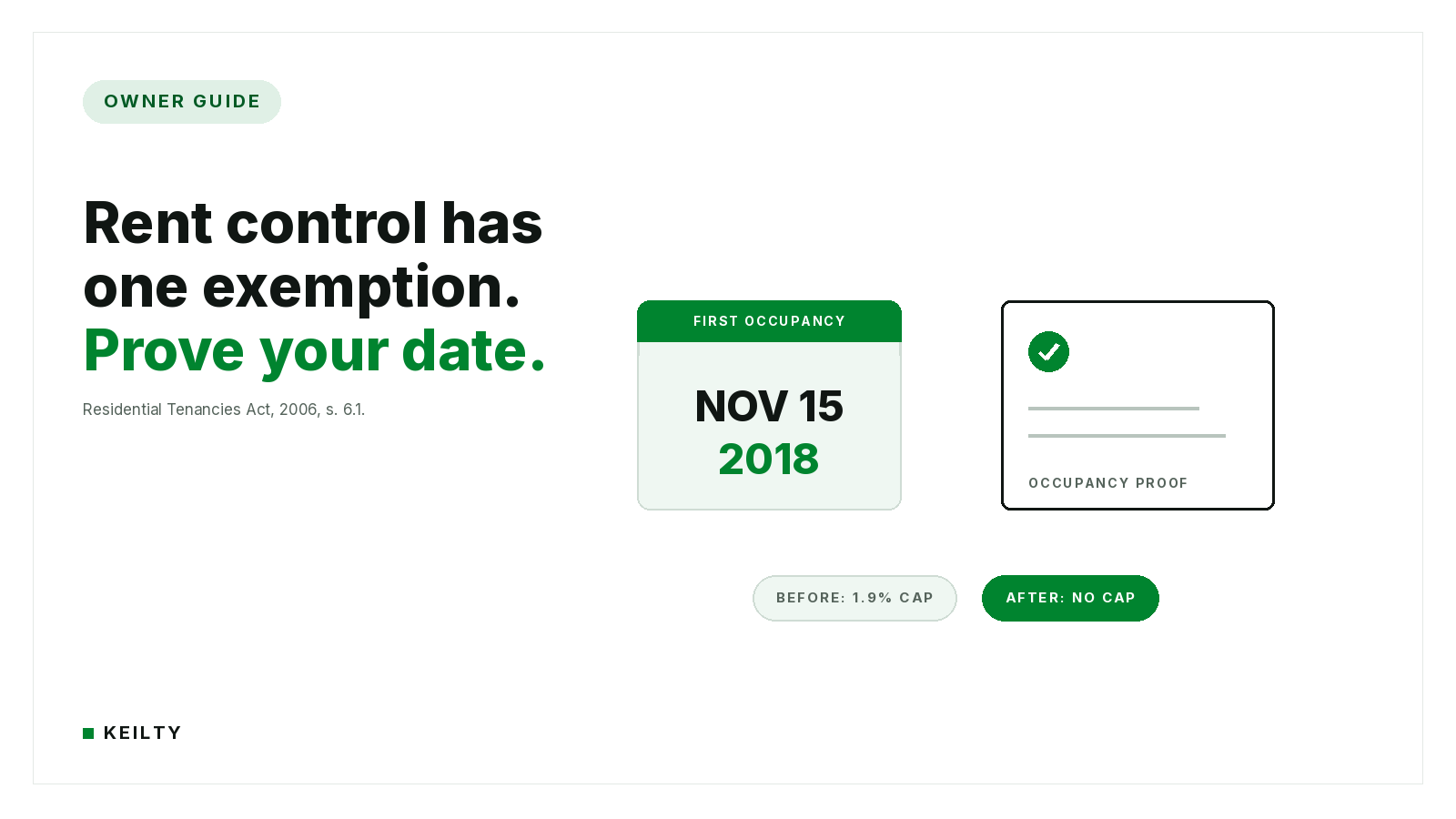
Your unit is exempt from Ontario's rent increase guideline only if it was occupied for the first time for residential purposes after 2018-11-15. Everything older than that is capped, and for 2027 the cap is 1.9%. If your unit does qualify, you can raise the rent by any amount, but you still have to wait 12 months between increases and give 90 days written notice on the right Landlord and Tenant Board form.
The short version.
Second units inside an existing house are the part people get wrong, and the test there is stricter than most owners expect. It is set out in full below.
It does not mean the Residential Tenancies Act, 2006 stops applying to your unit. The exemption lives in section 6.1 of the Act, and it is narrow. It switches off the sections that cap how much you can raise the rent. Everything else about the tenancy carries on unchanged.
The guideline itself is set each year from the Ontario Consumer Price Index, using data from June to May, and it is capped at 2.5% by legislation. It has been 1.9% for 2027, 2.1% for 2026, and 2.5% for each of 2023, 2024 and 2025. We went through the 2027 number in this post.
One point that decides most disputes before they start: under section 6.1(6), the onus is on the landlord to prove the exemption applies. If you cannot document it, you do not have it.
Two categories, tested differently. The first is generous. The second is not.
A building, or an addition to an existing building, where no part was occupied for residential purposes on or before 2018-11-15, is exempt. A purpose-built rental building that took its first residents in 2020 is exempt, and stays exempt through every tenant who ever lives there. A 1970s walk-up is not exempt, and never will be, no matter how much you spend on it. The same test covers mobile home parks and land lease communities, and their additions.
This is the one that trips people up. A new self-contained unit added to a detached, semi-detached or row house can be exempt, but under section 6.1(3) all of the following must be true:
Miss any one of the four and the unit is guideline-controlled. Note that the fourth condition is genuinely an either/or, so you do not need both owner occupancy and unfinished space, and note that the third condition asks when the unit became self-contained, not merely when someone lived in it.
Two limits sit alongside the test. Under section 6.1(4), the exemption does not apply to a tenancy whose agreement was entered into on or before 2018-11-15, though under 6.1(5) it does apply to every tenancy after that one. And unlike the new-building exemption, the second-unit exemption does not switch off sections 165 and 167, so it is the narrower of the two.
What this means for a basement apartment. A basement apartment is not automatically exempt, and it is not automatically disqualified either. Two questions decide most files: was the basement finished living space before the conversion, and did the owner occupy the house when the tenant moved in. A finished rec room converted to a rental in a house the owner does not live in is guideline-controlled. The same conversion in a genuinely unfinished basement is exempt. A basement apartment that already existed in 2010, was gutted and rebuilt in 2022, does not qualify, because the unit was not created after the date.
A basement unit that shares the upstairs bathroom is not exempt at any date, because it is not self-contained. One caution there: if the shared bathroom or kitchen is shared with the owner, or the owner's spouse, child or parent, and that person lives in the building, then under section 5(i) the RTA may not apply to the tenancy at all. That is a different and much larger question than the guideline, and it is worth getting advice on rather than assuming either way.
If the condo was occupied for the first time for residential purposes after 2018-11-15, it is exempt, and the exemption follows the unit rather than you. The trap is interim occupancy. First residential occupancy is what counts, not registration and not your closing date. If someone moved in on 2018-11-01 during interim occupancy, the unit is inside rent control even though the building registered in 2019.
Most of them. An exemption from the guideline is not an exemption from the Act:
A tenant in an exempt unit who receives a rent increase they think is improper can still dispute it at the Board within 12 months of first being charged.
With documents, because the onus is yours. Keep whatever establishes the date of first residential occupancy and, for a second unit, the physical facts: building permits and final inspection sign-offs, the occupancy permit, dated construction photographs showing the space unfinished beforehand, the first lease and first rent receipts, your own proof of residence in the house if you are relying on owner occupancy, and municipal records.
It is also worth stating the exemption in the lease itself. Do that as an additional term under section 15 of the Standard Form of Lease, which is the form's "Additional Terms" section. To be clear about the citation, because the two are easily confused: section 15 of the lease form is where additional terms go, while section 15 of the Act is an unrelated provision voiding acceleration clauses. Noting the exemption in the lease does not create it, and it will not save you if the documents do not support the date.
Yes, for every unit, exempt or not. Vacancy decontrol means there is no cap on what you ask a new tenant, whatever the age of the building. For most owners that matters far more than the exemption does, because turnover is where the pricing decision actually gets made. Our rental income calculator is the place to model it.
Being allowed to is not the same as being smart to. Asking rents across Canada averaged $2,033 in June 2026, down 4.3% year over year, according to the Rentals.ca national rent report. Ontario fell further than the national average, down 5.3% to $2,233.
City-level direction is mixed, and worth checking before you rely on the provincial figure. Statistics Canada's two-bedroom series showed Kingston asking rents down nearly 6% in the first quarter of 2026, the largest year over year drop of any census metropolitan area in the country, as Global News reported. Note that Kingston's vacancy rate moved the other way, easing to 2.4% in CMHC's 2025 survey from roughly 2.9% a year earlier, and that asking rents and rents actually paid are different measures that are currently moving in opposite directions. On the Rentals.ca series, which measures asking rents across all property types rather than two-bedroom units, Kingston was up on the year and Toronto rose for a third consecutive month. Different programs, different definitions, and they do not always agree. Use both as background and price off your own comparables. Our vacancy loss calculator shows what an empty month costs, and we covered current conditions in this post.
An above-guideline increase on a sitting tenant in a soft market can manufacture your own vacancy. The tenant can leave with 60 days notice, and there is more competing supply for them to leave into than there was two years ago.
No, not for rent control. The section 6.1 exemption is intact, the 2018-11-15 date has not moved, and the guideline still applies to everything else.
Bill 60, the Fighting Delays, Building Faster Act, 2025, was introduced on 2025-10-23 and received royal assent on 2025-11-27 as chapter 14 of the Statutes of Ontario, 2025. It is law. It is also widely misremembered, so it is worth being precise about what happened.
Alongside the bill, the province announced it would consult on alternatives to Ontario's lease expiry rules, which renters and advocates read as a path to uncapped increases at renewal. After sustained public pushback, Housing Minister Rob Flack said on or about 2025-10-26 that the province would not proceed with those consultations. What was abandoned was the consultation, not a clause in the bill. Bill 60 never contained a provision changing security of tenure or the guideline, and nothing was struck out of it before passage. The rent control framework is exactly where it was.
Bill 60 did amend the RTA elsewhere, and those changes matter operationally even though they have nothing to do with rent control. Most are not in force yet. As of 2026-08-04, only the notice-form provision and a new 15-day window to request a review of a Board decision have been proclaimed. The following are proclaimed to take effect on 2026-09-21:
Several of those depend on regulations that have not been made yet, so treat the detail as provisional. If you are planning around an own-use termination or an arrears application this autumn, the sequencing matters, and it is worth confirming the in-force position on the day you serve.
KEILTY manages rentals across Ontario, from single houses and basement suites to purpose-built communities. If you are developing new rental supply, our build-to-rent page is the right starting point. For existing stock, see our single family rental page, small multi-family, or apartment communities. Each carries its own pricing. Ours is a flat monthly rate per unit rather than a percentage of rent, so it does not climb as your rent does.
Your unit is exempt from Ontario's rent increase guideline only if it was occupied for the first time for residential purposes after 2018-11-15. Everything older than that is capped, and for 2027 the cap is 1.9%. If your unit does qualify you can raise the rent by any amount, but you still have to wait 12 months between increases and give 90 days written notice on the right Landlord and Tenant Board form.
There are two categories. A building, or an addition to an existing building, where no part was occupied for residential purposes on or before 2018-11-15 is exempt and stays exempt through every tenant who ever lives there. A new self-contained unit added to a detached, semi-detached or row house can also be exempt, but only if the house had no more than two residential units on or before 2018-11-15, the unit is genuinely self-contained with its own bathroom and kitchen, it became self-contained after 2018-11-15, and either the owner lived in the house when it was first occupied or the space was unfinished immediately before it became a residential unit.
Most of them, because an exemption from the guideline is not an exemption from the Act. You must use the standard form of lease, wait at least 12 months from the tenancy start or the last increase before raising rent again, give at least 90 days written notice on Form N2, follow the ordinary eviction rules, maintain the unit to the same standard, and collect only the deposits the Act permits. A tenant in an exempt unit can still dispute an increase at the Board within 12 months of first being charged.
With documents, because under section 6.1(6) the onus is on the landlord. Keep whatever establishes the date of first residential occupancy and, for a second unit, the physical facts: building permits and final inspection sign-offs, the occupancy permit, dated construction photographs showing the space unfinished beforehand, the first lease and first rent receipts, your own proof of residence if you rely on owner occupancy, and municipal records. Stating the exemption as an additional term in the lease is worth doing, but it does not create the exemption and will not save you if the documents do not support the date.
Yes, for every unit, exempt or not. Vacancy decontrol means there is no cap on what you ask a new tenant, whatever the age of the building. For most owners that matters far more than the exemption does, because turnover is where the pricing decision actually gets made.
Not sure whether your unit is exempt, or what it should actually rent for in today's market? Request a free rental evaluation or contact us and we will work through the date question with you.
This post is general information about Ontario residential tenancy and human rights law as of 2026-08-02, not legal advice. Legislation, regulations and tribunal practice change. For advice on a specific applicant, property or situation, speak with a lawyer or licensed paralegal.
Ontario property management with published pricing, same-day answers, and no surprises. Since 2003.
300-80 Queen StreetNot served yet. Join a list and hear from us the day we open.