
By A.J. Keilty, President, KEILTY Realty Management
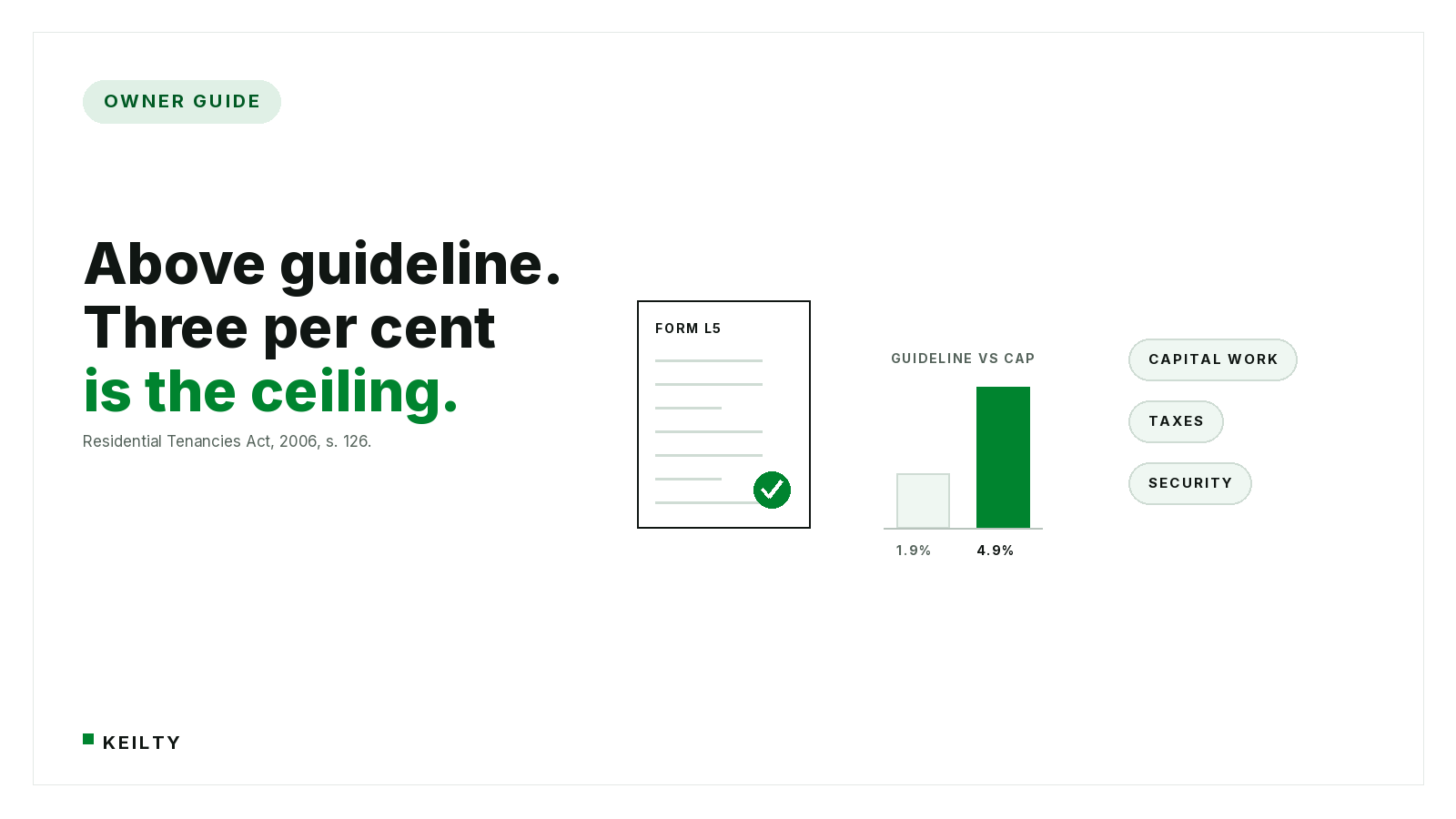
You file a Form L5 with the Landlord and Tenant Board at least 90 days before the date you want the higher rent to start, and you serve every affected tenant an N1 notice showing that higher amount. The application has to rest on one of three grounds: eligible capital expenditures, an extraordinary jump in municipal taxes and charges, or the cost of security services. For capital work and security costs, the Board cannot approve more than 3 per cent above the guideline in any single year, so with the 2027 guideline set at 1.9 per cent, the practical ceiling for a 2027 increase is 4.9 per cent.
That is the short version. The longer version matters, because most AGI applications that fail do not fail on the math. They fail on paperwork, timing, and receipts.
Every year Ontario sets a rent increase guideline. For most rent-controlled units, that is the most you can raise rent without asking anyone's permission. The 2027 guideline is 1.9 per cent, and it applies to increases taking effect between 2027-01-01 and 2027-12-31.
Section 126 of the Residential Tenancies Act, 2006 gives you a way to go past that number, but only with an order from the Board. That is what an above guideline increase, or AGI, is. It is not a landlord decision. It is a tribunal decision, and you are the applicant carrying the burden of proof.
Before you go any further, check whether you even need one. If the unit was first occupied for residential purposes after 2018-11-15, it is likely exempt from the guideline altogether and you can set the increase yourself with proper notice. We wrote about how to establish that date in Is My Rental Unit Exempt from Rent Control in Ontario? Owners of single houses and small buildings often assume they are stuck at the guideline when they are not, and owners of older buildings sometimes assume they are exempt when they are very much not.
The LTB's own brochure on AGIs lists them plainly.
You can combine grounds in one application. You cannot invent a fourth one. Higher mortgage payments, higher insurance premiums, a bad year, a soft market: none of that gets you an AGI. The Board is also barred from considering your financial circumstances, the tenants' ability to pay, income tax treatment of your expenses, or whether it thinks the government's guideline was fair.
A capital expenditure is money spent on an extraordinary or significant renovation, repair, replacement, or new addition, with an expected benefit of at least five years. That five-year test does real work. A roof qualifies. Repainting hallways does not.
Four categories are specifically excluded:
That last one catches owners off guard. Upgrading a functional lobby into a showpiece, adding a feature wall, installing a nicer entry system than the building needs: an adjudicator can read all of that as prestige rather than integrity, and the claim disappears.
Meeting the definition is step one. The spend also has to be eligible, which under the RTA means it does at least one of the following:
There is one more filter. If you replaced something, the Board asks whether it actually needed replacing. Swapping out a boiler with ten good years left in it usually fails, with three exceptions: accessibility, energy or water conservation, and building security. Those three can be eligible even when the old item was still fine.
The practical consequence is that your condition assessments and service records are evidence. A furnace failure log, a plumber's note that the stack is at end of life, an energy audit: these turn a spending decision into a defensible claim. Owners who replace on gut feel and keep no paper trail end up funding the work entirely out of the guideline.
This is where applications die quietly. Capital expenditures must be completed inside an 18-month window that ends 90 days before the date of the first rent increase you are asking for. So if you want the higher rent to start on 2027-09-01, the work has to be complete by roughly 2027-06-03, and you cannot reach back further than about 2025-12-03 for it.
The work also has to be fully paid before you file, apart from any construction lien holdbacks you are required to hold. Invoices alone are not proof. The Board expects to see what you were charged and evidence that you paid it, which in practice means contractor invoices matched to cleared payments. Claims for your own labour get scrutinized for reasonableness, and anything you already claimed in an earlier application cannot be claimed again.
If you are planning a project now with an AGI in mind, work the calendar backwards from the increase date before the first shovel moves. A three-week overrun in the wrong direction can push a completed project outside the window and cost you the whole claim for that cycle.
For capital expenditures and security service operating costs, the increase cannot exceed 3 per cent above the guideline in any one year. Against the 1.9 per cent 2027 guideline, that means 4.9 per cent total.
Justify more than the cap and the excess is not lost, it is staged. The order will let you take the remainder over the next two 12-month periods, again at up to 3 per cent above the guideline each year. So a large, well-documented capital claim can spread across three annual increases.
The extraordinary municipal tax ground has no percentage cap at all. Mobile home parks get their own treatment: capital work on government-required infrastructure such as roads, water, fuel, sewage, and electricity systems is not capped at 3 per cent, and the Board decides the amount.
Run the numbers on a real unit before you decide the effort is worth it. On a $1,800 rent, the 2027 guideline alone is $34.20 a month. An approved 4.9 per cent increase is $88.20. Across a 40-unit building, that gap is roughly $25,900 a year in recovered revenue. Across a duplex, it is about $1,300, against filing fees, evidence preparation, and a hearing you have to show up for. The arithmetic points different owners in different directions, which is exactly why it is worth doing before you commit.
Maintenance is the big one. The Board can consider existing serious breaches of health, safety, or housing standards, or of your obligation to keep the complex in repair. If a member finds those breaches, the application can be dismissed for the affected units, or the order can withhold the increase until the work is done. Tenants can also file their own T6 maintenance applications and have those heard separately.
Elevators have a special rule. If you have not completed ordered elevator repairs, the Board may not be able to grant an increase at all.
Then there is the human side. AGI hearings are group proceedings. Tenants get to inspect your entire evidence file, they can appoint a spokesperson, and they will look at whether the parking garage you claimed was really rebuilt. Buildings where the relationship is already strained tend to produce organized, well-prepared opposition. Buildings where residents get straight answers and repairs that actually happen tend not to. That is one of the quieter arguments for professional apartment community management: the operating record is the evidence.
You cannot apply for an above guideline increase for a unit where a new tenant's tenancy agreement took effect after you finished the capital work. And increases granted in an order cannot be charged to anyone who moved in after your filing deadline, which is 90 days before the first requested increase date.
Tenants also do not have to pay the higher amount until the order comes down, even though you must have served the N1 with that amount to be able to collect it later. Expect a gap between the notice date and the money.
Worth separating in your head: an AGI is about recovering the cost of work in an occupied building. It is not a route to vacant possession. If your plan involves emptying units to renovate, that is an N13 and a different set of rules, including the municipal renovation licensing regimes now in force in several Ontario cities. We covered that in Renovating a Tenanted Unit in Ontario.
For a well-documented capital program in a mid-size or larger building, usually yes. The recovery compounds, since the approved increase becomes part of the lawful rent and every future guideline increase is calculated on the higher base.
For a single house or a duplex where the work was one furnace and a roof, the answer is often no. The filing effort, the evidence assembly, and the hearing are the same shape whether you have three units or three hundred. The revenue on the other side is not.
The middle case is the interesting one, and it usually turns on whether anyone kept records. Owners who can produce a dated invoice, a cleared payment, and a reason the item needed replacing have an application. Owners who cannot have a story. Read the Board's Interpretation Guideline 14 and the L5 instructions before you file, and if you are weighing whether to take this on yourself, our management versus self-management comparison lays out where the time actually goes.
Not sure whether the work you did last year is claimable, or what your unit should be renting for in the first place? Ask us for a free rental evaluation. We will tell you what the market supports and what your options are, on the guideline or above it.
This post is general information about Ontario residential tenancy and human rights law as of 2026-08-05, not legal advice. Legislation, regulations and tribunal practice change. For advice on a specific applicant, property or situation, speak with a lawyer or licensed paralegal.
Ontario property management with published pricing, same-day answers, and no surprises. Since 2003.
300-80 Queen StreetNot served yet. Join a list and hear from us the day we open.