
By A.J. Keilty, President, KEILTY Realty Management
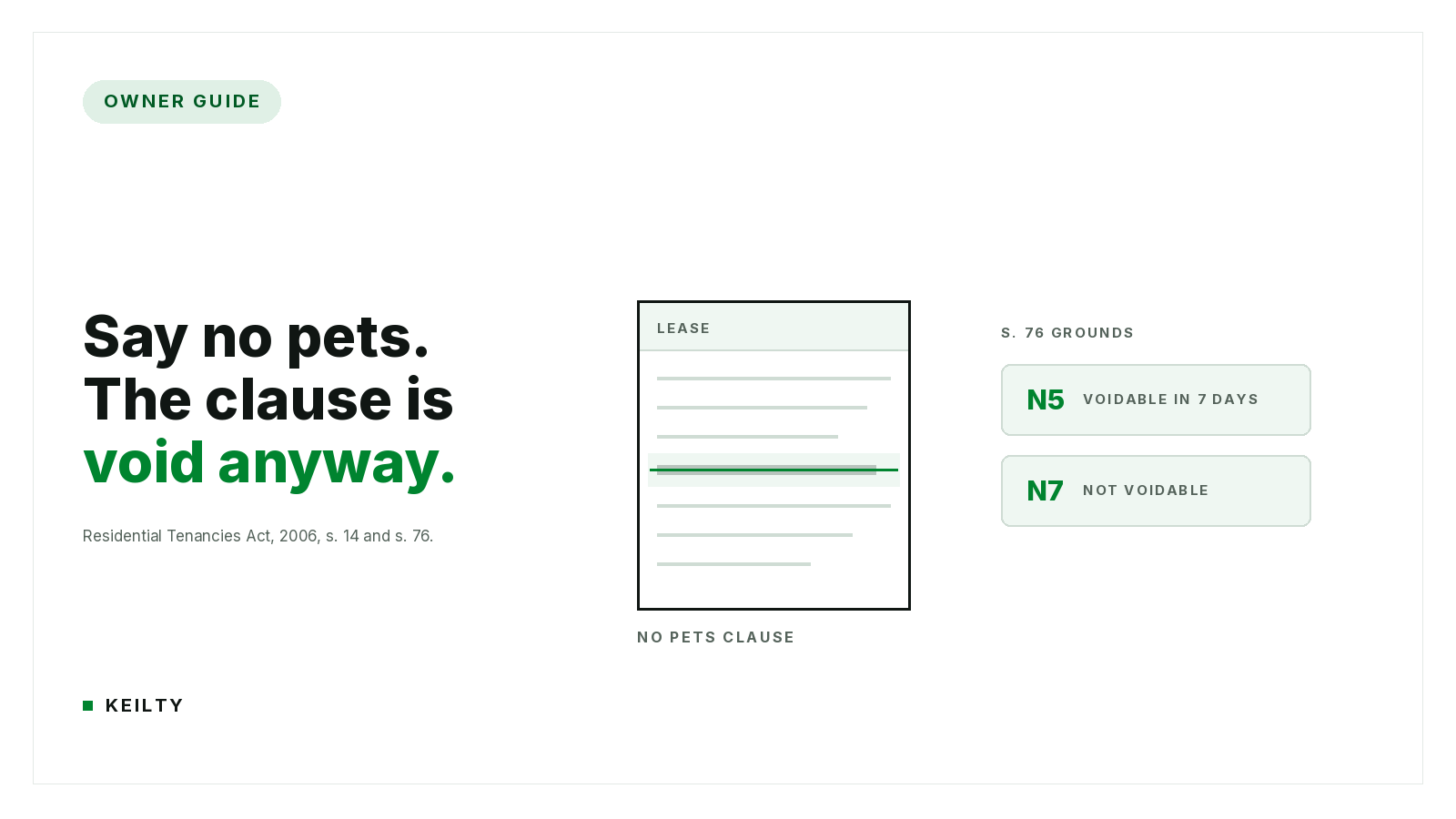
Before a lease is signed, yes. After it is signed, no. An Ontario landlord can decline an applicant who discloses a pet, but the moment a tenancy agreement exists, any clause in it that bans animals is void by law, and the pet can move in regardless of what the lease says. Section 14 of the Residential Tenancies Act, 2006 makes that unambiguous, and no wording you add to the lease changes it.
That one sentence catches a lot of Ontario owners off guard. People sign a lease with "no pets" written into it, feel protected, and find out a year later that the clause was never worth anything. Here is how the rule works, what you can still do about a problem animal, and why a pet policy that fits the law usually rents faster anyway.
Is this you? If you own this rental rather than rent it, KEILTY manages homes and buildings across Eastern Ontario and will tell you what the unit should rent for. Start with a free rental evaluation.
Section 14 is one sentence long. A provision in a tenancy agreement prohibiting the presence of animals in or about the residential complex is void. Not unenforceable in some situations, not subject to a reasonableness test. Void, meaning it has no legal effect from the start.
You do not have to take our word for it, because the government prints it on the lease. Section 15 of the Standard Form of Lease (Form 2229E) lists void and unenforceable additional terms, and among them are terms that "Do not allow pets (however, the landlord can require the tenant to comply with condominium rules, which may prohibit certain pets)." The bound appendix repeats it. If you are handing a tenant a lease with a pet ban in it, you are handing them a document that tells them the ban is void.
A few practical consequences follow:
One housekeeping note. The current lease is version 2229E (2020/12), required for tenancies entered into on or after 2021-03-01. If your template still says 2018/01, replace it.
Nothing in the RTA prohibits the ad, and choosing a pet-free applicant is lawful. So yes, you can run it. We would still tell you not to.
The ad buys you nothing after the lease is signed, and it creates two problems. It sets an expectation you cannot enforce, which is how disputes start. And a flat "no pets, no exceptions" line becomes evidence against you the day a person with a service animal is turned away, because it shows a blanket rule applied without any accommodation analysis. "Pet-friendly" or silence both cost you less than a human rights application.
Yes. The Act protects tenants, and an applicant is not yet a tenant. Until a tenancy agreement exists you are free to choose a different applicant, and having a dog is not a protected ground under the Ontario Human Rights Code.
Two things narrow that in practice. The first is service animals and support animals, covered below. An applicant who needs an animal because of a disability is in a completely different legal position than an applicant who wants a cat.
The second is that the screening decision has to stand on its own and be documented like any other. If your file shows you passed on the applicant with the strongest income and rental history and picked a weaker one, and the only visible difference is the dog, you have created a record you may not want. It is also worth being clear-eyed about the trade. Vacancy costs real money on a schedule, while pet damage is a possibility. Our vacancy loss calculator puts a number on the first half of that.
For where the screening line sits generally, see what a landlord can legally ask for when screening a tenant in Ontario.
This is the real exception, and it is more complicated than "condos are different." A pet restriction that comes from the condominium corporation rather than your lease is not caught by section 14, because section 14 only voids terms in a tenancy agreement. But whether that restriction holds up depends on where it lives.
A restriction in the declaration is the strong position. The Condominium Act imposes no reasonableness requirement on a declaration, and in Waterloo North Condominium Corp. No. 186 v. Weidner (2003) the court upheld a total pet ban in a declaration.
A restriction in a rule is weaker. Section 58(2) of the Condominium Act, 1998 requires that rules be reasonable. In 215 Glenridge Ave. Ltd. Partnership v. Waddington (2005) the Superior Court held a corporation could not make a blanket rule banning all pets, because a blanket ban was not reasonable. That said, courts do not lightly second-guess a board: in York Condominium Corp. No. 382 v. Dvorchik (Ont. C.A., 1997) the Court of Appeal reinstated a weight limit on dogs and warned against turning a board's judgment into a court's. A specific, proportionate rule tends to survive. A total ban in a rule alone tends not to.
Four more things that catch owners out:
If you own a condo unit and pets matter to you, pull the declaration and the rules and read them before you list. You are relying on someone else's paperwork and someone else's willingness to enforce it.
No. Ontario allows two deposits and neither is a pet deposit. Section 105 prohibits security deposits outright. Section 106(2) caps the rent deposit at the lesser of one rent period's rent and one month's rent, so if you rent weekly, the cap is one week. It can only be collected at or before the agreement is entered into, and under section 106(10) it must be applied to the last rent period, which means it is not available for damage or arrears.
A key deposit is permitted, but the rules are narrow: it must be refundable and no more than the expected direct replacement cost, and it covers remote entry devices and cards as well as keys.
A pet deposit, a pet fee, a cleaning deposit, a damage deposit, or an extra monthly charge called pet rent are all illegal. A tenant who paid one can file a T1 and the Board can order it repaid. More detail in can you charge a damage deposit in Ontario.
You still have recourse on damage. It just comes after the fact, through an application to the Board, not through money you held in advance.
Section 76 sets the bar, and it is narrower than it first looks. It applies to notices under sections 64, 65 and 66, and it requires the Board to be satisfied that the tenant is keeping an animal and that one of three things is true:
Two refinements matter. First, section 76 does not catch a damage notice under section 62, so ordinary pet damage is dealt with as damage, not as an animal question. Second, sections 76(2) and 76(3) add an individual-animal test: even where the species-level ground is proven, the Board cannot evict if the tenant's actual animal did not cause or contribute to the interference or to the allergic reaction. There is no equivalent carve-out for the inherently dangerous ground.
Read the wording closely. It is about behaviour, allergy, or danger. It is never about the animal simply existing, and it is never about your lease.
Usually noise or damage, and barking is the most common pet complaint that reaches the Board. Substantial is the operative word. One neighbour who finds a dog irritating is not enough. A pattern of late-night barking, documented by several residents over weeks with dates and times, is a different file.
What decides these hearings is the quality of the record: written complaints with dates, your written notices to the tenant, photographs of damage, a clear timeline. Verbal complaints relayed second-hand rarely survive.
The Act says serious allergic reaction, and the Board expects medical evidence. A note saying someone is allergic to cats will not carry an application. A physician's documentation describing the severity and its connection to the animal is what the section contemplates. It is a real ground, but an evidentiary one, and section 76(3) still lets the tenant show their particular animal was not the cause.
The inherently dangerous branch is narrow and rarely wins on its own. Ontario's Dog Owners' Liability Act restricts pit bulls province-wide, and municipalities layer their own animal control by-laws on top, including licensing and limits on the number of animals. Those rules apply in your building whether or not they appear in your lease.
Getting the form wrong is one of the most common ways a legitimate pet complaint dies at the Board.
An N5 covers damage and disturbance, and it is the right form for the ordinary pet problem: barking, a scratched floor, waste left in common areas. A first N5 needs a termination date at least 20 days after the notice is given, and the tenant has 7 days to correct the problem, which voids the notice. That is usually the point. Most pet complaints end there.
If the tenant voids the first N5 and the behaviour comes back, the second N5 is the path people miss. Under section 68, a second N5 within six months of the first is a 14-day notice, it cannot be voided, and you can apply to the Board the same day you serve it. For recurring barking, that is the actual remedy. It only works if the first notice was voided by the tenant's compliance, so the first notice has to have been served properly.
An N7 is for serious problems, and its grounds are a closed list: seriously impairing someone's safety (s.66), wilfully damaging the unit (s.63(1)(a)), use inconsistent with residential use causing serious damage (s.63(1)(b)), and interference with the landlord in a building of three or fewer units where the landlord lives (s.65). It is a 10-day notice with no void period. Illegal acts are not an N7 ground; that is an N6, at 20 days, or 10 days for drug production or trafficking.
Either way the notice has to describe specific conduct on specific dates. "Tenant has a dog that bothers people" is not a notice. It is a dismissal waiting to happen.
A service animal is not a pet, and the governing law is not the RTA, it is the Ontario Human Rights Code. Where a tenant or applicant needs an animal because of a disability, you have a duty to accommodate up to the point of undue hardship, and the Ontario Human Rights Commission treats undue hardship as a high bar. Preferring a pet-free building is nowhere near it.
Practically, a guide dog or other service animal comes in even where a condo restriction would otherwise apply, and you cannot charge extra rent or a deposit for it. On process, three lines to stay inside: you may ask about the disability-related need the animal meets, you may not demand a diagnosis, and you may not substitute your own preferred accommodation for the animal a health professional has identified. Support animals sit in a more contested space, and the strength of a request turns on the documentation connecting the animal to a disability-related need. Consider every request in good faith, ask only for what you need to assess it, and get advice before refusing one.
Owners assume pets mean damage. The arithmetic is usually less clear.
More than half of Canadian households have a pet, on the Canadian Animal Health Institute's 2024 survey conducted by Léger. Screening all of them out removes a large share of your applicant pool.
Whether that pool is scarce depends on your city, and the answer in 2026 is that the picture is mixed. CMHC's most recent vacancy survey, taken in October 2025 and published on 2025-12-11, put national purpose-built vacancy at 3.1%, up from 2.2%, and no newer vacancy survey has been released. On asking rents, Rentals.ca and Urbanation had Ontario down 5.3% year over year in June 2026, but Toronto rose for a third consecutive month, and Kingston was up on the year. Statistics Canada's separate two-bedroom series for the first quarter of 2026 shows declines in Kingston and Ottawa and flat readings in Peterborough and Belleville-Quinte West. The two series measure different things and sometimes disagree, and smaller markets like Cornwall are in neither. Treat provincial averages as background and price off your own building. We wrote about the broader conditions in what rising vacancy and falling asking rents mean for landlords.
Meanwhile the thing you were trying to prevent is not prevented. The clause is void, so a tenant who wants a dog can get one after move-in. What a restrictive posture buys is a smaller applicant pool and a tenant who does not tell you about the animal, which is worse than one who does.
Pet owners also tend to stay longer, which rarely makes it into the spreadsheet. Finding a rental that takes a large dog is hard enough that people who find one do not move casually, and a turnover costs more than most pet damage claims.
On the statute books, yes. Ontario is the only Canadian jurisdiction whose tenancy legislation voids no-pet clauses outright. But "every other province allows them" overstates it. Only British Columbia and Yukon affirmatively authorise pet prohibitions in their tenancy statutes. The rest are simply silent, which leaves enforceability to ordinary contract principles and a tribunal's view of whether a term is unreasonable or abusive.
That distinction is live. In March 2026 Quebec's Tribunal administratif du logement struck a no-pet clause as contrary to the Quebec Charter, unreasonable and abusive. It is a first-instance decision, leave to appeal was granted, and the appeal is pending, so it is not a change in Quebec law. Nova Scotia's Bill 180 would import Ontario's approach almost word for word, but it received first reading in October 2025 and has gone no further. Service and assistance animals are protected by human rights law everywhere in Canada regardless.
You cannot ban animals, but you can set terms that are enforceable because they restate obligations the tenant already has:
Then do the thing that actually protects you, which is documentation. A move-in inspection with dated photographs of floors, trim and doors is worth more than any clause. When a damage claim happens two years later, the photographs are the case.
Handled well, a pet issue is a short paper trail and a phone call. A complaint gets logged with a date, the tenant gets a written note describing the specific conduct, and it stops. If it does not, the second complaint lands on a file that already has a record, and the notice that follows is specific enough to survive. Handled poorly, it becomes a landlord insisting the lease says no pets, a tenant who knows the clause is void, and an application that fails on the evidence. The law was rarely the problem. The process was.
KEILTY manages residential and commercial rentals across Ontario, from Kingston and Belleville through Peterborough, Oshawa, Cornwall and Ottawa. Our pricing is a flat monthly rate per unit rather than a percentage of rent, so it does not climb as your rent does. Current numbers are on the single-family rental page, and if you are weighing whether to keep doing this yourself, management versus self-management lays out the comparison.
If you own a rental in Ontario and you are not sure whether your lease, your pet policy or your rent is where it should be, request a free rental evaluation, or get in touch and ask.
This post is general information about Ontario residential tenancy and human rights law as of 2026-08-04, not legal advice. Legislation, regulations and tribunal practice change. For advice on a specific applicant, property or situation, speak with a lawyer or licensed paralegal.
Ontario property management with published pricing, same-day answers, and no surprises. Since 2003.
300-80 Queen StreetNot served yet. Join a list and hear from us the day we open.