
By A.J. Keilty, President, KEILTY Realty Management
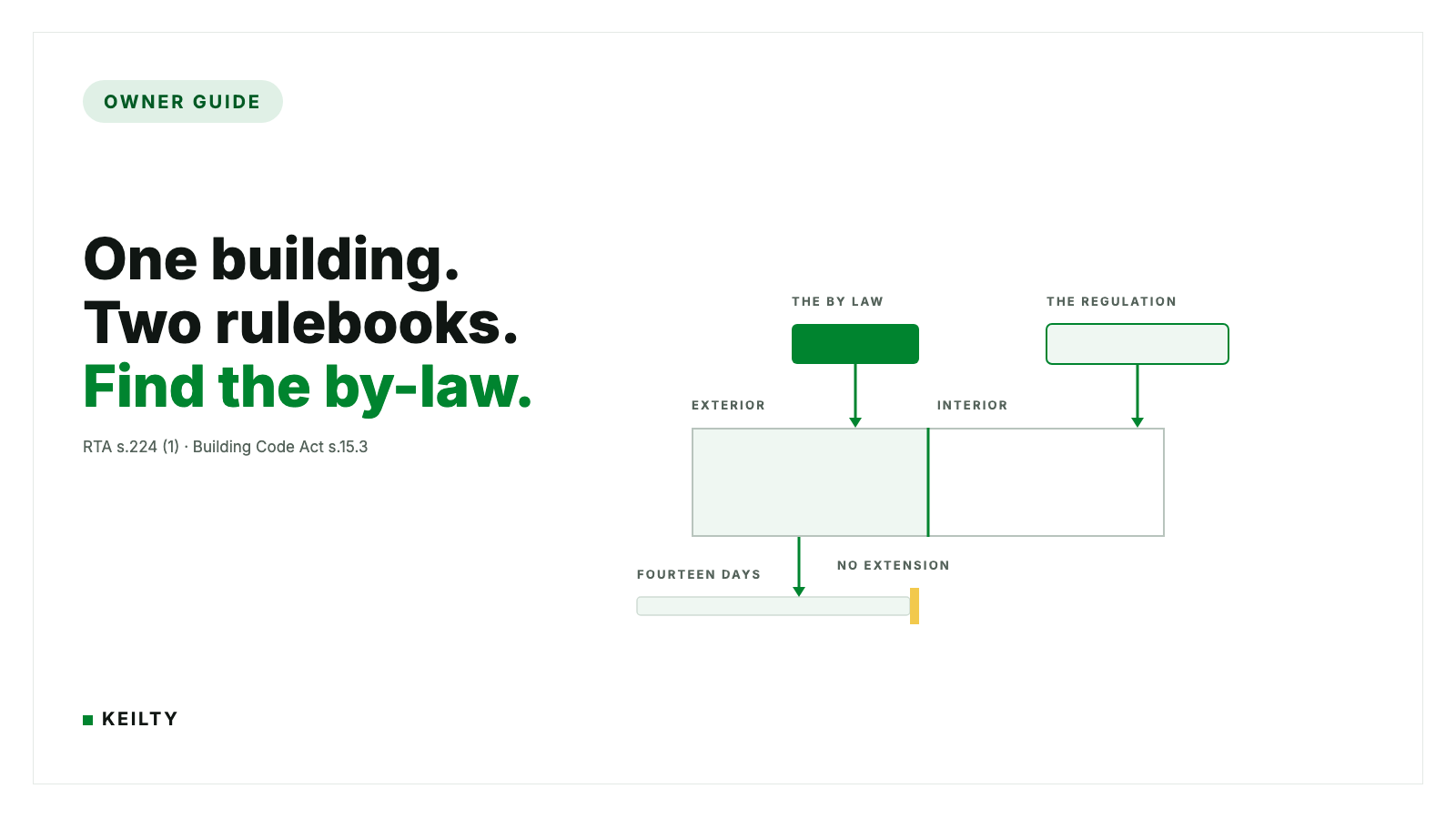
If you own a rental in Ontario, the document that decides what standard your building has to meet, who inspects it, and where you appeal if you disagree, is not the Residential Tenancies Act. It is your municipality's property standards by-law. And in the four Ontario markets we checked on 2026-09-28, finding that by-law took between one click and four hours.
This is a guide to doing that search properly, because the answer changes your obligations. Section 224 (1) of the Residential Tenancies Act, 2006 switches the provincial maintenance standards on only where there is no applicable municipal property standards by-law. Where your municipality has one, its text is the standard, its officer does the inspection, and a 14 day appeal clock under the Building Code Act, 1992 replaces the 20 day one you may have read about.
The short version.
Section 20 (1) of the Act is the duty every Ontario owner starts from: "A landlord is responsible for providing and maintaining a residential complex, including the rental units in it, in a good state of repair and fit for habitation and for complying with health, safety, housing and maintenance standards." That last phrase is doing quiet work. It points outward, at standards written somewhere else.
Section 224 (1) of the Residential Tenancies Act, 2006 says where those standards come from. Read at source on 2026-09-28, it provides: "The prescribed maintenance standards apply to a residential complex located in a local municipality and the rental units located in the residential complex if, (a) there is no municipal property standards by-law that applies to the residential complex; or (b) there is a municipal property standards by-law that applies to the residential complex and the prescribed circumstances apply."
The prescribed standards are O. Reg. 517/06, whose section 2 (1) says so in terms: "This Regulation prescribes the maintenance standards for the purposes of subsection 224 (1) of the Act." So limb (a) is the ordinary route into the provincial rulebook.
Limb (b) is empty. Paragraph 73 of section 241 (1) gives the Lieutenant Governor in Council power to prescribe circumstances for the purposes of clause 224 (1) (b), and it has never been exercised. We opened and searched all eight regulations made under the Act on 2026-09-15 and the string "224" appears in exactly one of them, O. Reg. 517/06, twice. Nothing has been prescribed.
Put those together and the consequence is blunt. If a municipal property standards by-law applies to your complex, neither limb of section 224 (1) is satisfied, so the provincial maintenance standards do not apply to you, and the section 225 inspector's work order and the section 226 review at the Landlord and Tenant Board are not available either. Your maintenance standard is the by-law, its officer does the inspection, and a section 15.2 (2) order is appealed to a municipal committee rather than to the Board.
What does not change is section 20 (1). A tenant can still apply to the Board under paragraph 1 of section 29 (1) for an order that you breached it, and section 30 (1) lets the Board abate rent, order the repair, order its cost paid to the tenant, or terminate the tenancy. The municipal route is added to the Board route, not substituted for it. That is an expensive thing to get wrong, because a rent abatement is an exposure an owner actually pays.
O. Reg. 517/06 is short by the standards of Ontario regulations, about 31,000 characters, and its masthead has not moved since it was made. Read on 2026-09-28 it prints "Consolidation period: January 31, 2007 - e-Laws currency date (September 23, 2026)" and, where an amendment history would go, the words "No amendments." A whole-regulation search returns zero for "Note:" and zero for "Section Amendments with date in force". Nineteen years without a change is unusual and worth knowing before you build a maintenance program on it.
It runs to seven Parts: Interpretation and Application, Structural Elements, Utilities and Services, Safety and Security, Mobile Home Parks and Land Lease Communities, General Maintenance, and Inspection Charges. Section 2 (2) puts the duty on you: "Except as otherwise provided, the landlord shall ensure that the maintenance standards in this Regulation are complied with."
The practical point for an owner is that this is a checklist you can actually work from, and a municipal by-law is not the same checklist. They cover similar ground and they are not identical documents, which is why knowing which one binds you is not an academic question.
Section 4 of O. Reg. 517/06 contemplates exactly that case. Under the marginal heading "Municipal property standards by-laws applicable to exterior" it provides, read at source on 2026-09-28: "If there is a municipal property standards by-law applicable only to the exterior of residential complexes or rental units, the maintenance standards in this Regulation that relate to the exterior of residential complexes or rental units do not apply to the residential complexes or rental units in the municipality that are subject to the by-law, but the maintenance standards in this Regulation that relate to the interior of residential complexes or rental units do apply to them."
So in an exterior-only municipality you are in both rulebooks at once. The by-law governs the roof, the walls and the yard. The regulation still governs the inside.
Two things about that provision are worth saying plainly, because they cut in opposite directions.
The first is that it sits awkwardly with section 224 (1) as written. Section 224 (1) (a) switches the regulation on where there is no by-law that applies to the complex, full stop. Section 4 of the regulation assumes the regulation still reaches a complex in a municipality that does have a by-law, provided the by-law is exterior-only. Those two cannot both be read at full width.
Our own view is that section 4 is the better guide to how the pair is meant to work, and that an exterior-only by-law leaves the interior standards live. That is a reading of the two provisions side by side rather than something either instrument states outright, and we flag it as ours.
The second is that the exterior-only by-law has no foundation in the statute that authorizes property standards by-laws at all. We searched the whole of the Building Code Act, 1992 on 2026-09-28 for "exterior" and for "interior". Both counts are zero, across the entire Act, not merely across the property standards sections.
Section 15.1 (3) lets a council pass a by-law, but only "if an official plan that includes provisions relating to property conditions is in effect in the municipality or if the council of the municipality has adopted a policy statement as mentioned in subsection (2)". Paragraph 1 of that subsection is the standards power: "Prescribing standards for the maintenance and occupancy of property within the municipality or within any defined area or areas and for prohibiting the occupancy or use of such property that does not conform with the standards." Nothing there distinguishes inside from outside.
The exterior-only by-law is a creature of municipal practice that a regulation under a different Act then had to account for.
And here is the number that matters for your planning. Of the four markets we checked on 2026-09-28, three had by-laws we could read and all three cover the interior as well as the exterior. None of the three we could read was exterior-only, and we could not classify the fourth. We found no exterior-only by-law in this set. Section 4 is real law and you should check for it, but do not plan on the assumption that it will save you.
This is the question that trips owners up, because municipalities pass several by-laws that look like property standards by-laws and are not. Cobourg has By-law 060-2017, which regulates clean yard and lot maintenance. Kingston has a Community Standards By-law, 2023-214, and a Yards By-law. Either one can produce a letter from the municipality about the condition of your property.
The power behind those by-laws is in the Municipal Act, 2001, and we read that Act at source for the first time on 2026-09-28. Section 127, under the marginal note "Refuse and debris", provides: "Without limiting sections 9, 10 and 11, a local municipality may, (a) require the owner or occupant of land to clean and clear the land, not including buildings, or to clear refuse or debris from the land, not including buildings;". The words "not including buildings" appear twice in a single clause, so the section 127 power itself stops at the land.
The opening words matter as much as the clause. Section 127 does not cut down sections 9, 10 and 11, so a municipality may still reach buildings under its general by-law powers. What it cannot do is reach them through section 127.
Section 128 is the public nuisance power, and it is broad: a local municipality "may prohibit and regulate with respect to public nuisances, including matters that, in the opinion of council, are or could become or cause public nuisances." Subsection (2) then says council's good-faith opinion on what is or could become a public nuisance "is not subject to review by any court." Broad as that is, it carries no standards, no officer, no committee and no appeal route.
Searching the whole Municipal Act, 2001 on 2026-09-28 for "property standards" returns zero occurrences. The Act contains no property standards by-law power of its own. Every piece of the apparatus, the standards, the officer, the order, the committee, the appeal, the lien, sits in sections 15.1 to 15.8 of the Building Code Act, 1992.
So does a yard by-law count as a "municipal property standards by-law" for section 224 (1)? Frankly, no instrument says. We checked. The phrase is used three times in the Act and defined nowhere in it. O. Reg. 517/06 uses it and defines it nowhere. That is two instruments using a phrase that neither of them defines.
The exact phrase "property standards by-law" appears zero times in the Building Code Act, whose own idiom is "a by-law passed under section 15.1", although its section 1 (1) defines "officer" as "a property standards officer who has been assigned the responsibility of administering and enforcing by-laws passed under section 15.1". And the Municipal Act, 2001 does not use the phrase at all.
Our reading, offered as ours, is that a yard or nuisance by-law is not a property standards by-law for the purposes of section 224 (1), because the whole statutory machinery the phrase implies exists only under section 15.1 and because section 127 is expressly barred from reaching buildings. The argument the other way is that the drafter could have written "a by-law passed under section 15.1 of the Building Code Act, 1992" and did not. We think the first argument is stronger.
We would not build a defence on it without advice, and the practical answer is simpler: find out which by-laws your municipality actually has, and read the one that says it prescribes standards for the maintenance and occupancy of property.
Here is the procedure we used, including the parts that failed.
All of the following was read on 2026-09-28. Two caveats on provenance first, because they matter and because it would be easy to leave them out. Kingston publishes no text of its by-law online at all, so what follows is from a university republication of the office consolidation rather than from the City. Belleville's official copy sits on a document portal we could not reach this run, so what follows is from a third-party republication. Both are usable for reading and neither is the official copy.
Where a page carried no last-updated stamp we date the reading rather than the page, because there is nothing on the page to date.
Kingston has By-law 2005-100, passed on Tuesday 2005-05-17. It is a full by-law. Section 2.1 reads: "This By-law shall apply to all Property within the limits of the City." Part 5 covers heating, plumbing, ventilation, occupancy, and walls, ceilings and floors, and section 5.41 requires every dwelling unit to have "a heating system capable of Maintaining a minimum temperature of 21.1 C (70 F)." The City's own page for the by-law prints "Last updated: September 2, 2025" and carries no text of the by-law at all.
The republished office consolidation prints "Updated: 2023-11-07 (Office Consolidation)". Two currency dates for one by-law, and the City's disclaimer tells you the original is available from the Clerk on request.
A caution on numbers, since we have cited Kingston by-laws on this blog before. By-law 2025-34 is the Business License Bylaw and 2021-10 is the Short-term Rental Licensing Bylaw. Neither is the property standards by-law.
Belleville replaced its by-law recently, which is the freshest fact in this post. By-law 2025-157 is "A By-law to Prescribe Standards for the Maintenance and Occupancy of Property within the City of Belleville", passed on Monday 2025-09-22. It is a full by-law with a "Part IV: Interior Maintenance and Occupancy Standards", and section 29.1 requires a heating system "capable of maintaining a room temperature of not less than 21 degrees Celsius (69.8 degrees Fahrenheit) in all Habitable Rooms and bathrooms from the 15th day of September one year to the 31st day of May the following year." Note that the Belleville duty is seasonal where Kingston's is not.
Ottawa has By-law No. 2013-416, a full by-law with fifteen amending by-laws folded in. Section 33 requires a heating system "capable of maintaining a room temperature of 20 degrees Celsius (68 degrees Fahrenheit) in the centre of all habitable rooms, bathrooms and powder rooms." The consolidation block states: "This consolidation of the By-law is current to January 24, 2024." The page carries no last-updated stamp of any kind; a search of about 126,000 characters of expanded page text for "last updated", "last modified" and "last review" returns zero matches.
Cobourg is the hard case, and we are going to be straight about what we could not do. The by-law is 018-1999, titled "Property Standards By-law". It is published only on a by-laws portal on a domain separate from the Town's website, which the Town's own by-law index does not link to. The file is a 28 page scan of a 1999 document with no text layer. We could not read a single operative sentence of it.
So we are not going to tell you whether it covers the interior of your building. It is 28 pages and it very likely does, but that is an inference and not a reading.
Cobourg's committee does exist. Its published description says the Property Standards Committee "hears appeals by registered owners of property who have received a Property Standards Order regarding a component(s) of their property that does not conform to the Property Standards By-law", that it has three members, and that members "are appointed under the authority of the Building Code Act, 1992, S.O. 1992, c.23 ("BCA") section 15.1 at the beginning of each new term of Council". On that page, "secretary" appears zero times, "registered mail" zero times and "14 days" zero times.
If you own in Cobourg and you want your own copy of the by-law that governs your building, the Clerk's office is the route, and you should ask for it before you need it rather than after.
This is the part to take away if you read nothing else here, because three of our four municipalities differ from the statute in ways that could cost you the appeal.
The statute is section 15.3 (1) of the Building Code Act, 1992. An owner or occupant who has been served with a section 15.2 (2) order and who is not satisfied with its terms or conditions "may appeal to the committee by sending a notice of appeal by registered mail to the secretary of the committee within 14 days after being served with the order." That sentence names a method, an addressee and a deadline, and it says nothing about a fee.
Every by-law we could read adds something to it.
So an owner who reads only the statute posts a bare letter to a secretary. In Kingston and Ottawa the fee has to travel with it. In Belleville the notice has to carry grounds. In Ottawa the addressee is the Chief License Inspector rather than a secretary, although the committee does make provision for a secretary of its own, and the body is called the Property Standards and License Appeals Committee; on Ottawa's consolidated by-law the phrase "Property Standards Committee" appears once, in a transitional clause.
Cobourg presents a different problem again. The Town's appeal processes page groups "an Order, a Property Standards Order, or a Licensing or Exemption Decision" together and routes them all to Screening and Hearings Officers, telling you to "submit an Order Appeal Request Form" and "pay the $250 appeal fee within the period listed on the Order", and adding that "an appeal of an Order does not operate as a stay of the Order." That page never mentions the Property Standards Committee, registered mail, 14 days, or section 15.3. Meanwhile the Town's committee page says the committee hears property standards appeals under section 15.1.
We could not reconcile those two from Cobourg's published material and we are not going to guess at it here. What we would do on a file is all three of: put a section 15.3 notice of appeal in the registered mail inside the 14 days, follow whatever the order itself instructs, and telephone the Clerk the same day. The deadline is the one thing in this area with no safety valve, which is the next section.
The 14 days runs from being served, not from the date on the order and not from the day you opened the envelope. The counting rules come from the Legislation Act, 2006, which applies here through section 46, "Every provision of this Part applies to every Act and regulation.", read with section 47, which makes section 46 apply unless a contrary intention appears or the context requires otherwise. Nothing in sections 15.1 to 15.8 shows a contrary intention. Section 89 (3) counts days between two events by excluding the first day and including the second.
Section 89 (1) then provides that "Time limits that would otherwise expire on a holiday are extended to include the next day that is not a holiday."
Worked through: an order served on Monday 2026-11-02 starts its count on 2026-11-03, and the fourteenth day is Monday 2026-11-16. Remembrance Day falls inside that window, on Wednesday 2026-11-11, and it is a holiday under paragraph 9 of section 88 (2). It makes no difference, because section 89 (1) extends a limit that would otherwise expire on a holiday, and this one does not. A holiday in the middle of the period is not a holiday at the end of it.
Note as well that Saturday is not on the section 88 (2) list while Sunday is, so a period ending on a Saturday is not extended by section 88 (2). Section 89 (2) is a separate route: time limits for registering or filing documents, or for doing anything else, that expire on a day when the place for doing so is not open during its regular hours of business are extended to include the next day it is open. Do not rely on either one. Send it early.
Now the part with no give in it. We searched the whole of sections 15.1 to 15.8 of the Building Code Act, 1992, about 20,700 characters, for every word beginning "exten". There is exactly one occurrence, in paragraph 2 of section 15.3 (3.1), and it lets the committee "Extend the time for complying with the order." That is the compliance time, not the appeal time. There is no equivalent anywhere of section 190 (1) of the Residential Tenancies Act, which lets the Board extend or shorten a time requirement.
Miss the 14 days and section 15.3 (2) does the rest: "An order that is not appealed within the time referred to in subsection (1) shall be deemed to be confirmed." Section 15.3 (7) then makes a confirmed order "final and binding upon the owner and occupant who shall carry out the repair or demolition within the time and in the manner specified in the order." The sentence does not end at "repair or demolition", and an owner reading a summary that stops there would miss the operative obligation.
The regulation has one of its own, for what it is worth. Section 48 of O. Reg. 517/06 lets the Minister charge a municipality for each inspection made under "subsection 224 (3) of the Act", and section 224 has only two subsections. Read a stale cross-reference as a drafting artefact rather than as a gap you can stand in.
One drafting oddity worth knowing, because it looks like an error in your favour and is not. Section 15.3 (7) refers to an order "confirmed or modified by the committee under subsection (3)". Subsection (3) reads, in its entirety, "The committee shall hear the appeal." The power to confirm, modify or rescind moved to subsection (3.1) when the section was amended in 2002 and the cross-reference was never updated. The substance is plain enough on the face of the section; the citation is stale.
If your order came through the Board's route instead, the clock is different and the forum is different, and we set the two side by side in our post on which property standards order you actually received. The short of it is 20 days from the day the order is issued under section 226 (1) of the Residential Tenancies Act, against 14 days from service here, with the Board's section 190 (1) extension available on the first and nothing available on the second.
Four things, and the money route is the one owners underestimate.
First, section 15.4 lets the municipality do the work itself. Subsection (1) permits the repair or demolition at the owner's expense where the order is not complied with, subsection (2) permits entry without a warrant, and subsection (3) rules out compensation for anything done in the reasonable exercise of that power, which leaves the unreasonable exercise of it where it was.
Second, subsection 15.4 (4) gives the municipality "a lien on the land" for that cost, and says the amount has "priority lien status as described in section 1 of the Municipal Act, 2001 or section 3 of the City of Toronto Act, 2006, as the case may be". Because the Building Code Act imports that status rather than spelling it out, you have to follow the chain, and we did on 2026-09-28.
"Priority lien status" is not a defined term in the Municipal Act, 2001. Section 1 (2.1) is the link: if under any Act an amount is given priority lien status, the amount may be added to the tax roll, and the permissive "may" is the point. Section 1 (3) then does the work, and it opens: "If an amount is added to the tax roll in respect of a property under subsection (2.1) or (2.2), that amount, including interest," and then, among four clauses, provides that the amount "is a special lien on the property in the same manner as are taxes under subsection 349 (3)". That sends you on once more.
Section 349 (3) reads: "Taxes are a special lien on the land in priority to every claim, privilege, lien or encumbrance of every person except the Crown, and the lien and its priority are not lost or impaired by any neglect, omission or error of the municipality or its agents or through taking no action to register a tax arrears certificate."
Two things follow, and they matter in both directions. The priority, once it attaches, is very strong, ahead of every encumbrance of every person except the Crown. But it is conditional: section 1 (3) bites only once the amount has been added to the tax roll. That is a step the municipality has to take, and it is the thing to ask about if you are in this position.
For contrast, the general municipal power to do work at an owner's expense, section 446 of the Municipal Act, 2001, is drafted quite differently. Subsection (3) lets the municipality recover the cost "by action or by adding the costs to the tax roll and collecting them in the same manner as property taxes", which is a statement about the manner of collection rather than about priority, and subsection (6) provides that "The amount of the costs, including interest, constitutes a lien on the land upon the registration in the proper land registry office of a notice of lien." Subsection (5) sets interest at 15 per cent or such lesser rate as the municipality determines.
The words "priority lien status" do not appear in section 446. The property standards route and the general route are not the same exposure.
Third, there is an administrative penalty route that does not need an order at all. Section 15.4.1 (1) lets a municipality "require a person, subject to such conditions as the municipality considers appropriate, to pay an administrative penalty if the municipality is satisfied that the person has failed to comply with, (a) a by-law of the municipality passed under section 15.1; or (b) an order of an officer under subsection 15.2 (2) as deemed confirmed or as confirmed or modified by the committee or a judge under section 15.3." Clause (a) is the one to notice: bare non-compliance with the by-law is enough, with no order in front of it.
There are two limits on the same page, and both are worth having. Section 15.4.1 (3), headed "Monetary limit", provides that the amount of an administrative penalty "(a) shall not be punitive in nature; and (b) shall not exceed the amount reasonably required to promote compliance with a by-law under section 15.1 or an order under subsection 15.2 (2)". Section 15.4.1 (4) then provides: "If a person is required by a municipality to pay an administrative penalty under subsection (1) in respect of a contravention, the person shall not be charged with an offence in respect of the same contravention." That is a real bound on your exposure.
It is conditional in two ways. It bites only once the penalty has actually been required, so it is the municipality's election rather than your immunity, and it is confined to the same contravention. Section 15.4.2 (2) then provides that an unpaid penalty may be added to the tax roll if it is not paid "within 15 days after the day that it becomes due and payable", which runs from the day it is due rather than from the day it was imposed.
Fourth, failing to comply with an order is an offence. Section 36 (1) (b) of the Building Code Act, 1992 covers a person who "fails to comply with an order, direction or other requirement made under this Act". On conviction, section 36 (3) sets a maximum fine of $50,000 for a first offence and $100,000 for a subsequent one, and section 36 (4) sets $500,000 and $1,500,000 where the person convicted is a corporation.
There is an outer limit on that route, and it is the kind of thing worth knowing before you assume old paper can still bite. Section 36 (8) bars a proceeding commenced more than one year after the facts on which it is based first came to the knowledge of an officer, where the proceeding is about enforcing a by-law passed under section 15.1.
This is the second place the Act sends you to your by-law, and it is easy to miss because it sits nowhere near Part XIV. Section 36.1 governs a tenant's right to install a window or portable air conditioner. Subsection (2) is the one owners should read first: "The landlord may, in the prescribed circumstances, prohibit a tenant from installing an air conditioner." Paragraph 5 of subsection (3) then makes one of the conditions that "The installation of the air conditioner is not prohibited by any applicable municipal property standards by-law or other applicable law, and the air conditioner is installed and maintained in accordance with any applicable laws."
So the same document that sets your repair standard can also decide whether your tenant may put a unit in the window, and the answer is municipality by municipality. Kingston's by-law, for example, addresses a central air-conditioning system with fans and ductwork and does not reach a tenant's window unit, which we read on 2026-08-11. That is a fact about one by-law and it is not transferable to the next municipality over.
If you are answering a tenant's request about an air conditioner, the by-law is part of the answer and so is the rest of section 36.1. Do not answer from the Act alone.
One thing, and it has been wrong for years, so it is worth naming if you are reading Board material to prepare.
The Landlord and Tenant Board's Interpretation Guideline 5, "Breach of Maintenance Obligations", still says: "Work orders will also be issued by the Ministry of Housing for municipalities which do not have their own property standards by-laws." Read on 2026-09-28, the Guideline prints exactly one date, a bare "December 15, 2018", with no revision label, and a search of its roughly 36,000 characters for any word beginning "revis" returns zero.
That sentence was overtaken on 2018-07-01, when sections 224.1 and 226.1 to 226.4 moved the complaint, the inspection and the prosecution to the local municipality. Section 224.1 (1) requires the local municipality, where the prescribed maintenance standards apply to the complex, to receive a current tenant's written maintenance complaint, and section 226.1 provides that "A local municipality may appoint inspectors for the purposes of sections 224.1 and 225." The Ministry is not the work order issuer.
Guideline 5 also never mentions the exterior-only carve-out. We searched it on 2026-09-28: "224" appears zero times, "517/06" once in a footnote, and "exterior" once, about the exterior grounds of a complex. So it cannot be cited as authority for the section 4 point above, in either direction.
Interpretation Guidelines are not law in any event. The disclaimer printed at the head of Guideline 5 itself says a Member "is not required to follow a Guideline and may make a different decision depending on the facts of the case."
The work in this post is not difficult. It is specific, it is local, and it does not reward being done in a hurry after an order arrives.
If you are self-managing one or two properties in one municipality, you can do this once and be done. Find the by-law, save a copy, note whether it covers the interior, write down the appeal addressee and the fee, and put the 14 days in your own words somewhere you will find it. That is an afternoon, and it is the afternoon that makes the difference if an order ever lands.
The case for handing it over is different and it is about breadth rather than difficulty. If you own in more than one municipality, you have more than one rulebook, more than one appeal addressee and more than one fee schedule, and the documents are published as badly as this post describes. That is the case for handing it over.
On a small multi-family file we do three things: identify the governing by-law for each property, hold a current copy, and calendar the appeal clock from the day an order is served rather than from the day it reaches the office. Frankly, the value is not legal expertise. It is that somebody has already done the search and the clock starts running the day the envelope arrives, not the day it is opened.
There is an affirmative step in the same part of the Act worth knowing about, and it fits the do-it-once approach above. Section 15.5 (1) lets an officer who has inspected a property and is of the opinion that it complies with the standards in a section 15.1 by-law issue a certificate of compliance. Whether your municipality issues them, and on what terms, is a question for the municipality rather than for the statute.
One limit worth publishing, because it cuts against us. Interpretation Guideline 5 says: "A landlord may assert that they have a good program of maintenance and repair, including preventative maintenance and a system of processing complaints. This is not a release of the landlord's responsibility to respond to a real problem." Having a manager is not a defence to a real problem. It is a way of finding the problem earlier and answering the paper on time.
If what you are holding is already an order rather than a question, start with our guide to what to do when you get a work order, and check the issuing authority on the face of it before you calendar anything.
How do I find out whether my municipality has a property standards by-law? Search for the statutory wording "prescribing standards for the maintenance and occupancy of property" rather than for the popular name, and check the municipality's records system as well as its website. Two of the four municipalities we checked publish the by-law on a different domain from the one their main site points to.
Does a yard or clean-and-clear by-law count? No instrument defines the phrase "municipal property standards by-law", so this is not settled by the text. Our reading is that it does not, because the section 127 power itself is expressly limited to land "not including buildings" and because the standards, officer, committee and appeal machinery exist only under section 15.1 of the Building Code Act, 1992.
How long do I have to appeal a property standards order? Fourteen days from being served, by registered mail, under section 15.3 (1) of the Building Code Act, 1992. There is no power anywhere in sections 15.1 to 15.8 to extend that deadline, and an unappealed order is deemed confirmed under section 15.3 (2).
Do I have to pay a fee to appeal? The Act does not mention one. All three of the by-laws we could read on 2026-09-28 require a fee with the notice of appeal, and Belleville also requires the notice to set out grounds. Read your own by-law's appeal section rather than relying on the statute.
If a by-law applies, do the provincial maintenance standards still matter? Where the by-law covers the whole property, section 224 (1) means the provincial standards do not apply and the Board's work order route is not available. Where the by-law is exterior-only, section 4 of O. Reg. 517/06 keeps the regulation's interior standards live. We found no exterior-only by-law in the four markets we checked.
Not sure which by-law governs your building, or which of your properties are in different regimes? Tell us about the property and A.J. Keilty will call you within 20 minutes in business hours.
This post is general information about Ontario residential tenancy law as of 2026-09-28, not legal advice. Legislation, regulations and tribunal practice change. For advice on a specific property or situation, speak with a lawyer or licensed paralegal.
Ontario property management with published pricing, same-day answers, and no surprises. Since 2003.
300-80 Queen StreetNot served yet. Join a list and hear from us the day we open.