
By A.J. Keilty, President, KEILTY Realty Management
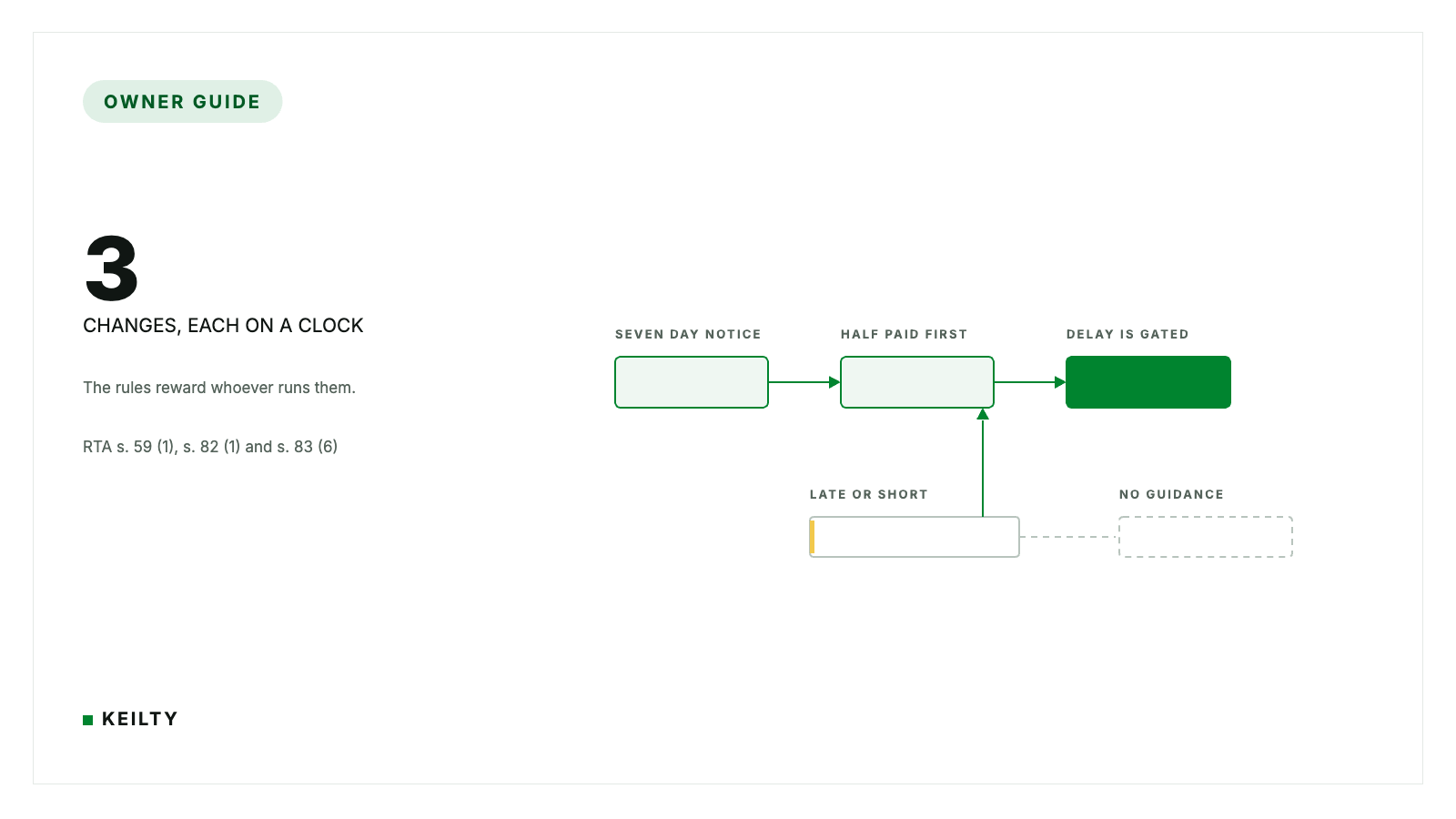
On 2026-09-21 a package of amendments to the Residential Tenancies Act, 2006 came into force. The headline items read as landlord-favourable. The notice period on an N4 dropped from fourteen days to seven. A tenant who wants to raise maintenance or harassment at a rent arrears hearing now has to pay the landlord half the arrears claimed before the hearing. The Board's power to postpone an eviction has been narrowed to a test written in a regulation.
The package is not one-directional, and that is the first thing to get straight. The same batch commenced a reverse onus that runs against the landlord on an own-use notice, and a second presumption on right of first refusal after a renovation. This is a mixed package, not a win.
What the favourable half has in common is that none of it pays you anything by itself. Each is a procedure with a deadline attached, and one of them quietly hands you a piece of paperwork whose accuracy now decides somebody else's rights. The question worth asking this week is not whether the law improved. It is who in your arrangement is going to run these, and what happens on the file when no one is assigned to.
The short version.
They made parts of the rules better, they made the execution narrower, and they added an exposure. Those are three different things and only the first is good news.
Every favourable change in the package is conditional on somebody doing something correctly on a date. The seven days run from the day the notice is given. The half has to reach the landlord no later than seven days before the hearing. The Information Update has to be filed and served five days before it.
An owner who serves the right form on the right day, files a clean application and files the update is better off than they were on 2026-09-20. An owner who serves a form saved to a hard drive in 2024 is worse off than they were, because the form is now prescribed and it was not before.
That is the shape of the package. It rewards the operator rather than the owner. If those are the same person in your case, the work landed on you on 2026-09-21.
The underlying statutory detail is set out in our companion piece on what changed for Ontario landlords in September 2026. This post is about the operating consequences.
Fourteen amendments to the Act came into force, drawn from two statutes. Ten came from the Fighting Delays, Building Faster Act, 2025. Four came from the Helping Homebuyers, Protecting Tenants Act, 2023, covering renovations, bad faith after an own-use notice, and the regulation-making power behind the new sixty-day period. Those last four had been sitting unproclaimed for three years.
Alongside them, O. Reg. 241/26 amended O. Reg. 516/06 and did a great deal of the practical work, adding sections 8.1, 8.2, 8.3 and 8.4 and a new Part II.1 for non-profit housing co-operatives. Two further regulations came into force the same day. O. Reg. 308/26 prescribes the N4, and O. Reg. 240/26 supplies the sixty-day period behind the new presumption of bad faith.
One practical note on checking any of this yourself. When these provisions commenced, the e-Laws consolidation of the Act had not caught up, so the site printed the superseded text. It has since caught up.
As of 2026-09-22 the Act's masthead reads "Consolidation period: September 21, 2026 - e-Laws currency date (September 17, 2026)", and O. Reg. 516/06 carries the same consolidation period with "Last amendment: 241/26." Sections 59, 82 and 83 print the current law as ordinary text. If you printed any of them on 2026-09-21, replace the printout.
Section 59 (1) of the Residential Tenancies Act, 2006 was repealed whole and replaced. It now reads: "If a tenant fails to pay rent lawfully owing under a tenancy agreement, the landlord may give the tenant notice of termination of the tenancy effective not earlier than the 7th day after the notice is given."
The old clauses (a) and (b), which gave seven days for a daily or weekly tenancy and fourteen for everything else, are gone. There is one rule now and it is seven days for every tenancy.
The trigger is the date the notice is given. A notice given on 2026-09-20 runs on the old fourteen-day rule even though the hearing will be months later, and a notice given on 2026-09-21 runs on the new one.
Counting it is not simply adding seven. Under section 89 (3) of the Legislation Act, 2006, a period of days between two events excludes the first day and includes the last. That holds "even if the reference is to ‘at least’ or ‘not less than’." The Board's own N4 checklist works the same example: hand the notice over on March 3rd and the earliest termination date is March 10th.
Then there is service. The same checklist says, in terms, "If you are giving the notice to the tenant by mail or courier, you have to add extra days in calculating the termination date." An owner who hands the notice to a courier and counts seven from that day has dated the notice wrong.
Watch the holidays too, because two different lists are in play on these files. Under section 88 (2) of the Legislation Act, 2006 a Sunday is a holiday and a Saturday is not, while Rule 1.1 of the Board's Rules of Procedure defines a holiday as "any Saturday, Sunday or other day on which the LTB's offices are closed." A statutory deadline and a Rule deadline on the same file can land on different dates whenever a Saturday is involved. Name the instrument when you write the date down.
The second half of this is the form. O. Reg. 308/26 provides that an N4 "shall be in version 1 of the form titled “Notice to End Your Tenancy Early for Non-payment of Rent (N4)”, available on the Landlord and Tenant Board's website." Before 2026-09-21 the N4 was Board-approved. It is now prescribed, and the live form carries the header "Version 1" and the footer "N4 (2026/09)".
Section 212 (1) of the Act provides that "Substantial compliance with this Act respecting the contents of forms, notices or documents is sufficient", and section 212 (2) adds that an error in the contents is still substantial compliance "as long as the error does not significantly prejudice a party's ability to participate in a proceeding under this Act." Read those carefully before relying on them. Both are expressly about the contents of a document. Our reading is that neither reaches the choice of form itself or a wrong termination date, and that is a reading of the two subsections rather than something either of them states.
There is a gap worth knowing about. The Board's Operational Update of 2026-09-21 sets a hard cut-off for ten other forms, saying "Previous versions of these forms will no longer be accepted as of November 30, 2026" in respect of the N5, N6, N8, N12, N13, L1, L2, L9, L10 and T5. The N4 is not on that list and the Update states no acceptance cut-off for old N4s at all. The replacement was made in place at the same file path, so a copy saved last year looks identical to the current one and carries the wrong notice period.
Less than the headline suggests, and it is worth being precise about, because the seven days are the headline item in the whole package.
What the notice period governs is the earliest date you may file. Section 74 (1) provides that a landlord may not apply to the Board for an arrears eviction order "before the day following the termination date specified in the notice." Shortening the notice period moves that filing date forward by a week. It does nothing to the queue behind it.
The tenant also keeps two off-ramps that the September package did not touch. Under section 74 (2) the application is discontinued if, before the Board issues an eviction order, the tenant pays the arrears, the additional rent that has since come due, and "the landlord's application fee". Under section 74 (4) an eviction order is void if the tenant pays before the order becomes enforceable.
There is a limit on the tenant's side as well, and it is one owners rarely have at hand. Section 74 (11), read with clause 74 (3) (c), allows a tenant to make a motion to set aside an ex parte order only once during the period of their tenancy agreement with that landlord. The order itself has to say so.
So the arithmetic on the seven days is this. It brings your filing date forward by a week, it does not shorten the hearing queue, and it does not close the payment routes that end the application. It is worth having. It is worth considerably less than not having to serve the notice twice.
This is the change with the longest tail, and it is the one that turns a piece of your own paperwork into a number that decides somebody else's rights.
Section 82 (1) previously let a tenant raise any issue at an arrears hearing either by giving advance notice under subsection (2) or by giving the Board "an explanation satisfactory to the Board" for not having done so. That second route was deleted on 2026-09-21. Compliance with subsection (2) is now the only way in.
Subsection (2) then gained two new paragraphs. Paragraph 4 opens "Unless the regulations provide otherwise, the tenant shall pay the following amounts to the landlord or, if the regulations so provide, into the Board:" and then splits. Subparagraph 4 i is "Half of any rent arrears that were claimed in the application when it was filed." Subparagraph 4 ii is "Such other amounts as may be prescribed", and no regulation currently prescribes any. Paragraph 5 requires payment "before the hearing and in accordance with any prescribed timelines".
Section 8.3 of O. Reg. 516/06 supplies the timeline: "no later than seven days before the hearing."
Read subparagraph 4 i slowly. The measure is half of what was claimed in the application when it was filed. It is not half of what the tenant accepts is owed, and it is not half of what has accumulated by the hearing date. The figure is the one you wrote on your own L1, and the reissued form says so to the tenant in terms, telling them to "pay the landlord at least half of any rent arrears that are claimed in the landlord's application at least seven days before the hearing."
That is not a lever to pull, and this is the part to be unambiguous about. The Act does not cap the figure or require you to verify it before filing, but section 234 (v) makes it an offence to furnish false or misleading information in material filed in a proceeding, section 238 sets the fine, and section 197 (2) lets the Board dismiss a proceeding without a hearing where it finds the applicant filed documents the applicant "knew or ought to have known contained false or misleading information." The L1 itself carries the warning on its face.
The practical risk runs the other way from the one owners imagine. A figure you cannot support is a figure an adjudicator can take apart at the hearing, after the tenant has already been kept out of their issues on the strength of it.
And an understated figure, which is what an unreconciled ledger produces, lowers the tenant's threshold and hands back the very thing the amendment gave you. Both errors come from the same place, which is filing before the ledger has been checked.
Our companion piece on what a tenant can raise at an arrears hearing works through the tenant side of this in detail.
More than owners assume, and less than they need.
Start with what is required, because the Board publishes a landlord form for this and it is easy to miss. The "L1/L9 Information Update", footer "L1/L9 Information Update (2026/09)", must be filed with the Board and served on each tenant at least five days before the hearing. Its question 4 asks whether you received any additional payments after filing, and requires the amount and the date of each one, under a declaration as to truth. That is where a half-payment gets reported.
Rule 19.6.1 sits on the same five-day clock. Where the tenant has given you their issues and disclosure under Rules 19.4 and 19.6, you "must provide the other parties and the LTB with any responding documents, pictures and other evidence the Landlord intends to rely upon at least 5 days before the scheduled hearing." Rule 19.7 then provides that a party who fails to disclose "may not rely on the evidence that was not disclosed as directed or ordered, unless otherwise ordered."
Receipts are the third piece. Section 109 (1) requires a landlord to provide a receipt "on request" for "any other amount paid to the landlord", which reaches this payment. Section 9 of O. Reg. 516/06 then prescribes the contents, including the address, the amount and date of each payment, "and shall specify what the payment was for", and the landlord's signature. So the receipt you issue is the document that puts a label on an unlabelled payment.
Now the part that is genuinely unaddressed, and it is narrower than it first looks. The Rules do deal with a late payment in one sense: Rule 19.4 requires payment at least seven days before the hearing, and Rule 19.5 provides that "Rule 19.4 cannot be waived except where required by the Human Rights Code." What no source addresses is the landlord's side of the transaction:
Our reading, and we say plainly that it is a reading rather than something any source states, is that an owner should be recording the date and amount of anything received on a file with a pending application, issuing a receipt without waiting to be asked, and writing down how the payment was applied. Only the receipt on request is mandatory. Issuing it unasked is our practice, not a rule, and it is what you will want in front of you when you fill in question 4.
They read inconsistently on their face, and one Rule reconciles the apparent conflict.
Rule 19.4 of the Rules of Procedure, updated 2026-09-21, requires a tenant who intends to raise section 82 issues to do two things "at least 7 days before the scheduled CMH or hearing: make the payment required by subsection 82(2) of the RTA; and provide the other parties and the LTB with a written description of each issue the tenant intends to raise."
Note the divergence there, because it is a real one. Rule 19.4 counts from "the scheduled CMH or hearing". Section 8.3 of the regulation counts from "the hearing". Where a case management hearing is scheduled first, the Rule's seven days and the regulation's seven days can land on different dates.
The Practice Direction on Evidence prints a date line of "Updated: September, 2026" and still says a tenant who has not provided the required disclosure "must provide an explanation satisfactory to the LTB Member explaining why the tenant could not comply with the requirements." The Board's form "Issues a Tenant Intends to Raise at a Rent Arrears Hearing", footer v. 2026/09, carries the same wording.
Read on its own that looks like a route the legislature deleted. Rule 19.5.1 is what puts it back in its place. Where the application was filed before 2026-09-21, "Rule 19.4(a) does not apply", so the payment requirement is switched off entirely, and a tenant who fails the notice requirement is still permitted to raise issues "if the LTB is satisfied the tenant could not comply with the requirements to provide notice." The Practice Direction's escape hatch attaches to the written description rather than to the payment, and it remains correct for pre-2026-09-21 applications.
Two loose ends survive that. Guideline 10, which the Operational Update names as updated, still prints "December 15, 2018 - Updated September 2025". And Guideline 11's closing cross-reference to Guideline 7 links to the December 2020 file rather than the September 2026 one, so a reader who follows it lands on pre-amendment text.
We are not predicting how the Board will resolve any of that. The point for an owner is narrower. The deciding fact on any given file is the date you filed, not the date of the hearing, and it is worth knowing which of your files sit on each side of it before you walk in.
Clause 83 (1) (b) of the Act now opens "subject to any prescribed limitations or conditions", and section 8.4 of O. Reg. 516/06 supplies them. The Board may postpone enforcement of an eviction order "only if the landlord consents to the postponement" or the prescribed conditions are met.
Those conditions split. On a notice under section 48, 49 or 50, the Board must be satisfied that postponing "would not be unfair to the landlord or other tenants of the residential complex". On any other application, the Board must be satisfied of that and that "there are compelling grounds to postpone the enforcement of the eviction order."
The phrase "compelling grounds" is not defined. The word "compelling" appears nowhere in the Act, and in O. Reg. 516/06 it appears exactly twice, both times as the operative words themselves. So there is no statutory content to it yet.
The Board has conformed Guideline 7 and said so, and the Guideline now retires its own examples in terms: "The following are some examples of tenant circumstances where a delay has been considered; however, these examples are based on decisions that were made before section 8.4 of O.Reg. 516/06 came into effect on September 21, 2026, and therefore may no longer be applicable:".
Our reading is that the narrowed gate bears on the expedited stream too, since section 84 has always been expressly "Subject to clause 83 (1) (b)", so narrowing the postponement power narrows what can hold an expedited order up. That is an inference from reading the two together rather than a change anybody made to section 84.
What none of this does is shorten a hearing. Clause 83 (1) (a), the power to refuse the application outright, is untouched, and so are subsections 83 (2) through (8). Guideline 11 makes the residual route explicit, telling tenants that issues not considered under section 82 "may still be raised by the tenant as circumstances the LTB should consider when deciding whether to delay or refuse the eviction under section 83 of the RTA."
It is worth saying what reduces the claim as plainly as what creates it. Guideline 11 records that where the Board finds a tenant entitled to a rent abatement, "it will be deducted from any rent arrears owing to the landlord". The half-payment gate also defers a tenant's issues rather than extinguishing them: Guideline 11 tells a tenant who is not permitted to raise issues under section 82 that they "may file their own application in order to have the LTB consider these issues at a separate hearing." The maintenance claim you kept out of the arrears hearing can come back as a T6.
Both ways, on the same notice, and it is an easy part of the package to read only half of.
Section 48.1 now opens "Subject to subsection (2)", and the new subsection (2) removes the one month's compensation obligation on a landlord's-own-use notice where three criteria are met. All three, not any of them: the notice is given on or after 2026-09-21, "The date for termination specified in the notice is at least 120 days after the notice is given", and that date "is the day a period of the tenancy ends or, where the tenancy is for a fixed term, the end of the term."
Read the third one again. Giving 120 days is not enough on its own. The termination date has to land on the end of a rental period as well, so a notice that gives 130 days but lands mid-month misses the carve-out and the compensation is owed. Count the period end first, then count backward.
Now the other direction. Section 57 (6.1) commenced the same day, and it provides that on a bad faith application, if no person referred to in clause 48 (1) (a), (b), (c) or (d) occupied the unit within the prescribed period after the former tenant vacated, "it is presumed, unless the contrary is proven on a balance of probabilities", that the notice was given in bad faith and that the unit was not occupied within a reasonable time. O. Reg. 240/26 sets that period at sixty days.
Put those two together and the effect is uncomfortable. Taking the compensation carve-out does not reduce that exposure. It makes the 120-day own-use notice cheaper to give. And every one of those notices now carries a reverse onus if the move-in does not happen inside sixty days. An owner whose plans change after serving is in a materially worse position than they were on 2026-09-20.
Section 58 (1.1) now says what constitutes persistent failure to pay rent "shall be determined in accordance with the regulations, if any", and section 8.1 (1) of O. Reg. 516/06 supplies a benchmark: failing to pay within seven days of the due date "on at least three occasions within any six-month period", with a carve-out where the failure was solely attributable to the landlord applying a rent payment made during that same six-month period to another amount the tenant owed.
Note the word "solely". A failure that was partly attributable to something else is not carved out.
Section 8.1 (2) is the part to notice. It says "For greater certainty, a persistent failure to pay rent on the date it becomes due and payable may arise in circumstances not set out in subsection (1) and the circumstances set out in subsection (1) shall not limit what may constitute a persistent failure to pay rent on the date it becomes due and payable." That is a floor, not a test. Three occasions in six months is a route in, and it does not cap what else can qualify.
The operating consequence is mundane and it is the whole point. Three late payments in six months is now a documented threshold, and it only helps you if somebody logged the actual date each payment landed, month after month, on a file where nothing had gone wrong yet.
It is a fair question and the answer is published, so there is no need to guess.
The Board's key performance indicators for the reporting period 2025-04-01 to 2026-03-31 set a target of 80 per cent on a combined scheduling measure: hearings scheduled within 50 calendar days for L1 and L9 applications and 55 calendar days for all other applications except L5s and A4s. It reported 78 per cent, 78 per cent and 81 per cent across the first three quarters. A second combined measure, decisions issued within 20 calendar days for L1 and L9 applications and 35 for all other applications except L5s and A4s, ran at 89, 84 and 83 per cent.
The number that matters more sits underneath those. The ninety-day case lifecycle measure, which covers all applications except L5s and A4s for English applications, ran at 51, 53 and 52 per cent against a target of 80 per cent. Roughly half of files finish inside 90 days, and the Board is running about 28 points below its own target on that measure, three quarters running.
Set that against the cost of a false start. An L1 costs $201, or $186 filed through the Tribunals Ontario Portal, and the forms and fees page notes that "Please note that LTB fees are non-refundable." A defective notice does not refund the fee. It sends you back to the start of a process whose middle half takes longer than three months.
Two cheaper routes are worth knowing before you file anything. The fees page and the L1 both point to a Fee Waiver Request for a landlord who cannot afford the fee, and the Board publishes a Payment Agreement form that can produce a consent order without a hearing at all. The L4, which enforces a settlement or order the tenant has broken, is listed as "No charge through the Tribunals Ontario Portal".
Six things changed in our own operating routine, and they are concrete rather than aspirational.
The form is pulled fresh every time. Not from a template folder, not from last month's file. The N4 is prescribed now and it was replaced at the same file path, so a saved copy is indistinguishable from the current one by eye and wrong on its face.
The arrears figure is reconciled before the L1 is filed, not after. That number sets the tenant's threshold under subparagraph 4 i, and it is the number we sign a declaration about. A ledger that has not been reconciled since the last payment is not a basis for filing.
The L1/L9 Information Update goes in the calendar the day the application is filed. Five days before the hearing, filed and served, with every payment received since filing listed by amount and date. It is a landlord obligation with a deadline and no reminder attached to it.
Every payment received on a file with a pending application is dated, receipted and applied on the record. The receipt is only mandatory on request, which is exactly why it gets issued unasked. Section 9 of O. Reg. 516/06 requires the receipt to specify what the payment was for, so it is the document that labels an unlabelled transfer.
The date each rent payment actually lands is logged on every tenancy, not just the troubled ones. Section 8.1 (1) turns on three occasions in six months. That cannot be reconstructed from a bank statement half a year later with any confidence, and a persistent late payment case is built from data captured before anybody decided to build a case.
Notices and applications are tracked by date against three separate triggers. The N4's seven days keys off the date the notice is given. The pay-half rule keys off the date the application was filed. And the transitional subsections preserve the old section 82 for an application made before 2026-09-21 that has not been finally determined, even where the hearing is on or after that date. A file note that says "the September rules" does not tell you which of the three applies.
None of this is difficult. All of it is the kind of work that gets done when it is someone's job and gets skipped when it is someone's evening.
The test is not whether you understand the changes. You have just read them and they are not complicated.
The test is whether the six routines above will happen on your properties every month without anybody deciding to do them. If you own a duplex in Peterborough and you already reconcile the ledger monthly, date every payment received, diarize the Information Update and check the Board's forms page before serving anything, the favourable half of this package is straightforwardly good news for you and you do not need us.
If you recognized something in this post that you are not currently doing, the question worth sitting with is whether that changes because you read an article. Working with owners across Peterborough and the rest of Eastern Ontario, the pattern we can speak to is our own: what holds up over a year is a routine somebody is accountable for, not an intention formed in September.
The other half of the test is volume. One unit, one tenant, one payment a month is a routine a person can hold. A small multi-family building with eight tenants is ninety-six payment dates a year to log, eight ledgers to reconcile before any filing, and an Information Update per application. That is the point at which the arithmetic stops being about whether you can and starts being about what your time is worth.
There is one more thing worth knowing before you hand any of it over, and it is not in the Residential Tenancies Act, 2006 at all. Section 184 (1) applies the Statutory Powers Procedure Act to all proceedings before the Board. Section 23 (3) of that Act then lets a tribunal exclude from a hearing anyone "other than a person licensed under the Law Society Act" appearing on behalf of a party, if it finds that person "is not competent properly to represent" the party. So who stands up for you at a hearing is a separate question from who manages the building, and it is governed by a different statute.
We will say the unhelpful thing too, because it is true. Handing a property to a manager does not make any of this automatic either. It makes it somebody's assigned work, with a system behind it and a person answerable for it. If you are interviewing managers this autumn, the useful question is not whether they know the September rules. It is to ask them how they log the date a rent payment lands, who files the Information Update, and what they do when half the claimed arrears lands in the account six days before a hearing.
Does the seven-day N4 apply to a notice I gave before September 21, 2026? No. The rule keys off the date the notice is given, so a notice given on or before 2026-09-20 runs on the old fourteen-day period even if the hearing is months later. Track pre and post notices separately.
Can I still use an N4 I saved on my computer last year? No. O. Reg. 308/26 prescribes the N4 in version 1, and the current form carries the footer "N4 (2026/09)". The Board replaced the file at the same path, so an old copy looks identical and carries the wrong notice period. Download it fresh each time, and add days if you are serving by mail or courier.
How is the tenant's half calculated? It is half of the rent arrears claimed in your application when it was filed, not half of what has accrued since or half of what the tenant accepts is owed. Section 8.3 of O. Reg. 516/06 requires payment no later than seven days before the hearing, and it is paid to you directly, not to the Board.
Do I have to report the payment to the Board? Yes. The L1/L9 Information Update must be filed and served at least five days before the hearing, and its question 4 asks for the amount and date of every payment received after you filed. What no source addresses is what you do with a payment that arrives short or unlabelled, or who bears the burden of proving it arrived on time.
Does the new postponement gate mean the Board can no longer delay an eviction? No. Section 8.4 of O. Reg. 516/06 conditions the postponement power in clause 83 (1) (b), but clause 83 (1) (a), the power to refuse the application outright, is untouched, and so are subsections 83 (2) through (8).
Not sure whether the September changes have landed properly on your own files? Tell us about the property and A.J. Keilty will call you within 20 minutes in business hours to walk through where you stand.
This post is general information about Ontario residential tenancy law as of 2026-09-22, not legal advice. Legislation, regulations and tribunal practice change. For advice on a specific property or situation, speak with a lawyer or licensed paralegal.
Ontario property management with published pricing, same-day answers, and no surprises. Since 2003.
300-80 Queen StreetNot served yet. Join a list and hear from us the day we open.