
By A.J. Keilty, President, KEILTY Realty Management
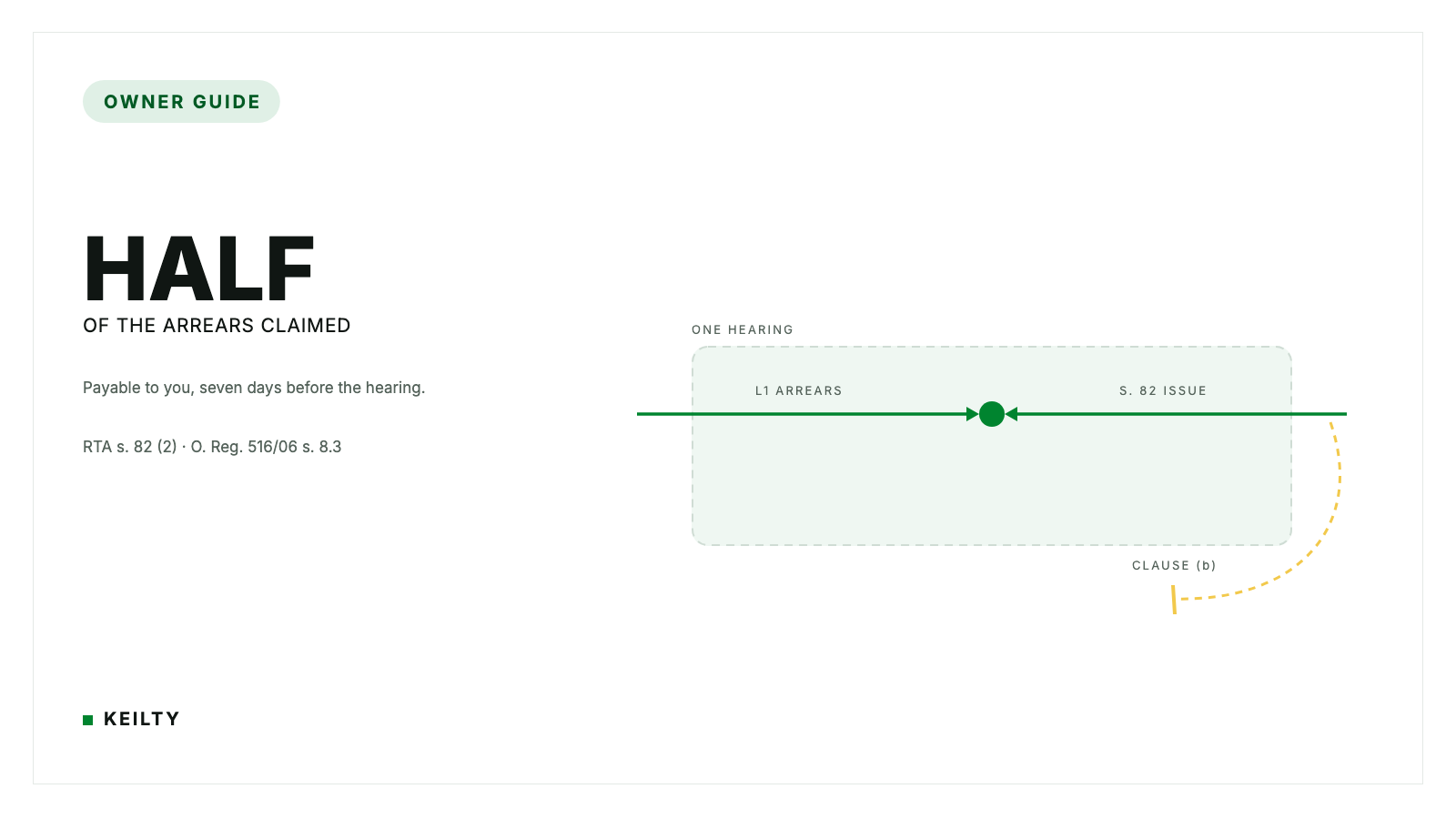
At the hearing of your own arrears application, the tenant is allowed to argue about something else. Section 82 of the Residential Tenancies Act, 2006 requires the Board to let them raise any issue that could have been the subject of their own application, and section 82 (3) lets the Board make any order on that issue it could have made had they applied. So an application you filed about unpaid rent can still produce an abatement, an order to do work, or a prohibition on your next rent increase.
What changed on 2026-09-21 is the door the issue comes through rather than what waits on the other side of it. On an application filed on or after that date, the tenant has to pay you half the arrears you claimed when you filed, at least seven days before the hearing, and the old escape hatch for a tenant who could not give notice in time is gone from the statute. On an application filed before that date, none of that applies.
The short version.
This is the other side of a file we have written about from the tenant's end. Where the issue raised is maintenance, the substance is the same material set out in what happens if a tenant files a T6 against you in Ontario, arriving without a form and without a fee.
Three things, and since 2026-09-21 there is a fourth that involves money.
Section 82 (2) still opens with the three that were there before: "1. The tenant shall give advance notice to the landlord of the tenant's intent to raise the issue at the hearing. 2. The notice shall be given within the time set out in the Rules. 3. The notice shall be given in writing and shall comply with the Rules." Paragraph 2 sends you to the Rules for the number, and an owner counting off the statute will not find one there.
Added on 2026-09-21 is paragraph 4: "Unless the regulations provide otherwise, the tenant shall pay the following amounts to the landlord or, if the regulations so provide, into the Board: i. Half of any rent arrears that were claimed in the application when it was filed. ii. Such other amounts as may be prescribed." Paragraph 5 follows: "The amounts specified in paragraph 4 shall be paid before the hearing and in accordance with any prescribed timelines."
Section 82 (1) itself was replaced the same day. It now reads that at a hearing of a section 69 application based on a section 59 notice the Board "shall permit the tenant to raise any issue that could be the subject of an application made by the tenant under this Act if the tenant complies with the requirements set out in subsection (2)." The lettered structure is gone, and with it the old clause (b), which let a tenant in on an explanation satisfactory to the Board. Compliance with section 82 (2) is now the only route in.
The Board's Rules of Procedure carry the timing. Rule 19.4 now reads that a tenant intending to raise issues under sections 82(1) or 87(2) at a rent arrears hearing must, at least 7 days before the scheduled CMH or hearing, "make the payment required by subsection 82(2) of the RTA; and provide the other parties and the LTB with a written description of each issue the tenant intends to raise." Both limbs, both on the same seven day clock.
Is this you? If you own a rental in Kingston or Eastern Ontario and would rather not handle this yourself, KEILTY Realty Management manages it for a flat monthly rate. See how it works for single-family rental management. Tell us about the property and A.J. Keilty will call you within 20 minutes in business hours.
By obliging the Board to hear them. Section 82 (1) is directed at the Board rather than at either party, and the obligation survived the amendment intact. What changed is the condition attached to it, not the width of what can be raised.
Read "any issue that could be the subject of an application made by the tenant under this Act" without narrowing it. It is not confined to maintenance. Anything in the tenant's own suite of applications is inside those words, so illegal charges, an interference complaint, a locking system changed without a key, harassment, and the whole of the maintenance ground all reach the same hearing.
Section 82 (3) is the part owners underestimate, and it was not amended: "If a tenant raises an issue under subsection (1), the Board may make any order in respect of the issue that it could have made had the tenant made an application under this Act." That is not a set-off provision. It imports the remedy section that would have applied on the tenant's own form, which on a maintenance issue is the whole of section 30 (1), including its first paragraph, terminating the tenancy, and its sixth, seventh and eighth, which reach your rent.
Two, and the second one catches owners who thought they had stepped around the first.
Section 82 (1) names one application precisely: an application under section 69 for an order terminating a tenancy and evicting a tenant, based on a notice of termination under section 59. That is the arrears eviction. A section 69 application founded on some other notice is outside those words.
Then section 87 (2) says, in full: "Section 82 applies, with necessary modifications, to an application under subsection (1)." Section 87 (1) is the standalone arrears application, the one that seeks the money without seeking the tenancy. So choosing the money-only route does not take you outside section 82. The whole of it is carried across by reference, which means the payment obligation arrives on that route automatically, without section 87 (2) itself being touched. Rule 19.4 names sections 82(1) and 87(2) side by side, so the Board's own Rule reads it the same way.
The practical consequence is worth stating plainly, because it removes an option owners reach for. If the reason you were considering the money-only application was to keep the hearing narrow, that is not what it does.
Whatever it could have ordered had the tenant filed their own application about the same issue. Nothing in this package narrows that.
Take maintenance, because it is the ground with the widest remedy list. Section 30 (1) opens: "If the Board determines in an application under paragraph 1 of subsection 29 (1) that a landlord has breached an obligation under subsection 20 (1) or section 161, the Board may do one or more of the following". Nine paragraphs follow. Three take money out, being the abatement, the tenant's repair costs and out-of-pocket expenses, and an authorization of work with its cost ordered against you. Three limit what you can charge: capping a new tenant's rent at the last lawful rent charged to the former tenant, prohibiting a notice of rent increase, and prohibiting an increase already noticed but not yet taken. One terminates the tenancy. One orders specified work within a specified time. The ninth is "Make any other order that it considers appropriate".
So an application you brought to recover arrears and end a tenancy can end with the tenancy continuing and your next rent increase blocked. All three prohibitions close on the same two conditions, and the qualifier in them is easy to drop. Each runs until the landlord has completed the items in work orders whose compliance period has expired and which were "found by the Board to be related to a serious breach of a health, safety, housing or maintenance standard", and has completed the work ordered under paragraph 4 found by the Board to be related to "a serious breach of the landlord's obligations under subsection 20 (1) or section 161". Both, not either.
Note where "serious breach" sits, because it is not a threshold for imposing the prohibition, which is triggered by any breach under the opening words of section 30 (1). It qualifies the work you have to finish before the prohibition lifts. So a prohibition runs until that work is done rather than for a fixed period, and there is no date you can wait out.
Section 30 (2) is the provision to have ready against all of it: "In determining the remedy under this section, the Board shall consider whether the tenant or former tenant advised the landlord of the alleged breaches before applying to the Board." It is mandatory, it is directed at the remedy rather than at the finding, and on a section 82 issue it is the one argument that is built entirely out of your own records.
There is a ceiling on the money and none on the prohibitions. Section 207 (1) lets the Board "order the payment to any given person of an amount of money up to the greater of $10,000 and the monetary jurisdiction of the Small Claims Court". That jurisdiction is $50,000, set by section 1 (1) of O. Reg. 626/00 with effect from 2025-10-01. Carry the rule rather than the figure, because the figure moves with the regulation while the Act only ever points at it. The three rent prohibitions are not orders for the payment of money, so nothing in section 207 reaches them.
One limit belongs here. On the classes of rental unit listed in section 7 (1), paragraphs 6, 7 and 8 of section 30 (1) are disapplied. Those classes are wider than the label suggests. They include a federal government complex, a designated housing project under the Housing Services Act, 2011, a non-profit housing project developed or acquired under a prescribed programme, a non-member unit of a non-profit housing co-operative, a complex operated by a religious institution for a charitable use on a non-profit basis, and a unit provided by an educational institution to a student or a member of its staff "that is not exempt from this Act under clause 5 (g)". A university, a federal department and a faith-based owner are in the same position as a housing provider on this point.
On those units the abatement and the work order remain fully available to a tenant under section 82, and so does paragraph 9, the catch-all. Only the three rent prohibitions are switched off, which is not the same as capping the exposure.
Half of the arrears figure that appeared in your application on the day you filed it. Not the balance at the hearing, and not the balance the tenant admits.
That distinction is the practical heart of the change, so work it on a file. A unit in Kanata rents for $2,000 a month. The tenant misses the 1st of three consecutive months, you serve an N4, and you file an arrears application claiming $6,000. The hearing is set four months later, by which time the tenant has paid nothing further and the balance has grown to $14,000.
Now the three qualifications, each read off the text rather than predicted.
Counting those seven days is not quite the same exercise as counting Rule 19.4's. Rule 1.12 of the Rules says a number of days means calendar days, Rule 1.13 counts "by excluding the first day and including the last day", and Rule 1.14 rolls a deadline ending on a holiday to the next day that is not one. Rule 1.12 is limited by its own words to an LTB order or a Rule, and section 8.3 is neither, so a regulatory period is counted under the Legislation Act, 2006 instead.
The definitions of a holiday in the two instruments are not identical, and the Rules define it at Rule 1.1 as "any Saturday, Sunday or other day on which the LTB's offices are closed". Our reading is that the payment date and the disclosure date can therefore come apart by a day on a hearing near a statutory holiday, and that this is worth checking rather than assuming. Rule 19.4 now puts both obligations on the same seven day line, which makes the safe practice obvious: treat the earlier of the two dates as the real one.
It does as of 2026-09-22, and it did not on the day the amendment commenced. We told readers the opposite when we published this on 2026-09-21, so the correction belongs here rather than in a quiet deletion.
On 2026-09-21 the e-Laws masthead on the Act read "Consolidation period: July 1, 2026 - e-Laws currency date (September 16, 2026)", and section 82 printed the superseded text as the main text with the law that had taken effect that morning sitting underneath it in a grey not-yet-in-force Note. e-Laws rebuilt the consolidated text within a day. The masthead now reads "Consolidation period: September 21, 2026 - e-Laws currency date (September 17, 2026)" and records "Last amendment: 2025, c. 14, Sched. 12." So the consolidation runs from 2026-09-21 to an e-Laws currency date of 2026-09-17.
Section 82 therefore prints as ordinary operative text, credited to the amending statute in black letter, and carries no Note. The same is true of sections 59 and 83. O. Reg. 516/06 carries the same consolidation period and records "Last amendment: 241/26."
The amendment history table remains the place a commencement date is recorded rather than inferred. It carries the line "2025, c. 14, Sched. 12, s. 6 (1-4) - 21/09/2026", and the commencement formula is "On September 21, 2026, the day named by order of the Lieutenant Governor in Council", by order rather than by proclamation.
One practical consequence survives the rebuild. A printout of section 82 taken on 2026-09-21 shows the superseded subsection unless the Notes were printed with it, so replace anything printed that day before you hand it up. A page printed from 2026-09-22 onward matches the citations in this post. The rest of the package is set out in what changes for Ontario landlords in September 2026.
The old ones, and the hearing date does not change that.
The replacement section 82 (4) reads: "Subsection (1), as it read immediately before the day subsection 6 (1) of Schedule 12 to the Fighting Delays, Building Faster Act, 2025 came into force, continues to apply to any application described in subsection (1) that was made before that day and has not been finally determined before that day, even if the hearing of the application is on or after that day."
The new section 82 (5) does the same job for section 82 (2), and it is printed with a garbled phrase which we quote as it appears: "Subsection (2), as it read the day before day subsection 6 (2) of Schedule 12 to the Fighting Delays, Building Faster Act, 2025 came into force, continues to apply to any application described in subsection (1) that was made before that day and has not been finally determined before that day, even if the hearing of the application is on or after that day. 2025, c. 14, Sched. 12, s. 6 (4)." The phrase "as it read the day before day" is e-Laws' own, reproduced here rather than corrected.
Two conditions have to hold together for the old rules to continue: the application was made before 2026-09-21, and it has not been finally determined before that day. The closing words settle the question owners ask first. A hearing held after 2026-09-21 on an application filed before it runs on the old section 82, so the tenant keeps the explanation route and owes you nothing in advance.
Rule 19.5.1 carries the same line on the Board's side. Where the arrears application was filed before 2026-09-21, "Rule 19.4(a) does not apply", which is the payment limb, and a tenant who misses the written description "shall be permitted to raise issues under sections 82(1) or 87(2) of the RTA during a hearing for a landlord's application about rent arrears if the LTB is satisfied the tenant could not comply with the requirements to provide notice." The LTB's operational update published on 2026-09-21 says it more shortly: "This applies if the landlord filed the rent arrears application on or after September 21, 2026."
Three trigger dates run in this area and they are not the same date. Keep them apart.
Guideline 11 adds a fourth thing to watch on the notice: "The N4 Notice must be given to the tenant at least 7 days before the termination date. If the N4 Notice was given to the tenant before September 21, 2026, different deadlines apply." Section 59 (1) as it now reads sets the 7th day after the notice is given for every tenancy, where a monthly tenancy took 14 days before that date.
The notice also has to be on a different piece of paper. O. Reg. 308/26 requires a section 59 notice to be "in version 1 of the form titled “Notice to End Your Tenancy Early for Non-payment of Rent (N4)”, available on the Landlord and Tenant Board's website". The live N4 is headed "Version 1" and carries the footer "N4 (2026/09)". Check the footer on the copy in your templates folder before serving it.
Those dates assume the notice was handed over in person, because the day a notice is "given" depends on how it was served and a mailed notice is not given on the day it is posted. We set the service rules out in how to serve a notice to a tenant in Ontario.
Not entirely, and the disagreement sits exactly on the provision that changed on 2026-09-21.
Interpretation Guideline 11, "Rent Arrears", prints "Effective as of: September 1, 2021Updated: September 21, 2026" and tracks the new law. It tells a tenant to "Pay the landlord half of the rent arrears claimed in the landlord's application at least 7 days before the hearing. This payment cannot be made to the LTB. This amount must be paid even if the tenant does not agree that they owe the money claimed in the landlord's application (The tenant is not required to meet this condition if the landlord's rent arrears application was filed before September 21, 2026.)"
The LTB's Practice Direction on Evidence prints "Updated: September, 2026" and still tells a tenant who missed the disclosure deadline that they "must provide an explanation satisfactory to the LTB Member explaining why the tenant could not comply with the requirements." That is the wording of the escape hatch the legislature deleted from section 82 (1).
Both documents are live on the Board's site. Guideline 11 and Rule 19.5.1 confine the explanation route to applications filed before 2026-09-21. The Practice Direction on Evidence states it without that limit. Our reading of the three together is that the Practice Direction has not been updated for the amendment rather than that it preserves a route the statute removed, but that is our reading and neither document says so. What an owner should take from it is narrow: expect the argument to be made, and expect it to be made out of the Practice Direction.
The Rules themselves now print "Effective: September 1, 2021" and "Updated: September 21, 2026".
On an application filed on or after 2026-09-21, Rule 19.4 is the gate and Rule 19.5 is unusually firm about it.
Rule 19.5 reads in full: "Rule 19.4 cannot be waived except where required by the Human Rights Code." That is a narrower relieving provision than the one it replaced, and it is not an invitation to argue hardship. It names one instrument.
Two things follow for an owner, and neither is a prediction about how a Member will decide a particular file.
The more important point is what happens after the gate closes, because the issue does not vanish. Guideline 11 closes with it: "Issues that are not considered by the LTB under section 82 may still be raised by the tenant as circumstances the LTB should consider when deciding whether to delay or refuse the eviction under section 83 of the RTA." A tenant locked out of a section 82 remedy can still put the same facts to the Board as a reason not to evict.
So an owner who treats this change as the end of maintenance arguments in arrears hearings has read half of it. The remedy route narrowed. The relevance of the facts did not.
For an application already filed, no. For a notice you have not served, it changes the arithmetic rather than the urgency.
Anything filed before 2026-09-21 runs on the old section 82 whenever it is heard, so there is nothing to reconsider on those files. For a new notice, four things now run in the owner's favour at once: a 7 day notice period rather than 14 for a monthly tenancy, no explanation route for a late tenant, half the arrears claimed payable to you seven days before the hearing, and a postponement of enforcement under clause 83 (1) (b) now gated by your consent or by prescribed conditions.
Two things belong beside that before anyone treats it as a plan.
One thing not to carry over from the rest of the Act. Section 69 (2) gives a landlord 30 days after the termination date to apply, but section 69 (3) says that limit "does not apply with respect to an application based on the tenant's failure to pay rent". There is no outer deadline on an arrears application, so nothing here is a reason to file a file that is not ready.
Answer it, and diarize your own date before you finish reading theirs.
Rule 19.6 keeps the tenant's seven day evidence disclosure, and Rule 19.6.1 gives the landlord a five day window to respond with the documents, pictures and other evidence you intend to rely on. On a hearing on Wednesday 2026-12-09, the tenant's material is due Wednesday 2026-12-02 and yours is due Friday 2026-12-04.
That leaves two days to assemble a response to issues you may be seeing for the first time, which is the practical argument for keeping a maintenance record as a matter of course rather than building one after an application is served.
Yes on refusing, and the power to postpone narrowed on 2026-09-21. That narrowing is worth naming on its own, because it is not in the Act.
Section 83 (1) provides that on an application for an order evicting a tenant the Board may, despite any other provision of the Act or the tenancy agreement, "(a) refuse to grant the application unless satisfied, having regard to all the circumstances, that it would be unfair to refuse; or (b) order that the enforcement of the eviction order be postponed for a period of time." Clause (a) is unchanged, and so are sections 83 (2) to (8).
Clause 83 (1) (b) was amended on 2026-09-21 by adding "subject to any prescribed limitations or conditions" at the beginning. The limitation arrives in the regulation. Section 8.4 of O. Reg. 516/06, added by section 5 of O. Reg. 241/26, opens: "The Board may order that the enforcement of an eviction order be postponed under clause 83 (1) (b) of the Act only if the landlord consents to the postponement or if the following conditions are satisfied". On a section 48, 49 or 50 notice the condition is that postponement "would not be unfair to the landlord or other tenants of the residential complex". On any other application, including arrears, that same test applies and so does a second: "there are compelling grounds to postpone the enforcement of the eviction order."
Read the word "only". From that date a postponement on an arrears eviction needs either your consent or both conditions met, where before it needed neither. Note also that "compelling" appears nowhere in the Act and "compelling grounds" is not defined in O. Reg. 516/06, so what clears that bar is an open question until Members start deciding it. If you take one thing from this package as an owner with an arrears file, it is this, and a reader working from section 83 alone will not find it.
Now the half of section 83 that runs the other way, because it is the reason the maintenance record in a section 82 issue reaches further than the abatement. Section 83 (2) is mandatory: on an application under section 69 based on a section 59 notice the Board "shall not grant the application unless it has reviewed the circumstances and considered whether or not it should exercise its powers under subsection (1)". Section 83 (3) is stronger still. The Board "shall refuse to grant the application where satisfied that" one of several things is so, and the first of them is that "the landlord is in serious breach of the landlord's responsibilities under this Act or of any material covenant in the tenancy agreement".
So the maintenance issue a tenant raises is not only a claim for money against you. On a serious breach it is an answer to your eviction, and that is true whether it arrives through section 82 or through the section 83 route Guideline 11 points at. That is the sharpest reason an owner with an arrears file should close out open work orders before the hearing rather than after it.
Differently in each case, and the co-operative is where owners run two things together.
A member unit of a non-profit housing co-operative is outside the Act under clause 5 (c), which excludes it "except for Part V.1, and except for those provisions in other Parts that are needed to give effect to Part V.1". Read to the end of that. Part V.1 is the termination of occupancy regime for co-operatives and it has its own machinery, which is why clause 94.12 (1) (b) exists as the mirror of clause 83 (1) (b) rather than the co-operative simply borrowing section 83.
A non-member unit in the same building is the opposite case. It stays inside the Act under paragraph 4 of section 7 (1), so section 82 applies to it in full and only paragraphs 6, 7 and 8 of section 30 (1) are switched off. One co-operative, two units, two different answers at the same hearing.
A care home under Part IX is inside the regime. Nothing disapplies section 82, and Part IX adds the tenant's own applications about care services and meals to the list of things that "could be the subject of an application made by the tenant", which widens rather than narrows what can arrive. A long-term care home is a different animal, because clause 5 (e) puts accommodation subject to the Fixing Long-Term Care Act, 2021 outside the Act altogether.
The filing is administration. The hearing is a record, and the record is made months earlier.
An organized owner can serve the current N4 correctly, count the days, file on the right date and diarize a five day disclosure deadline. Those are four calendar tasks and nothing about them needs a firm.
What is harder is the thing section 82 actually tests. When a tenant raises maintenance inside your arrears application, what decides it is whether you were told, whether you should have known, how long the response took and whether it was appropriate to effect the repair. Those are four separate findings, each proved by something somebody wrote down at the time, and none of them can be created after the application is served. If the order goes against you, the routes out are set out in what you can do if you disagree with an LTB order, and all of them are more expensive than the log would have been.
That is where KEILTY earns its keep on an arrears file. A request logged when it arrives, attended on a timeframe that matches how serious it is, and closed out with an invoice attached, is a file that answers a section 82 issue by existing. It is ordinary work done consistently, and it is cheaper than an abatement and a blocked rent increase on a tenancy you were trying to end anyway.
Can a tenant really raise maintenance at a hearing about unpaid rent? Yes. Section 82 (1) requires the Board to permit a tenant to raise any issue that could be the subject of an application made by the tenant under the Act, at the hearing of a landlord's section 69 application founded on a section 59 notice, where the tenant complies with section 82 (2). Section 82 (3) then lets the Board make any order on that issue it could have made had the tenant applied, so the remedy is not limited to a set-off against the arrears.
How much does a tenant have to pay before the hearing now? Half of any rent arrears that were claimed in the application when it was filed, plus any other prescribed amounts, and nothing further has been prescribed. It is payable to the landlord and cannot be paid into the Board, because payment into the Board depends on a regulation so providing and none does. Section 8.3 of O. Reg. 516/06 sets the timeline at no later than seven days before the hearing.
Is it half of what is owed at the hearing? No. It is half of what was claimed in the application on the day it was filed, so arrears that accrue afterwards do not raise it. Guideline 11 also states that the amount must be paid even where the tenant does not agree the money is owed.
Does filing a money-only arrears application avoid section 82? No. Section 87 (2) provides that "Section 82 applies, with necessary modifications, to an application under subsection (1)", which is the standalone arrears application. The whole of section 82 is carried across by reference, including the payment obligation, and Rule 19.4 names sections 82(1) and 87(2) together.
If I filed before 2026-09-21, which rules apply at a hearing held afterwards? The old ones. Sections 82 (4) and 82 (5) continue the former subsections 82 (1) and 82 (2) for any application made before that day and not finally determined before it, "even if the hearing of the application is on or after that day". Rule 19.5.1 says the same for the Board's own process.
What happens to an issue the tenant cannot raise under section 82? It can still be put to the Board under section 83. Guideline 11 closes with the point that issues not considered under section 82 "may still be raised by the tenant as circumstances the LTB should consider when deciding whether to delay or refuse the eviction under section 83 of the RTA."
Can the Board still postpone enforcement of an eviction order for arrears? Yes, but not freely. Section 8.4 of O. Reg. 516/06 provides that the Board may order a postponement under clause 83 (1) (b) "only if the landlord consents to the postponement or if the following conditions are satisfied", and on an arrears application those conditions are that postponement would not be unfair to the landlord or other tenants and that there are compelling grounds for it. Separately, section 83 (3) still requires the Board to refuse an eviction application where satisfied the landlord is in serious breach of their responsibilities under the Act.
Facing an arrears hearing and not sure what your file says about the rest of the tenancy? Get in touch and we will work through the items and the dates with you.
This post is general information about Ontario residential tenancy law as of 2026-09-22, not legal advice. Legislation, regulations and tribunal practice change. For advice on a specific property or situation, speak with a lawyer or licensed paralegal.
Ontario property management with published pricing, same-day answers, and no surprises. Since 2003.
300-80 Queen StreetNot served yet. Join a list and hear from us the day we open.