
By A.J. Keilty, President, KEILTY Realty Management
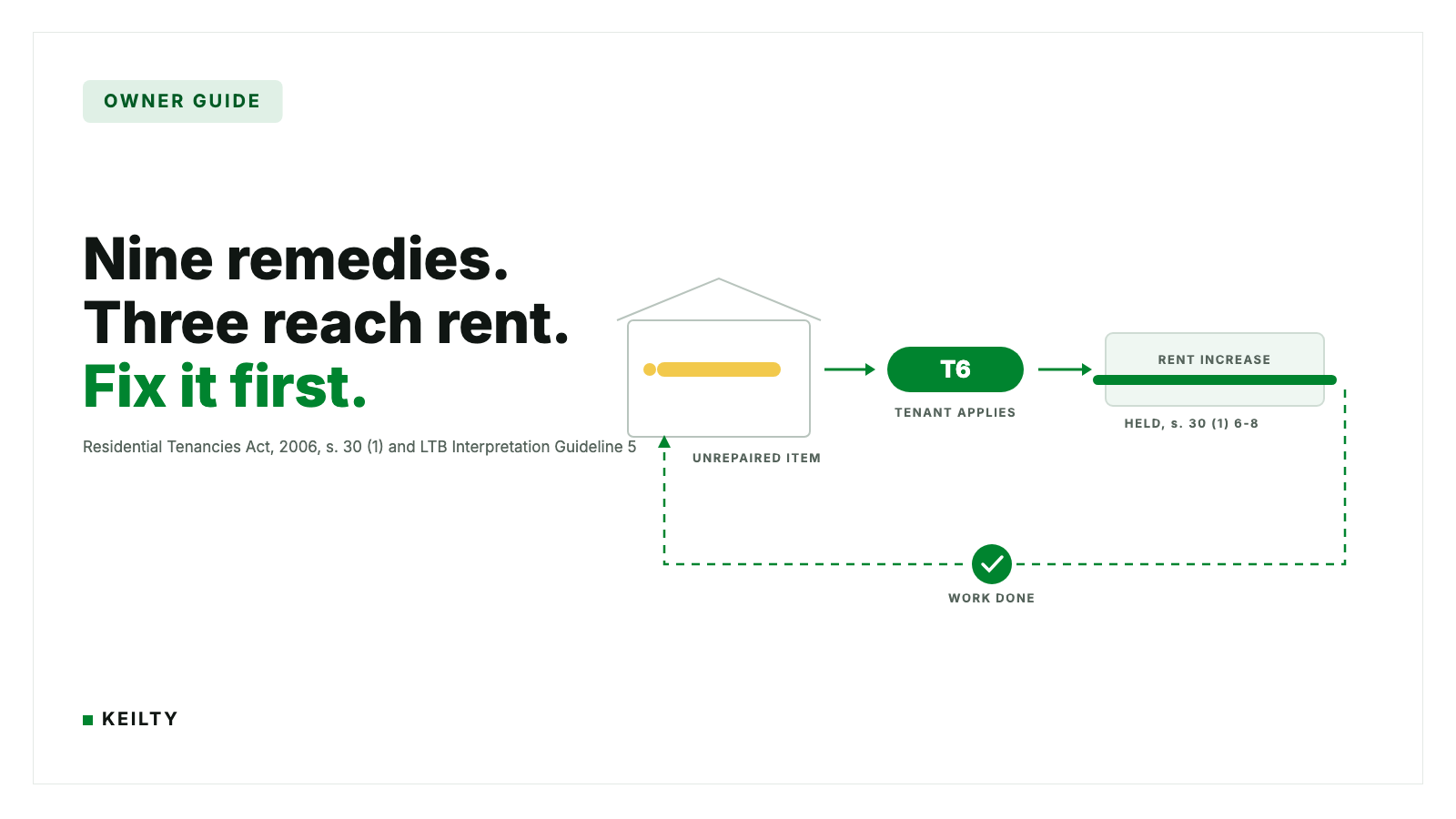
A T6 is the tenant's application about maintenance. It is made under paragraph 1 of subsection 29 (1) of the Residential Tenancies Act, 2006, it asks the Board to determine that you have breached your repair obligation under subsection 20 (1) or section 161, and it has to be filed within one year of the day the conduct occurred. It costs the tenant $53, or $48 through the Tribunals Ontario Portal. If the Board finds the breach, section 30 (1) gives it nine things it can do, and three of those nine limit what you can charge in rent.
The short version.
This is the tenant's side of facts we have written about from the other direction. If an inspector has issued you a work order, that is a different process with a different deadline, set out in what to do if you get a work order on an Ontario rental property.
One thing only: a finding that you breached section 20 (1) or section 161. Paragraph 1 of subsection 29 (1) reads, in full: "An order determining that the landlord has breached an obligation under subsection 20 (1) or section 161." Everything else on the form is a remedy that follows from that finding.
Note who is allowed to bring it, because it is wider than the form's name suggests. The stem of subsection 29 (1) reads "A tenant or former tenant of a rental unit may apply to the Board for any of the following orders", and the Board's T6 instructions say the same in plainer words: "You can make this application if you are either a current or former tenant." A maintenance file does not close when the unit turns over. Section 30 (2) speaks of "the tenant or former tenant" for the same reason, and on Guideline 5's reading of an ongoing breach, set out below, the one year can still be running well after the tenant has handed back the keys.
Section 20 (1) is the obligation: "A landlord is responsible for providing and maintaining a residential complex, including the rental units in it, in a good state of repair and fit for habitation and for complying with health, safety, housing and maintenance standards." Three separate tests sit inside that sentence and a tenant only has to succeed on one. Good state of repair, fit for habitation, and compliance with a standard are not the same question, and a unit can fail the first while passing the third.
Section 20 (2) closes off the argument that the tenant took the unit as they found it: "Subsection (1) applies even if the tenant was aware of a state of non-repair or a contravention of a standard before entering into the tenancy agreement." Read the whole of it. It reaches awareness of a contravention of a standard as well as awareness of non-repair, so a tenant who saw the problem at the showing and signed anyway has not given anything up.
The Board's forms, filing and fees page lists the form as "T6 – Tenant Application about Maintenance". Its fee table gives the title differently, as "Form T6: Tenant Application about Maintenance", and puts the T6 in one row with the T1, T2 and T5 at "$53 or $48 through the Tribunals Ontario Portal". No version number or date is printed for it. The page also states, in terms, "Please note that LTB fees are non-refundable."
Treat that fee as a ceiling rather than a floor. Rule 2 of the Rules of Procedure provides for fee waivers on request, and the Board publishes a Fee Waiver Request form on the same page, so for an applicant who qualifies the cost of putting your maintenance record in front of a Member is nothing at all. Worth knowing that the fees page itself never explains the waiver, never states an eligibility test and never cites Rule 2. It simply lists the form.
There is a separate row for a joint filing, and on a building it is the one that bites: "$53 for first unit + $5 each additional unit to a maximum of $450", with the Board adding in bold that "multi-tenant applications must be submitted to the LTB by mail or courier". Twenty units come to $148 between them rather than $53 each. If the complaint is a boiler or a roof rather than one unit's taps, assume the tenants can afford to bring it together.
One year, and the day it runs from is the part worth slowing down on.
Section 29 (2) reads, in full: "No application may be made under subsection (1) more than one year after the day the alleged conduct giving rise to the application occurred." Note two things about how that is built. It is drafted as a prohibition on making the application rather than as a limit on the remedy. And it excludes the day itself by its own words, "after the day", so you do not need to borrow a counting rule from anywhere to find the first day of the year.
The difficulty is the phrase "the day the alleged conduct occurred", because a leak is not a day. Interpretation Guideline 5, Breach of Maintenance Obligations, gives the Board's answer in two parts. On a one-off: "When a breach is a single event such as an illegal entry, the limitation period begins on the day the event happened." On a continuing problem: "Where the breach is not a single event but is ongoing or recurring as may be the case with some maintenance obligations or with non-compliance with standards, then the breach occurs over a period of time and the limitation period runs from the date that the repair is completed or the standard is complied with."
Work that on a Napanee file. A tenant reports water coming through a bedroom ceiling on Monday 2025-11-03. You get it diagnosed, get the roof section replaced and finish the interior repair on Tuesday 2026-02-17.
Take the point rather than the date. The clock you are exposed on does not start when the problem starts. On the Board's own reading it starts when you finish fixing it, so an owner who leaves a deficiency open for eight months has not run out the limitation period, they have moved it.
One caution on counting. Rule 1.12 of the Rules of Procedure says that "Where an LTB order or a Rule refers to a number of days this means calendar days", and Rules 1.13 to 1.15 build the counting convention on that. Section 29 (2) is in the Act rather than in an order or a Rule, and it is expressed in years rather than days, so those Rules do not by their terms reach it. Work an anniversary date from the provision's own words and do not assume a weekend rolls forward.
There is a gap in the published guidance worth knowing about before somebody quotes the wrong thing at you. The Board's T6 instructions state the limitation twice, in identical words, and only for one branch of it: "If the problem has been fixed, you must apply within one year of the date the problem was fixed." That is the whole of what that page says about timing. It never addresses an ongoing, unfixed problem and it never cites section 29 (2).
Nine things, and it can do more than one of them. Section 30 (1) opens: "If the Board determines in an application under paragraph 1 of subsection 29 (1) that a landlord has breached an obligation under subsection 20 (1) or section 161, the Board may do one or more of the following". The nine are set out below in the Act's own words, except that paragraphs 6, 7 and 8 are given down to the words "until the landlord has," because the two conditions that close all three are identical and are set out in the next section.
Paragraph 9 is the one to hold in mind when you are told what the exposure is, because the list is not closed and a Member who wants a remedy outside paragraphs 1 to 8 has an express power to reach it. Paragraph 1 deserves the same attention: terminating the tenancy is on the list of remedies available to a tenant who applies about maintenance.
Three of them take money out and three of them limit what you can charge. The second group is the one to price, because a prohibition is not expressed as an amount anywhere in the order and you have to work out what it is worth yourself.
The money out is paragraph 2, the abatement, paragraph 5, the tenant's repair costs and out-of-pocket expenses, and paragraph 3, which authorizes work and orders you to pay its cost. Guideline 5 makes a practical point about the last of those when it discusses combining paragraphs 3 and 4: "It would usually be advisable to have evidence, through estimates, of the cost of the repairs or replacements." An unanswered estimate is an unanswered claim.
There is a ceiling on that money. Subsection 207 (1) lets the Board "order the payment to any given person of an amount of money up to the greater of $10,000 and the monetary jurisdiction of the Small Claims Court". That jurisdiction is $50,000, set by section 1 (1) of O. Reg. 626/00 and raised from $35,000 by O. Reg. 42/25 with effect from 2025-10-01. Write the rule down rather than the figure, because the figure moves with the regulation and the Act only ever points at it.
Two riders, one in each direction. Subsection 207 (2) lets a claimant whose claim exceeds that jurisdiction go to court instead, so the ceiling is not a cap on the tenant's total recovery. But subsection 207 (3) extinguishes all rights in excess of the Board's monetary jurisdiction once the Board issues its order, so a tenant who elects the Board and wins cannot then top up in court. They choose once. And the ceiling is on money only. The three prohibitions in paragraphs 6, 7 and 8 are not orders for the payment of money, nothing in section 207 reaches them, and that is the second reason to price them separately from the abatement.
The three prohibitions are different from each other and worth separating. Paragraph 6 caps what you can charge the next tenant at the last lawful rent charged to the former tenant, which removes the vacancy uplift on that unit. Paragraph 7 stops you giving a notice of rent increase at all. Paragraph 8 stops you taking an increase you have already served notice of, where the increase has not been taken before the order issues, so a notice served in good faith three months ago can be stranded by an order made next week.
All three close on the same two conditions, word for word. The landlord must have "completed the items in work orders for which the compliance period has expired and which were found by the Board to be related to a serious breach of a health, safety, housing or maintenance standard", and have "completed the specified repairs or replacements or other work ordered under paragraph 4 found by the Board to be related to a serious breach of the landlord's obligations under subsection 20 (1) or section 161". Both, not either.
Note where "serious breach" sits in that, because it is easy to read it as a threshold and it is not one. It does not qualify the power to impose the prohibition, which is triggered by any breach under the opening words of subsection 30 (1). It qualifies only the work you have to finish before the prohibition lifts. So a prohibition runs until the work is done rather than for a fixed period, and there is no end date you can wait out.
On a building where the rent sits materially below market, paragraph 6 can be worth more than the abatement several times over, and it attaches to the unit rather than to the tenant who applied.
Yes, and it is one of the few places in this part of the Act where the Board is told what it must think about.
Section 30 (2) reads, in full: "In determining the remedy under this section, the Board shall consider whether the tenant or former tenant advised the landlord of the alleged breaches before applying to the Board." Note where it bites. It is directed at the remedy rather than at the finding, so it does not defeat the application, and it is mandatory rather than permissive.
Guideline 5 gives it a heading of its own and sets out four things worth knowing before you rely on it. A failure to notify does not mean the application, or even the item, must be dismissed. Notice does not have to be in writing, though the Guideline calls written notice the best practice. Where a tenant alleges oral notice they have to convince the Member through their testimony that notice was given to the landlord or an employee, and when. And the provision carries two exceptions in how the Board applies it: "However, failure to advise the landlord will affect the remedies to be ordered, unless the landlord knew about the problem already or should have known."
Read that last clause carefully, because it is where a maintenance record earns its keep. "Should have known" is not about what you were told. A deficiency visible in a common area, or one your own staff attended and did not report on, can be something you should have known about whether or not anybody sent you an email. Guideline 5 extends the same reasoning to a tenant who reasonably believed others had already complained, or that the problem should have been obvious to you or your employees.
So the useful document on a T6 file is not a denial. It is a dated log of what was reported, by whom, when you attended and what you did, kept as a matter of course rather than assembled afterwards.
The Act does not say. That is not a gap in this post, it is a fact about the statute, and it matters because it tells you where to look instead.
The word "evidence" appears in the Act, but not once inside sections 29, 30 or 31. Neither the application provision nor the remedies provision says anything about what a tenant must produce, what standard they must meet, or who carries the burden. Section 201 gives the Board its general powers over a proceeding and section 240 sits in the offences Part, and neither is directed at a tenant's burden on a maintenance application.
Guideline 5 is no more explicit on burden than the Act is. It contains no reference to an onus, a burden of proof, a balance of probabilities or a standard of proof. What it supplies instead is how the Board handles particular kinds of proof. On an official finding: "If a notice of violation, work order or other order has been issued for this complex or unit, it represents a finding by a public official that the landlord has not complied with the standard. Once the tenant files a copy of the notice or order, a Member will be entitled to accept this as evidence of non-compliance with a standard. However, the landlord is entitled to have the issue determined by the Board if they dispute the notice or order. In such a case, the landlord must raise this dispute, file the document and bring forward evidence to prove their position."
Read the closing sentence twice. Where an inspector's order is filed against you, the work of displacing it is yours, in three steps: raise the dispute, file the document, and bring evidence. Turning up to say the order was wrong is none of the three.
Where there is no official finding, the Board decides for itself, and Guideline 5 adds a sentence to read as an entitlement rather than a warning: "However, the landlord is entitled then to introduce the standard, and to show that they are meeting it." The passage it closes explains that a tenant who cannot prove the exact nature of a standard does not lose, because the Member may consider the item under the other two tests in section 20 (1). Both halves are true at once.
One more thing about the published guidance, because it decides what a tenant arrives with. The Board's T6 instructions say nothing about evidence at all. The words evidence, photograph, receipt, proof and supporting do not appear on that page, the word inspector does not appear, and neither does the phrase work order. Its section headed "What to include when you file your application" requires the completed form and the fee, and adds that the application will be refused if either is missing. A tenant who follows that page exactly has filed a valid application and brought nothing.
Seven days before the hearing, and five if you are responding. This is the part of a T6 decided on a calendar rather than on the merits, and the part the tenant's own instructions never mention.
Rule 19 of the Rules of Procedure, headed Disclosure and Evidence, sets it out. Rule 19.1: "Unless the LTB has directed or ordered otherwise, all parties to a matter that has been scheduled for a CMH or a hearing must provide the other parties and the LTB with a copy of all documents, pictures and other evidence that the party intends to rely upon at least 7 days before the CMH or hearing. The evidence must be provided to the other parties using one of the methods of service identified in the RTA or Rule 3." Rule 19.1.1 closes a route an owner reaches for first: "Uploading documents, pictures and other evidence to TOP is not a permitted method of providing evidence to a party, other than to the LTB, unless that party has consented in writing to accept service through TOP. The written consent must be uploaded to TOP." Putting your file in the Portal serves the Board and nobody else. Rule 19.2 puts responding material at "at least 5 days before the scheduled CMH or hearing". Rule 19.3 lets the Board direct disclosure at any time before the hearing has been completed, "unless the LTB is satisfied the document is privileged".
Rule 19.7 is the sanction and it is short: "A party who fails to comply with Rule 19 or an order or direction for disclosure may not rely on the evidence that was not disclosed as directed or ordered, unless otherwise ordered." The Rules print "Effective: September 1, 2021" and "Updated: September 21, 2026", read at source 2026-09-29. They were renumbered and rewritten on 2026-09-21, and an earlier version of this post set out Rule 19 as it stood before that day. What follows is the current text.
Four sub-rules sit between those, and they are the ones that govern a tenant raising maintenance inside your arrears application rather than on a T6 of their own. Rule 19.4 now reads: "A tenant who intends to raise issues under sections 82(1) or 87(2) of the RTA during a hearing for a landlord's application about rent arrears must, at least 7 days before the scheduled CMH or hearing:", and the two lettered items under it are (a) "make the payment required by subsection 82(2) of the RTA" and (b) "provide the other parties and the LTB with a written description of each issue the tenant intends to raise". That is a different rule from the one this post carried before 2026-09-21. The version it replaced opened on "Unless the LTB has directed or ordered otherwise", said nothing about money, and asked for the written description and the evidence together. The current one puts the subsection 82 (2) payment in as item (a), moves the evidence to Rule 19.6, and drops the opening words that let the Board direct otherwise.
Rule 19.6 is now the tenant's evidence obligation rather than yours: "Where a tenant has complied with Rule 19.4, they must provide the landlord and LTB with a copy of all documents, pictures and other evidence they intend to rely upon at the hearing at least 7 days before the scheduled hearing." Your five days in reply moved to Rule 19.6.1: "Where a tenant has provided a landlord with issues and disclosure in accordance with Rules 19.4 and 19.6, the landlord must provide the other parties and the LTB with any responding documents, pictures and other evidence the Landlord intends to rely upon at least 5 days before the scheduled hearing." The stray capital on "Landlord" there is the Board's own, and it survived the rewrite.
Rule 19.5 is now one sentence, and it runs the other way: "Rule 19.4 cannot be waived except where required by the Human Rights Code." The Rule 19.5 it replaced was an exclusion with an escape built into it, barring a tenant who missed the written description unless the Board was satisfied they could not comply. That escape is gone from 19.5, and it has not simply moved across. What sits beside it now is Rule 19.5.1, and Rule 19.5.1 is transitional: "If the landlord's application about rent arrears was filed before September 21, 2026:", then (a) "Rule 19.4(a) does not apply; and," and (b) a tenant who fails to comply with Rule 19.4(b) "shall be permitted to raise issues under sections 82(1) or 87(2) of the RTA during a hearing for a landlord's application about rent arrears if the LTB is satisfied the tenant could not comply with the requirements to provide notice".
So the could-not-comply relief is keyed to the filing date of your application rather than to the tenant's circumstances. On an arrears application filed before 2026-09-21 the tenant owes nothing under Rule 19.4 (a) and can still argue they could not give notice. On one filed on or after that day both items bite, Rule 19.5 says Rule 19.4 cannot be waived, and the only exception the Rule states is where the Human Rights Code requires it. That is a harder gate than the one this post set out before, and which side of it you are on turns on a date you control by choosing when to file.
These seven days are also the answer to a question the statute leaves open. Paragraph 2 of subsection 82 (2) says only that "The notice shall be given within the time set out in the Rules", so Rule 19.4 is where the section 82 deadline actually lives, and an owner counting off the Act alone will not find a number.
The Board also publishes a Practice Direction on Evidence, which carries a bare "March, 2024" at its foot with no label on the date. It reads evidence broadly, naming documents, pictures, physical objects, audio and video recordings, emails, text messages and social media posts. It also makes a point worth absorbing before you file: "An item does not automatically become evidence once it has been given to the LTB or the other parties. It is up to the LTB Member hearing the application to decide whether to accept an item as evidence during the hearing." On form, it requires material to be readable and consecutively numbered, and where more than one item is submitted, to carry a table of contents identifying each item in order and by page number.
Two consequences. Your maintenance log, invoices and photographs are worth nothing if they arrive on the day, so the seven day date goes in the diary the moment the notice of hearing does. And the tenant is under the same rule, so material not disclosed by their deadline is material you can ask to have excluded.
Yes, and this is the route that reaches the largest number of owners, because it does not need a form, a fee or a filing date of its own.
Section 82 lets a tenant raise maintenance inside your application. At the hearing of a landlord's application to terminate for arrears, the Board "shall permit the tenant to raise any issue that could be the subject of an application made by the tenant under this Act". So an L1 you filed about unpaid rent can come back at you as an abatement claim about a bathroom fan, and the tenant has paid nothing to put it there.
That section changes on 2026-09-21, and it changes in four separate places rather than one. Subsection 82 (1) is repealed and substituted by section 6 (1) of Schedule 12 to the Fighting Delays, Building Faster Act, 2025. Subsection 82 (2) is amended by adding paragraphs, by section 6 (2). Subsection 82 (4) is repealed and substituted, by section 6 (3). And a new subsection 82 (5) is added, by section 6 (4). Subsection 82 (3), the Board's power to make any order it could have made on the tenant's own application, is untouched. The last two are transition provisions and they matter on timing: an application made before that day and not finally determined by it keeps the old rules, even where the hearing falls after the day.
Two changes of substance. The first is the one owners have been told about. The current subsection 82 (1) lets a tenant raise issues either by complying with the advance notice requirements in subsection 82 (2) or, under clause (b), by providing "an explanation satisfactory to the Board explaining why the tenant could not comply with the requirements set out in subsection (2)". The replacement deletes clause (b) and makes compliance with subsection 82 (2) the single condition.
The second is new money, and it is the one to time an L1 around. Section 6 (2) adds two paragraphs to subsection 82 (2). Paragraph 4 opens "Unless the regulations provide otherwise, the tenant shall pay the following amounts to the landlord or, if the regulations so provide, into the Board", and its first item is "Half of any rent arrears that were claimed in the application when it was filed". Its second item is "Such other amounts as may be prescribed". Paragraph 5 then provides that those amounts "shall be paid before the hearing and in accordance with any prescribed timelines". From that date a tenant who wants to argue about your bathroom fan inside your arrears application has to put up half the arrears first.
Something has been prescribed for that, and it is easy to miss because it sits in the regulation rather than the Act. Section 4 of O. Reg. 241/26 adds section 8.3 to O. Reg. 516/06, commencing the same day: "For the purposes of paragraph 5 of subsection 82 (2) of the Act, the timeline for paying the amounts referred to in paragraph 4 of that subsection is no later than seven days before the hearing." Nothing has been prescribed under paragraph 4 itself. We read all eight regulations made under the Act on 2026-09-12 and searched each for "82" and "section 82", and that timeline is the only hit anywhere. So on the day it comes into force the money is payable to the landlord rather than into the Board, it is half the arrears claimed and nothing further, and it is due seven days before the hearing. That is the same seven days as Rule 19.4, which is convenient rather than coincidental.
A correction to an earlier version of this post. We wrote here that losing clause (b) removes the statutory excuse but does not turn the written notice into an absolute gate, because the Rules carried their own version of the same relief and had not been changed. We searched the Rules of Procedure on 2026-09-12 for "September 21", "September 21, 2026" and "2026-09-21", found none of them, and concluded that Rule 19 would go into that date unamended. That was wrong. The Rules were amended on 2026-09-21 and now print "Updated: September 21, 2026". The free-standing relief we relied on is no longer in Rule 19.5, which now says only that Rule 19.4 cannot be waived except where the Human Rights Code requires it. It survives in Rule 19.5.1, and only for arrears applications filed before 2026-09-21. Paragraph 2 of subsection 82 (2) does still leave the timing to the Rules, so the argument moves from the Act to the Rules rather than disappearing, but on an application filed on or after that day it arrives at a rule that says it cannot be waived. We set out the rest of that day in what changes for Ontario landlords in September 2026.
The related point is what a T6 cannot carry. Section 30 is the remedies provision for paragraph 1 of subsection 29 (1). Section 31 is a different provision, opening "If the Board determines that a landlord, a superintendent or an agent of a landlord has done one or more of the activities set out in paragraphs 2 to 6 of subsection 29 (1)". Those other paragraphs cover things like substantial interference and altering the locking system, and they are made on a T2 at the same $53 or $48. So the administrative fine in section 31 (1) (d), capped at "the greater of $10,000 and the monetary jurisdiction of the Small Claims Court" and payable to the Board rather than to the tenant, is not available on a maintenance application, and neither is the section 31 (2) order for a tenant induced to vacate. A tenant with both kinds of complaint files both forms, so that is a point about which application you are answering rather than about your total exposure.
Then the same facts are running on two tracks with different applicants, deadlines and burdens.
The inspector's order is yours to challenge. Section 226 (1) provides that "If a landlord who has received an inspector's work order is not satisfied with its terms, the landlord may, within 20 days after the day the order is issued, apply to the Board for a review of the work order." Under section 226 (2) the Board may confirm or vary the order, rescind it if it finds you have complied, or quash it. The power to rescind is conditional on compliance rather than being a free-standing option.
The T6 is the tenant's and it runs on the one year in section 29 (2). So the twenty days can be long gone while the tenant's window is still open, and on Guideline 5's reading of an ongoing breach the tenant's year may not have started at all. The two applications can be heard by different Members on different days about the same ceiling.
Guideline 5 deals with the argument that an order whose compliance period has not run should not count yet, and it does not accept it. The fact that another authority has given you more time "does not mean that there is no problem", and "the issue should not be dismissed on this basis". But the paragraph has a tail worth arguing: "Of course, if the work order was the first way that the landlord discovered this problem existed, the fact that the compliance period has not yet expired for a non-urgent item may indicate a different remedy than a long-standing problem that was ignored."
That does not keep the order out of the hearing. What it opens is a different remedy where the order was genuinely the first you knew of the problem and the item is not urgent, which is a submission about quantum rather than liability, and it depends on showing what you knew and when.
No, and Guideline 5 is careful in both directions, so an owner should not take either half on its own.
On breadth it is emphatic: "The landlord's obligation under section 20 to provide and maintain the premises in a good state of repair is very broad. It would include anything that was capable of being repaired." Money is not an answer either, because the obligation "is not subject to whether the landlord has available funds".
On knowledge it is equally clear: "A landlord may assert that they are not liable for the unexpected results of maintenance problems of which they were not aware or that they could not reasonably be expected to have knowledge of. This is indeed the law, as established by two Ontario Court of Appeal decisions." Neither case is named in the body of the Guideline. Both sit in footnotes, and the contrast between them is the whole rule.
The first is McQuestion v. Schneider (1975), 8 O.R. (2d) 249 (C.A.), where a tenant fell through rotting steps the landlord did not know about, and the Court "rejected the tenant's argument that this duty to repair imposed a strict or absolute liability on the landlord". The second is Dye v. McGregor (1978), 20 O.R. (2d) 1 (C.A.), where the tenant had told the landlord about wobbling stairs, and there the Court "found that this notice was sufficient to establish some degree of want of repair and found the landlord liable". Two staircases, two outcomes, and the thing that moved between them was whether anybody had told the landlord. That is the section 30 (2) point arriving from the damages side, and the Guideline closes the passage by carrying it across: these "were claims for “damages” but the same principle applies to abatements."
What follows from the two together is a standard about response rather than outcome: "However, it would appear that the cases generally support the principle that, if the landlord responded within a reasonable time, and the response was appropriate to effect the repair, no abatement or other remedy should be ordered." On what a reasonable time is, the Guideline continues in the next paragraph that it depends principally on the seriousness of the state of non-repair, its possible effects on the tenant, and the availability of materials and contractors.
That is a defence with two limbs and you need both. Responding quickly with something that does not work is not it, and neither is the right repair six months late. A failed heater in a cold snap and a cracked tile do not share a reasonable time.
Guideline 5 also has a heading pointing the other way, "Tenant Conduct that will Result in Dismissing a Claim", and it is the best owner material in the document. It starts from section 34 of the Act: "The tenant is responsible for the repair of undue damage to the rental unit or residential complex caused by the wilful or negligent conduct of the tenant, another occupant of the rental unit or a person permitted in the residential complex by the tenant." Three classes of person, not one, and the damage reaches the residential complex and not only the unit. The Guideline adds that where the landlord says the repairs requested were in fact the tenant's responsibility, "this issue must be decided by the Member".
Its second paragraph is the one to keep. "The tenant may have unreasonably prevented the landlord from entering the unit to assess the problem or make the repairs." Then: "In such a case, the repair may still be ordered to be done by the landlord or the tenant, but the tenant's conduct may result in no abatement or other remedy." Read the heading against the text before you rely on it, because the heading promises a dismissal and the text does not deliver one. The repair still gets ordered. What the tenant's conduct reaches is the money.
That is a reason to paper a refused entry on the day it happens rather than at the hearing. Paragraph 4 of subsection 27 (1) lets a landlord enter "in accordance with written notice given to the tenant at least 24 hours before the time of entry" to carry out an inspection, where "the inspection is for the purpose of determining whether or not the rental unit is in a good state of repair and fit for habitation and complies with health, safety, housing and maintenance standards, consistent with the landlord's obligations under subsection 20 (1) or section 161" and "it is reasonable to carry out the inspection". Guideline 5 gives it a heading of its own, and prints the cross-reference with a word missing, as "Paragraph 4 of subsection 27(1) the RTA". A dated notice, a dated attendance and a note of what happened does two jobs at once: it proves the conduct point, and it puts photographs of the item on file before the item changes.
Guidelines are not law, and the disclaimer printed on the face of Guideline 5 says so. It carries the bare date December 15, 2018 with no label of any kind, which puts it more than seven years behind the Rules of Procedure it sits beside, last updated 2026-09-21. What it tells you is how the Board has said it approaches the question, which is what your evidence gets built against.
Not from the Act, because the Act does not say. Guideline 5 opens the point that way: "There is no guidance in the RTA to assist the Member in determining the amount of an abatement of rent."
What it puts in place of a rule is a two factor test and a benchmark. "In determining the amount to be ordered, the Member will consider the period of time that the problem existed and the severity of the problem in terms of its effect on the tenant. The test should be the impact on the average tenant or the impact a reasonable person would expect this problem to have had on a tenant." So the tenant's own distress is not the measure, and neither is your cost of the repair. Guideline 5 then adds a qualification an owner should have ready: "If the tenant has a particular susceptibility to this particular problem, the landlord can only reasonably be liable to the tenant for more significant penalties if it can be shown that the landlord knew of the particular condition of the tenant."
The arithmetic is proportional, and the consequence is worth spelling out: "The usual approach will be to look at an abatement as a portion of the rent. In other words, a Member will assess what percentage of the package of shelter and services rented by the tenant is not available to the tenant. That will then be expressed as a dollar amount, and logically this will be greater if the rent is greater." The same defect in a $2,400 unit and a $1,200 unit produces two different numbers on identical facts.
Do not stop the quotation there, because the Guideline spends the next three paragraphs pulling against the obvious reading of it. On a cheap unit it records the argument that a lower maintenance standard should be expected, so "there should be no abatement or a minimal one", and rejects it: the Act requires adequate maintenance even where the tenant took the unit as it was. It supports that with a block quotation from an Ontario Court Justice, in Prenor Trust Company of Canada v. Karen Forrest, that "there is no magic formula for determining what is an appropriate amount for an abatement" and that a tenant "cannot reasonably expect luxury accommodation for marginally economic rent" while still being entitled to a minimum at the low end of the market. Those are the court's words carried into the Guideline, not the Board's own, and they sit two paragraphs from the proportionality sentence rather than beside it.
Two paragraphs further on it closes the door from the other side, and this is the half an owner wants: "The other side of this issue is whether a higher rent entitles a tenant to better maintenance, and thus faster repairs, a wider responsibility for repairs and higher abatements if repairs are not done. This would seem to be an expectation related to the contract, rather than a tenant protection intended by the statute. Section 20 should not be interpreted in this way." So the proportional arithmetic goes to the size of the rent the abatement is a percentage of. It does not mean a higher standard of repair is owed on an expensive unit. Two different propositions, and only the first survives.
Three limits belong with it and each is a reason to move early. An abatement is compensation rather than punishment, and the Guideline says so in terms. Where you fixed it in time it does not arise: "If the landlord has already rectified the problem, and did so within a reasonable time, an abatement is not appropriate." And where the application was the first you heard of it: "This remedy is not appropriate where the landlord was not aware of the problem until the application was filed, but they should be ordered to fix the problem." Note the second half of that sentence. Not knowing spares you the abatement, not the work.
Section 16 applies to both sides: "When a landlord or a tenant becomes liable to pay any amount as a result of a breach of a tenancy agreement, the person entitled to claim the amount has a duty to take reasonable steps to minimize the person's losses." A tenant who let a small problem become a large one has that duty too.
One regulation belongs in this section, and it belongs here because of what it does not do. Section 8 of O. Reg. 516/06 sets out detailed abatement rules for the situation where a landlord is carrying out work, and they look like exactly what an owner wants. Section 8 (4) tells the Board it "shall not order an abatement of rent if all of the following conditions are satisfied", and then lists ten, cumulative by the word "all" in the stem. The first is that "The landlord gave notice to the tenant or former tenant at least 60 days before the commencement of the work, or, in cases of emergency, as soon as was reasonable in the circumstances, concerning the work to be carried out." Two things in that sentence are easy to drop. Nothing in the whole of section 8 requires the notice to be in writing, and the 60 days carries an emergency alternative inside the same sentence.
The percentages in it are read too simply as well. Section 8 (6) provides that, "Except as permitted under subsection (7)", no abatement "shall exceed 25 per cent of the monthly rent for each month or part of a month" of substantial interference. That 25 per cent is a default rather than a ceiling, and it is per month, so a part month counts as a whole one. Section 8 (7) lets the Board go past it where the interference "far exceeded the level that would normally be expected" and one of five aggravating findings is made, and the real ceiling sits in section 8 (8), at 100 per cent.
Now the trap, and it is the reason this belongs in a maintenance post. None of it applies to a T6. Section 8 (2) says the section applies "For the purposes of section 22, paragraph 3 of subsection 29 (1) and subsection 31 (1) of the Act", and a T6 is paragraph 1. Guideline 5 says the same in its own words: the section 8 rules "must be applied in an application for a finding that the landlord has substantially interfered with the reasonable enjoyment of the unit by the tenant, but they do not apply to an application for a finding that a landlord has failed to repair or maintain the unit or complex." So the ten condition bar and both percentages live on the T2. Giving 60 days notice before a roof replacement is still worth doing, and on the disruption claim it can take the abatement to nothing, but it does nothing about the non-repair claim, where no equivalent bar and no percentage ceiling exists anywhere in the Act or the regulations. The same roof can produce both applications from the same tenant in the same month, on two forms, under two sets of rules.
Four checks, and the answer differs on each.
A mobile home park or land lease community is inside this regime and then some. Paragraph 1 of subsection 29 (1) names section 161 alongside subsection 20 (1), with no clause limitation, and section 161 opens "In addition to a landlord's obligations under section 20" before listing six lettered responsibilities. Five are what you would expect: garbage, park roads, snow, the water, sewage, fuel, drainage and electrical systems, and the grounds and common buildings. Clause (f) is the one to notice, because it is not a maintenance obligation at all. It makes the landlord responsible for "repairing damage to a tenant's property, if the damage is caused by the wilful or negligent conduct of the landlord". That reaches further than anything in section 20, and it is enforceable on the same T6 with the same nine remedies.
Clause (f) has a sting elsewhere in the Act that is easy to miss because it is nowhere near section 30. Clause 126 (7) (b), the eligible capital expenditure test for an above guideline rent increase, allows an expenditure that "is necessary to comply with subsection 20 (1) or clauses 161 (a) to (e)". It stops at (e). So work you are compelled to do under clause (f) is a T6 exposure you cannot recover through an above guideline increase, while the same work under clauses (a) to (e) may be recoverable. Guideline 5 says in a footnote that it does not discuss the additional section 161 responsibilities, while confirming they are enforceable under subsection 29 (1), so the application route is identical and the published guidance is thinner. We set out what else changes on a site in what rules apply to a mobile home park or land lease community in Ontario.
A care home under Part IX is inside it, and this is a place to be careful what you mean by a care home. Part IX adds requirements about care services and meals on top of the tenancy, and nothing in the Act disapplies section 20, so the obligation and the T6 route both survive. A long-term care home is a different animal. Clause 5 (e) puts living accommodation subject to the Fixing Long-Term Care Act, 2021 and several other named statutes outside the Act altogether, so there is no section 20 obligation and no T6 there at all.
The subsection 7 (1) exemption is where the answer genuinely changes, and social housing is too narrow a name for it. The subsection opens by disapplying a long list of provisions, and the very first item on that list is "Paragraphs 6, 7 and 8 of subsection 30 (1)". It then applies that disapplication to six classes of rental unit: a complex owned, operated or administered by or on behalf of the Government of Canada or a federal agency; a designated housing project under the Housing Services Act, 2011 owned, operated or managed by a service manager or local housing corporation; a non-profit housing project or other complex developed or acquired under a prescribed federal, provincial or municipal program and still operating under one of three named arrangements; a non-member unit of a non-profit housing co-operative; a unit provided by an educational institution to a student or a member of its staff that is not exempt under clause 5 (g); and a complex owned, operated or administered by a religious institution for a charitable use on a non-profit basis. A university, a federal department and a faith based owner are all in exactly the same position as a housing provider, and none of them would look for themselves under a social housing heading.
What is not on that list is sections 20 and 29, and the rest of section 30. So on a subsection 7 (1) unit the maintenance obligation, the T6 route, the abatement and six of the nine remedies are fully open, and only the three rent prohibitions priced above are unavailable.
A non-profit housing co-operative member unit is outside the regime, and this is the one people run together with the non-member unit above. Clause 5 (c) provides that the Act does not apply to "living accommodation that is a member unit of a non-profit housing co-operative, except for Part V.1, and except for those provisions in other Parts that are needed to give effect to Part V.1". Read it to the end. Part V.1 is the termination of occupancy regime for co-operatives, and the second exception pulls in whatever else is needed to make Part V.1 work, so the exclusion is less clean than the first eight words suggest. What it does not pull in is section 20, so there is no maintenance obligation and no T6 on a member unit. The non-member unit in the same building is the opposite case: it stays inside the Act under paragraph 4 of subsection 7 (1), so section 20 and the T6 both apply to it and only paragraphs 6, 7 and 8 of subsection 30 (1) are switched off. One co-operative, two units, two different answers.
None of this is in the Act. It is process, and it decides whether the evidence you already have ever reaches a Member.
One thing an owner should hear plainly. Losing a T6 can take money out twice over, once as an abatement and again as a rent increase you cannot take. If an order goes against you, the routes out are a request to review under Rule 26 or an appeal to the Divisional Court on a question of law under section 210, both set out in what you can do if you disagree with an LTB order. The cheaper outcome is the one where the log shows you were told, you attended and you finished, and none of that can be created after the application arrives.
The parts you can run yourself are real. Reading the application, diarizing two disclosure dates and assembling a numbered bundle are administration, and an organized owner with a unit or two can do all three.
What is harder is the material underneath them. A T6 is decided on a record of what happened over months, and that record either exists or it does not by the time the application lands. Whether you were told, whether you should have known, how long the response took and whether it was appropriate to effect the repair are four separate findings, each proved by something somebody wrote down at the time.
There is a separate question about who is allowed to speak for you at the hearing. The Board's Practice Direction on Representation before the Landlord and Tenant Board, effective 2022-03-03, says a person not licensed by the Law Society of Ontario as a lawyer or paralegal "may not represent a party at an LTB proceeding unless that person falls within the specific licensing exemptions established by the LSO". On property managers it adds that an unlicensed one "may not be allowed to represent the landlord if they are in fact engaged in the business of providing legal services to multiple third parties and do not fall within one of the LSO exemptions". Both limbs have to be met before the door closes, so ask the question well before the hearing rather than on the day.
Where KEILTY earns its keep on a maintenance file is upstream of all of it. A request logged when it comes in, attended on a timeframe that matches how serious it is, and closed out with an invoice attached, is a file that answers a T6 by existing. That is ordinary work done consistently, and it is cheaper than an abatement and a blocked rent increase. If you own a small building and the maintenance is handled off the side of a desk, our small multi-family page sets out how we run it.
Holding a T6 and not sure what your own file says about it? Get in touch and we will work through the items and the dates with you.
This post is general information about Ontario residential tenancy law as of 2026-09-29, not legal advice. Legislation, regulations and tribunal practice change. For advice on a specific property or situation, speak with a lawyer or licensed paralegal.
Ontario property management with published pricing, same-day answers, and no surprises. Since 2003.
300-80 Queen StreetNot served yet. Join a list and hear from us the day we open.