
By A.J. Keilty, President, KEILTY Realty Management
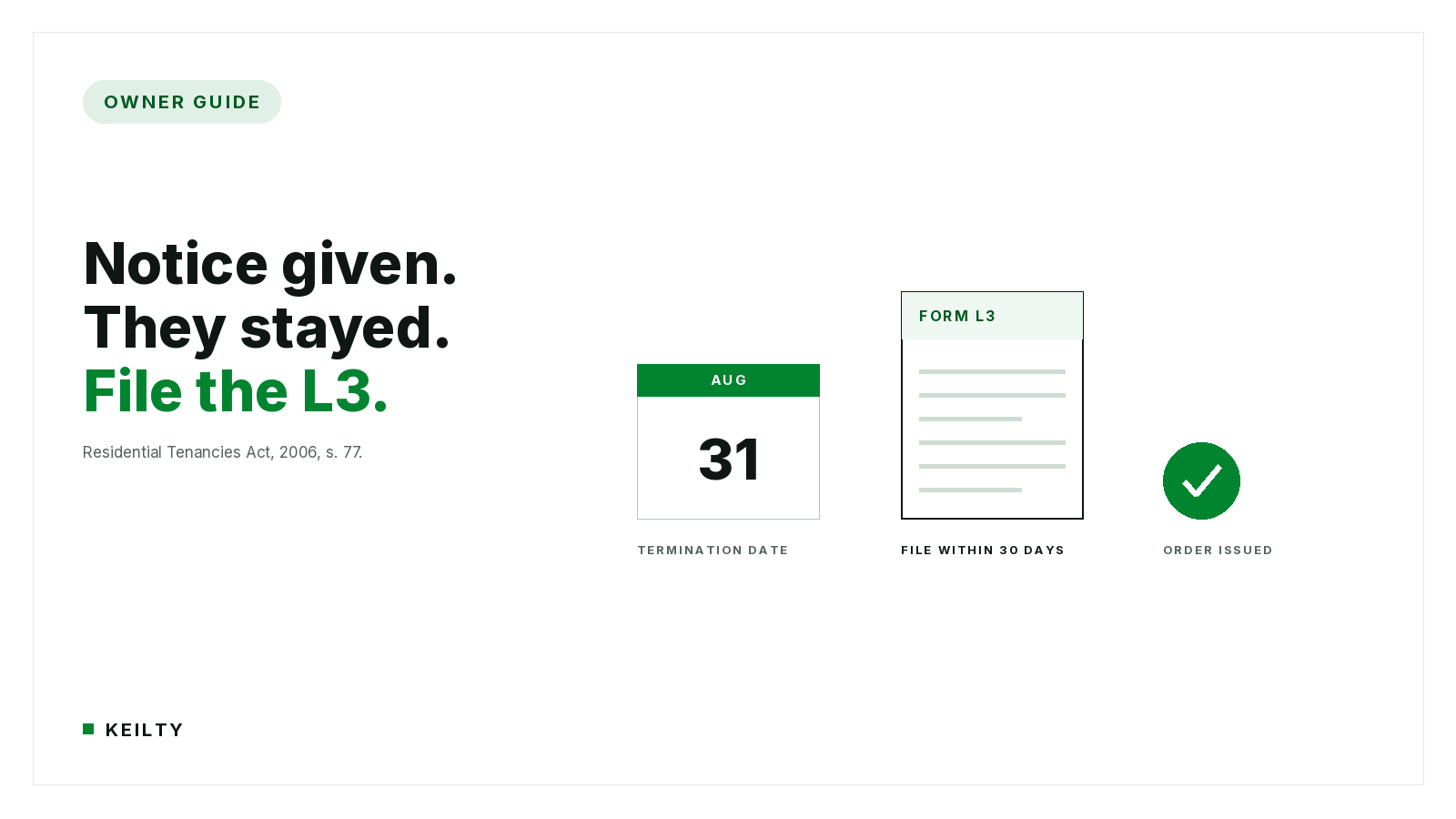
No. You apply to the Landlord and Tenant Board on Form L3, and under section 77 (3) of the Residential Tenancies Act, 2006 that application shall not be made later than 30 days after the termination date. The deadline is absolute. The LTB's own Request to Extend Deadline instructions say it plainly: the Board cannot extend time for a landlord to file an L3.
Meanwhile you cannot change the locks, and the only person who can physically remove a tenant is the sheriff. Here is the whole sequence, what it costs, and the two versions of this that go wrong most often.
Is this you? If you own this rental rather than rent it, KEILTY manages homes and buildings across Eastern Ontario and will tell you what the unit should rent for. Start with a free rental evaluation.
Because of how section 37 is built. Section 37 (1) says a tenancy may be terminated only in accordance with the Act, and section 37 (2) adds the condition everyone misses: where notice is given in accordance with the Act and the tenant vacates in accordance with the notice, the tenancy is terminated on the date in the notice.
Read those together and the notice is a date plus a right to apply. It is not a transfer of possession. If the tenant does not vacate, the second half of section 37 (2) never happens and the tenancy simply continues.
This catches experienced owners as often as new ones, because the notice looks so final. A tenant hands you a signed Form N9 for the last day of the month. You mark the calendar, book the paint, sign a lease with somebody new for the first. Then, four days out, the tenant tells you their closing fell through and they need another six weeks.
At that moment you have no order and no lawful way to take the unit back. What you do in the next 72 hours decides whether this costs you three weeks or six months.
No, and this is the single strongest reason to move early. Section 46 (1) says a notice of termination becomes void 30 days after the termination date unless the tenant vacates before then or the landlord applies for an order before then. Section 46 (2) carves out notices based on non-payment of rent, and nothing else.
So the 30 days in section 77 (3) is not just a filing rule. It is the life of the document. Past it, the notice is void, the L3 route is gone, and the tenant who was quietly betting you would do nothing has won on a technicality you handed them.
No, the route out is the same. Section 77 (1) covers both a mutual agreement to end the tenancy, usually on Form N11, and a tenant's own notice of termination. Either supports an L3, and both carry the same 30 day limit.
This is the version that actually arrives, and the post would be useless without it.
A monthly tenant owes 60 days under section 44 (2), and the termination date has to fall on the last day of a rental period. Someone who tells you on the 10th that they are leaving at the end of next month has given you roughly 50 days on a mid-period date, and that is not a notice that complies with section 44 (2).
You cannot fix it by being agreeable about it. Section 3 (1) applies the Act despite any agreement or waiver to the contrary, so writing back to say the short date is fine does not convert a defective notice into a good one, and section 77 (8) (a) requires the Board to set aside an order where the tenant did not give notice of termination.
The fix is a signed agreement rather than an accepted notice. Section 37 (3) says no notice of termination is needed where a landlord and tenant have agreed to terminate, which means an N11 for the earlier date carries no notice period at all. Sign the N11 for the date the tenant actually wants, file the L3 on it under section 77 (1), and you have the same order on a foundation that holds. Refuse the short notice and insist on the full 60 days and you usually get neither the date nor the cooperation.
When it was signed at the wrong moment. Section 37 (4) voids a tenant's notice to terminate if it is given either at the time the tenancy agreement is entered into or as a condition of entering into it. Section 37 (5) does the same for an agreement to terminate. Both limbs matter. Owners who know about the first one assume that collecting the form a week after the lease fixes the problem, and it does not, because making it a condition of getting the unit is independently fatal.
Void means void. It is not a defect you argue about at a hearing: section 77 (8) (a) obliges the Board to set aside any order built on a notice or agreement that never legally existed. So if a previous owner or a leasing agent collected signed exit forms at move-in as a matter of routine, none of them will carry an L3. Sections 37 (6) and (7) exempt some post-secondary student housing, which is the only place this practice survives.
The fee is $201, or $186 through the Tribunals Ontario Portal, per the LTB's filing and fees schedule. Filing online also timestamps the application, which is what you will care about if the 30 days gets tight.
Four things go in, and the LTB refuses the application if any one of them is missing:
The declaration is where applications die. It has to set out when the tenancy agreement was entered into, the termination date, the date the tenant signed, and who signed. The LTB's instructions say you should also state that the notice or agreement was not signed at the same time as the tenancy agreement, and where it is an N11, that no later agreement replaced it. Treat that as mandatory even though the wording is permissive, because it is the fact that decides the section 37 (4) question. Note the signature block while you are there: furnishing false or misleading information in material filed with the Board is an offence under section 234 (v).
The day the notice arrives. The LTB is explicit that you may apply as soon as the tenant gives you the notice or signs the agreement, and the Board will not end the tenancy before the termination date anyway, so filing early costs you nothing and buys you the whole notice period.
Run the two versions on a notice that lands two months before a month-end termination date:
The difference is a filing fee against a month of rent. Most owners wait, because filing against a tenant who has said they are leaving feels adversarial. The tenant never needs to know unless they stay.
This is why the L3 is worth having. Section 77 (1) lets you apply without notice to the tenant, and section 77 (4) lets the Board make the order on receipt of the application. It is decided on the paperwork, with no hearing and no appearance, so it does not sit in the hearing queue that hearing based applications sit in.
The tenant then has 10 days from the day the order is issued to file a Form S2 motion to set the order aside under section 77 (6). Two things about that motion are worth knowing before you decide how fast to move:
Filing the motion stays your order automatically under section 77 (7), and it cannot be enforced during the stay. Practical warning: if you have already booked enforcement, the Board will not tell the sheriff for you, because once it issues a final order it cannot give the sheriff further direction. Somebody has to take the stay down there.
At the hearing the Board must set the order aside where there was in fact no agreement and no notice, may set it aside if satisfied that would not be unfair in all the circumstances, or may lift the stay and let your order stand.
All of which is the real argument for filing on receipt rather than after the date passes. Everything downstream, including the motion, moves forward by however early you file.
No, and this is the most expensive mistake available to you here.
Three sections close the door together. Section 39 says a landlord shall not recover possession unless the tenant has vacated or abandoned, or a Board order authorizes it. Section 85 gives an eviction order the same effect as a writ of possession and requires it to be enforced the same way. Section 81 then expires the order six months after it takes effect unless you file it with the sheriff who has jurisdiction where the unit is. No single section says only the sheriff can enforce, but read together that is exactly what they say.
So you take the order to the Court Enforcement Office, pay to file it, pay an enforcement fee, and pay mileage from the courthouse. Fees are set by regulation and vary by office, so confirm the current amounts with the office covering your property.
Doing it yourself is not a shortcut, it is an offence, and the section you land under depends on what you did:
Fines under section 238 doubled on 2026-07-01 to $100,000 for an individual and $500,000 for a corporation. Worth being precise about where that came from, because it is widely misattributed: the increase was enacted by Schedule 7 of the Helping Homebuyers, Protecting Tenants Act, 2023, and only proclaimed this July. Prosecution runs through the province's Rental Housing Enforcement Unit, and you can find the current figures on the province's rental housing offences page.
The Board side is closer to home than the fine. On a tenant's application about an illegal lockout, section 31 (1) (d) lets it order an administrative fine up to the greater of $10,000 and the monetary jurisdiction of the Small Claims Court, which has been $50,000 since 2025-10-01. Section 31 (3) lets it order you to let the tenant back in and to refrain from renting the unit to anyone else, and section 31 (4) gives that order the force of a writ of possession.
The arithmetic is not close. A holdover tenant in a $2,200 unit costs you roughly $72 a day. A lockout can cost you a $50,000 fine and an order putting the tenant back in the unit you were trying to empty.
It can, and this is the quiet trap.
There is no provision that automatically voids a tenant's notice the moment you take a payment. That mechanic belongs to non-payment notices, where sections 59 (3) and 74 govern whether an N4 or an order goes void on payment, and section 46 (2) keeps those notices out of the 30 day void rule entirely.
What you are risking is different. Accept rent for a period that begins after the termination date and you have handed the tenant a clean argument that the two of you agreed the tenancy continues. Do it while you are also asking the Board for an eviction order and you look like you are trying to have it both ways.
So decide, and put the decision in writing. If you are letting them stay, say so and set the new end date. Where a fixed term has already expired and the tenant stays with your agreement, the tenancy continues month to month on the same terms, which is a perfectly workable outcome as long as you chose it.
The tenant, for their part, cannot withdraw the notice on their own. Once it is given the date is fixed and only you can agree to cancel it. That cuts both ways: a tenant who changes their mind a week out has no right to stay, and you have no obligation to release them. We cover the tenant's side in our guide to how much notice a tenant has to give before moving out.
Take a $2,200 unit where the tenant was due out at month end and leaves six weeks later. If they keep paying, your direct loss is small. If they stop, you are down roughly $3,300 in rent, plus the L3 fee, plus the sheriff's costs, plus your time.
Here is the part most owners find out too late: the L3 gets you possession and nothing else. There is no field on the form for arrears and none for compensation for use and occupation. Your order empties the unit and stops there.
The money is a separate application, and the Act is generous about the timing if you know the rule:
Expect the Board to net the deposit out. Section 87 (4) requires it to subtract any rent deposit and interest owing to the tenant from the amount it orders, so a $2,200 last month's rent deposit takes most of a six week claim with it.
Then there is the incoming tenant, who signed for the first and has a truck booked. The legal picture there is awkward: the LTB does not take disputes between a landlord and a tenant for a period before the tenancy begins. What it will do is order you to return a rent deposit you took from someone you then could not house, on a Form T1. Everything past that deposit, the hotel nights, the storage, the second set of moving costs, is a contract claim against you in Small Claims Court, where the limit rose to $50,000 on 2025-10-01.
The market decides how bad that gets. CMHC's 2025 Rental Market Report, released 2025-12-11, put the national vacancy rate at 3.1%, up from 2.2% a year earlier. Ottawa eased to 3.0%, with newly built units at 6.7% and lower-rent units under 1%. Kingston went the other way, tightening to 2.4% from 2.9%, though still above its roughly 1.8% average over the past decade. Read together: a walked-away tenant is easy to replace at the bottom of the market and slow to replace in new supply. Our vacancy loss calculator puts a number on your unit, and we broke the daily cost down in how much a vacant rental unit costs you per day.
You cannot stop a tenant from staying put. You can make it cost you almost nothing when they do.
Items six and seven are the ones self-managing owners skip, because they mean a phone call, a site visit and a calendar entry at the busiest point of a turnover. That is also exactly when they pay for themselves. September is the heaviest turnover date of the year in student heavy markets like Kingston and Peterborough, and our late-summer turnover playbook covers the rest of that sequence. If a tenancy has already gone properly wrong, how long it takes to evict a tenant in Ontario in 2026 sets out the realistic timelines.
KEILTY Realty Management has managed Ontario residential and commercial rentals since 2003, from Kingston and Belleville through Peterborough, Cobourg, Oshawa, Cornwall, and Ottawa. Turnover is where process beats good intentions, so we run it the same way every time: every notice acknowledged in writing on the day it arrives, every termination date checked against section 44 (2), an N11 offered where the notice is short, an L3 filed on receipt rather than after the date passes, a confirmation at 21 days and a walkthrough at 14, incoming leases dated with a buffer, and the unit still marketed until the keys come back.
Our fee structure is a flat monthly rate per unit rather than a percentage of rent, plus a placement fee when we lease a vacancy. Because it is flat, it does not climb every time market rent does. For current numbers in your city, see the pricing section on our single-family rental page, and our locations page shows where we operate.
Facing a tenant who gave notice and has not left, or a turnover you would rather not manage yourself? Book a free rental evaluation and we will tell you what your unit should rent for and how quickly it should lease, or get in touch and we will walk through your situation.
This post is general information about Ontario residential tenancy law as of 2026-08-13, not legal advice. Legislation, regulations and tribunal practice change. For advice on a specific applicant, property or situation, speak with a lawyer or licensed paralegal.
Ontario property management with published pricing, same-day answers, and no surprises. Since 2003.
300-80 Queen StreetNot served yet. Join a list and hear from us the day we open.