
By A.J. Keilty, President, KEILTY Realty Management
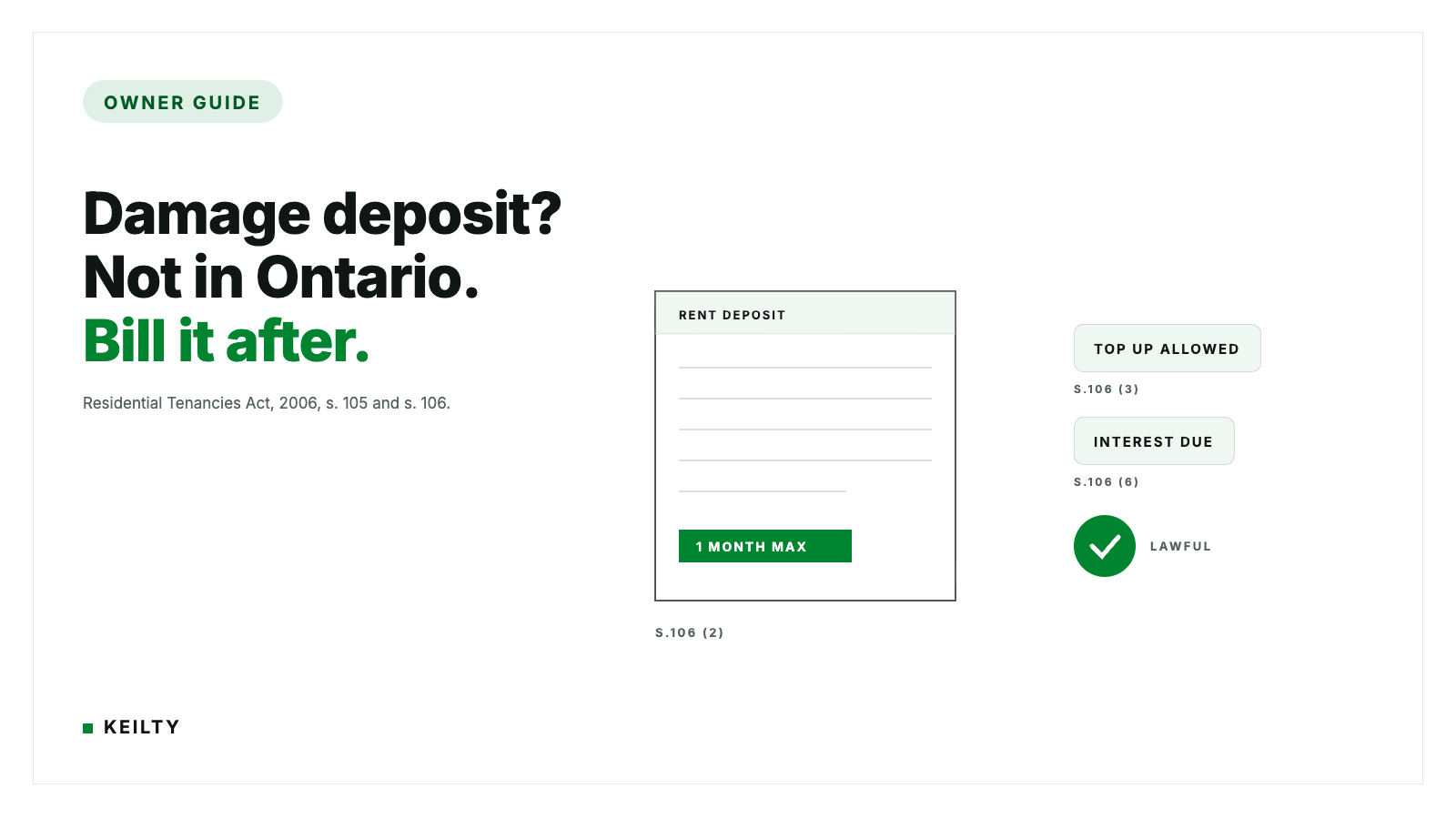
No. In Ontario the only security deposit a landlord may collect is a rent deposit, and it cannot be more than one month's rent, or one rent period's rent if that is less. A separate damage deposit, cleaning deposit or pet deposit is not allowed, whatever you call it in the lease. If you take one, the tenant can apply to the Landlord and Tenant Board to get it back for up to a year after you collected or retained it.
That is the short answer. The longer answer matters more, because the rules around the one deposit you can take include two routes that put money back in your pocket, and most owners we talk to have never used either of them.
One thing: a rent deposit. Section 105(1) of the Residential Tenancies Act, 2006 says the only security deposit a landlord may collect is a rent deposit collected in accordance with section 106. There is no second category.
Section 106 sets the boundaries:
Broader than most people expect. Section 105(2) defines a security deposit as money, property or a right paid or given by, or on behalf of, a tenant to be held by or for the landlord's account as security for the performance of an obligation or the payment of a liability of the tenant, or to be returned to the tenant when a condition happens.
Read that definition and the workarounds stop working. A "damage deposit" is caught. So is a cleaning deposit, a pet deposit, a blank cheque you hold in a file, and a guarantor's cash sitting in your account until move-out. Because the definition covers property and rights, not just money, holding a tenant's belongings as security is caught too.
There is one narrow carve-out worth knowing. O. Reg. 516/06, s. 17, paragraph 3, exempts a refundable key, remote entry device or card deposit from the general prohibition on extra charges, capped at the expected direct replacement cost of the key or fob. That is a key deposit for keys. It is not a general damage deposit with a different label on it.
Section 106(6) requires you to pay the tenant interest on the rent deposit annually, at a rate equal to the rent increase guideline determined under s. 120 that is in effect at the time the payment becomes due.
Note how that is written. The rate is not a fixed number in the Act, it is whatever the guideline is for the year your payment falls due, and the guideline moves every year. As of 2026-08-14, Ontario has published a guideline of 1.9% for 2027. The 2026 guideline is 2.1% and 2025 was 2.5%. Look up the year, do not memorize a figure. Ontario publishes the current guideline on its residential rent increases page.
One more detail worth reading closely. Section 106(6) fixes the rate by reference to the guideline determined under s. 120, and it does not carve out units that are exempt from the guideline for rent increase purposes. That is our reading of the text rather than a settled point, but if you own a post-2018 building and have assumed the deposit interest rule skips you, go back to the subsection before you assume anything. Our guide on whether your unit is exempt from rent control covers what that exemption does and does not reach.
Skipping the interest payment does not save you the money. Under s. 106(9), if you fail to make the payment when it comes due, the tenant may deduct the amount from a later rent payment. You lose the same dollars and hand the tenant a legitimate complaint on the way out.
Yes, and this is the part owners leave on the table.
Section 106(3) says that if the lawful rent increases after a tenant has paid a rent deposit, the landlord may require the tenant to pay an additional amount to bring the deposit up to the maximum permitted under s. 106(2). It says "may", so nothing happens automatically. You have to ask.
Section 106(7) gives you a second, quieter route. You may deduct from the interest payable under s. 106(6) the amount, if any, by which the s. 106(2) maximum exceeds the deposit the tenant actually paid, and the deducted amount is deemed to form part of the rent deposit. In plain terms: instead of writing an interest cheque, you can apply the interest to the shortfall.
Here is what that looks like on a real unit. Take a two-bedroom in Belleville. The tenant paid a $1,900 rent deposit at the start of a monthly tenancy. After two annual guideline increases the rent is $1,975, so the s. 106(2) maximum is now $1,975 and the deposit is $75 short. Interest for a year in which the guideline in effect is 2.1% works out to $39.90 on $1,900. Because the $75 shortfall is larger than $39.90, s. 106(7) lets you deduct the entire interest payment, and the deposit becomes $1,939.90. No cheque leaves your account, the deposit moves closer to the rent, and s. 106(3) is still there for the remaining $35.10 if you want to ask for it.
Run that for ten years on a portfolio and it is real money. Most owners never do it, because nobody diarizes the interest payment in the first place.
Three situations to keep straight.
Very little, and the list is prescribed rather than negotiable. Section 134(1) opens with "Unless otherwise prescribed" and then prohibits a landlord from collecting, requiring, or attempting to collect a fee, premium, commission, bonus, penalty, key deposit or other like amount of money, whether or not it is refundable. Clause 134(1)(b) also catches requiring payment for goods or services as a condition of granting the tenancy or continuing to permit occupancy, where that consideration is in addition to the rent the tenant is lawfully required to pay you.
Two points owners miss. Section 134(2) applies the same prohibitions to a superintendent, property manager or other person acting on the landlord's behalf, with or without the landlord's authority. A late fee your manager invented is still your exposure. And s. 134(1.1), added by the Rental Fairness Act, 2017 (2017, c. 13, s. 24(2)), bars collecting money purporting to be rent for any period after the tenancy has terminated and the tenant has vacated.
The prescribed exceptions are in O. Reg. 516/06, s. 17. Read on 2026-08-14, the ones that come up most are:
Paragraph 8 of s. 17 allows a transfer charge of up to $250 at the tenant's request, but only for transfers between the specific classes of unit described in that paragraph. Do not read it as covering every transfer in every building. And note that the $20 and $250 caps are set by regulation, so they are accurate as of 2026-08-14 and could be amended.
Not on the list: late fees, cleaning fees, pet fees, application fees, lease renewal fees, or an administration charge for anything other than an NSF cheque.
Two related rules. Section 108 says neither a landlord nor a tenancy agreement shall require a tenant or prospective tenant to provide post-dated cheques, or to permit automatic debiting, credit card charging or any other form of automatic payment for rent. The prohibition is on requiring it, so a tenant who chooses pre-authorized debit on their own is a different situation. And under s. 109(1) you must give a tenant or former tenant, free of charge and on request, a receipt for rent, the rent deposit, arrears, or any other amount paid. For a former tenant that obligation runs for 12 months after the tenancy terminated, under s. 109(2).
You apply for it. This is the route that actually protects the asset, and it reaches further than a deposit would, because it is not capped at one month's rent.
Section 89(1) lets a landlord apply to the Board for an order requiring a tenant or former tenant to pay reasonable costs to repair damaged property, or to replace it where repairing is not reasonable, where the tenant, another occupant, or a person the tenant permitted in the complex wilfully or negligently caused undue damage. Clause 89(1)(b) adds a condition for a former tenant no longer in possession, that they ceased to be in possession on or after the 2020 amendment came into force, which is not a live issue for any tenancy ending now. The words that do the work in practice are "wilfully or negligently" and "undue". Ordinary wear is not damage, and a claim built on worn carpet will not survive a hearing.
Two things about timing. Section 89(1.1) says the application may be made while the tenant is in possession, or no later than one year after the tenant or former tenant ceased to be in possession. That year runs from the day possession ceased, not from the termination date on the notice. Put the date in your calendar the day you get the keys back.
And section 89(2) is the piece that closes the loop on deposits. Where the Board orders payment under s. 89(1) and also orders termination of the tenancy, the Board sets off against the amount the tenant owes any rent deposit, or interest on the rent deposit, that would be owing to the tenant on termination. The deposit does get applied to the damage. The Board does it, on the record, and not you unilaterally at move-out.
The forms are an L2 while the tenant is in possession and an L10 once they are out. Both are $201, or $186 through the Tribunals Ontario Portal, per the LTB's forms, filing and fees page read on 2026-08-14.
There is a ceiling, just not the one a deposit would give you. Under s. 207(1) the Board may order payment of up to the greater of $10,000 and the monetary jurisdiction of the Small Claims Court, which O. Reg. 626/00, s. 1(1) sets at $50,000 as of 2026-08-14. That figure is set by regulation and has been raised before, so check it rather than quoting it from memory. If your damage claim is larger, s. 207(2) lets you take the whole thing to a court of competent jurisdiction instead, and that court can exercise the powers the Board would have had. Do not trim the claim to fit the Board. Under s. 207(3), if you claim a sum at or below the Board's monetary jurisdiction, your rights above that amount are extinguished once the Board issues its order.
What decides these applications is evidence, not deposits. A dated move-in condition report the tenant signed, photographs of every room and every appliance, contractor invoices rather than estimates, and a clear line between damage and wear. If you have that file, you do not need a damage deposit. If you do not have it, a damage deposit would not have saved you either. Our guide to what repairs a landlord is responsible for sets out where the line between your obligation and the tenant's usually falls.
Section 135(1) lets a tenant or former tenant apply for an order that the landlord, superintendent or agent pay back any money the person collected or retained in contravention of the Act. Section 135(2) extends that to a prospective tenant, so an applicant you rejected can file over an application fee you kept. Section 135(4) sets the outside limit: no order can be made on an application filed more than one year after the money was collected or retained.
The tenant's cost to start that is a Form T1 at $53, or $48 through the Tribunals Ontario Portal, on the same LTB fee schedule read 2026-08-14. Yours is a hearing date, a day of preparation, and a file where the first thing the adjudicator learns about you is that you charged something you were not allowed to charge. That colours everything else you are asking for.
If that list reads like six jobs you will not get to, that is the argument for handing the file to someone whose job it is. KEILTY charges a flat monthly rate per unit rather than a percentage of rent, so what we charge does not climb every time your rent does, and deposit accounting, interest payments and Board applications are inside the scope. The pricing sections on single-family rentals and small multi-family have the current numbers for those portfolio types.
The rule to carry out of this: you do not get a damage deposit in Ontario, and you do not need one. You get one month's rent held as last month's rent, an interest obligation you can partly recycle back into the deposit, and if a tenant wrecks the place, a damage application limited by the Board's monetary jurisdiction under s. 207(1) rather than by the size of a deposit. The owners who lose money on damage are not the ones without a deposit. They are the ones without a condition report.
Not sure whether your leases and deposit records would survive a T1 application? Book a free rental evaluation and we will tell you what we see, or get in touch and ask us directly.
This post is general information about Ontario residential tenancy law as of 2026-08-14, not legal advice. Legislation, regulations and tribunal practice change. For advice on a specific property or situation, speak with a lawyer or licensed paralegal.
Ontario property management with published pricing, same-day answers, and no surprises. Since 2003.
300-80 Queen StreetNot served yet. Join a list and hear from us the day we open.