
By A.J. Keilty, President, KEILTY Realty Management
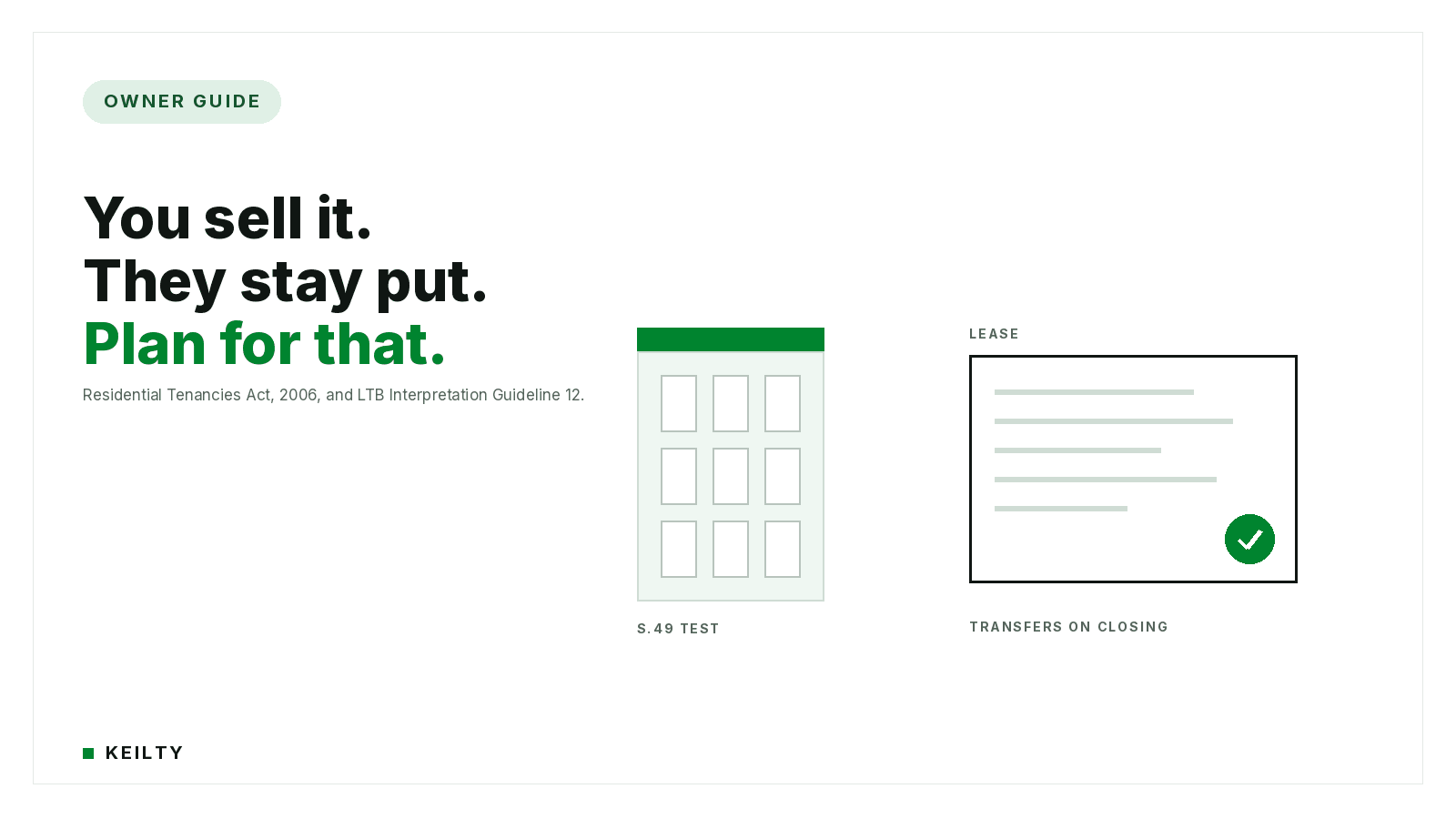
Nothing happens to them. The tenancy stays exactly as it was, and on closing the buyer becomes the landlord under the same lease, at the same rent, holding the same last month's rent deposit. Selling is not a reason to end a tenancy in Ontario, and there is no notice form for it.
The only route to vacant possession runs through an N12 for purchaser's own use, and it is narrower than most sellers assume. It needs a signed agreement of purchase and sale, a property that qualifies under section 49, a purchaser or close family member who in good faith requires the unit, 60 days of notice, and one month's rent paid to the tenant as compensation. Miss any one of those and the Landlord and Tenant Board will dismiss the application.
Owners get surprised by this every year, usually after they have already accepted an offer with a vacant possession condition in it. Here is what actually transfers, what you can and cannot do while the property is listed, and how to decide whether to sell tenanted or sell empty.
No. Under the Residential Tenancies Act, 2006, the tenancy attaches to the unit, not to the person who owns it. A change of ownership is invisible to the tenancy. The buyer steps into the seller's shoes on closing and inherits every obligation the seller had.
That holds for both lease types. If the tenant is on a fixed term with eight months left, the buyer is bound for those eight months. If the tenant is month to month, the buyer is bound month to month. And when a fixed term expires in Ontario, section 38 does not let it simply end, it converts automatically to a month to month tenancy on the same terms. There is no point in the calendar where the tenancy lapses and the unit comes back empty.
One caveat worth checking before you rely on any of this. Section 5 lists the living accommodation the Act does not cover, and where the RTA does not apply, section 38 does not apply either. The one that comes up most in older Kingston and Brockville houses is s.5(i), accommodation where the occupant shares a bathroom or kitchen with the owner, or the owner's spouse, child or parent, and that person lives in the building. If that describes the unit you are selling, the rules below are not your rules. Confirm the status before you list.
Tenants also keep the right to stay through the sale process itself. They do not have to leave for showings, tidy up for photos, or agree to a lockbox on the door.
More than most sellers expect. Everything below moves with the property, and if you cannot document it, you will be negotiating about it at closing:
Assemble a clean package before you list: signed lease and any renewals, rent ledger going back at least 24 months, N1 history with both the dates served and the dates the increases took effect, deposit amounts and interest paid to date, key and fob inventory with any refundable deposits held, and copies of any LTB filings. A buyer who has to guess at these numbers will price the guess into the offer, and it will not be in your favour.
No. A sale is not a permitted reason for an increase, and the new owner has no more room than the old one had. Rent-controlled units move by the annual provincial guideline, which is 2.1% for 2026 and 1.9% for 2027. The 2.5% figure people still quote was the 2025 guideline. Serving the wrong number makes the increase unlawful and the difference recoverable by the tenant on a T1.
Units first occupied for residential purposes after 2018-11-15 sit outside guideline control, and if you are unsure which side of that line your unit falls on, we walked through the test in is my rental exempt from rent control.
Rent resets to market only when the unit genuinely turns over and a new tenant signs. A sale is not a turnover.
This is where below-market rent shows up in the sale price. A unit renting for $1,450 in a submarket where comparable units are getting $1,850 is not an $1,850 asset to an investor buyer. At the 2.1% guideline, $1,450 takes roughly 12 years to climb to $1,850, and market rent will not have stood still for those 12 years, so at guideline increases alone the gap never actually closes. That is not a gap you fix before closing. It is a permanent haircut on the income the buyer is underwriting, and it gets capitalised into the price. Run the numbers through our rental income calculator, then divide the annual shortfall by the cap rate your submarket trades at to see what the gap is costing you in value, not just in monthly cash flow.
Under s.27(2) you need 24 hours of written notice before each entry to let a potential purchaser view the unit, and s.27(3) requires the notice to state the reason, the day, and a time of entry between 8 a.m. and 8 p.m. Section 27(2) also says who may do the entering: you, or a broker or salesperson registered under the Trust in Real Estate Services Act, 2002 acting with your written authorization. A buyer's agent showing up without that authorization has no right of entry. We laid out the full entry rules in can a landlord enter without permission.
Do not confuse this with showings to prospective tenants, which run on the opposite rule. Under s.26(3) no written notice is needed at all, provided the tenancy is already ending by agreement or notice of termination, the entry is between 8 a.m. and 8 p.m., and you inform or make a reasonable effort to inform the tenant first. Purchasers need the 24 hours in writing. Prospective tenants do not. People mix these two up constantly, usually in the direction that gets them in trouble.
What the tenant does not owe you: cleaning, staging, leaving the unit, agreeing to a lockbox, or accepting a block of showings on 24 hours' notice for the whole weekend. Push on any of those and you are relying entirely on goodwill, which is worth protecting for exactly that reason.
Practically, the sellers who get clean showings do three things. They tell the tenant about the sale before the sign goes up rather than after. They batch showings into predictable windows, for example Tuesday and Thursday evenings plus Saturday afternoons, and give the schedule out in writing a week ahead. And they offer something concrete for the disruption, whether that is a cleaning service before photos or a rent credit for the listing month. None of it is required. All of it is cheaper than a tenant who starts declining entries.
One route: the purchaser's own use N12 under section 49. The conditions are strict and the Board checks all of them.
Note what is not on that list. The requirement that the person intend to occupy the unit for at least a year lives in s.48(1) and is enforced through the affidavit in s.72(1)(a), and both are about a landlord's own use. Section 49 does not impose it on a purchaser, and s.72(1)(b) leaves it out of the purchaser affidavit. Good faith is still required. A fixed one year term is not.
The seller serves the N12 on the purchaser's behalf, and the compensation obligation stays with the seller. That is not a matter of custom, it is s.49.1(2), which says that despite section 18 the obligation remains with the landlord who gave the notice and does not become an obligation of the purchaser. Build it into your closing math, because if it is not paid, the LTB will not end the tenancy. Filing the follow-up L2 also requires an affidavit from the person moving in and a two-year disclosure of every N12 and N13 you have served.
The penalties for getting this wrong went up on 2026-07-01. Maximum fines under s.238 of the RTA, for offences prosecuted by the Rental Housing Enforcement Unit, rose to $100,000 for an individual and $500,000 for a corporation. That increase came from Bill 97, the Helping Homebuyers, Protecting Tenants Act, 2023, not from the Bill 60 tranche that landed the same day.
The private exposure is larger and easier to trigger. A former tenant who believes the notice was given in bad faith has one year from vacating to file a T5, under s.57(2). If the Board agrees, s.57(3) lets it order the rent difference for a year after the move, reasonable moving and storage costs, general compensation of up to 12 months of the last rent charged whether or not the tenant is out of pocket, an abatement of rent, and an administrative fine of up to the greater of $10,000 and the monetary jurisdiction of the Small Claims Court, which moved to $50,000 on 2025-10-01. Those stack. Never use an N12 as a negotiating tactic. The paper trail lasts two years and the Board reads it.
One timing note, because it is being reported loosely. Bill 60 does contain an exemption from the compensation requirement where the termination date is at least 120 days out, coming into force 2026-09-21. Schedule 12 amends s.48.1 only, which is a landlord's own use. It does not touch s.49.1 or s.55.1. Purchaser's own use compensation is unaffected and will still be one month's rent after 2026-09-21. We track the N12 mechanics in more detail in can you evict a tenant to move into your own rental.
Check whether it is a condominium first. If you are selling a single condo unit, s.49(2) applies regardless of how many units are in the building, and everything in the section above is available to you.
If it is a non-condominium complex with four or more residential units, there is no own-use route at all, and the property sells as an income asset. That is not a problem, it just changes who buys it and what they look at. Investor buyers price off the rent roll, the expense ratio, the vacancy history, and the quality of the leases. They will read your ledger closely.
Which means the year before you list matters more than the listing itself. A rent roll at market with documented increases, low turnover, and no open LTB files sells for more than an identical building with soft rents and a shoebox of paperwork. If you are running a small building or a community and thinking about an exit in the next 24 months, the operating detail is the value. We work with owners on both ends of that, whether it is small multi-family or a full apartment community.
It depends entirely on who your buyer is, and in most Ontario markets there are two of them.
An investor buyer wants the tenant. A stable resident paying at or near market with a clean payment record is an asset, and delivering vacant possession to that buyer destroys value. Selling tenanted also means no lost rent during the listing period, which in a submarket at $2,000 a month runs roughly $66 a day. Our vacancy loss calculator puts a number on that for your own unit.
An end-user buyer needs it empty, and in single-family neighbourhoods in Kingston, Oshawa, Brockville, and Whitby that is often the larger pool paying the higher price. If your unit is a detached house or a townhouse in a family neighbourhood, run the math both ways before you decide.
If you conclude you need vacancy, there is a legitimate path that does not involve an N12. An N11 is a mutual agreement to end the tenancy, signed by both sides, usually with money attached. It is legitimate and common, and it is far cleaner than a contested own-use application that can take months and might fail.
It also has a deadline that catches people. If the tenant does not leave on the agreed date, s.77(3) gives you 30 days from that date to file the L3. Miss the 30 days and the agreement is worth nothing, and you are back to starting a fresh application on other grounds. If the Board issues the order, the tenant then has 10 days under s.77(6) to move to set it aside, which stays the order until the motion is heard. Diarise both dates on the day you sign the N11.
A fair number of owners list because managing the property stopped being worth the hassle, not because they wanted out of the asset. If that is the actual problem, selling is an expensive way to solve it, once you count the commission, the land transfer implications for whatever you buy next, and the capital gains.
KEILTY charges a flat monthly rate per unit rather than a percentage of rent, so the fee does not climb every time the rent does. Current numbers by city and portfolio size are on the single-family rental page. We compared the two approaches side by side in property management versus self-management, and it comes down to how many hours the property is taking and what those hours are worth to you.
The tenant stays. The lease, the rent, the deposit, and the rent increase clock all transfer to the buyer on closing, and the clock runs from the last increase, not from the notice. Showings to purchasers need 24 hours of written notice between 8 a.m. and 8 p.m. Vacant possession comes only from a purchaser's own use N12, which needs a signed agreement of purchase and sale, a complex of three or fewer units or a condominium unit of any size, 60 days of notice, and one month's compensation no later than the termination date. Everything else is either an N11 by agreement, filed within 30 days, or wishful thinking.
Sort the paperwork before you list, and decide which buyer you are selling to before you decide whether to empty the unit.
Not sure whether your rent is where it should be before you list, or whether selling is the right call at all? Book a free rental evaluation and we will price the unit against current comparables in your city, or get in touch and we will talk through the options.
This post is general information about Ontario residential tenancy and human rights law as of 2026-08-10, not legal advice. Legislation, regulations and tribunal practice change. For advice on a specific applicant, property or situation, speak with a lawyer or licensed paralegal.
Ontario property management with published pricing, same-day answers, and no surprises. Since 2003.
300-80 Queen StreetNot served yet. Join a list and hear from us the day we open.