
By A.J. Keilty, President, KEILTY Realty Management
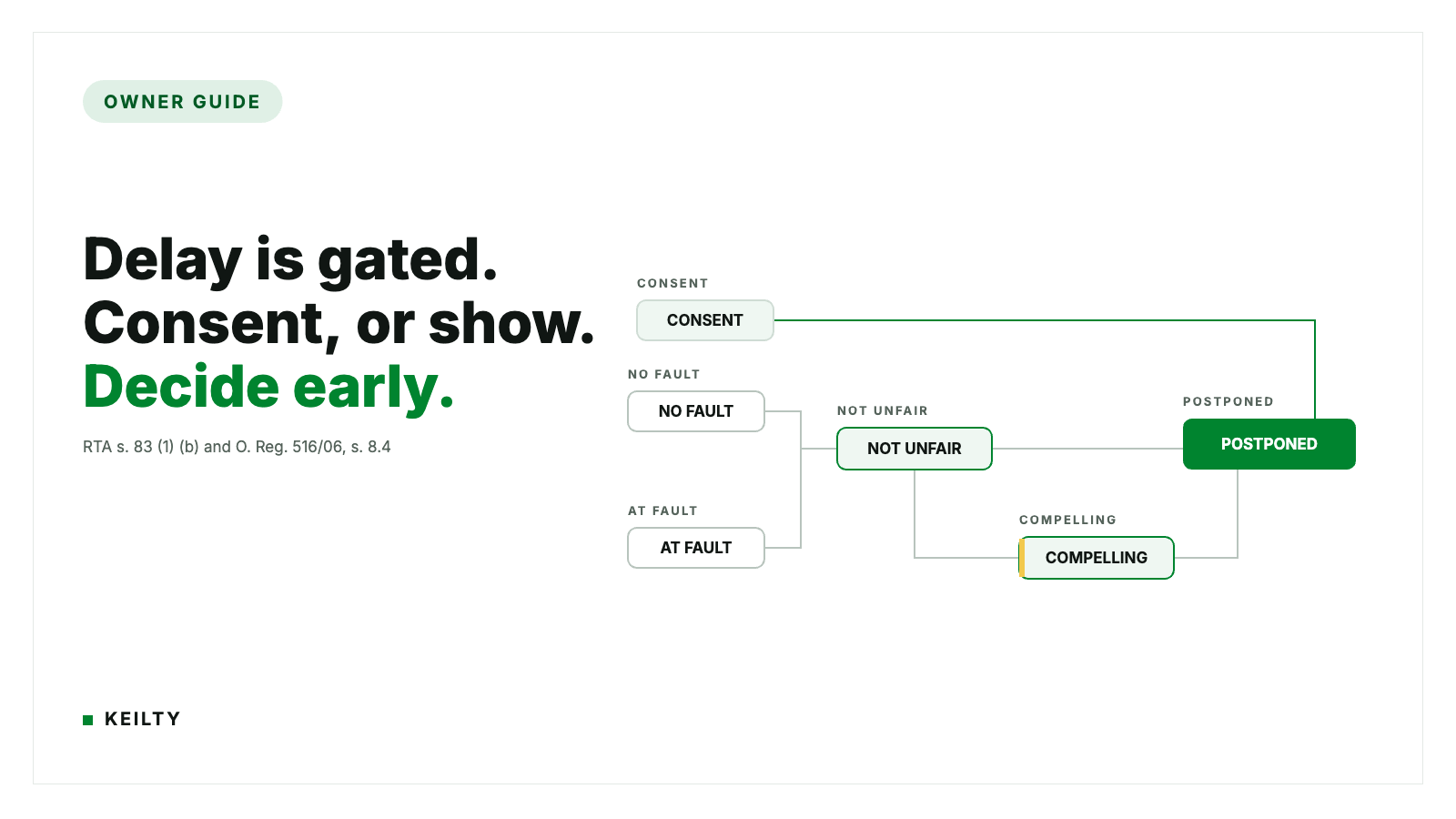
Yes, the Landlord and Tenant Board can still delay an eviction, and it can still refuse one outright. But on 2026-09-21 the delay power was narrowed sharply, and the narrowing sits in a regulation rather than in the Act, so an owner or a tenant who reads only section 83 of the Residential Tenancies Act, 2006 will miss it entirely.
Here is the short answer. The Board's power to refuse an eviction under clause 83 (1) (a) is unchanged. Its power to postpone enforcement of an eviction order under clause 83 (1) (b) is now available only where the landlord consents, or where a new test in section 8.4 of O. Reg. 516/06 is met.
On an eviction for the landlord's own use, a purchaser's use or demolition and repair, that test is a single question. On everything else, including arrears, it is two questions, and the second one uses a word that appears nowhere in the Act.
This post sets out what the Board can still do, what it can no longer do, and what an owner should put on the record at a hearing now rather than after an order issues.
The short version.
Section 83 gives the Board two distinct powers, and they are often run together in conversation when they are quite different things.
Subsection 83 (1) reads: "Upon an application for an order evicting a tenant, the Board may, despite any other provision of this Act or the tenancy agreement, (a) refuse to grant the application unless satisfied, having regard to all the circumstances, that it would be unfair to refuse; or (b) order that the enforcement of the eviction order be postponed for a period of time. 2006, c. 17, s. 83 (1)."
Clause (a) is a refusal. No eviction order issues at all, and the Board may attach conditions to that refusal. Clause (b) is a postponement. An eviction order issues, and then sits, unenforceable, for whatever period the Board sets.
The difference matters commercially. A refusal with conditions leaves you with a tenancy and a compliance mechanism. A postponement leaves you with an order you already hold and a date you cannot bring forward. They are not two strengths of the same remedy.
Subsection 83 (2) then makes the exercise compulsory: "If a hearing is held, the Board shall not grant the application unless it has reviewed the circumstances and considered whether or not it should exercise its powers under subsection (1). 2006, c. 17, s. 83 (2)." That is a duty to consider, not a duty to grant relief, and it applies at every hearing, not only where a tenant asks.
Is this you? If you own a rental in Kingston or Eastern Ontario and would rather not handle this yourself, KEILTY Realty Management manages it for a flat monthly rate. Tell us about the property and A.J. Keilty will call you within 20 minutes in business hours.
One clause of the Act, and one new section of a regulation.
The clause is 83 (1) (b). The amendment, brought in by section 7 of Schedule 12 to the Fighting Delays, Building Faster Act, 2025, adds "subject to any prescribed limitations or conditions" at the beginning of the clause. The amended clause now reads: "(b) subject to any prescribed limitations or conditions, order that the enforcement of the eviction order be postponed for a period of time."
On its own that does nothing at all. It is an empty vessel until something is prescribed. What fills it is section 8.4 of O. Reg. 516/06, added by section 5 of O. Reg. 241/26, in force the same day.
O. Reg. 241/26 is worth naming, because it is easy to miss. It is an amending regulation to O. Reg. 516/06, made on 2026-07-16 and filed on 2026-07-21. It has no consolidated page of its own on e-Laws, and the panel listing "Other regulations under the same Act" shows principal regulations only, so it does not appear there either. O. Reg. 516/06 now carries the line "Last amendment: 241/26." on its masthead, and that line is the only signpost on the page.
The same regulation does a good deal more on the same day. It renames Part II of O. Reg. 516/06 from "Rent" to "Rent, Termination and Eviction", defines persistent failure to pay rent for section 58 (1), supplies the new set-aside test for clause 77 (8) (b), sets the deadline for the new payment a tenant must make before raising issues at an arrears hearing, and adds a whole new Part II.1 carrying two co-operative mirrors.
We have set out the whole package in our post on what changed for Ontario landlords in September 2026.
Section 8.4 of O. Reg. 516/06 reads, in full:
"The Board may order that the enforcement of an eviction order be postponed under clause 83 (1) (b) of the Act only if the landlord consents to the postponement or if the following conditions are satisfied: 1. In the case of an application for an order evicting a tenant based on a notice of termination given under section 48, 49 or 50 of the Act, the Board is satisfied that it would not be unfair to the landlord or other tenants of the residential complex to postpone the enforcement of the eviction order. 2. In the case of any other application for an order evicting a tenant, the Board is satisfied that, i. it would not be unfair to the landlord or other tenants of the residential complex to postpone the enforcement of the eviction order, and ii. there are compelling grounds to postpone the enforcement of the eviction order. O. Reg. 241/26, s. 5."
Read the word "only". Before 2026-09-21 the postponement power was a discretion bounded by nothing except the general words of subsection 83 (1). It is now a discretion that does not arise at all unless one of two doors opens.
The first door is your own. If you consent to a postponement, the conditions do not have to be considered, because the regulation is framed in the alternative. The second door is the test, and which version of the test applies turns on what kind of notice you served.
The Board's own Interpretation Guideline 7 puts it in one line: "If the LTB is not satisfied these conditions are met it does not have the authority to delay an eviction."
Paragraph 1 of section 8.4 covers an application based on a notice of termination given under section 48, 49 or 50 of the Act. That is the landlord's own use or a family member's use, a purchaser's own use, and demolition, conversion or repair. On those, the Board asks one question: would postponement be unfair to the landlord or the other tenants in the complex?
Paragraph 2 covers "any other application for an order evicting a tenant". That is everything else, and it plainly includes an arrears application under section 69 on an N4, a persistent late payment application, and every conduct-based ground. On those the Board asks the same unfairness question, and then a second one: are there compelling grounds to postpone?
The practical effect of the split is worth stating plainly, because it is counter-intuitive. The applications where the tenant has done nothing wrong, the no-fault ones, carry the lighter gate. The applications where a tenant is in arrears or has breached carry the heavier one. Interpretation Guideline 7 summarises it the same way: "In cases where the tenant is at “fault” there must also be compelling reasons to delay the eviction."
Note the Guideline says "compelling reasons" where the regulation says "compelling grounds". We would use the regulation's words in any submission, not the Guideline's.
Nothing says. That is not a gap in our research, it is the state of the law on the day it commenced.
The word "compelling" appears zero times in the whole of the Residential Tenancies Act, 2006. We searched the consolidated text of the Act for it. The root "compel" returns four hits, and every one of them is the heading or the text of section 175, which is about whether a Board member or a mediator can be compelled to give testimony.
In O. Reg. 516/06 the word "compelling" appears exactly twice, and both are the operative uses themselves: section 8.4 paragraph 2 (ii), and the co-operative mirror at section 17.2 (b). There is no interpretive provision anywhere.
So a term that now decides whether an eviction can be delayed at all has no statutory definition, and no body of decisions applying it, because it commenced on 2026-09-21.
Interpretation Guideline 7 is unusually candid about the consequence. It sets out the familiar examples of circumstances where the Board has delayed an eviction, and prefaces them with this: "The following are some examples of tenant circumstances where a delay has been considered; however, these examples are based on decisions that were made before section 8.4 of O.Reg. 516/06 came into effect on September 21, 2026, and therefore may no longer be applicable:"
That is the Board telling you, in its own guideline, that its own worked examples may no longer be good. We read that as an invitation to argue the point from the regulation's text rather than from precedent, and it is a reading rather than something the Guideline states outright.
For an owner, the useful consequence is procedural rather than substantive. If the tenant asks for time and you are not consenting, the question the Board has to answer is now a two-part one on a non-section-48 application, and the second part is unmapped. Putting your position on both parts on the record, separately, is worth more now than it was last week.
No. Clause 83 (1) (a) is untouched, and so are subsections 83 (2) through (8). The only not-yet-in-force Note anywhere in section 83 on the day was the one on clause (1) (b), and it is now spent.
That is a more significant point than it looks. The regulation gates the postponement power. It says nothing at all about the refusal power. A tenant who cannot get a postponement can still ask the Board to refuse the application outright under clause (a), on the old, unrestricted "having regard to all the circumstances" wording, and the Board still has to consider that question under subsection (2) whether or not anybody raises it.
Our own view is that this asymmetry will do a good deal of work. The regulation closes one door and leaves the other exactly as wide as it was. That is a reading of the two provisions together rather than something either source states.
Two other subsections are worth knowing because they are gates on you, not on the tenant. Subsection 83 (4) provides: "The Board shall not issue an eviction order in a proceeding regarding termination of a tenancy for the purposes of residential occupation, demolition, conversion to non-residential rental use, renovations or repairs until the landlord has complied with section 48.1, 49.1, 52, 54 or 55, as the case may be. 2017, c. 13, s. 17; 2020, c. 16, Sched. 4, s. 17 (1)."
Subsection 83 (5) is a different bar with a similar effect: where a tenant has given notice under subsection 53 (2) and subsection 54 (2) or (4) applies, no eviction order issues until the landlord has compensated the tenant in accordance with whichever of those subsections applies.
And subsection 83 (6) is a live consideration on a wide class of arrears applications. It bites where the application is under section 69 and is "based on arrears of rent arising in whole or in part during the period beginning on March 17, 2020 and ending on the prescribed date", and on such an application, "in determining whether to exercise its powers under subsection (1) the Board shall consider whether the landlord has attempted to negotiate an agreement with the tenant including terms of payment for the tenant's arrears. 2020, c. 16, Sched. 4, s. 17 (3)."
Read "in whole or in part" carefully. A single month of arrears from 2020-03-17 onward is enough to engage it. And the closing date has never been set: Interpretation Guideline 7 records that as at 2026-09-21 the ending date had not been proclaimed. Subsection 83 (8) removes any doubt about that: "For greater certainty, subsection (6) applies whether or not a date has been prescribed for the purposes of that subsection." So in practice this subsection reaches essentially every arrears application in Ontario today.
Subsection 83 (3) is mandatory, and it is not affected by anything that happened on 2026-09-21. It provides: "Without restricting the generality of subsection (1), the Board shall refuse to grant the application where satisfied that, (a) the landlord is in serious breach of the landlord's responsibilities under this Act or of any material covenant in the tenancy agreement; (b) the reason for the application being brought is that the tenant has complained to a governmental authority of the landlord's violation of a law dealing with health, safety, housing or maintenance standards; (c) the reason for the application being brought is that the tenant has attempted to secure or enforce his or her legal rights; (d) the reason for the application being brought is that the tenant is a member of a tenants' association or is attempting to organize such an association; or (e) the reason for the application being brought is that the rental unit is occupied by children and the occupation by the children does not constitute overcrowding. 2006, c. 17, s. 83 (3)."
Clause (a) is the one an owner controls. Interpretation Guideline 7 lists the Divisional Court decisions on mandatory refusal generally as Kim v. Leung, 2025 ONSC 6585, Vorobyev v. O'Shanter Development Company Ltd., 2025 ONSC 1251, Stirling v. 399527 Ontario Ltd., 2020 ONSC 1098 and Loc Le v. O'Grady, 2018 ONSC 6387.
Separately, under clause (a) itself, it says "the wording in s. 83(3)(a) is in the present tense meaning the serious breach must be ongoing at the time of the hearing." and cites Frolov v. Shakori, 2026 ONSC 4320 and Shearer v. Oz, 2024 ONSC 1723 for that point. We have not read any of those decisions at source and are reporting what the Guideline says about them.
If that reading holds, an outstanding repair that is closed out before the hearing sits differently from one that is still open on the day. That is an operational point, not a legal argument: the work order or the repair has to be finished and evidenced, not merely scheduled. Our post on how long it takes to evict a tenant in Ontario sets out where in the timeline that work has to land.
No, and Interpretation Guideline 7 says so directly: "This authority does not arise where an application is resolved without a hearing (e.g., in the issuing of an ex parte order under subsection 78(6) of the RTA) or where a hearing is held for another purpose (e.g., at a hearing of a set aside motion under subsection 74(11) of the RTA)."
Section 83 is a power on an application for an eviction order. A motion to set aside is a different proceeding with its own test.
The section 74 ladder is untouched by the September batch. A tenant can discontinue the application by paying before the order issues under subsection 74 (2). A tenant can void the order by paying "before the order becomes enforceable" under subsection 74 (4). And after the order becomes enforceable but before it is executed, a tenant can move to set it aside under subsection 74 (11) by paying and filing an affidavit.
Subsection 74 (12) limits that motion to once during the tenancy agreement. Subsection 74 (13) stays the order, but read its trigger carefully: the stay arises "when a motion under subsection (11) is accepted for filing by the Board". A motion the Board does not accept for filing does not stay anything, so a defective motion is not a delay.
What did change is the neighbouring set-aside route. Clause 77 (8) (b) was repealed and substituted on 2026-09-21, and its new test is now in section 8.2 of O. Reg. 516/06. Subsection 8.2 (1) reads: "For the purposes of clause 77 (8) (b) of the Act, the Board shall make an order setting aside an order under subsection 77 (4) of the Act if the Board is satisfied, having regard to all the circumstances other than those set out in subsection (2) of this section, that it would not be unfair to do so. O. Reg. 241/26, s. 3."
Those words point straight at the thing that was actually added, so do not stop at subsection (1). Subsection 8.2 (2) reads: "For the purposes of making a determination under subsection (1), the Board shall not consider changes in the circumstances of the tenant that arose after the landlord and tenant entered into an agreement referred to in clause 77 (1) (a) of the Act or after the tenant gave a notice referred to in clause 77 (1) (b) of the Act, as the case may be. O. Reg. 241/26, s. 3." The change is the exclusion, not the unfairness test.
Section 78 was not amended, so the set-aside route on an order made under a mediated settlement still runs on the unamended subsection 78 (11) wording.
Section 83, and the Board says so itself.
Where the landlord filed the arrears application on or after 2026-09-21, a tenant who wants to raise maintenance or other issues at the hearing must comply with subsection 82 (2), which now includes paying the landlord half of the rent arrears claimed in the application when it was filed, at least seven days before the hearing. The old escape hatch in the former clause 82 (1) (b), an explanation satisfactory to the Board for not complying, is gone from applications filed from that date.
Two qualifications belong with that, and leaving either out gives an owner a wrong answer. Substituted subsection 82 (4) and new subsection 82 (5) keep the old subsections alive for any application made before 2026-09-21 that has not been finally determined, "even if the hearing of the application is on or after that day." LTB Rule 19.5.1 says the same thing operationally, and the Board's Operational Update of 2026-09-21 puts it plainly: "This applies if the landlord filed the rent arrears application on or after September 21, 2026."
And the payment requirement is not absolute even where it does apply. Rule 19.5 reads: "Rule 19.4 cannot be waived except where required by the Human Rights Code." So there is a statutory human rights route around the payment, and an owner planning on the basis that a tenant who cannot pay has simply lost the issues is planning on an incomplete rule. We have set the whole change out in our post on what a tenant can raise at an arrears hearing.
Interpretation Guideline 11, "Rent Arrears", ends on the point, and then sends the reader to Guideline 7 for the rest of it: "Issues that are not considered by the LTB under section 82 may still be raised by the tenant as circumstances the LTB should consider when deciding whether to delay or refuse the eviction under section 83 of the RTA."
So the two changes interact, and not in the direction a quick reading suggests. Section 82 got harder to use. Section 83 (1) (b) got harder to use. But section 83 (1) (a), the refusal, and the subsection 83 (2) duty to consider, did not move at all. An issue shut out of section 82 can arrive at the same hearing through section 83 instead, with no payment precondition attached to it.
That is our reading of the three provisions together, and it is the reading the Board's own Guideline 11 points to.
No, and this is the part that decides what an owner does this week.
The section 82 payment gate is transitional. It reaches an application filed on or after 2026-09-21 and no earlier one, because substituted subsection 82 (4) and new subsection 82 (5) keep the old text alive for an application made before that day and not finally determined, and because Rule 19.5.1 and the Operational Update both key to the filing date.
The section 8.4 postponement gate carries no equivalent carve-out. We read section 8.4 and the commencement provisions of O. Reg. 241/26 looking for one and did not find it: section 8.4 contains no transitional words at all, and its commencement is tied to the later of 2026-09-21, the commencement of section 7 of Schedule 12, and the day the regulation was filed, with no condition about when an application was made.
Put those two together on a file already sitting in the queue, and you get an outcome worth stating slowly. On an arrears application filed in, say, May 2026, heard next month: the tenant still has the old section 82 route, escape hatch included, and can raise issues without paying anything. And the Board is already inside the new postponement gate, so if it wants to give that tenant time, it now needs compelling grounds.
That is our reading of the two commencement schemes rather than something either source states in those terms. If it is right, an owner with a pending arrears file gets the worse half of one change and the better half of the other, at the same hearing.
Paragraph 2 of section 8.4, the compelling grounds limb, catches everything that is not a section 48, 49 or 50 notice. Two of the entry doors into that bucket also moved on 2026-09-21, which is worth knowing before you work out where your file sits.
The first is the N4. Subsection 59 (1) was repealed and replaced, and the notice period is now the seventh day after the notice is given for every tenancy, where it used to be the seventh day for a daily or weekly tenancy and the fourteenth day for everything else. That rule keys off the date the notice is given, not the date anything is filed. The Board's Operational Update of 2026-09-21 states it as "The notice period for an N4: Notice to End Tenancy Early due to Non-Payment of Rent is shortened from 14 to 7 days for notices given on or after September 21, 2026."
The second is persistent late payment. Subsection 58 (1.1) was added to the Act, and section 8.1 (1) of O. Reg. 516/06 now gives the ground a prescribed floor: a persistent failure to pay rent on the date it becomes due "includes circumstances in which a tenant has failed to pay rent within seven days of the date it becomes due and payable on at least three occasions within any six-month period and on each of those occasions the failure to pay was not solely attributable to the landlord applying a rent payment made during that six-month period to another amount owing by the tenant, including rent arrears. O. Reg. 241/26, s. 2."
Section 8.1 (2) is a for greater certainty provision, so the three occasions are a floor rather than the only qualifying pattern.
Both of those streams run through section 69 and land in paragraph 2 of section 8.4. So do all the conduct grounds. The lighter, single-question test in paragraph 1 is reserved for the no-fault notices under sections 48, 49 and 50.
An eviction order is enforced by the sheriff, and the Act says very little about the mechanics.
The concrete thing a postponement does is move a date on the face of the order. Interpretation Guideline 7 explains it: "The date the landlord is entitled to file an eviction order with the Court Enforcement Office (“Sheriff”) for enforcement – the eviction date - is always specified in an LTB order", and a postponement under clause 83 (1) (b) "means the order cannot be filed with the Sheriff until a date that is more than 11 days after the date the order is issued."
So a postponement is not a pause you work around. It is the date you may first go to the sheriff, and it is printed on the order.
Section 85 provides: "An order evicting a person shall have the same effect, and shall be enforced in the same manner, as a writ of possession. 2006, c. 17, s. 85." Section 81 sets the shelf life: "An order of the Board evicting a person from a rental unit expires six months after the day on which the order takes effect if it is not filed within those six months with the sheriff who has territorial jurisdiction where the rental unit is located. 2006, c. 17, s. 81."
There is no statutory waiting period between the order and the sheriff. Interpretation Guideline 7 states the practice and marks it as practice: "Although the time period is not set out in the RTA, LTB orders commonly provide that the eviction date is 11 days after the date of the order." The word "sheriff" appears exactly three times in the whole Act, in subsection 31 (5), section 81 and section 84.
Section 84 is the expedited route, and it carries a detail that is easy to miss. It opens "Subject to clause 83 (1) (b)". Our reading is that the postponement power therefore sits above the Board's request that the sheriff expedite enforcement, so the new section 8.4 gate reaches the expedited stream as well. No source says that in terms; it is what the opening words of section 84 appear to us to do.
One arithmetic point an owner should hold in mind. A postponement does not pause the six-month clock in section 81 in any words we can find in the Act. If the Board postpones enforcement by four months on an order that takes effect on the 1st of a month, the order still has to be filed with the sheriff within six months of that effective date, and the postponement has eaten two thirds of the window before you may file at all.
There is no route around that by filing early, because the eviction date on the order is the date filing becomes permissible. The practical answer is to diarise the section 81 expiry from the day the order takes effect, not from the day the postponement ends.
The same thing, in mirror image, and it arrived on the same day.
Clause 94.12 (1) (b) of the Act was amended on 2026-09-21 by adding "subject to any prescribed limitations or conditions" at the beginning, exactly as clause 83 (1) (b) was. O. Reg. 241/26 then added a whole new Part II.1 to O. Reg. 516/06, headed "Matters Related to Non-Profit Housing Co-operatives", and section 17.2 inside it does the work of section 8.4.
Section 17.2 lets the Board postpone enforcement of an order terminating a member's occupancy only where the co-operative consents or the Board is satisfied that "(a) it would not be unfair to the co-operative or other members of the co-operative to postpone the enforcement of the order; and (b) there are compelling grounds to postpone the enforcement of the order. O. Reg. 241/26, s. 7."
Note the difference in structure. Section 8.4 splits its test in two depending on the notice served. Section 17.2 does not split at all: the co-operative stream carries the "compelling grounds" limb in every case.
Because the consolidation had not caught up on the day the law changed, and a reader who checks our citations against the government site will see the old text and reasonably conclude we are wrong.
The masthead of the Act on e-Laws reads "Consolidation period: July 1, 2026 - e-Laws currency date (September 16, 2026)". The period runs from 2026-07-01 to a currency date of 2026-09-16, five days before these provisions commenced. So the body text still prints the pre-amendment clause 83 (1) (b) as the main text, with the amendment sitting underneath in a grey editorial Note.
The regulation is the other way round, and the asymmetry is worth knowing before you go looking. O. Reg. 516/06 now reads "Consolidation period: September 21, 2026 - e-Laws currency date (September 16, 2026)", so its consolidation period begins on the commencement day. Sections 8.1, 8.2, 8.3, 8.4, 17.1 and 17.2 all print as ordinary operative text, each credited to O. Reg. 241/26. A search of the whole regulation for editorial Notes returns none.
So on the day: the Act shows you the old law with the new law in grey, and the regulation shows you the new law outright. A reader who checks only the Act will think the postponement gate does not exist. A reader who checks only the regulation will not see what it was hung on.
The in-force dates are on the record even so. The amendment history block under section 83 reads "2017, c. 13, s. 17 - 01/09/2017", "2020, c. 16, Sched. 4, s. 17 (1-3) - 21/07/2020" and "2025, c. 14, Sched. 12, s. 7 - 21/09/2026". The literal string "21/09/2026" appears fourteen times in the Act's amendment history, while the commencement Note formula appears twenty-eight times, which is the clearest single sign that the order has been made and the text has not been rebuilt around it.
One further distinction worth keeping straight. The formula on all twenty-eight of these Notes is "On September 21, 2026, the day named by order of the Lieutenant Governor in Council". The Act carries thirty-seven editorial Notes in all, so nine others are still pending and none of them moved on 2026-09-21.
Eight of those nine use the formula "On a day to be named by proclamation of the Lieutenant Governor". The ninth, on clause 94.10 (8) (b), uses a third formula again, "On a day to be named by order of the Lieutenant Governor in Council", with no day named. Three formulas, and only one of them fired.
Five things, and the first two cost nothing.
Decide your consent position before the hearing, not at it. Section 8.4 makes landlord consent a standalone route to postponement, which means you will be asked, and an unconsidered answer given in the moment is now a substantive decision rather than a courtesy. Sometimes a two-week postponement you agreed to is cheaper than the order you fought for and then had to enforce.
Where you are not consenting, address both limbs of paragraph 2 separately on any application that is not a section 48, 49 or 50 notice. Unfairness to you and the other tenants is one question. Whether there are compelling grounds is a different one. Nothing in the regulation, the Act or Guideline 7 says who has to establish it, so we would not assume it falls on either side, and we would put our position on both limbs on the record rather than argue the first and leave the second to the Board.
Close out any outstanding repair before the hearing rather than after it, because of what subsection 83 (3) (a) does and what Guideline 7 says about its tense.
Keep a record of what you offered on arrears. Subsection 83 (6) still requires the Board to consider whether you attempted to negotiate a payment agreement on arrears arising in part since March 2020, and subsection 83 (8) confirms that applies whether or not a date has been prescribed.
And if an order does issue, watch the section 81 six-month filing window rather than assuming a postponement suspends it.
One more date, which is not about section 83 at all but which will catch owners this autumn. The Board replaced the N5, N6, N8, N12, N13, L1, L2, L9, L10 and T5 on 2026-09-21, and its Operational Update of that day says "Previous versions of these forms will no longer be accepted as of November 30, 2026."
A saved copy of any of those forms on a local drive has a shelf life now. The N4 is deliberately not on that list, because its rule keys off the date the notice is given rather than a cut-off.
If you would rather not track any of this yourself, that is the kind of thing a manager exists to do. Our post on what to do if you disagree with an LTB order covers the separate question of challenging an order you have already received.
Can the Board still delay an eviction after 2026-09-21? Yes, but only where the landlord consents, or where section 8.4 of O. Reg. 516/06 is satisfied. On a section 48, 49 or 50 notice that means the Board must find postponement would not be unfair to the landlord or the other tenants. On any other application it must find that and that there are compelling grounds.
Did the Board's power to refuse an eviction outright change? No. Clause 83 (1) (a) and subsections 83 (2) through (8) are untouched. The only amendment in section 83 on 2026-09-21 was to clause 83 (1) (b), the postponement power.
What counts as compelling grounds? Nothing defines it. The word appears zero times in the Residential Tenancies Act, 2006 and twice in O. Reg. 516/06, both being the operative uses themselves. Interpretation Guideline 7 warns that its own pre-2026 examples of delay "may no longer be applicable".
Does a postponement stop the sheriff indefinitely? No. Section 85 makes an eviction order enforceable as a writ of possession, and section 81 expires the order six months after it takes effect if it has not been filed with the sheriff in that time. We can find nothing in the Act that pauses that six-month window during a postponement.
If a tenant cannot pay half the arrears, are their maintenance issues gone? Not necessarily, and three things cut against it. The payment requirement only reaches applications the landlord filed on or after 2026-09-21. LTB Rule 19.5 says Rule 19.4 cannot be waived "except where required by the Human Rights Code." And Interpretation Guideline 11 states that issues not considered under section 82 may still be raised as circumstances the Board should consider under section 83.
If you own a rental in Ontario and would rather somebody else tracked which notice period, which test and which deadline applies to your file, that is what we do. Get in touch and we will tell you plainly whether you need us.
This post is general information about Ontario residential tenancy law as of 2026-09-21, not legal advice. Legislation, regulations and tribunal practice change. For advice on a specific property or situation, speak with a lawyer or licensed paralegal.
Ontario property management with published pricing, same-day answers, and no surprises. Since 2003.
300-80 Queen StreetNot served yet. Join a list and hear from us the day we open.