
By A.J. Keilty, President, KEILTY Realty Management
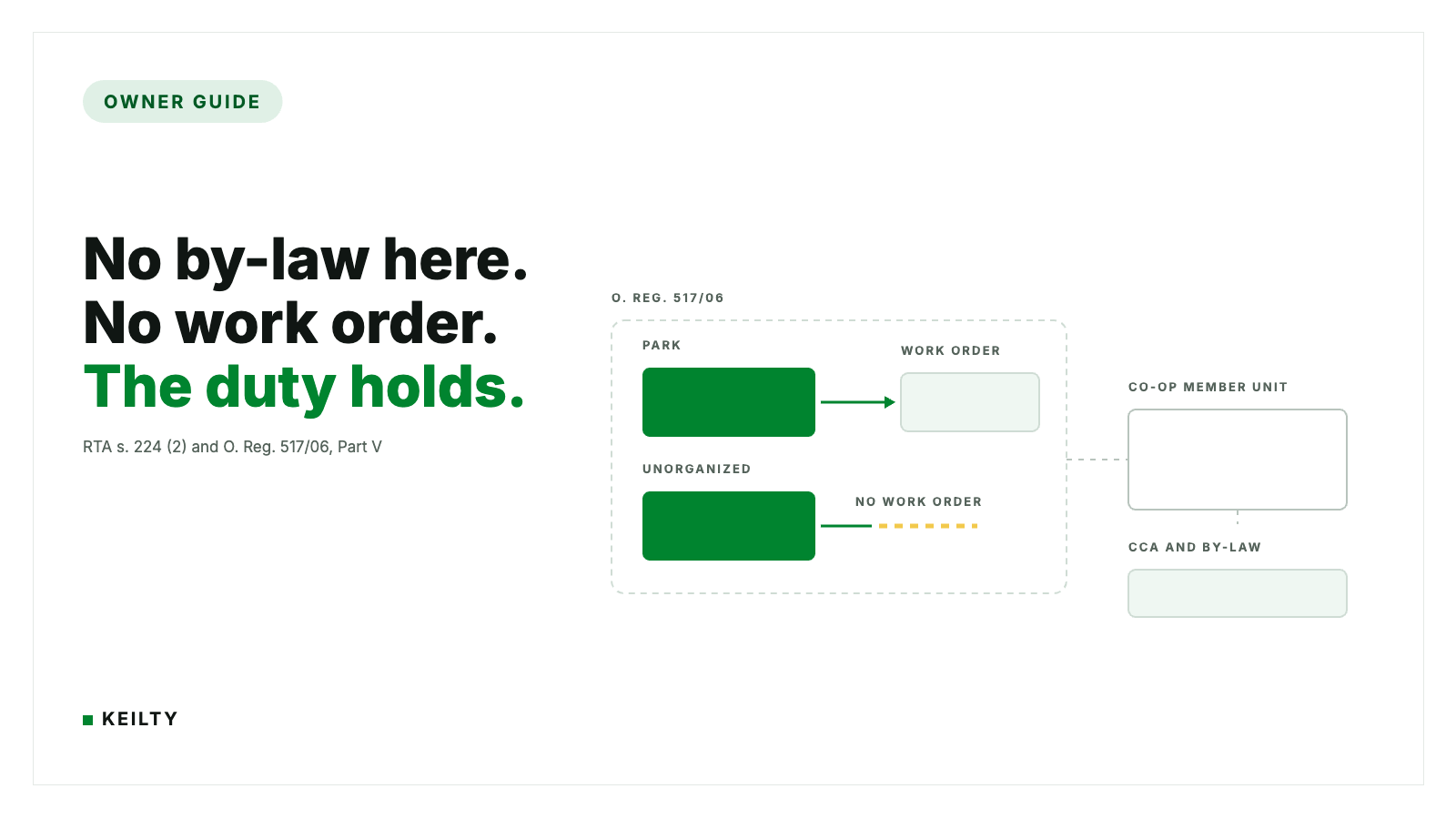
Ontario has one set of provincial maintenance standards, and three situations where the ordinary account of them is wrong. A mobile home park or land lease community gets more standard, not less, including seven sections of regulation written for parks alone. A member unit of a non-profit housing co-operative sits outside the Residential Tenancies Act, 2006 almost entirely, so the repair duty in section 20 and the work order machinery in sections 224 to 226 do not reach it at all. And in unorganized territory the standards apply, but the work order does not exist, because there is no municipality to receive a complaint or appoint an inspector.
The short version.
Each of the three is a different kind of departure. One adds obligation, one removes the Act, and one removes the enforcement while keeping the standard. Two errors are worth naming up front, because both follow from mixing the three together: waiting for a work order that is never coming, and assuming a standard does not apply because no inspector has ever mentioned it.
No, and the gate is section 224 (1). The prescribed standards in O. Reg. 517/06 apply to a residential complex located in a local municipality if, in the words of the provision, "(a) there is no municipal property standards by-law that applies to the residential complex; or (b) there is a municipal property standards by-law that applies to the residential complex and the prescribed circumstances apply." Nothing has ever been prescribed for limb (b). The power sits unused at paragraph 73 of section 241 (1), "prescribing circumstances for the purposes of clause 224 (1) (b)". We checked all eight regulations made under the Act on 2026-09-15, opening each rather than reading titles, and the string 224 appears in exactly one of them.
There is a third case, and it is the one the binary reading misses. Section 4 of O. Reg. 517/06 provides that where a municipal property standards by-law is "applicable only to the exterior of residential complexes or rental units", the provincial standards relating to the exterior drop away for complexes subject to that by-law, "but the maintenance standards in this Regulation that relate to the interior of residential complexes or rental units do apply to them". So an exterior-only by-law does not switch the province off. It splits the building in two, with the by-law governing outside and O. Reg. 517/06 governing inside. Establish which kind of by-law your municipality has before deciding which instrument an inspector could enforce against you.
So the province's own standards are, on the text, a fallback for municipalities that have not written their own. Where a full property standards by-law is in force, the reader is in the Building Code Act, 1992 instead, on a different clock and in a different forum. We set that gate out at length, including where our reading of it strains, in what to do if you get a work order on an Ontario rental. This post is about the three places where even that account does not hold.
Is this you? If you own a rental in Kingston or Eastern Ontario and would rather not handle this yourself, KEILTY Realty Management manages it for a flat monthly rate. Tell us about the property and A.J. Keilty will call you within 20 minutes in business hours.
Six, and the opening words of section 161 are the ones to read: "In addition to a landlord's obligations under section 20, a landlord is responsible for". Nothing in Part X of the Act subtracts. The six are removing or disposing of garbage, or ensuring the availability of a means of doing so, at reasonable intervals; maintaining park roads in a good state of repair; removing snow from park roads; maintaining the water supply, sewage disposal, fuel, drainage and electrical systems in a good state of repair; maintaining the grounds and all buildings, structures, enclosures and equipment intended for the common use of tenants; and repairing damage to a tenant's property where the damage is caused by the landlord's wilful or negligent conduct.
Section 152 (2) carries the whole Part across to land lease communities. It provides that the Part applies "with necessary modifications with respect to tenancies in land lease communities, as if the tenancies were in mobile home parks", so an owner of a land lease community reads section 161 exactly as a park owner does. We set out the rest of the Part X regime, including the rent and sale rules that have no equivalent anywhere else in the Act, in what rules apply to a mobile home park or land lease community.
Two things about section 161 are worth naming because they are easy to read past. It is a list of six specific duties rather than a general standard, so an item that is not on the list falls back to section 20 (1) and has to be argued there. And the snow duty in clause (c) is confined to park roads on its face. Do not read that as a boundary on the obligation overall, because the regulation closes the gap from the other side. Paragraph 5 of section 26 (1) of O. Reg. 517/06 requires unsafe accumulations of ice and snow to be removed from exterior common areas, and section 1 of the same regulation puts the sites the homes sit on inside that definition. Section 28 separately requires driveways, paths, walkways, landings and outside stairs to be maintained "to provide a safe surface for normal use", and section 30 (2) applies it to parks. Nor can the duty be moved by agreement: section 2 (2) puts compliance on the landlord, and section 4 (1) of the Act makes a term of a tenancy agreement that is inconsistent with the Act or the regulations void.
The six duties are also enforceable at the Board by name, which is the point a park owner needs to hold onto. Paragraph 1 of section 29 (1) allows "An order determining that the landlord has breached an obligation under subsection 20 (1) or section 161", and the stem of section 30 (1) opens on the same pair. That route needs no by-law, no inspector and no work order, and it runs anywhere in Ontario, including the two settings later in this post where a work order cannot exist. Footnote 1 of Interpretation Guideline 5, quoted further down, points at the same thing when it says the section 161 obligations may also be enforced under subsection 29 (1). Section 161 sits directly on top of section 20, and we set out what section 20 itself requires in what repairs a landlord is responsible for in Ontario.
Seven sections that apply to nothing else in Ontario. Section 30 (1) provides that sections 31 to 36 apply to mobile home parks and land lease communities, and section 30 (2) confirms that "the other sections of this Regulation also apply" to them. So Part V is additive, exactly as section 161 is.
Then there is a definition that reaches further than it looks. Section 1 defines "exterior common areas" to include "roads, pathways, parking areas, garbage storage areas, grounds for the use of tenants and, in a mobile home park or land lease community, the sites on which homes are situated". The site a tenant's own home sits on is therefore an exterior common area for the purposes of the whole regulation. That pulls the sites into section 26, which requires exterior common areas to be kept free of hazards and lists five things that must be removed, including "Unsafe accumulations of ice and snow" and "Dead, decayed or damaged trees or parts of such trees that create an unsafe condition". It also pulls them into section 19 (2) on exterior lighting and section 44 (1) on keeping common areas clean and free of hazards.
Note what section 34 does to a park owner's approval process. A tenant who adds a deck can put the landlord in breach of a maintenance standard the landlord did not build, because the standard measures the distance and does not ask who closed it. A park owner who approves structures informally is carrying that risk without a record of it.
Yes, on the same terms as anywhere else, and this is the case where nothing is special. A park inside a local municipality goes through section 224.1, which obliges the municipality to receive a written maintenance complaint from a current tenant and to "cause an inspector to make whatever inspection the local municipality considers necessary". An inspector satisfied that a prescribed standard has not been met may issue a work order under section 225. The landlord has 20 days after the day the order is issued to apply to the Board for a review under section 226 (1), on an L6 at $201, a fee the Board's forms page carries with no Tribunals Ontario Portal option and the express note that "LTB fees are non-refundable". Section 226 (2) sets out what the Board can then do with it: on an application under subsection (1) the Board may, by order, "(a) confirm or vary the inspector's work order; (b) rescind the work order, if it finds that the landlord has complied with it; or (c) quash the work order."
The gate in section 224 (1) applies unchanged, so the first question on a park file is still whether the municipality has a property standards by-law. Take a land lease community in Brighton. If the municipality has a full property standards by-law, our reading of section 224 (1) is that neither limb is satisfied, the prescribed standards do not apply to that complex, and there is no section 225 work order for an inspector to issue on them. If the by-law is exterior-only, section 4 of the regulation splits it: the by-law governs the roads, the sites and the grounds, and O. Reg. 517/06 still governs the interiors. Either way the sections 31 to 36 duties do not vanish, because a municipal by-law standard and the landlord's own obligations under section 20 and section 161 are different things. What changes is which instrument an inspector can write an order on.
Where the standards do apply, notice which side of the ledger Part V sits on. Each of the six substantive sections, 31 to 36, is a prescribed maintenance standard, so each of them is enforceable by a work order, and failing to comply with any item in a work order is an offence under clause 234 (t). Since 2026-07-01 the maximum fine under section 238 is $100,000 for a person other than a corporation and $500,000 for a corporation, and section 239 (2) bars a prosecution more than two years after the date the offence was, or is alleged to have been, committed. An unswept park road is on the same list as a leaking roof.
There is a route back on the money, and a post about park obligations that does not name it is only telling half the story. The work Part V requires is capital work on the complex: a water supply, park roads, a sewage system, electrical distribution. Paragraph 2 of section 126 (1) lets a landlord apply for an increase above the guideline for eligible capital expenditures, on an L5, at $233 for the first ten units plus $10 for each additional unit to a maximum of $1,000. Two conditions on the timing are worth diarizing now rather than later. Section 126 (3) requires the application at least 90 days before the effective date of the first intended increase. And section 126 (12) is the trap in the other direction: where the Board finds you have not completed work order items whose compliance period has expired and which relate to a serious breach, section 126 (13) requires it either to dismiss the application for that unit or to suspend the increase until the work is done. Do not stop reading at that limb. Subclause (a) (iii) of section 126 (12) is disjunctive with the two work order limbs and carries no order and no compliance period at all: it is enough that the landlord "is in serious breach of the landlord's obligations under subsection 20 (1) or section 161". Unorganized territory and a full by-law municipality are the two settings where an order never exists, so subclause (a) (iii) is the limb that reaches the owners this post is written for. So the disrepair and the recovery are on the same file. Do the work first, then apply.
Doing the work properly buys something on the other side as well, and the post would be incomplete without it. Section 8 of O. Reg. 516/06 deals with abatement where a landlord carries out "maintenance, repairs or capital improvements carried out in a rental unit or a residential complex". Where all ten conditions in section 8 (4) are met, no abatement of rent is to be ordered, and the first of the ten is that the landlord "gave notice to the tenant or former tenant at least 60 days before the commencement of the work, or, in cases of emergency, as soon as was reasonable in the circumstances, concerning the work to be carried out". Note the words: notice, not written notice, and an emergency alternative on its face. Where the ten conditions are not all met, section 8 (6) holds an abatement to 25 per cent of the monthly rent for each month or part of a month during which there was substantial interference, except as permitted under section 8 (7), which expressly allows the Board to exceed that figure where the interference far exceeded the level that would normally be expected and the Board is satisfied of one of several further things. Read the scope limit alongside it, because it is easy to overclaim. Section 8 (2) applies for the purposes of section 22, paragraph 3 of section 29 (1) and subsection 31 (1) of the Act. It does not reach paragraph 1 of section 29 (1), so it governs the substantial interference abatement that disruptive capital work attracts, not a maintenance application brought on subsection 20 (1) or section 161.
Not to a member unit, and two provisions get you there rather than one. Section 230 (7) provides that the inspection power "does not authorize an inspection in respect of the rights and duties of non-profit housing co-operatives or members of non-profit housing co-operatives". That is accurate, and it is only about inspection. Clause 5 (c) of the Act is the provision that decides the question. It provides that the Act does not apply with respect to "living accommodation that is a member unit of a non-profit housing co-operative, except for Part V.1, and except for those provisions in other Parts that are needed to give effect to Part V.1".
Part V.1 is sections 94.1 to 94.17, and it is about ending occupancy and evicting a member. It contains nothing about maintenance: searched across the whole Part on 2026-09-15, the strings 224, 225, 226, maintenance, work order and inspector return zero each. Section 94.16 (1) is the main provision naming which outside sections come along, and it lists "Subsections 74 (2) to (19) and sections 75, 76, 79 to 81, 84, 85 and 90". Section 94.11 (3) separately imports subsections 78 (2) to (12). Section 20 is on neither list, and neither is anything in Part XIV. Our reading is that section 20 and sections 224 to 226 are therefore not provisions "needed to give effect to Part V.1" within clause 5 (c), because Part V.1 can be operated end to end without them. That is a conclusion from reading the two provisions together rather than something either says outright.
The other statute says the same thing from its own side. Subsection 171.7 (1.1) of the Co-operative Corporations Act provides that the "Residential Tenancies Act, 2006 does not apply with respect to the member units of a non-profit housing co-operative, except as otherwise provided in this Act or the Residential Tenancies Act, 2006", and subsection 171.4 (1) confirms that only a member has a right to occupy a member unit. Section 94.1 (2) of the Act closes the loop from the Board's side: nothing in the Act "shall be construed as altering the relationship between a non-profit housing co-operative and a member and, in particular, the relationship shall not be construed as being one of a landlord and tenant".
So the answer to a member complaining of disrepair is not that section 20 (1) is hard to enforce here. It is that section 20 (1) does not apply.
The occupancy agreement and the co-operative's own by-laws, enforced in court. The Co-operative Corporations Act contains no repair or habitability standard: read on 2026-09-15, the strings repair, habitab, state of repair, fit for habitation and property standards each return zero across the whole Act. There is no provincial floor for a co-op member unit equivalent to the 20 degrees Celsius in section 15 (1) of O. Reg. 517/06 or the 43 degrees Celsius in section 11 (2).
Three provisions come closest and none of them is a maintenance standard. Clause 171.22 (a) is in two branches and they do different work. The first prohibits withholding a reasonable supply of a vital service "that it is the co-operative's obligation to supply under the by-laws", which converts a by-law obligation into a statutory one rather than creating an independent duty. The second prohibits deliberately interfering with the supply of any such vital service "whether or not it is the co-operative's obligation to supply such service", and that branch is free-standing: it binds whatever the by-laws say. Clause 171.22 (b) prohibits substantially interfering with reasonable enjoyment where the intent is to make the member give up possession or refrain from asserting rights, which is narrower than the equivalent in paragraph 3 of section 29 (1) of the Act. Section 178 is the enforcement lever: where a co-operative does not comply with "any provision of this Act or the articles or the by-laws", a member "may apply to the court for an order directing the co-operative" to comply.
The third one tells you what route the legislature assumed a member would take. Clause 171.21 (3) (b) requires a judge to refuse an application for possession where a reason for bringing it is that the person "has complained to any governmental authority of the co-operative's violation of any statute or municipal by-law dealing with health or safety standards including any housing standard or by-law". That is an anti-reprisal rule, and it presupposes that a municipal property standards by-law reaches a co-op and that a member may complain to the municipality about it. Section 230 (7) blocks an inspection under the Residential Tenancies Act. It says nothing about a property standards officer acting under a municipal by-law made under the Building Code Act, 1992, which is a different statute, a different officer and a different order. Clause 171.21 (3) (a) sits immediately beside it and is sharper for a member complaining of disrepair, because it needs no complaint to have been made to anyone. On an application by a co-operative for a writ of possession relating to a member unit under section 171.21 (1), the judge "shall refuse to grant the application" if satisfied that "the co-operative has contravened the Act or its articles or by-laws and the contravention is material and relevant to the application". The word is shall. Our reading is that a co-operative which has not met a repair obligation set by its own by-laws is within the words of that clause, subject to the materiality and relevance test the clause itself carries.
One limit worth stating precisely, because it is easy to overclaim. Section 94.9 of the Act does say the Board has no jurisdiction over a Co-operative Corporations Act question, but only one: it bars the Board from inquiring whether membership and occupancy rights "were properly terminated under section 171.8", and only in an application under section 94.7 or 94.8. It is not a general rule that the Board can never touch that Act.
That is a tenancy, the repair duty does apply to it, and the remedies are narrower than on an ordinary tenancy. The distinction turns on one thing: whether a member occupies the unit. Clause 5 (c) exempts a member unit. A non-member unit is not a member unit. Paragraph 4 of section 7 (1) then deals with it expressly, by exempting "a rental unit that is a non-member unit of a non-profit housing co-operative" from a named list of provisions.
Read the whole list, because both halves of the answer are in it. It opens "Paragraphs 6, 7 and 8 of subsection 30 (1), sections 48.1, 49.1, 51, 52, 54, 55, 56 and 95 to 99, subsection 100 (2) and sections 101, 102, 104, 111 to 115, 117, 120, 121, 122, 126 to 133, 140, 143, 149, 150, 151, 159, 165 and 167", and there is no catch-all at the end of it. Section 20 is not in it, sections 224 to 226 are not in it, and paragraph 1 of section 29 (1) is not in it, so the repair duty, the work order machinery and the tenant's maintenance application all reach a non-member unit. But paragraphs 6, 7 and 8 of section 30 (1) are in it, and those are the rent-side remedies for a maintenance breach: the power to bar charging a new tenant more than the last lawful rent, to bar giving a notice of rent increase, and to bar taking an increase already noticed, each until the work is done. On a non-member unit the Board has the repair remedies and not those three.
So in one building a co-operative can be outside the repair duty for the member units and inside it for the non-member ones, with the same roof over both. The tenant of a non-member unit can complain to the municipality under section 224.1, get an inspection, and hand the resulting work order to the Board on a T6 as evidence of non-compliance. The member next door cannot. And the co-operative's rent exposure on the non-member unit is lower than an ordinary landlord's, which is a point worth knowing before assuming the two are the same.
The standard survives and the enforcement disappears. Section 224 (2) is the provision, and its closing words are the whole of it: the prescribed maintenance standards apply to a residential complex located in unorganized territory and its rental units, "but only for the purposes of a landlord's obligations under subsection 20 (1) with respect to maintenance standards".
Everything else in Part XIV is keyed to a local municipality, and it is worth laying the four provisions side by side because the pattern is consistent. Section 224 (1) opens with a complex "located in a local municipality". Section 224.1 (1) obliges "the local municipality in which the residential complex is located" to receive the complaint. Section 226.1 provides that "A local municipality may appoint inspectors for the purposes of sections 224.1 and 225". Section 230 (1) empowers only "an inspector appointed by a local municipality under section 226.1". Where there is no local municipality there is no body under a duty to receive the complaint, no one with power to appoint an inspector, no inspector to be satisfied of anything under section 225 (1), no work order, and therefore nothing for the Board to review under section 226 and no occasion for an L6.
Read that both ways, because it is not simply good news for an owner. There is no work order to comply with and no clause 234 (t) offence exposure, so the section 238 maximum fines of $100,000 for a person other than a corporation and $500,000 for a corporation are off the table, and so is the municipality's own remediation power. That second one is worth naming, because on the by-law route it is larger than the fine: section 15.4 of the Building Code Act, 1992 lets the municipality do the repairs itself where an order is not complied with, enter without a warrant to do it, and take a lien on the land for what it spent, with priority lien status. There is also no municipal finding of non-compliance sitting on the building, which under Interpretation Guideline 5 is what a tenant would otherwise file as evidence. But the tenant's route does not disappear. It shortens. A tenant applies directly under paragraph 1 of section 29 (1), which allows "An order determining that the landlord has breached an obligation under subsection 20 (1) or section 161", on a T6 at $53, or $48 through the Tribunals Ontario Portal, and pleads O. Reg. 517/06 as the maintenance standards limb of that duty. Section 29 (2) gives one year from the day the conduct occurred. Conduct on Tuesday 2026-03-10 gives a last day of Wednesday 2027-03-10. Re-derive the anniversary rather than assuming it, because if it lands on a holiday under section 88 (2) of the Legislation Act, 2006, which includes Sunday, Good Friday and Thanksgiving Day, section 89 (1) carries it to the next day that is not one, and Rule 1.1 of the Board's Rules additionally treats every Saturday and Sunday as a holiday.
That year is a genuine wall, and it is the one bound on this topic that runs in an owner's favour. Section 190 (1) lets the Board extend or shorten a time requirement for only three things, section 126, subsection 159 (2) and section 226. Section 29 is not among them, and paragraph 2 of section 56 of O. Reg. 516/06 makes the remaining filing deadlines non-extendable. We set the T6 out in full, including the nine orders the Board can make, in what happens if a tenant files a T6 against you.
There is a drafting artefact here an owner should know about rather than trip over. Section 2 (1) of O. Reg. 517/06 still says the regulation prescribes the standards "for the purposes of subsection 224 (1) of the Act", and the regulation's header prints "No amendments." since its consolidation period opened on 2007-01-31. Subsection 224 (2), which is what applies the standards in unorganized territory, was added with effect from 2018-07-01 and the regulation has never been updated to mention it. Section 48 of the same regulation is a single sentence and the whole of it reads: "The Minister may charge a municipality $265 for each inspection made under subsection 224 (3) of the Act or to ensure compliance with a work order under section 225 of the Act." Section 224 has had no subsection (3) since 2018-07-01, so the first limb points at a provision that no longer exists. Section 225 is still live, so the second limb still has something to attach to. Hold two things alongside that before treating the second limb as untouched: the same 2016 amendment that orphaned the first limb inserted section 224.1, which makes complaint-driven inspection in a local municipality the municipality's own job through its own inspector, and O. Reg. 517/06 has not been amended since 2007. Neither point changes the result on the standards themselves, because section 224 (2) applies "the prescribed maintenance standards" and O. Reg. 517/06 is what is prescribed, but a reader checking the regulation alone would not find unorganized territory in it. The word does not appear there at all.
No, and this is the answer that closes the gap rather than filling it. Section 15.1 (3) of the Building Code Act, 1992 gives the power to pass a property standards by-law to "The council of a municipality", and subsection 1 (1) defines "municipality" as "a local municipality". The power is also conditional: council may pass it only "if an official plan that includes provisions relating to property conditions is in effect in the municipality or if the council of the municipality has adopted a policy statement as mentioned in subsection (2)", and subsection 15.1 (2) requires that policy statement itself to be adopted "by by-law approved by the Minister".
We looked for a substitute body and could not find one. Across sections 15.1 to 15.8, the property standards block of the Act, the phrase "territory without municipal organization" appears zero times and the phrase "planning board" appears zero times, although both appear elsewhere in the Act, planning boards 28 times and territory without municipal organization 12 times. A planning board's enforcement role under section 3.1 is confined to sewage systems. We also read the Northern Services Boards Act, where property standards, Building Code Act and housing each return zero, so a local services board has no property standards power either.
The province is present, but for different work. Subsection 4 (1) makes Ontario responsible for enforcing the Building Code Act, 1992 "in a territory without municipal organization", subsection 4 (4) has the Deputy Minister of Municipal Affairs and Housing appoint the inspectors, and subsection 4 (5) makes the director the chief building official for those areas. That reaches the building code and the unsafe building powers in sections 15.9 and 15.10, which contemplate territory without municipal organization expressly in their cost recovery subsections. It does not reach property standards, because there is no by-law to enforce.
So the comparison an owner should carry is this. In a municipality with no property standards by-law, a maintenance complaint runs through section 224.1 and can produce a section 225 work order with a 20 day route to the Board under section 226 (1), extendable under section 190 (1). In a municipality with a full by-law, our reading is that the complaint runs through the by-law instead and an order made under section 15.2 (2) of the Building Code Act, 1992 is appealed under section 15.3 (1) within 14 days after being served, by registered mail to the secretary of the property standards committee, with section 15.3 (2) deeming an unappealed order confirmed. In unorganized territory there is neither, and on ordinary disrepair the first document in the file is the tenant's T6.
Read the two deadlines carefully, because they are not the same kind of deadline. Section 226 (1) is a deadline to apply to the Board, so it is a filing deadline and the Board's own counting and filing rules bear on it. Section 15.3 (1) is a deadline to send, by registered mail, so it is satisfied when the notice of appeal goes into the mail rather than when it arrives. One is 20 days from the day the order was issued, the other 14 days from being served. Different lengths, different triggers, different verbs.
The by-law route does not stop at the committee, and an owner setting it beside section 226 should see the rest of it. On an appeal the committee has all the powers and functions of the officer who made the order, and section 15.3 (3.1) lets it, where in its opinion doing so would maintain the general intent and purpose of the by-law and of the official plan or policy statement, confirm, modify or rescind the order to demolish or repair, and, at paragraph 2, "Extend the time for complying with the order". There is then a further appeal, and three features of it are easy to misstate. Section 15.3 (4) runs from the committee's decision under subsection (3.1) rather than from the original order. It is satisfied only by two steps, "by notifying the clerk of the municipality in writing and by applying to the court within 14 days after a copy of the decision is sent", both inside the same 14 days. And the clock starts when a copy of the decision is sent, not when the original order was served. The appeal lies to the Superior Court of Justice, and it is open to the municipality in which the property is situate or any owner or occupant or person affected by the decision.
The Board, and the province's own guidance says so before it says anything else. On the "Renting in Ontario: Your rights" page, updated 2026-07-02, the municipality is never named as a place to go. The only routes given under Where to get help are the Landlord and Tenant Board, the Rental Housing Enforcement Unit and Legal Aid Ontario, and the first of the three is the Board, "the tribunal with the authority to resolve disagreements between landlords and tenants". The page's one municipal reference runs in the opposite direction from an enforcement venue: a tenant installing a window or portable air conditioning unit is told to "follow applicable laws, such as municipal by laws". The page sends a reader to the Rental Housing Enforcement Unit only for a disagreement related to offences. That unit's own page describes the remit the same way: "We first assess whether your issue is an offence under the act. If the issue is an offence under the act, we will take action. If the issue isn't an offence under the act, we" help the reader understand their rights and "connect you with the The Landlord and Tenant Board (LTB) or another agency, who may be able to help."
Ordinary disrepair is not an offence, so on a plain maintenance complaint that unit's practical answer is a referral. One category is different and an owner should not miss it. Clause 233 (a) makes it an offence to knowingly withhold the reasonable supply of a vital service, or interfere with the supply in contravention of section 21, and section 4 (1) of O. Reg. 516/06 prescribes heat as a vital service from September 1 to June 15. Heat, water, fuel, electricity and gas are therefore an enforcement matter rather than a referral, and that route works in unorganized territory like anywhere else. Section 227 still obliges the Minister to monitor compliance, investigate alleged failures and commence proceedings where the circumstances warrant. Its opening words are "Except for section 224 and except as otherwise provided in sections 224.1 and 226.2", and our reading is that where there is no local municipality those two sections do not otherwise provide, so the Minister's duty over offences outside section 224 is untouched.
For an owner the practical consequence is a change in what a complaint looks like. There is no maintenance inspection, no conversation with a property standards officer and no letter with a compliance date on it. What remains possible is other paper from other statutes: an unsafe building order under section 15.9 of the Building Code Act, 1992, whose cost recovery subsection is written expressly for territory without municipal organization, a sewage system inspector's order under section 3.1 of the same Act, or a Rental Housing Enforcement Unit file on a vital service. On ordinary disrepair, though, the first formal notice is a notice of hearing. That is an argument for answering maintenance requests in writing and keeping the record, because in this one setting the record is close to the only thing that exists before the hearing.
Because it has not been revised since the machinery changed, and an owner reading it cold will get the wrong counterparty. Interpretation Guideline 5, Breach of Maintenance Obligations, prints the date 2018-12-15 and carries no revision line. Under its heading Provincial Maintenance Standard it says: "Work orders will also be issued by the Ministry of Housing for municipalities which do not have their own property standards by-laws." Since 2018-07-01 that has not been how it works. Sections 224.1, 226.1 and 226.2 put the receipt of complaints, the appointment of inspectors and the monitoring and prosecution on the local municipality, and section 226.4 preserves the older provincial route only for a complaint the Minister received before that date.
The Guideline is also silent on two of this post's three subjects. Searched on 2026-09-15, it contains the strings co-operative and co-op zero times each, and unorganized zero times. Mobile home parks appear twice, both inside footnote 1, which says the Guideline "does not discuss the additional responsibilities under section 161 for mobile home parks or land lease communities" and that although those obligations "may also be enforced under subs. 29(1), they are not specifically addressed in this Guideline". The footnote is doing more work than a footnote should.
None of which makes the Guideline useless. Its treatment of a work order as evidence is the reason this topic matters, and its own disclaimer sets the weight to give it: "a Member is not required to follow a Guideline and may make a different decision depending on the facts of the case." Our reading is that where the Guideline describes machinery the Act has since replaced, the Act governs and the Guideline is a dated description. That is a reading of the two together rather than something either says outright.
An owner of a single home in a serviced municipality can run this without help. The standards are public, the complaint route is a phone call to the city, and the deadline that matters is printed on the order. One thing to settle before handing the property to anyone else is who an order can name. Section 15.1 (1) of the Building Code Act, 1992 defines "owner", for sections 15.1 to 15.8, to include "the person for the time being managing or receiving the rent of the land or premises in connection with which the word is used, whether on the person's own account or as agent or trustee of any other person, or who would receive the rent if the land and premises were let" and "a lessee or occupant of the property who, under the terms of a lease, is required to repair and maintain the property in accordance with the standards for the maintenance and occupancy of property". A manager who receives the rent, and a net lease tenant whose lease puts repair and maintenance on them, are each inside that definition, so each can be served with an order under section 15.2 (2) and appeal it in their own right. The limit matters as much as the definition. Section 15.3 (1) gives the appeal to "An owner or occupant who has been served with an order", and section 15.2 (3) leaves service to the officer: "The order shall be served on the owner of the property and such other persons affected by it as the officer determines." A manager who is in fact served can appeal; one who is not served has no section 15.3 (1) appeal. The further appeal in section 15.3 (4) is wider, reaching any owner or occupant or person affected, with no service precondition.
The three cases in this post are harder for a reason that has nothing to do with legal difficulty. They are all cases where the ordinary warning system is missing or points somewhere else. A park owner is carrying six extra standards that no inspector may ever mention, including a hydrant testing duty and a three metre spacing rule that a tenant's own deck can breach. A co-operative is running two legal regimes in one building, and the line between them is which unit a member lives in. An owner in unorganized territory has no by-law officer to tell them anything and will learn about a problem from a hearing notice. In each case the protection is a maintenance record and a response habit rather than a right of appeal.
That is the work KEILTY does upstream. We answer the maintenance request, write down what was reported and what was done, and keep the file in a shape that answers a T6 a year later, which is the whole of section 29 (2). Where a park or a co-op board wants that handled properly, we would rather set the system up before the first application than argue about a photograph after it.
Do Ontario's maintenance standards apply to a mobile home park? Yes, and more of them. Section 161 of the Act adds six duties on top of section 20, and Part V of O. Reg. 517/06, sections 30 to 36, adds standards on water, roads, mailboxes, spacing between homes, sewage and electrical supply. Section 30 (2) confirms that the rest of the regulation applies to parks as well.
Do the maintenance standards apply to a non-profit housing co-operative? Not to a member unit. Clause 5 (c) of the Act exempts a member unit of a non-profit housing co-operative from the whole Act except Part V.1, and Part V.1 contains nothing about maintenance, so section 20 and sections 224 to 226 do not reach it. A non-member unit in the same building is an ordinary tenancy and the ordinary rules do apply.
Can you get a work order on a rental in unorganized territory? No. Section 224 (2) applies the prescribed standards in unorganized territory but only for the purposes of the landlord's obligations under section 20 (1). The complaint, inspection and work order machinery in sections 224.1, 225, 226 and 226.1 is keyed throughout to a local municipality, so there is no inspector to issue an order and nothing for the Board to review.
Can a property standards by-law apply in unorganized territory instead? No. Section 15.1 (3) of the Building Code Act, 1992 gives the power to pass one only to the council of a municipality, and the Act defines a municipality as a local municipality. Neither a planning board nor a local services board has that power. Ontario enforces the building code itself in territory without municipal organization under section 4 (1), but that is a different set of rules.
What is the lowest temperature a landlord has to maintain under the provincial standard? Twenty degrees Celsius, and the provision that binds everywhere is section 4 (2) of O. Reg. 516/06, which requires that heat be provided so that the room temperature "at 1.5 metres above floor level and one metre from exterior walls in all habitable space and in any area intended for normal use by tenants, including recreation rooms and laundry rooms but excluding locker rooms and garages, is at least 20 degrees Celsius". That one is reached through the definition of vital service in subsection 2 (1) of the Act rather than through the gate in section 224 (1), so it does not depend on whether your municipality has a property standards by-law. Section 15 (1) of O. Reg. 517/06 carries the same 20 degrees where the prescribed standards apply, and it does not apply where the tenant can regulate the temperature and 20 degrees can be maintained by the primary source of heat. O. Reg. 517/06 itself contains no seasonal window. The date range lives in a different regulation: section 4 (1) of O. Reg. 516/06 prescribes September 1 to June 15 as the part of the year during which heat is a vital service.
Not sure which of these three your property is in, or which standard an inspector could actually enforce against it? Get in touch and we will work it out with you.
This post is general information about Ontario residential tenancy law as of 2026-09-16, not legal advice. Legislation, regulations, by-laws and tribunal practice change. For advice on a specific property or situation, speak with a lawyer or licensed paralegal.
Ontario property management with published pricing, same-day answers, and no surprises. Since 2003.
300-80 Queen StreetNot served yet. Join a list and hear from us the day we open.