
By A.J. Keilty, President, KEILTY Realty Management
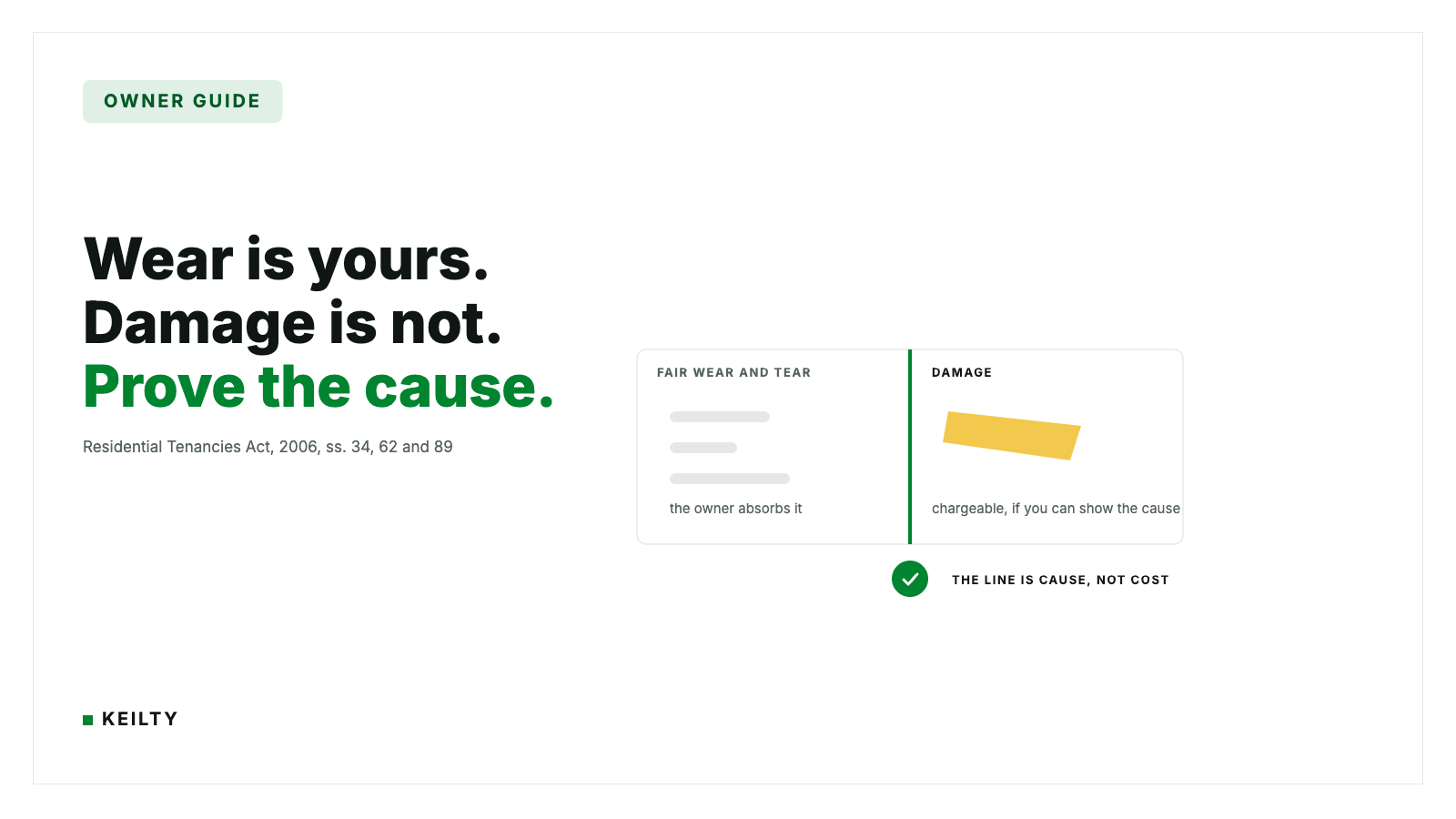
Yes, for undue damage. Section 34 of the Residential Tenancies Act, 2006 makes the tenant responsible for repairing undue damage to the rental unit or the residential complex caused by the wilful or negligent conduct of the tenant, another occupant of the unit, or a person the tenant permits in the complex. What you cannot do is turn that into a line item. There is no invoicing it as extra rent, and there is no helping yourself to the last month's rent deposit. You get paid one of three ways: the tenant repairs it or pays you, you settle it, or you get an order from the Landlord and Tenant Board.
Section 34 is short and it is worth reading in full: "The tenant is responsible for the repair of undue damage to the rental unit or residential complex caused by the wilful or negligent conduct of the tenant, another occupant of the rental unit or a person permitted in the residential complex by the tenant."
Three things follow from that sentence. The damage has to be undue. The conduct has to be wilful or negligent. And the tenant carries it even when they did not personally do it, because the section reaches occupants and anyone the tenant lets in. A guest who punches a hole in the hallway drywall is the tenant's problem, not yours.
The money side sits in section 89(1). It lets a landlord apply for an order requiring a tenant or former tenant to pay "reasonable costs that the landlord has incurred or will incur for the repair of or, where repairing is not reasonable, the replacement of damaged property". Clause (a) attaches a condition that is easy to skip past: the conduct must have happened "while the tenant or former tenant is or was in possession of the rental unit". Read the replacement branch carefully too. Replacement cost is available only where repairing is not reasonable, so one gouged board does not buy you a new floor.
Is this you? If you own this rental rather than rent it, KEILTY manages homes and buildings across Eastern Ontario and will tell you what the unit should rent for. Start with a free rental evaluation.
The Act does not define undue damage, and no LTB guideline or form instruction sets out a list. What the LTB does say, under the Damage heading in Part 3 of the instructions to Form L2, is this: "Normal wear and tear is not considered undue damage."
So work the section 34 test rather than the price tag. Ask whether the damage is undue, and then ask what wilful or negligent conduct you can actually point to. Thinning in a carpet traffic path after five years has no conduct behind it. A burn through the carpet backing does. Scuffed and yellowed paint has none. A fist through the wall does. A stove element that has finally quit has none. A cracked glass cooktop probably does. Every one of those is an illustration of how to frame the question, not a ruling, because the answer turns on the evidence in front of the adjudicator. But if you cannot identify conduct at all, you are describing wear, and wear is yours. That is the flip side of section 20(1), which makes the landlord responsible for providing and maintaining the complex and the units in it in a good state of repair and fit for habitation, and for complying with health, safety, housing and maintenance standards. We have written separately about what repairs a landlord is responsible for in Ontario, and the two obligations meet exactly here.
This is the part owners get wrong most often, and it is where a large claim quietly becomes a small order. Section 89(1) does not entitle you to what a replacement costs. It entitles you to "reasonable costs", and it reaches replacement only "where repairing is not reasonable". Both the L2 and the L10 ask you to explain how you calculated the figure. So if the thing you are replacing was part way through its life, its age is the first question you should expect, and your answer to it belongs in the application rather than in the hearing.
There is no depreciation schedule in the Act or in O. Reg. 516/06 for damage claims, and we are not going to invent one. What does exist is a published Ontario table of useful lives, the Schedule to O. Reg. 516/06, and it was built for a different job. Section 27(1) of that regulation uses the Schedule to fix the useful life of a capital expenditure on an above-guideline increase application, and rule 1 of that subsection deems anything with a listed life under ten years to be ten years, which tells you it was not drafted with a burned counter in mind. Treat it as the nearest published yardstick and nothing more. Some entries, for scale:
The arithmetic is simple enough to do on the back of the quote: replacement cost, multiplied by the years of life left, divided by the total life. A $1,000 item on a ten year comparator that is six years old prorates to $400. That is a calculation, not a forecast, and nobody is bound by a table written for rent increases. But an owner who has done it before filing is in a different position from one who turns up with an invoice for a new appliance and no answer about the age of the old one.
No. Section 105(1) says the only security deposit a landlord may collect is a rent deposit collected in accordance with section 106, and section 105(2), for the purposes of sections 105 and 106, defines a security deposit broadly enough to catch money held "as security for the performance of an obligation or the payment of a liability of the tenant". A damage deposit is not on the menu, which we covered in detail in can a landlord ask for a damage deposit in Ontario.
The deposit you do hold has one job. Section 106(10): "A landlord shall apply a rent deposit that a tenant has paid to the landlord or to a former landlord in payment of the rent for the last rent period before the tenancy terminates." That is a shall, not a may. It is last month's rent, not a repair fund. If you spend it on drywall instead, the tenant can apply under section 135(1) for an order that you pay back money collected or retained in contravention of the Act.
Section 135 is wider than the deposit, and our own managers should read the next sentence twice. It reaches any amount collected or retained in contravention of the Act, a charge for wear and tear included, and by its own words the order can run against "the landlord, superintendent or agent of the landlord", so the person who took the money can be ordered to pay it back personally. The tenant files a T1, which costs $53, or $48 through the Tribunals Ontario Portal, and section 135(4) bars an order on an application filed more than one year after the person collected or retained the money.
Three applications can carry a damage claim, and they are not interchangeable.
The money-only L2. It asks you to prove three things: that the damage is undue, that someone in the section 34 group caused it wilfully or negligently, and that your repair or replacement cost is reasonable. The L2 instructions tell you what the form wants on that last point: explain in detail what damage occurred and how you calculated the costs you are claiming, and get your evidence about the damage and the costs to the tenant and the LTB before the hearing.
Termination is a heavier lift on top of the same evidence. You have to have given the right notice, dated correctly, served correctly, with a certificate of service, and then filed on time. The deadline is statutory, not just a form instruction: section 69(2) says an application under section 69(1) "may not be made later than 30 days after the termination date specified in the notice", and section 69(3) carves out only applications based on the tenant's failure to pay rent. The L2 instructions say the same thing in the same words. Miss it and the notice is spent.
The practical read: if what you actually want is the money, claim the money and leave the tenancy alone. If what you want is the tenant gone, understand that you are proving two cases in one hearing, and that either can fail on its own.
Under an N5, yes, and it is the one route that can put the repair money in your hands without a filing fee. Section 62(2)(c) requires the notice to give the tenant seven days to repair the damaged property or pay the landlord the reasonable costs of repairing it, or to replace it or pay the reasonable costs of replacement where it is not reasonable to repair. Section 62(3) then makes the notice void if, within seven days after receiving the notice, the tenant complies with that requirement or "makes arrangements satisfactory to the landlord to comply with that requirement". The clock in subsection (3) runs from receipt, so how and when you served the notice matters.
Note who holds the pen on that last part. Arrangements satisfactory to the landlord means you decide whether a payment plan is good enough. A tenant who pays inside seven days keeps the tenancy and you keep the repair money, which for most owners is the better outcome anyway.
An N5 under section 62 carries that void right. A notice under section 63 does not, because section 63(3) says subsections 62(2) and (3) do not apply to a notice given under that section. If you reach for the shorter notice, you are giving up the pay-and-stay mechanism.
The cure window is not permanent either, and this is the one lever in the whole topic that runs in the owner's favour. Section 68(1) lets you give a further notice of termination where you already gave a notice under section 62, 64 or 67 and then, more than seven days but less than six months after that first notice was given, an activity takes place, conduct occurs or a situation arises that would ground a notice under section 60, 61, 62, 64 or 67. Section 68(2) puts the effective date no earlier than the 14th day after the notice is given, and section 68 contains no void provision at all. The N5 instructions say the same thing in plain language: on a second N5 inside six months, "the tenant cannot void this notice and you can apply to the LTB to terminate the tenancy and evict the tenant as soon as you have given the notice to the tenant." That squares with the Act, because section 70 only bars an early application on a notice given under section 62, 64 or 67, and section 71 otherwise lets a landlord who has served a notice apply immediately. A second incident inside six months is a different file from the first one.
Yes, and it is one of the more useful corners of the regulations. Section 134(1) opens with "Unless otherwise prescribed" and then bars a landlord from collecting a "fee, premium, commission, bonus, penalty, key deposit or other like amount of money" from a tenant, prospective tenant or former tenant. Section 17 of O. Reg. 516/06 lists the payments that are prescribed out of that prohibition, and item 6 is "Payment by a tenant, former tenant, subtenant or former subtenant in settlement of a court action or potential court action or an application or potential application to the Board."
So a negotiated payment for damage, made in settlement of an application you could otherwise bring, is not an illegal charge. Put it in writing, describe what it settles, and keep the quotes that supported the number. It is the cheapest route available, and it is not one you will find flagged on the forms.
Four things, and a post that only lists the upside is not much use to you.
The L2 and the L10 both cost $201, or $186 through the Tribunals Ontario Portal, per the fee table on the LTB's forms, filing and fees page read on 2026-08-20. Deadlines: an L2 based on a notice goes in within 30 days of the termination date on the notice under section 69(2); a damage claim against a tenant or former tenant goes in either while they are in possession or, under section 89(1.1)(b), no later than one year after they ceased to be in possession.
While you have the money form open, the L10 instructions confirm one small charge that survives section 134: the bank's NSF charge, plus a landlord administration charge of no more than $20 per cheque. That comes from items 4 and 5 of section 17 of O. Reg. 516/06. Both forms attach a condition to it. On the L10 you can only claim NSF charges if you are also claiming rent arrears or compensation, and on the L2 only if you are also claiming compensation for each day the tenant stayed past the termination date.
Then the Board is closed to you and the courthouse is not. Section 168(2) gives the Board exclusive jurisdiction over applications under the Act, and section 89(1.1)(b) is what puts your damage claim inside or outside that door. Once the one-year window has passed, or where the tenant ceased possession before 2021-09-01, the L10 is unavailable and a civil claim is the remaining route. Section 207(2) also lets a person whose claim exceeds the Board's monetary jurisdiction go to court instead, and the court may then exercise the powers the Board would have had.
Two neighbouring regimes displace everything above, and each one changes the answer end to end.
The first is the shared-facility exemption. Under section 5(i) the Act does not apply to living accommodation whose occupants must share a bathroom or kitchen facility with the owner, the owner's spouse, child or parent, or the spouse's child or parent, where that person lives in the same building. If your basement tenant shares your kitchen, there is no Board application to bring, because there is no tenancy under the Act. Damage becomes an ordinary civil claim.
The second is mobile homes and land lease communities. Section 2(4) makes a rented site a rental unit for the purposes of the Act "even if the mobile home or the land lease home on the site is owned by the tenant of the site". So the site, the services and the park are within the Act. What section 2(4) does not do is make the tenant's own home part of your rental unit, so do not assume damage to that structure is a claim you can bring.
Expect that argument, and expect it to be heard. LTB Interpretation Guideline 5, dated 2018-12-15, addresses the collision directly: "if the landlord alleges that the repairs requested by the tenant were in fact the tenant's responsibility, this issue must be decided by the Member." The guideline also tells you what it is worth on its own terms, which is worth knowing before you quote it at anyone: "a Member is not required to follow a Guideline and may make a different decision depending on the facts of the case."
The lesson is evidentiary. A cracked window frame in a unit where the tenant reported a draft twice and nobody came looks like a maintenance question. The same frame in a unit with a service record showing it was sound six weeks earlier looks like a damage question. Neither record decides anything, but only one of them gives you something to put in front of an adjudicator.
Practice, not statute, but this is where most claims are won or lost.
One caution on that last point, because it cuts against how our industry talks about it. Ontario has no statutory move-in inspection report. Nothing in the Act or in O. Reg. 516/06 requires one, prescribes a form for one, or attaches a consequence to not having one, and the only inspection the Act itself deals with is the landlord's own right of entry to inspect under paragraph 4 of subsection 27(1). A condition report is evidence, and it is the best evidence you can cheaply create, but it is not a legal instrument. It cannot create liability the Act has not already created, and no tenant can sign their way into a damage deposit or out of the wilful or negligent test in section 34, because section 105(1) permits only a rent deposit and section 4(1) makes a provision in a tenancy agreement that is inconsistent with the Act void.
A single-family rental in Belleville, rent $2,100, one month's rent held as a rent deposit. On 2026-03-14 the tenant's guest kicks through a bedroom door and puts a hole in the hallway drywall, and a pan burns the laminate counter, which is eight years old. Quotes come in at $780 for the door and frame, $640 for drywall and paint, and $1,450 to replace the counter. Total $2,870.
Start with the notice, because the facts here are mixed. The kick is deliberate, so the wilful ground in clause 63(1)(a) is at least arguable on the door, but the burned counter looks like carelessness rather than intent, and negligence cannot travel on an N7 at all. An N5 under section 62 covers both wilful and negligent damage, and it is the notice that can produce payment instead of a hearing, so on these facts it is the sensible choice even though it is the slower one.
Then price it accurately. The door and the drywall are repairs, so the quotes are the quotes. The counter is a replacement, and on the 25 year comparator in Table 10 of the Schedule to O. Reg. 516/06 an eight year old counter has 17 years of life left, which prorates $1,450 to $986. Claiming the full $1,450 with no reference to the counter's age puts the weakest number in your application in the largest type.
You give an N5 on 2026-03-14 with a termination date no earlier than 2026-04-03, which is the 20th day after the notice, and it requires the tenant, within seven days, to repair or pay the reasonable costs of repair. The N5 has a field for that figure, so put $2,406 in it, being the two repair quotes plus the prorated counter. If the tenant receives the notice the same day it is given, the seven days in section 62(3) run out on 2026-03-21. If the tenant pays, the notice is void under section 62(3), the tenancy continues, and you never file anything. If the tenant instead offers $500 down and the balance over three months and you accept, that is an arrangement satisfactory to the landlord, and the payments are prescribed out of section 134(1) by item 6 of section 17 of O. Reg. 516/06.
If nothing happens, you file an L2 by 2026-05-03 under section 69(2), claiming termination and the $2,406, and you attach the notice, the certificate of service, the photographs, the quotes and your working on the counter. If the Board terminates and orders payment, section 89(2) requires the set-off. Your deposit has already gone to April's rent under section 106(10), so what comes off is the deposit interest still owing, not the $2,100. And if the counter turns out to be repairable, section 89(1) reaches the repair cost rather than any replacement figure, because it allows replacement only where repairing is not reasonable.
Now change one fact. Say the same tenant had a first N5 for damage two months earlier. Section 68(1) is then in play, section 68(2) puts the termination date at the 14th day instead of the 20th, there is no seven day cure to wait out, and section 71 lets you file as soon as the notice is given.
Most damage files are lost long before the damage happens, in a thin move-in record and a slow first response. KEILTY Realty Management has been managing Ontario rentals since 2003, and the boring parts are the parts that pay: a documented condition report, inspections that actually get done, quotes from trades we already use, and notices served correctly the first time. Our management pricing is a flat monthly rate per unit, not a percentage of your rent, so it does not climb as your rent climbs. You can see how that works for a single-family rental.
Not sure what your unit should be renting for, or whether your current setup is protecting you? Ask us for a free rental evaluation and we will give you a straight answer.
This post is general information about Ontario residential tenancy law as of 2026-08-20, not legal advice. Legislation, regulations and tribunal practice change. For advice on a specific property or situation, speak with a lawyer or licensed paralegal.
Ontario property management with published pricing, same-day answers, and no surprises. Since 2003.
300-80 Queen StreetNot served yet. Join a list and hear from us the day we open.