
By A.J. Keilty, President, KEILTY Realty Management
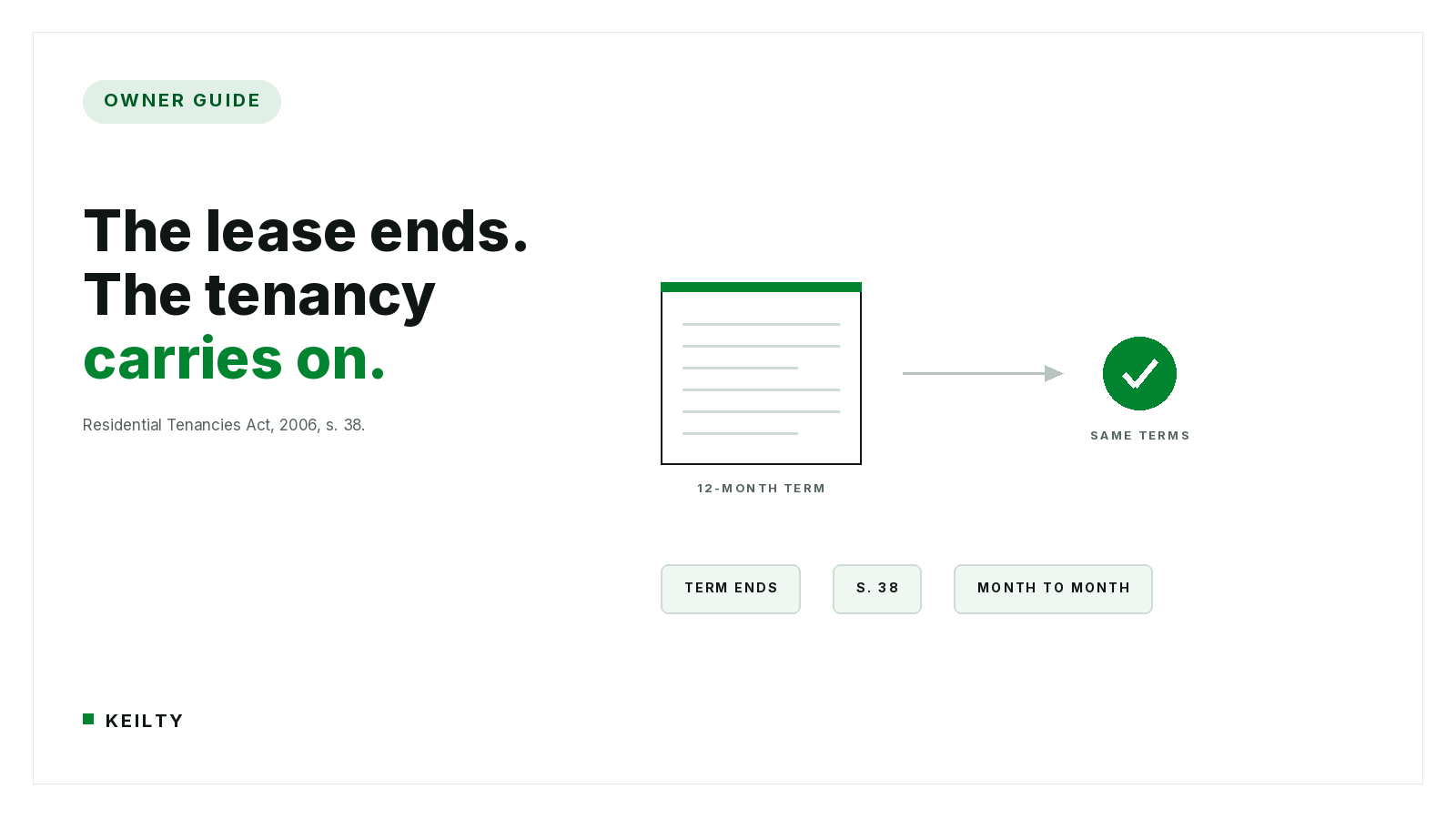
Yes and no, and the distinction is the whole answer. You can refuse to sign a new fixed-term lease. No owner is obliged to give a tenant another one-year term. What you cannot do is refuse to continue the tenancy. Under section 38 of the Residential Tenancies Act, 2006, a fixed term that expires without being renewed or terminated rolls into a month-to-month tenancy on the same terms, and the tenant stays. So the answer to a tenant asking to renew is that you can decline the new term and they keep the unit anyway.
That distinction catches plenty of owners off guard, especially owners who came from commercial leasing or from a province with different rules. It is worth understanding properly, because acting on the wrong half of the answer is one of the faster ways to end up at the Landlord and Tenant Board with a weak file.
Is this you? If you own this rental rather than rent it, KEILTY manages homes and buildings across Eastern Ontario and will tell you what the unit should rent for. Start with a free rental evaluation.
Section 38 does the work. If a fixed-term tenancy agreement ends and has not been renewed or terminated, the landlord and tenant are deemed to have renewed it as a monthly tenancy, with the same terms and conditions as the expired agreement, subject to any rent increase charged in accordance with the Act. The same deeming rule applies to daily, weekly and monthly tenancies that roll over.
Three things follow from that one sentence:
One caveat on that last point, because owners get it backwards in both directions. The 90 day N1 applies to everyone. The guideline cap does not. Section 6.1 exempts units first occupied for residential purposes after 2018-11-15, so in an exempt unit the increase amount is whatever the market will bear, provided the notice and timing rules are followed. We set out how to establish that exemption in Is My Rental Unit Exempt from Rent Control in Ontario?
Ontario's own guidance says the same thing from the tenant's side. The province's Renting in Ontario: Your rights page is direct about it: even if a landlord gives written notice, the tenant does not have to move out, and the landlord has to apply for and receive an eviction order from the LTB first. Community Legal Education Ontario tells tenants outright that a landlord who says the only options are renew or leave is wrong, and that staying month-to-month is a third option the tenant can take on their own.
Yes, and this is the exception worth knowing before you tell anyone the flat answer. Section 38 only operates where the Act applies. Section 5 lists the accommodation the Act does not cover, and in those situations a fixed term genuinely ends when it says it ends.
The one that comes up constantly in our markets is section 5(i): living accommodation where the occupant has to share a kitchen or a bathroom with the owner, or the owner's spouse, child or parent, and that person lives in the building. That is a large share of the room rentals around Queen's and St. Lawrence in Kingston, and a fair number of arrangements in Peterborough and Oshawa too. Rent a room in your own house with a shared kitchen and you are outside the RTA, which means no section 38 rollover, no guideline, and no LTB.
Section 5 also covers things like accommodation in a care facility for rehabilitative or therapeutic purposes for a limited period, seasonal or temporary accommodation in some circumstances, and certain co-operative and institutional housing. It is a list worth reading rather than guessing at, because the difference between being in and out of the Act changes every other answer in this article. If you are not certain which side of the line a unit sits on, get advice on that specific unit before you act on it.
Because in most other kinds of leasing, it is. A commercial lease expires and the tenant is holding over. A car lease expires and you return the car. Residential tenancy law in Ontario runs on different logic. The tenant's right to stay is the default, and every exit from that default is a named process with a specific form and a specific waiting period.
Paperwork reinforces the confusion. Plenty of owners send a friendly "your lease expires 2026-09-30, please confirm whether you intend to renew" email every year and get a signed renewal back every year. Nothing wrong with asking. The trap is believing that a tenant who does not answer has agreed to leave. Silence means month-to-month, not vacancy.
You can ask. You cannot require it, and you cannot penalize a tenant for declining. A tenant who wants to go month-to-month is exercising a right, and treating that as a lease violation is a dead end.
You also cannot use the renewal conversation as leverage to change terms. An owner who says "I will renew you, but only at $2,400 and only if you agree to no pets" is describing an agreement that needs the tenant's consent. If the tenant says no, the old terms continue and the rent moves by the guideline, or by proper notice in an exempt unit.
Here is the part owners miss: the tenant agreeing does not save it. Section 3(4) applies the Act despite any agreement or waiver to the contrary, and section 4(1) makes a lease term that is inconsistent with the Act void. So a rent figure written into a renewal lease, signed willingly by the tenant, is not lawful rent if it was not arrived at through a valid increase. Section 116(4) makes an increase void where proper notice was not given, and the tenant can come after the difference on a T1 application. A signature does not convert an unlawful increase into a lawful one.
The reason so many owners believe it does work is section 136. If a tenant pays the increased amount for 12 months without applying to the Board, the rent is deemed lawful going forward. That is a real limitation period and it explains why plenty of improper renewal increases never get challenged. It is not permission. It is a clock, and until it runs you are carrying an unrecorded liability on the unit. On pets specifically, a no-pets clause is void the moment it is written, which we covered in Can a Landlord Say No Pets in Ontario?
There are three doors, and lease expiry is not one of them.
A tenant ends the tenancy by serving Form N9 with at least 60 days notice. The timing depends on the tenancy. Under section 44(4), a tenant on a fixed term can only give notice effective the last day of that term. A month-to-month tenant can give 60 days notice effective the last day of any rental period. We walked through the mechanics in How Much Notice Do I Have to Give My Landlord Before Moving Out in Ontario?, which is worth reading if you want to know what a valid tenant notice looks like, since an invalid one is not binding on either of you.
Form N11 is a mutual agreement to end the tenancy. It works, but it has to be genuinely mutual and signed after the tenancy has already started. An N11 that a tenant was pressured into signing, or one presented as a condition of getting the unit in the first place, is the kind of document that falls apart at a hearing. If you use one, keep the surrounding correspondence, because that correspondence is what shows the agreement was real.
Everything else runs through a notice form and, if the tenant does not leave voluntarily, an application to the Board. The grounds an owner would typically use, with the notice periods that actually apply:
Two details on the N12 and N13 that owners routinely get wrong, and both cost money.
On N12 compensation, the statute is more demanding than most summaries suggest. Section 48.1 requires one month's rent, or the offer of "another rental unit acceptable to the tenant." Not comparable, not equivalent, acceptable to the tenant. That is a much higher bar, and in practice it means the cash is usually the cleaner route.
On N13, there is no single compensation figure and there is no universal right of first refusal. The right of first refusal under section 53 exists only where the notice is for repairs or renovations, and only where the tenant gives you written notice before vacating that they intend to return. It does not attach to a demolition or a conversion, because there is nothing to come back to. Compensation is tiered. For demolition or conversion under section 52, it is three months rent where the residential complex has at least five residential units and one month's rent where it has fewer. For repairs and renovations under section 54, the same five-unit split applies, and where the tenant has given notice of intent to return the amount is limited to the rent for the period the unit is under repair, capped at the three month or one month figure. Work out which subsection you are in before you budget for it.
None of this is fast. We are not going to quote a single average wait, because the published spread at the Landlord and Tenant Board is wide, with the bulk of cases heard somewhere between roughly three and sixteen months after filing depending on application type. Months rather than weeks is the realistic planning assumption, and for anything other than straightforward arrears you should assume the longer end.
Yes, and it is worth a diary note, but read the limit on it carefully. Bill 60, the Fighting Delays, Building Faster Act, 2025, removes the requirement to compensate a tenant where the landlord gives at least 120 days notice and the termination date falls on the last day of a rental period or the end of a fixed term. That change takes effect 2026-09-21 and applies to notices served on or after that date. Schedule 12 amends section 48.1 only, which is the compensation rule for a landlord's own use. It does not touch section 49.1, so a purchaser's own use notice still carries one month's compensation no matter how much notice is given.
As of this writing it is scheduled, not yet law. Serving an N12 without compensation before 2026-09-21 is a bad-faith exposure, not a saving. But from that date, an owner who genuinely needs a unit back and can plan four months ahead is looking at a real difference: one month's rent, kept rather than paid, on every landlord's own use notice. On a unit at $2,100 that is $2,100 per notice, purely for planning earlier. It turns "start early" from good advice into a line item.
Usually one of two things. Either the tenant knows the law, refuses, and you have lost credibility for every conversation that follows. Or the tenant does not know the law, leaves, and you have exposure.
Pressuring a tenant out with something that looks like a notice but is not one is a bad place to be. Harassing or threatening a tenant to get them to move is an offence under the Act, with maximum fines of $100,000 for an individual and $500,000 for a corporation. If the Board finds a no-fault notice was given in bad faith, the remedy can include the rent difference in the tenant's new unit for up to a year, up to 12 months of the last rent charged, and the tenant's moving and storage costs. On a unit renting at $2,100, twelve months of rent alone is $25,200 before anything else is counted.
There is a quieter cost too. A homemade non-renewal letter in the file is the first thing a tenant's legal clinic will point to if you later serve a legitimate N12 or N13. It reads as a pattern.
Most owners asking about non-renewal are really asking about rent. The unit is $300 under market, the tenant is fine, and resetting to market on a new tenancy looks like the fix. That deserves a hard look in the current market.
Ontario's guideline for increases taking effect in 2026 is 2.1%, and the province has set the 2027 guideline at 1.9%, which we covered in Ontario's 2027 Rent Increase Guideline Is 1.9%. Those are modest numbers, so in a rent-controlled unit the gap between in-place rent and market rent does keep widening on long tenancies. That part of the reasoning is sound.
What has changed is the other side of the ledger. CMHC's 2026 Mid-Year Rental Market Update, published 2026-06-09, reports asking rents declining in Toronto, Vancouver and Calgary, with Ottawa now in that group and falling since Q2 2025. Operators are leaning on incentives to fill units, in some cases as much as several months of free rent, plus free parking, move-in credits and gift cards. Nationally, Rentals.ca put the average asking rent at $2,033 in June 2026, down 4.3% year over year. CMHC also notes that new units are taking longer to lease, sometimes months to fill a single vacancy.
So the arithmetic on a deliberate turnover is tighter than it was in 2022. A one-month vacancy on that same $2,100 unit costs $2,100 in lost rent, before turn costs, before advertising, before the concession you may have to offer to get a signature. If the reset gains you $150 a month, you have spent 14 months earning back the vacancy alone. Our vacancy loss calculator will run those numbers on your actual rent. In a softening market a good tenant paying slightly under market is frequently the more profitable asset, and CMHC reports that turnover in 2025 was highest in the most expensive rent quartile, which is exactly where vacancy risk is worst right now.
If your unit is genuinely far below market and the gap is driven by capital work you have already done, the above-guideline increase route exists and is a legitimate tool. That is a different application with its own evidence burden, covered in How Do You Apply for an Above Guideline Rent Increase in Ontario?
Yes, and it is a better reason than most owners realise. A fixed term buys you a floor on when the tenant can leave, and that floor resets every time you renew.
Section 44(4) is the mechanism. A tenant on a fixed term cannot serve notice effective before the end of that term. A month-to-month tenant can serve 60 days notice effective the end of any rental period, which means any month of the year, including the ones you least want. Renew a term ending 2027-08-31 and you have removed the possibility of a January or February vacancy for the next twelve months. Leave the same tenant on month-to-month and you have not.
In student-influenced markets like Kingston, Peterborough and Oshawa, that floor is worth real money, because a mid-winter vacancy is both expensive and slow to fill. The rest of the difference between a renewed tenant and a month-to-month tenant is thin: your rent increase rights are identical, and your grounds for ending the tenancy are identical. But the exit-timing control is not thin, and it is entirely in your favour. If a tenant is happy to sign another term, take it.
A short, unexciting sequence handles almost every case:
You can decline a new fixed term. You cannot decline the tenancy. Section 38 rolls the expired term into a month-to-month tenancy on the same terms, the tenant does not have to sign anything or leave, and the only lever the anniversary reliably gives you is a properly served rent increase. The exceptions are narrow and they live in section 5, so check whether the Act applies at all before you rely on any of this. Owners who plan around that spend far less time at the Board than owners who treat the end date as a deadline.
The cost of getting this wrong is one of the plainer arguments for professional management. If you want to see how the two compare on a specific property, our property management versus self-management breakdown lays out the real costs, and the pricing detail for houses and single units lives on our single-family rental page.
If you are heading into a lease anniversary and are not sure whether your rent is where it should be, or what your unit would lease for today, request a free rental evaluation. KEILTY manages residential and commercial rentals across Ontario, from Kingston and Belleville through Peterborough, Oshawa and Ottawa, and we are happy to look at your numbers before you commit to a plan. You can also just get in touch.
This post is general information about Ontario residential tenancy and human rights law as of 2026-08-06, not legal advice. Legislation, regulations and tribunal practice change. For advice on a specific applicant, property or situation, speak with a lawyer or licensed paralegal.
Ontario property management with published pricing, same-day answers, and no surprises. Since 2003.
300-80 Queen StreetNot served yet. Join a list and hear from us the day we open.