
By A.J. Keilty, President, KEILTY Realty Management
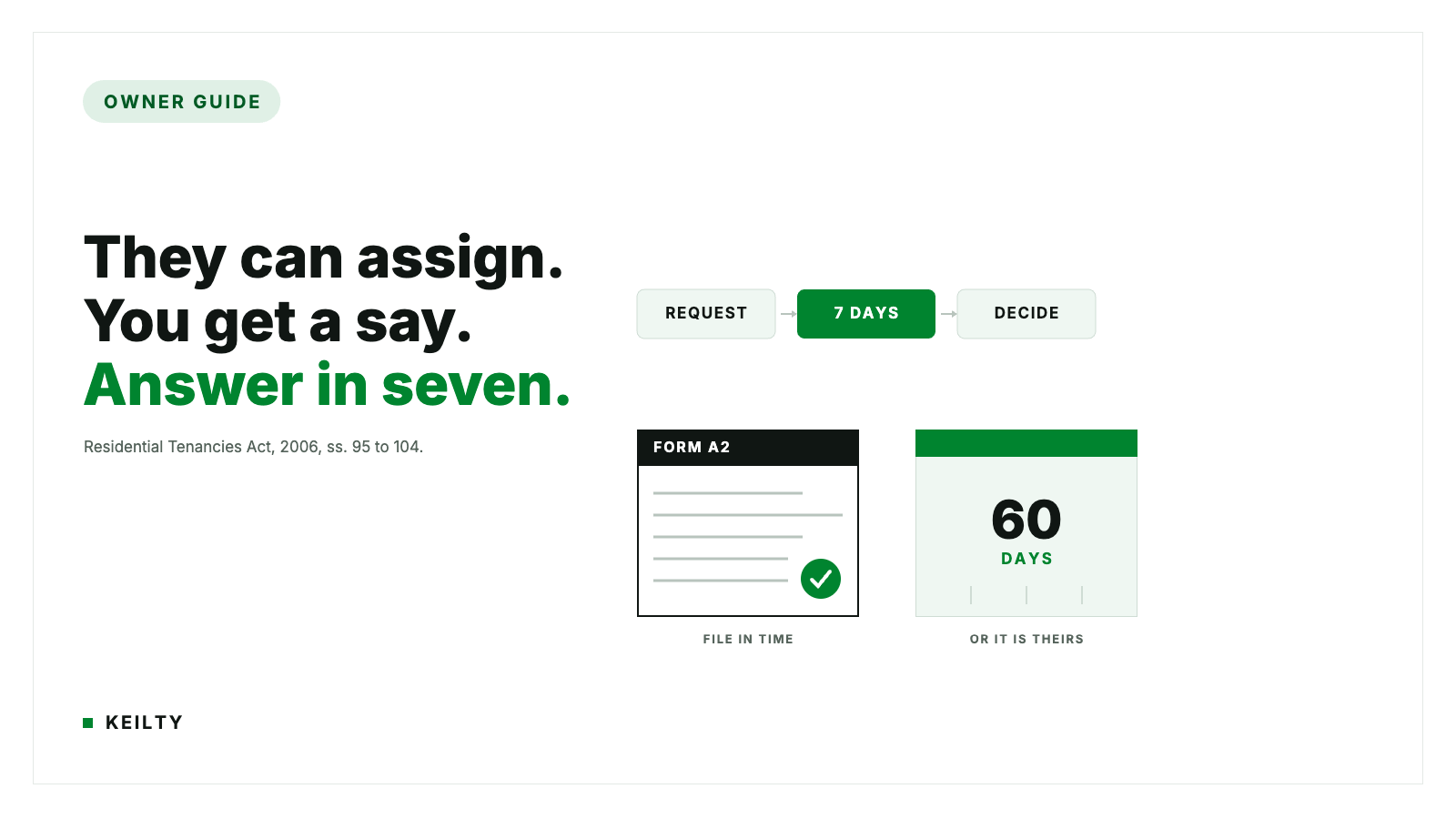
Not without being asked, and not on the same terms for both. A tenant needs your consent to sublet and to assign, but the two run on different rules. On a sublet you cannot arbitrarily or unreasonably withhold consent, under section 97(2) of the Residential Tenancies Act, 2006. On an assignment you can refuse outright and give no reasons at all, under sections 95(2)(b) and 95(3)(c). The one place the reasonableness duty bites on an assignment is section 95(5), which applies only when you have agreed to an assignment in principle and are refusing the specific person the tenant then puts in front of you.
Two clocks decide what it costs you. Refuse an assignment or say nothing for seven days and the tenant can end a fixed term early. Let someone move in without your consent and let 60 days pass, and they become your tenant, at the old rent, backdated to the day they moved in.
Is this you? If you own this rental rather than rent it, KEILTY manages homes and buildings across Eastern Ontario and will tell you what the unit should rent for. Start with a free rental evaluation.
They get used interchangeably in conversation. They are not the same thing, and the difference changes who owes you rent.
A sublet, under section 97, is when your tenant vacates, gives someone else the right to occupy for a term ending before the end of their own, and keeps the right to move back in. The tenant is still your tenant. They still owe you the rent. If the subtenant trashes the kitchen, you look to your tenant, not the subtenant. Classic example: a Queen's student in Kingston going on a work term from January to April and putting someone in the unit until they return.
An assignment, under section 95, is a permanent handover. The new person steps into the existing tenancy on the existing terms. This is the one owners underestimate. An assignment is not a turnover. It is your existing lease, with a different name on it.
The practical test is simple. Is the tenant coming back? If yes, it is a sublet. If no, it is an assignment.
Section 95(8) splits it at the assignment date, and owners routinely chase the wrong party.
The assignee is liable for anything relating to the period after the assignment. The former tenant stays liable for breaches relating to the period before it. So the arrears your outgoing tenant ran up are still the outgoing tenant's problem, and the assignee does not inherit them. If you have four months of unpaid rent and you consent to an assignment, you have not just written that money off, but you are collecting it from someone who no longer lives there.
No, and this is the most expensive misunderstanding in this area of the law.
Ontario has vacancy decontrol, which means when a unit genuinely turns over you can set the new rent at whatever the market will pay. Owners hear that and assume any new name on the lease is a reset. It is not. On a consented assignment the tenancy continues, so the rent continues. If the unit is renting at $1,650 and market is $1,950, the assignee pays $1,650.
Same on a sublet. Section 134(3)(a) stops your tenant from charging the subtenant more than the lawful rent, and nothing in the Act lets you charge more either.
This is the real commercial question, and in 2026 the answer has moved.
If you refuse consent to assign, the tenant's remedy is to give notice and go, which produces a genuine vacancy, which does reset the rent. That trade looked attractive when asking rents were climbing. It looks worse now. Statistics Canada's quarterly rent statistics for the first quarter of 2026, released 2026-06-09, put Kingston two bedroom asking rents down close to 6 percent year over year, the largest decline of any census metropolitan area in the country. Rentals.ca's August 2026 National Rent Report, published 2026-08-06 on July data, groups Brampton, Mississauga, Oakville and Oshawa together as neighbouring markets posting "steep annual rent declines of over 7% across all property types."
Read that against the arithmetic above. Forcing a vacancy to chase a higher rent only pays if the higher rent exists. In a market that has softened, you may re-let below what the assignee was willing to keep paying, and you carry the empty weeks to find out. Our vacancy loss calculator puts a daily number on those weeks, and the rental income calculator will tell you what the two scenarios actually net. If you want the current number for a specific address rather than a regional average, that is what a free rental evaluation is for.
Seven days. Not seven business days.
Section 95(4) gives the tenant a right to terminate in four situations: you refuse a general request to assign, you do not respond to a general request within seven days, you refuse the assignment outright when a specific assignee was proposed, or you do not respond to that specific request within seven days.
Two details in that section get misread constantly, and both cut against the owner.
First, the deadline for the tenant to serve the notice runs from the date of the request, not from the date you answer. The tenant has 30 days after making the request. So if you sit on it for 25 days and then refuse, you have not run out the clock, you have handed the tenant a five day window that is still open.
Second, 30 days is a ceiling on the notice, not the notice period. Section 96(2) sets the termination date at the lesser of the notice period otherwise required and 30 days. It is never longer than 30 days and it can be shorter.
The practical version: answer inside seven days, in writing, even if the answer is that you need an application from the proposed assignee before you can decide.
Section 95 gives you more room than most owners think, and section 97 gives you less.
On a general request to assign, where no name is attached, section 95(2) lets you consent or refuse. You do not have to justify a refusal. The cost of refusing is the section 95(4) exit, not a hearing.
On a specific request naming a proposed assignee, section 95(3) gives you three options: consent, refuse that person, or refuse the assignment altogether. Only the middle one, refusing the named person under clause 3(b), carries the duty in section 95(5) not to refuse arbitrarily or unreasonably. And under section 95(6), agreeing in principle does not lock you in, you can still turn down the specific person the tenant brings.
On a sublet, section 97(2) has no general refusal power at all. You may not arbitrarily or unreasonably withhold consent, full stop.
Where the reasonableness test does apply, the Board looks at commercial reality and what a reasonable landlord in your position would do, not at your preferences. Refusals that hold up rest on objective criteria applied consistently: the proposed person does not meet the income or credit standard you use across the portfolio, references do not check out, the occupancy would breach housing standards. Refusals that fail are the ones that are really about something else, usually wanting the unit back at market. Human rights grounds are an automatic loss, and they show up here more often than owners expect, dressed up as a remark about family size or source of income. Screen an incoming assignee or subtenant exactly the way you screen anyone else, and keep the file, because the rules on what a landlord can legally ask when screening a tenant apply here unchanged.
The tenant or former tenant applies under section 98, and the window is a year, not days. Section 98(2) gives them one year from the conduct complained of, which is worth knowing next to the seven and 60 day clocks elsewhere in this post.
Under section 98(3) the Board can authorize the assignment or sublet you refused, authorize a different one the tenant proposes, terminate the tenancy, or order an abatement of rent. That last one is the remedy with a number attached, and it is the reason a badly reasoned refusal is not a free option.
Your reasonable out-of-pocket expenses, and nothing beyond that. Sections 95(7) and 97(3) both use that wording. Reasonable is a narrower test than actual, so a credit check you genuinely paid for is defensible and an hour of your own time is not.
An assignment fee, a lease transfer fee, or a month's rent as the price of saying yes are all prohibited charges. Note section 134(2) if you manage for someone else: it catches a superintendent, property manager or other person acting for a landlord directly, whether or not the landlord authorised the charge. Collecting an unlawful transfer fee on an owner's instructions is still your exposure.
Someone is occupying your unit under no authority, and you have 60 days from the day you discover it to decide what to do. Doing nothing is a decision, and it is the worst of the three.
You have three real options.
Sixty days sounds generous until you count backwards from when you actually found out. Owners typically learn about it from a neighbour, a parking complaint, or a name they do not recognize on a maintenance request, then spend three weeks deciding whether it is worth the trouble. Date-stamp the day you found out. Every option above is measured from it.
Yes. This is the question every owner asks in this situation, and the answer is in section 103. Subsection (1) entitles you to compensation for their use and occupation. Subsection (2) says accepting it does not create a tenancy with them, unless you and they agree otherwise.
Two cautions. Accepting compensation does not pause the section 104(4) clock, so taking the money quietly for 60 days still ends in a deemed assignment. And if you want that compensation ordered, section 100(3) allows it only where the unauthorized occupant is still in possession on the day you file. If they have already gone, that route is closed and the claim becomes an L10 application against a former occupant.
Same 60 days, different start date. A subtenant has no right to occupy after the subtenancy ends, and both you and your tenant can apply to evict an overholding subtenant. That right expires 60 days after the subtenancy ends.
Let it lapse and the person in the unit has effectively become a tenant. This is the sublet version of the problem we covered in what happens if a tenant gives notice then does not move out, and the lesson is identical. Possession problems do not improve while you think about them.
A workable process for a small portfolio looks like this.
None of that is complicated. It is time-sensitive, which is a different problem, and it is why these files go wrong for owners running one or two properties around a full-time job. The seven day window does not care that you were away. Neither does the 60 day one. This is a fair part of what we mean when we compare professional management against self-management: not that an owner cannot read the Act, but that statutory clocks run whether or not anyone is watching them.
Not the way owners hope. A blanket ban on subletting or assigning is void under section 4(1), which voids any provision of a tenancy agreement inconsistent with the Act. That is a different mechanism from a no-pets clause, which section 14 voids expressly and by name, and the difference matters here because your position on assignment is genuinely stronger. You cannot contract out of the tenant's right to ask, or out of the section 95(4) consequences of refusing. You do not need to, because section 95 already lets you refuse an assignment.
What a lease can usefully do is set out procedure: request in writing, application from the proposed occupant, credit and reference checks, a signed agreement before anyone moves in. Procedure is enforceable.
One more thing worth knowing. Adding a roommate or a partner is not an assignment or a sublet, because the tenant is not leaving. It is an occupant, with different rules and different risks, and the rent still does not move. If you are working out where your unit sits on rent control, start with whether your rental is exempt from rent control.
A tenant can ask to sublet or assign. On a sublet you need a real reason to say no. On an assignment you can say no without one, and the price is that the tenant can leave a fixed term early. Answer inside seven days either way, and remember the tenant's 30 days runs from their request, not your answer. If someone moves in without your consent, you have 60 days to sign them up at today's rent or apply to evict, and 60 days is also how long you have before the law signs them up for you at yesterday's rent.
Not sure whether to consent, or what the unit would rent for if it came back to market? Book a free rental evaluation and we will give you the number before you make the call, or get in touch and we will walk through the file with you. KEILTY has managed residential rentals across Ontario since 2003, from Kingston and Belleville to Oshawa and Ottawa. Our management pricing is a flat monthly rate per unit rather than a percentage of rent, so it does not climb when your rent does, and the current numbers are on our single family rental page.
This post is general information about Ontario residential tenancy law as of 2026-08-14, not legal advice. Legislation, regulations and tribunal practice change. For advice on a specific property or situation, speak with a lawyer or licensed paralegal.
Ontario property management with published pricing, same-day answers, and no surprises. Since 2003.
300-80 Queen StreetNot served yet. Join a list and hear from us the day we open.