
By A.J. Keilty, President, KEILTY Realty Management
Sometimes, and which answer you get depends on where your deadline is written down. Ontario runs two counting regimes side by side, and they do not agree about what a holiday is. Under the Legislation Act, 2006, Saturday is not a holiday. Under the Landlord and Tenant Board's own Rules of Procedure, it is.
That divergence decides whether your notice is valid, whether your application was filed in time, and whether the five days you added for mail actually bought you five days. This post sets out which regime governs which deadline, shows where one envelope produces two different dates, and names the one question neither instrument answers cleanly.
The short version.
Start with where the deadline is written, because the answer is different in three cases and almost every counting error begins by reaching for the wrong instrument.
If the deadline is in the LTB's Rules. The Legislation Act, 2006 s.46 says "Every provision of this Part applies to every Act and regulation." The Rules are neither. Section 25.1 (5) of the Statutory Powers Procedure Act settles it: "Rules adopted under this section are not regulations as defined in Part III (Regulations) of the Legislation Act, 2006." So for a deadline set by Rule 19.4 or Rule 26.5, the general statutory counting rules never applied in the first place, and the Rules' own provisions govern.
If the deadline is in the Act or in a regulation under it. Here Legislation Act s.46 does reach it, but s.47 qualifies the reach: "Section 46 applies unless, (a) a contrary intention appears; or (b) its application would give to a term or provision a meaning that is inconsistent with the context." A contrary intention appears. Section 193 of the Residential Tenancies Act, 2006 is seven words long and carries no qualifier: "Time shall be computed in accordance with the Rules."
"Rules" is defined in s.2 (1) as the rules of practice and procedure made by the Board under s.176 of the Act and s.25.1 of the Statutory Powers Procedure Act.
Where the Rules supply no method. This is the only case that is genuinely contestable, and it comes up below. The Rules cannot contradict the Act in any event: SPPA s.25.1 (3) requires that "The rules shall be consistent with this Act and with the other Acts to which they relate."
One point of interpretation runs through all three. Rule 1.3.2 reads: "Rules and procedures are not to be interpreted in a technical manner." Rule 1.3.1 requires them to be "liberally and purposively interpreted and applied". A literal reading that produces an absurd result is not obviously the reading the Board will take.
Is this you? If you own a rental in Kingston or Eastern Ontario and would rather not handle this yourself, KEILTY Realty Management manages it for a flat monthly rate. Tell us about the property and A.J. Keilty will call you within 20 minutes in business hours.
Under the Rules, yes. Under the Legislation Act, no. This is the divergence to carry in your head.
LTB Rule 1.1 defines the term directly, and the definition is "any Saturday, Sunday or other day on which the LTB's offices are closed". That sweeps in every Saturday, every Sunday, and every day the Board's offices happen to be shut.
The Legislation Act builds its list differently, and it builds it for a confined purpose. Section 88 (1) reads: "This section applies for the purposes of the definition of “holiday” in section 87." Section 88 (2) then sets out the holidays as numbered paragraphs: Sunday, New Year's Day, Family Day, Good Friday, Easter Monday, Victoria Day, Canada Day, Labour Day, Thanksgiving Day, Remembrance Day, Christmas Day, Boxing Day, and any day fixed as a holiday by proclamation. Saturday is not on that list. We searched the whole Act for the string "Saturday" and found one occurrence, in s.88 (5), where it appears only as a day Christmas might fall on.
Because s.88 feeds the s.87 definition, and s.87 operates on Acts and regulations, the narrower list never reaches the Rules at all. So the same calendar date can be a holiday for one purpose and an ordinary working day for another, and for tenancy matters the wider definition is the one that governs your notice, your application and your disclosure deadline.
There is a second mechanism that answers the Saturday question from a different direction. Legislation Act s.89 (2) reads: "Time limits for registering or filing documents or for doing anything else that expire on a day when the place for doing so is not open during its regular hours of business are extended to include the next day the place is open during its regular hours of business." That provision does not care what day of the week it is.
It asks whether the place you have to go to is shut. A Saturday is not extended because it is a Saturday; it is extended, where this applies, because the office is closed.
Three short Rules do the work, under the heading "Calculation of Time".
Rule 1.12: "Where an LTB order or a Rule refers to a number of days this means calendar days." Not business days, not working days.
Rule 1.13: "When something must be done within a specific number of days, the days are counted by excluding the first day and including the last day." So the day you serve the notice is day zero, not day one.
Rule 1.14: "When the time for doing anything ends on a holiday as defined in these Rules the thing may be done on the next day that is not a holiday."
Rule 1.15 adds that a notice or document "may be delivered to a party or person on a holiday and a notice may take effect on a holiday", so the holiday rule relieves the person acting by a deadline rather than blocking delivery. Rule 1.16 reads: "Rules 1.12 to 1.15 may not be waived or varied." The counting method itself is fixed.
The Board's own Interpretation Guideline 10, which prints "Effective as of: September 1, 2021Updated: September 21, 2026", puts it in plainer words: "When counting the days to determine the correct termination date, the date the Notice is given to the tenant is not included but the date of termination is (Rule 1.13 of the LTB's Rules of Procedure)."
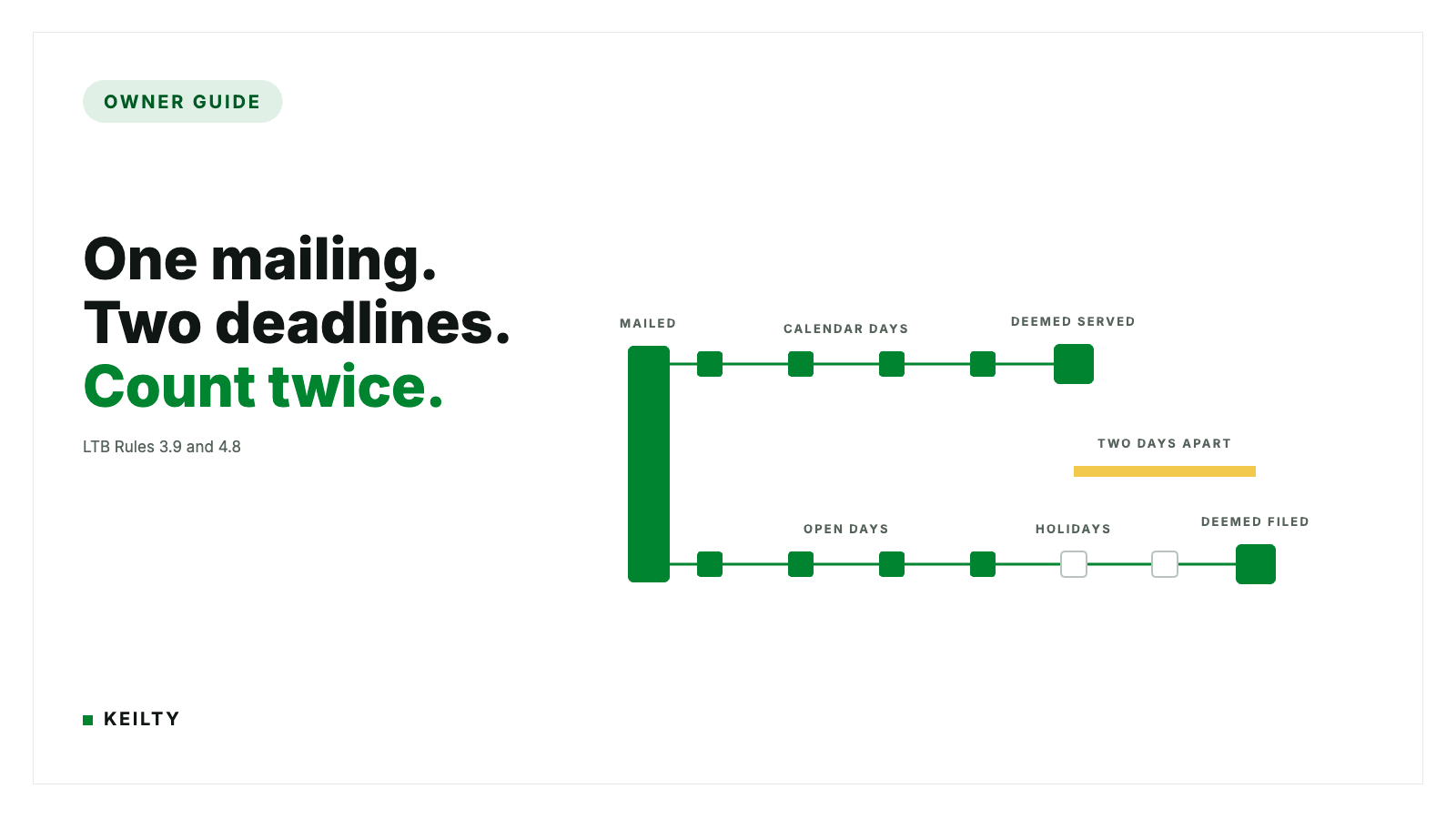
No, and this is the finding we would put at the top of any owner's checklist. The Rules deem mail twice, in two places, using two different formulas.
Rule 3.9, which governs service on a person or party, deems a mailed document served on the "fifth day after mailing". Calendar days. Holidays counted.
Rule 4.8, which governs filing a document with the Board, deems a mailed document filed on the "fifth day that is not a holiday after mailing". Holidays skipped.
Work it through. Put an envelope in the post on Monday 2026-11-02. Serving a party, the document is deemed served five calendar days later, on Saturday 2026-11-07. Filing the same envelope with the Board, you count only days that are not holidays: Tuesday, Wednesday, Thursday and Friday give you four, the Saturday and the Sunday are holidays under Rule 1.1 and do not count, so the fifth lands on Monday 2026-11-09. Two days apart, from one trip to the post box.
Add a day the Board's offices are closed and the gap widens. Mail on Thursday 2026-10-08 and service is deemed on Tuesday 2026-10-13. Filing by mail skips the Saturday, the Sunday and Thanksgiving Monday 2026-10-12, so it is deemed filed on Friday 2026-10-16, three days later than the service date from the same envelope.
The two Rules do not cross-reference each other, so nothing on the page you are reading points out the divergence. If you have been applying one five-day rule to both halves of a file, you have been working from the wrong date on one of them. The practical answer is the dull one: do not rely on mail for anything close to a deadline, and if you must, count the filing side separately. Our guide to serving a notice on a tenant in Ontario works through the service side in detail.
Rule 3.9 opens "A document is considered served on the:" and then runs seven limbs, not the five or six that shorter summaries tend to give. In the Rule's own order, a document is considered served on the:
Two features repay attention. Only the courier limb carries a holiday adjustment: mail, Xpresspost, fax, email, hand delivery and portal upload are deemed without any weekend or holiday wrinkle. And the Xpresspost limb is the only rebuttable one, displaced where a party establishes actual delivery on an earlier date.
The statute runs the same way for notices between parties. RTA s.191 (3) provides that a notice or document given by mail "shall be deemed to have been given on the fifth day after mailing." That fixes the giving date. It is not five days added to a deadline, and it carries no holiday carve-out.
Two neighbouring provisions soften the edges. Section 191 (2) saves a notice given the wrong way: one "that is not given in accordance with this section shall be deemed to have been validly given if it is proven that its contents actually came to the attention of the person for whom it was intended within the required time period." And s.192 (2), covering a document given to the Board by mail, deems it given "on the earlier of the fifth day after mailing and the day on which the notice or the document was actually received."
The counting rule exists, in a provision that is easy to miss, and the open question is narrower than it first appears.
Plenty of tenancy deadlines run backwards from a hearing rather than forwards from an event. Rule 19.4 requires a tenant intending to raise issues under RTA s.82 (1) or s.87 (2) at a landlord's arrears hearing to act "at least 7 days before the scheduled CMH or hearing". O. Reg. 516/06 s.8.3 fixes the timeline for the s.82 (2) payment at "no later than seven days before the hearing". Rule 19.6 sets the tenant's evidence at seven days before, and Rule 19.6.1 gives the landlord five days to respond.
Searching the Rules of Procedure on whitespace-normalised text for the string "days before" returns eighteen occurrences, and seventeen of the eighteen take the form "at least" a number of days before.
That phrasing is not accidental, and it is the key. Legislation Act s.89 (3) reads: "A reference to a number of days between two events excludes the day on which the first event happens and includes the day on which the second event happens, even if the reference is to "at least" or "not less than" a number of days." The provision names the exact formula these deadlines use.
For O. Reg. 516/06 s.8.3, which sits in a regulation, s.46 reaches it directly. So the method for counting a backwards deadline is settled: exclude the day the first event happens, include the day of the second.
Note what Rule 1.13 does and does not do beside it. It governs where "something must be done within a specific number of days". A step required "at least 7 days before" a hearing is not something done within a number of days, so Rule 1.13 is not the provision that counts it.
What remains unresolved is the holiday relief, not the counting. Rule 1.14 relieves a deadline that "ends on a holiday" by letting the thing be done "on the next day that is not a holiday", and Legislation Act ss.89 (1) and 89 (2) both extend a limit "to include the next day". All of those move a deadline forward in time. Applied to a deadline counted backwards from a hearing, forward means closer to the hearing, which shortens the notice the other side receives rather than lengthening the time available. We have not found a provision, Guideline or Practice Direction that addresses that direction.
The drafters were alive to the problem in at least one place. Rule 21.1 requires a consent request to reschedule to be received "not less than 5 business days before the scheduled date", and Rule 21.2 deals with a request received "less than 5 business days" before. Business days are the one unit that insulates a backwards deadline from weekends without needing any extension provision.
Our own view is that the contrast is instructive rather than conclusive, and that the safe course is to treat a backwards deadline as a hard floor and act earlier, because every reading that moves it does so in a direction that hurts the party relying on it. That is a reading of the provisions together rather than something any one of them states outright. Our note on what a tenant can raise at an arrears hearing covers the Rule 19.4 deadlines themselves.
Less than owners expect, and the limits sit in a regulation rather than in the Rules.
Rule 1.6 opens "In order to provide the most expeditious and fair determination of the questions arising in any proceeding the LTB may:" and its first limb reads: "extend or shorten any time limit except where prohibited by legislation or a specific Rule". Shortening is in there as well as extending, and the Rules give the subject its own rule, Rule 16, titled "Request to Extend or Shorten Time".
A separate power is frequently run together with that one and should not be. The power to waive or vary is Rule 1.4.2: "The LTB may vary or waive the application of any rule or procedure, on its own initiative or on the request of a party, except where to do so is prohibited by legislation or a specific rule."
Now the limits, which matter more. Section 190 of the Act is narrower than it looks. Subsection (1) lets the Board extend or shorten time only for applications under s.126, s.159 (2) or s.226. The general power is s.190 (2), and it carves out "the prescribed time requirements".
Those are prescribed by O. Reg. 516/06 s.56, which opens: "The following are time requirements that the Board may not extend or shorten under subsection 190 (2) of the Act:" and then lists them. The first two paragraphs are the ones that bite here: "All time requirements related to notice requirements for terminating tenancies" and "All deadlines for filing applications, other than those which the Board is expressly permitted to extend or shorten under subsection 190 (1) of the Act."
Read that against the mail example above. A filing deadline missed because the filing side of a mailing was deemed later than the service side is precisely a deadline the Board may not extend.
Guideline 10 states the related point in its own words: "Section 56 of O. Reg. 516/06 under the RTA and Rule 1.6(a) of the LTB's Rules of Procedure provide that the LTB cannot extend or shorten a notice period required by the RTA." And Rule 1.16 puts the counting method itself beyond waiver. The relief an owner reaches for is not available for the deadlines that are easiest to miss.
Less than it first appears, and the remaining point is still worth knowing.
The Board's N4 instructions were updated on 2026-09-21 and now open the counting passage with the current notice period: "The termination date must be at least 7 days after you give the notice to the tenant. When you are counting the days, do not include the date you are giving the notice to the tenant. If you are faxing the notice, the notice is deemed to be given on the date imprinted on the fax. If you are sending the notice by courier, add one business day for delivery. If you are sending the notice by mail or Xpresspost, add five days for delivery."
The mail line treats mail and Xpresspost together, and that tracks the Rules' own default: Rule 1.1 defines "mail" as "sending an item via Canada Post including by registered mail and Xpresspost unless otherwise indicated in these Rules". Rule 3.9 does indicate otherwise, by giving Xpresspost its own rebuttable limb, so the instructions are a simplification rather than an error.
The courier line is the live point. It tells you to "add one business day". Rule 3.9's courier limb says the document is considered served on the "day after it was given to the courier when sent by courier, or if that day is a holiday, the next day that is not a holiday". Those reach the same answer in ordinary cases.
But the Rules use "business days" in exactly one place, Rule 21, and never define the term, while Rule 1.12 makes calendar days the default and Rule 1.1 defines "holiday". A landlord working from the instruction sheet is applying a unit the governing instrument barely uses, when the Rule itself gives a test that is defined. Work from the Rule when a date is tight.
This changed on 2026-07-01 and the old figure is still circulating, so state both halves.
Rule 26.4: "A request to review an order or an amended order issued by the LTB before July 1, 2026, must be made within 30 days of the order being issued." Rule 26.5: "A request to review an order or an amended order issued by the LTB on or after July 1, 2026, must be made within 15 days of the order being issued in accordance with section 209(3) of the RTA."
The Rules follow the statute here rather than leading it: RTA s.209 (3) is the source of the fifteen days, and it ends by preserving a discretion, "unless the Board considers it just and appropriate in the circumstances to extend the time to request the review."
So the answer turns on the date the order was issued, not the date you read it, and a late request needs the extension. Rule 26.6 adds that it must be accompanied by a request for an extension of time with reasons. We set out the review route and its alternatives in our guide to what to do if you disagree with an LTB order.
Four habits follow, and none costs anything.
Write down what the deadline runs from before you write down the date. A deadline recorded as "seven days" without its trigger is a date waiting to be wrong. Note whether it runs forward from an event or backward from a hearing, because the relief provisions only work in one of those directions.
Count the service side and the filing side separately when mail is involved. They are deemed under different formulas and they diverge across any weekend.
Treat Saturday as a holiday for tenancy purposes and verify before relying on the opposite. The narrower Legislation Act list applies to Ontario legislation generally, and never to the Rules.
Build in margin instead of relying on an extension. O. Reg. 516/06 s.56 puts notice requirements for terminating tenancies and deadlines for filing applications outside the Board's power to extend, which covers a large share of the dates an owner actually has to hit.
At KEILTY Realty Management we diarise the trigger and the instrument alongside every date on a file, which is a dull discipline that removes an entire class of defect. A missed filing date is one the Board has no power to forgive.
Is Saturday a holiday for an LTB deadline? Under LTB Rule 1.1 it is, because the Rules define a holiday as any Saturday, Sunday or other day the Board's offices are closed. Under Legislation Act s.88 (2) it is not, and because s.88 (1) confines that list to the s.87 definition, it never reaches the Rules.
Do you count the day you serve the notice? No. Rule 1.13 counts by excluding the first day and including the last day, and Interpretation Guideline 10 states the same thing for a termination date.
Is a mailed document served and filed on the same day? No. Rule 3.9 deems service on the fifth day after mailing, counting calendar days. Rule 4.8 deems filing on the fifth day that is not a holiday after mailing. Across a weekend those are different dates.
How is a deadline counted backwards from a hearing? Legislation Act s.89 (3) supplies the method and names the "at least" and "not less than" wording these deadlines use. What no provision addresses is whether a holiday moves such a deadline, and since every extension provision runs forward, acting early is the only position that is safe on every reading.
Can the Board give me more time? Not for the deadlines that matter here. O. Reg. 516/06 s.56 lists time requirements the Board may not extend or shorten under RTA s.190 (2), and its first two paragraphs cover notice requirements for terminating tenancies and deadlines for filing applications. Rule 1.16 also puts the counting rules beyond waiver.
If you would rather not track trigger dates, deemed service and filing formulas across a portfolio, that is what we do. Get in touch with KEILTY Realty Management and we will tell you plainly whether your file needs us.
This post is general information about Ontario residential tenancy law as of 2026-10-02, not legal advice. Legislation, regulations and tribunal practice change. For advice on a specific property or situation, speak with a lawyer or licensed paralegal.
Ontario property management with published pricing, same-day answers, and no surprises. Since 2003.
300-80 Queen StreetNot served yet. Join a list and hear from us the day we open.