
By A.J. Keilty, President, KEILTY Realty Management
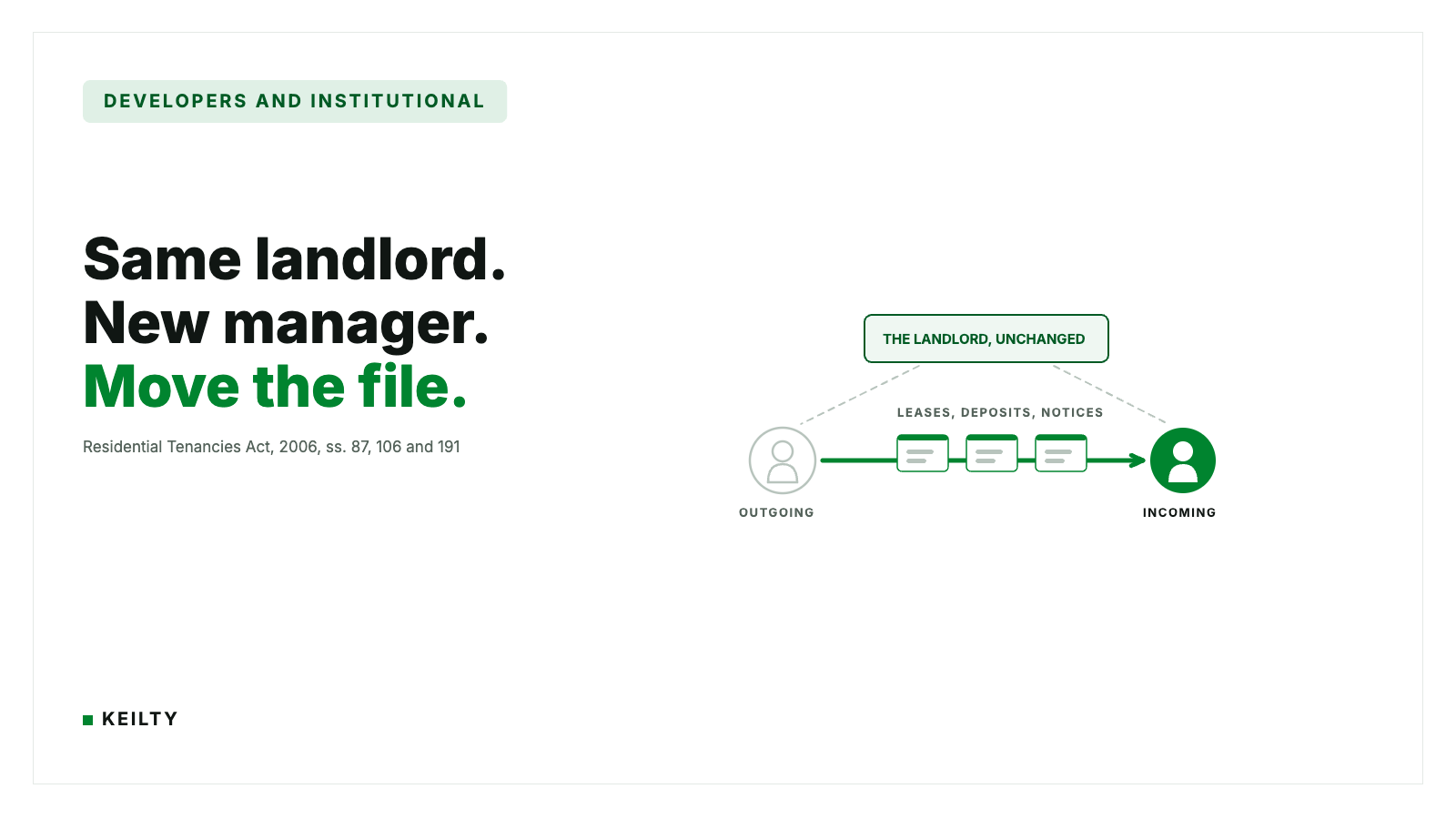
You switch property management companies on an apartment building by treating it as a records transfer first and a service change second. The tenancies do not change, the leases do not restart, and your Landlord and Tenant Board files stay yours, because you are still the landlord. What actually moves is the rent roll, the deposit register with its interest history, the rent increase history, the arrears aging, the in-flight LTB applications, the vendor and insurance files, and the keys. Get those across cleanly and residents barely notice. Miss one and you spend a year rebuilding a record you already paid for once.
Two pieces of vocabulary, because managers use them loosely and you will be reading both during the handover. The rent roll is the suite-by-suite schedule of every unit in the building, showing who occupies it or that it is vacant, on what lease term, at what rent, with what parking or storage attached. The arrears aging is the schedule that ages every unpaid charge from its due date, usually into current, 31 to 60, 61 to 90 and over 90 day buckets, so that a $400 charge from last week is not sitting in the same column as a $4,000 charge from last spring. Note that it ages charges, not people, so one resident's balance routinely splits across several buckets.
Those two documents, plus the deposit register and the rent increase history, are the transition. Everything else can be rebuilt in an afternoon. A rent roll with no lease copies behind it, or a deposit register with no dates on it, cannot be rebuilt at all, because the source documents are in a filing cabinet at an office you no longer have a relationship with.
So the transfer list is short and it is not negotiable: signed leases and any renewals for every occupied suite, the rent roll as at the transfer date, the arrears aging as at the transfer date, the deposit register showing the amount held and the interest history for each suite, the rent increase history for each suite showing the date of the last increase and every N1 served with its effective date, every open and recently closed LTB file with its file number, the vendor list with contracts and certificates of insurance, and the keys and fobs with a count that matches the suite list.
Because neither one can be rebuilt from a rent roll. A rent roll shows the rent being charged today. It does not show when that rent last moved, or what notice supported the move, and those are the two facts the next increase depends on.
Section 119(1) permits a landlord who is lawfully entitled to increase the rent to do so only if at least 12 months have elapsed since the day of the last increase for that tenant in that rental unit, or since the day the unit was first rented to that tenant where there has been no previous increase. Section 116(1) requires at least 90 days written notice of the intention to increase. Section 116(4) then supplies the consequence: an increase in rent is void if the landlord has not given the notice required by that section, and the landlord must give a new notice before the landlord can take the increase.
Put those together on a building where the N1 file did not come across. The incoming manager has two options and both cost money. Serve an N1 on a suite whose last increase was more recent than the record suggests, and the increase is not available under section 119(1). Or wait a full twelve months from the transfer date on every suite to be certain, and forgo a year of increases the owner was entitled to take. Ask for the increase history in the same breath as the deposits, and ask for it suite by suite with dates rather than as a summary.
Almost nothing, and that is the point most owners get backwards. The definition of landlord in section 2(1) of the Residential Tenancies Act, 2006 has three clauses. Clause (a) reaches the owner of a rental unit or any other person who permits occupancy of it. Clause (b) reaches that person's heirs, assigns, personal representatives and successors in title. Clause (c) reaches a person entitled to possession of the residential complex who attempts to enforce a landlord's rights, including the right to collect rent. Selling the building brings clause (b) into play, because a purchaser takes title. Hiring a different company to run the building puts nobody new on title, so clause (b) is not engaged. Whether a manager is caught by clause (a) or clause (c) on particular facts is a separate question the Act does not answer in the abstract. What does not change is the party named as landlord on the tenancy agreements. That is still you.
Three consequences follow, and each one is a place transitions go wrong.
The first is deposits. Section 106(1) permits a rent deposit only on or before entering into the tenancy agreement. There are narrow later routes, section 106(3) where the lawful rent has increased and section 106(5) for a new landlord buying from a person deemed to be a landlord under section 47(1) of the Mortgages Act, but a change of manager is neither. Nobody may require a sitting tenant to pay a fresh deposit because the letterhead changed. Section 134(1) points the same way, and section 134(2) extends the same prohibition to a superintendent, property manager or other person acting on behalf of a landlord, expressly "with or without the authority of the landlord". Note its opening words, "Unless otherwise prescribed", which is the hook by which the regulations under the Act permit a short list of charges that would otherwise be caught.
The second is how tenants pay. Section 108 says neither a landlord nor a tenancy agreement shall require a tenant or prospective tenant to provide post-dated cheques or other negotiable instruments for payment of rent, or to permit automatic debiting of their account at a financial institution, automatic charging of a credit card, or any other form of automatic payment for the payment of rent. Read the verb. You cannot require a resident to enrol in the incoming manager's pre-authorized debit system as a condition of anything. A resident who volunteers is a different matter, and most will, but the enrolment campaign has to be an invitation.
The third is service of documents. Section 191(1)(b) says a notice or document is sufficiently given to a landlord by handing it to an employee of the landlord exercising authority in respect of the residential complex. Whether a particular site person is your employee or your manager's turns on who actually employs them, which is worth knowing before the transfer rather than after. In practice, treat anything a resident hands to anyone in a KEILTY polo shirt as served on you, as internal policy rather than because the section says so, and get it scanned into the file the same day. A notice of termination that sat in a departing superintendent's truck for three weeks is a problem you cannot argue your way out of.
One more, and it is quiet. Section 12(1) requires every written tenancy agreement entered into on or after 1998-06-17 to set out the legal name and address of the landlord to be used for giving notices, and section 12(3) requires written notice of the same thing within 21 days after the tenancy begins where the agreement is not in writing. Section 12(4) gives that requirement teeth: until the landlord has complied, the tenant's obligation to pay rent is suspended and the landlord shall not require the tenant to pay rent. Section 12(5) restores the right to collect the withheld rent once the landlord complies.
Now apply that to a handover. If the address in your leases is the outgoing manager's office, and that office stops accepting mail on the transfer date, your residents have a stated address for service that no longer works. The Act does not spell out a re-notification procedure where a compliant address later goes dead, so treat that as practice: tell every resident in writing where to send notices now, and keep proof that you did.
The deposits stay where they legally always were, as a liability of the landlord. The risk is not that the money disappears. The risk is that the history disappears.
Section 106(6) requires a landlord to pay interest to the tenant annually on the rent deposit at a rate equal to the guideline determined under section 120 that is in effect at the time payment becomes due. Write the rule down that way rather than memorizing a number, because the number moves. Ontario's published guideline chart gives 2026 as 2.1% and 2027 as 1.9%, confirmed on ontario.ca on 2026-08-25. We covered the mechanics of that obligation, including the section 106(3) top-up and the section 106(7) deduction, in an earlier post on rent deposit interest.
Here is why the record matters more than the money. The LTB's own Form L1 instructions, dated July 2026, tell a landlord that the Board will subtract any rent deposit and interest owed from the arrears claimed, and that Part 4 asks for the amount currently held, the date the deposit was collected, and, where interest has been paid, the start and end dates of the last period for which it was paid. That is three data points per suite, on every future arrears application, for the life of the tenancy. If the outgoing manager hands you a spreadsheet with a dollar column and no dates, you have inherited a defect that surfaces one hearing at a time.
Put a number on it before you decide how hard to push. Assume a 120-suite community where 96 suites hold a rent deposit averaging $1,380. One year of interest at the 2026 guideline is $1,380 multiplied by 0.021, which is $28.98 per suite. Across those same 96 suites that is $2,782.08 for the year. That is not a catastrophe on its own. It is, however, an annual liability you are being asked to carry without documentation, and it recurs every year you do not fix it.
They continue, because the applicant has not changed. Part 3 of the L1 asks for the landlord's name and address, and where the landlord is a company, the company name. Part 7 asks the person signing to identify themselves as either the landlord or the landlord's representative. Your outgoing manager signed as your representative. The file is yours. What has to change is the representative and the contact information on it. The LTB publishes an information update form for the L1 and L9 on its forms, filing and fees page, so have the incoming manager work through every in-flight file in week one rather than discovering the gap when a hearing notice goes to an office nobody is watching.
The expensive part is not the open files. It is the ones that have not been filed yet, and specifically the former tenants.
Section 87(1) lets a landlord apply for arrears against a tenant or former tenant, and it carries two limbs that have to be read together. Clause 87(1)(b) requires, for a former tenant no longer in possession, that they ceased to be in possession on or after the day subsection 18(1) of Schedule 4 to the Protecting Tenants and Strengthening Community Housing Act, 2020 came into force. Section 87(1.1)(b) then sets the deadline: the application may be made no later than one year after the tenant or former tenant ceased to be in possession. The LTB's L1 instructions render both limbs in plain words, pointing landlords to the L10, the Application to Collect Money a Former Tenant Owes, where the tenant moved out on or after 2021-09-01, and stating that an L10 cannot be filed more than one year after the date the former tenant moved out.
That one-year clock does not pause for your transition. Every week the file transfer drags, a few of those claims quietly expire.
So give the incoming manager a triage rule for week one, and make it a rule you can audit. Pull any former-tenant file where possession ended more than nine months ago, or where the balance exceeds $2,000. Both branches earn their place. A file where possession ended eleven months ago carrying $1,200 is caught by the age branch and has roughly a month of statutory life left, even though the balance is modest. A file four months old carrying $3,100 is caught by the balance branch, because it is worth the effort regardless of how much time is left.
Assume that rule pulls 5 of 14 former-tenant files, and those 5 carry $9,400 between them. Filing an L10 costs $201, or $186 through the Tribunals Ontario Portal, per the LTB fee table read on 2026-08-25. Five filings through the Portal is 5 multiplied by $186, or $930. So on those same five files, $930 of filing fees stands against $9,400 of claims that expire if nobody looks. That is the decision, and it is not a close one. Note the comparison is five files against five filings, not five files against the whole book of fourteen.
Worth saying plainly: nothing here predicts what any adjudicator will do with any of those claims. The point is narrower. A claim you file inside the statutory window is a claim that is not out of time under section 87(1.1)(b). A claim you file outside it is. And an order is not money. A former tenant who has moved on may have nothing to collect against, which is a reason to file early rather than a reason not to file.
For residents still in the building, there are two routes to the same money and they rest on different documents. The L9 collects rent the tenant owes without ending the tenancy, and the LTB's L1 instructions note that an order on an L9 cannot then be used to evict. The L1 ends the tenancy and collects, and it requires you to have given an N4 Notice to End your Tenancy for Non-payment of Rent first, to have waited until the day after the termination date on that N4, and to have a Certificate of Service showing how and when the N4 was given. Per the LTB's L1 instructions, neither route is available once the tenant has moved out, at which point the former-tenant route above is the one that applies. During a transition the practical difference is documentary: the L9 rests on the rent ledger alone, while the L1 rests on the ledger plus a valid N4 and its Certificate of Service, which are exactly the documents that go missing in a handover. If the N4 file did not come across cleanly, the ledger-only route is still open to you while the incoming manager rebuilds the notice record.
This is where a legally tidy transition still goes sideways, because none of it is in the Act. Four items, all practice rather than statute.
Insurance first. Collect current certificates of insurance from every vendor working on the property, and confirm with your own broker that the policy on the building reflects the change in who manages it and who is named. Wording and notice requirements vary by insurer, so ask your broker what yours actually says rather than assuming.
Utilities second. Common-area hydro, gas, water and any bulk accounts have to be moved or re-authorized deliberately, with meter reads on the transfer date. An account that lapses in a mechanical room is a burst pipe waiting for a cold week. Take the readings even if nothing appears to be wrong, because those readings are the baseline your first budget-to-actual comparison will be measured against, in the sense we set out in what a monthly report on an apartment building should contain.
Keys and fobs third, and this is the one owners skip. Count them against the suite list, deactivate every fob nobody can account for, and record who holds master keys. A key register that does not reconcile is the cheapest thing to fix on day one and the most expensive to fix in month six.
Receipts fourth. Section 109(1) requires a landlord to provide, free of charge and on request, a receipt for payment of any rent, rent deposit, arrears of rent or any other amount paid to the landlord, and section 109(2) extends that to a former tenant who asks within 12 months after the tenancy terminated. Transitions generate receipt requests, because residents get nervous when the payee changes. Make sure the incoming manager can produce one for a payment made to the outgoing manager. If they cannot, you have found your records gap early, which is the best time to find it.
One charge does survive all of this, and it is easy to lose in a system migration. The LTB's L1 instructions state that the maximum administration charge for an NSF cheque allowed under the Act is $20 per cheque, on top of what your bank charged you. If the incoming manager's accounting setup does not carry that field, it stops being billed and nobody notices for a year.
The legal picture is identical and the workload compresses hard. On a ten-suite building one person can read every lease in an afternoon and count the fobs in twenty minutes, so the deposit register and the key reconciliation stop being projects and become a morning. What does not compress is the former-tenant clock under section 87(1.1)(b), because that runs per tenancy, not per portfolio. An owner with ten suites and two expiring claims is looking at the same arithmetic as an owner with two hundred and forty, just with fewer rows. If that is your building, our small multi-family page sets out how we handle it.
Then goodwill has stopped being a plan, and you need to know that your own obligations do not pause while the file sits on somebody else's desk.
Section 12(4) still suspends the tenant's obligation to pay rent until the landlord has complied with the name and address requirement, and the landlord in that sentence is you. Section 106(6) still requires deposit interest to be paid annually whether or not anyone can show you what was paid last year. Section 116(4) still voids an increase served without proper notice, whether or not you could see the increase history when you served it. None of those obligations has a clause suspending them while a records dispute runs.
So handle it before it happens. The records obligation belongs in the management agreement, in writing, with a delivery deadline, a defined format, a named recipient, and a holdback on the final management fee tied to delivery rather than to the termination date. If the deadline passes, escalate it in writing as a contractual matter rather than asking a fourth time. What you can and cannot compel turns on the agreement you signed, so that is the document to read first, and the point at which a lawyer is worth an hour.
Meanwhile, rebuild in parallel rather than waiting. Residents hold copies of their own leases, notices and receipts, and most will provide them if asked plainly. The bank record shows what was collected. Your own LTB file numbers can be looked up. A record you reconstruct in month one is worth more than a complete record you receive in month six.
Work backwards from the first rent due date after the transfer, not forwards from the day you sign. Residents need the new payment instructions and the new address for notices in hand well before that date, the deposit register and arrears aging need to be reconciled before the first collection cycle runs on the new system, and the former-tenant triage needs to happen in week one because it is the only part of the list with a statutory deadline attached. Everything else can slip a week without costing you anything.
Give the outgoing manager a written list, with a date, and a single point of contact on your side. Most transitions that go badly go badly because nobody wrote down what "complete" looks like, not because anyone refused.
If you are weighing a change of manager on an apartment building or a portfolio, KEILTY will walk the transfer list with you before you give notice to anyone. Start with our apartment communities page, or get in touch and we will talk through the building.
This post is general information about Ontario residential tenancy law as of 2026-09-18, not legal advice. Legislation, regulations and tribunal practice change. For advice on a specific property or situation, speak with a lawyer or licensed paralegal.
Ontario property management with published pricing, same-day answers, and no surprises. Since 2003.
300-80 Queen StreetNot served yet. Join a list and hear from us the day we open.