
By A.J. Keilty, President, KEILTY Realty Management
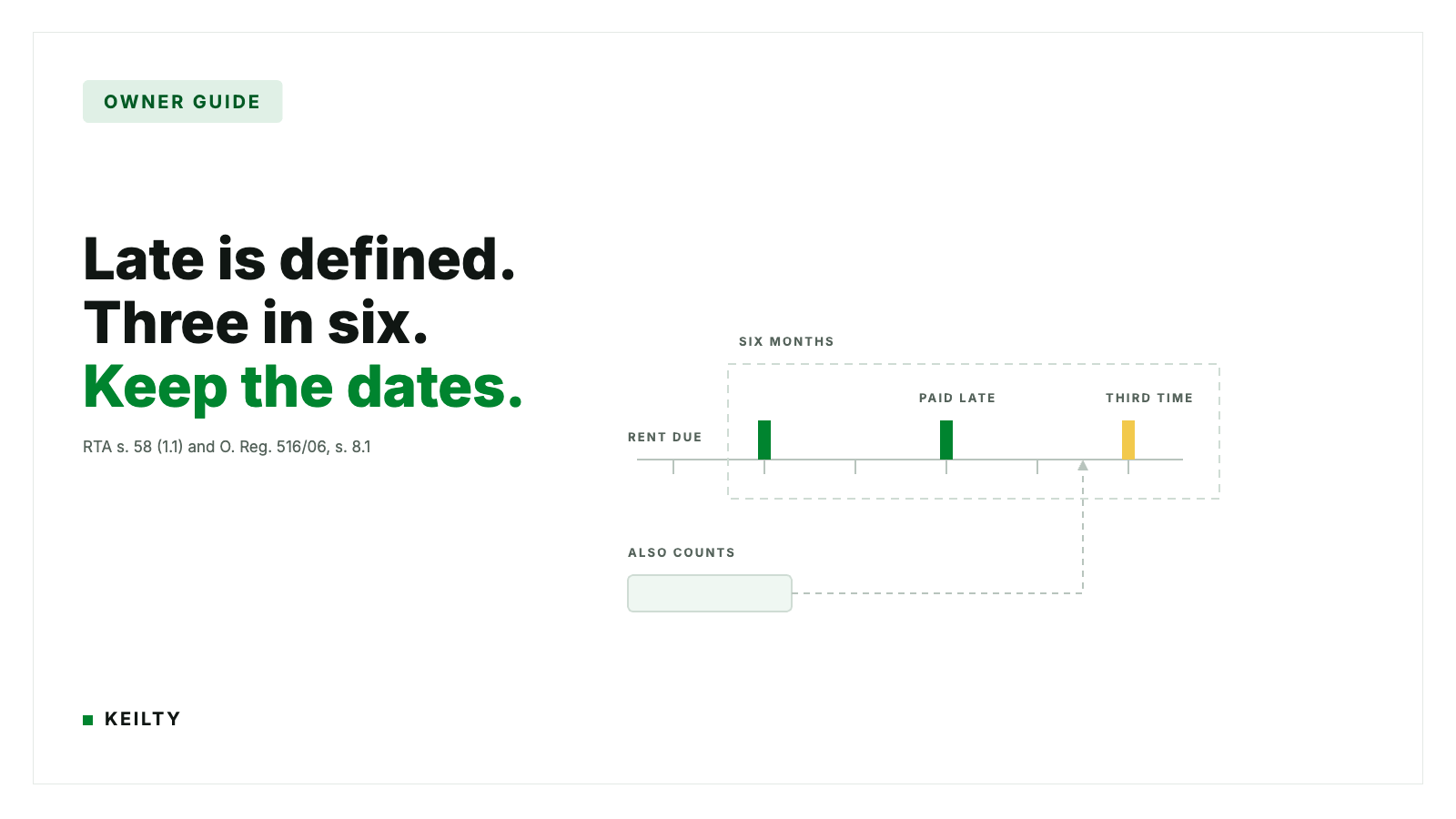
Since 2026-09-21 Ontario has a written floor for what counts as a tenant who is persistently late with the rent. A tenant who pays rent more than seven days after it is due, on at least three occasions in any six-month period, meets the prescribed test in section 8.1 of Ontario Regulation 516/06. That supports an N8 notice on the ground in paragraph 1 of subsection 58 (1) of the Residential Tenancies Act, 2006.
That is the useful part of the change, because it replaces an argument with a count. What it does not do is put a ceiling on the ground. The regulation says in terms that persistence can arise in other circumstances too, so three in six months is the safe harbour rather than the whole definition. Below is what the instruments actually say, what the numbers count, which form to serve, how long you have to file, and the one place where the Board has published nothing at all.
The short version.
The ground did not change. Paragraph 1 of subsection 58 (1) has read the same way since 2006 and is still credited 2006, c. 17, s. 58 (1) in the consolidation. What changed is how you prove it.
Before 2026-09-21 there was no written standard. A landlord put a payment history in front of the Board and argued that it showed a pattern. Since 2026-09-21 there is a number in a regulation, and a landlord who can show the number has something concrete to point at instead of an adjective.
The change arrived in two pieces on the same day. Subsection 58 (1.1) of the Act was added by the Fighting Delays, Building Faster Act, 2025, and section 8.1 of Ontario Regulation 516/06 was added under it. Neither piece works without the other, which is why a reader who opens only the Act finds a provision that appears to say nothing.
Is this you? If you own a rental in Kingston or Eastern Ontario and would rather not handle this yourself, KEILTY Realty Management manages it for a flat monthly rate. Tell us about the property and A.J. Keilty will call you within 20 minutes in business hours.
Section 58 carries the marginal heading "Notice at end of term or period, additional grounds". Subsection 58 (1) opens plainly: "A landlord may give a tenant notice of termination of their tenancy on any of the following grounds:". There are four grounds. The first is the one this post is about, and it reads in full: "The tenant has persistently failed to pay rent on the date it becomes due and payable."
Note the shape of that sentence. It is a verb formulation, not a defined term. Nothing in the Act tells you how many times, how late, or over what period.
Subsection 58 (1.1), under the marginal heading "Persistent late payment", is the new piece and it is one sentence: "For the purposes of paragraph 1 of subsection (1), what constitutes a persistent failure to pay rent on the date it becomes due and payable shall be determined in accordance with the regulations, if any."
Read the opening words rather than the heading. The Act does not define persistence and does not say "includes". It hands the question over: persistence "shall be determined in accordance with the regulations, if any". The closing words matter as much, because "if any" is what keeps the ground alive in a world where no regulation had been made.
Section 58 carries no not-yet-in-force notes. Its whole amendment history is two lines, 2016, c. 25, Sched. 5, s. 1 - 08/12/2016 and 2025, c. 14, Sched. 12, s. 3 - 21/09/2026. Everything else about the section is the same text a landlord would have read in 2007.
One oddity is worth naming, because it will confuse anyone who follows the citation chain. The regulation-making power in the Act, paragraph 13.0.2 of subsection 241 (1), is expressed to be "for the purposes of paragraph 1 of subsection 58 (1.1)", and subsection 58 (1.1) has no paragraphs. The regulation made under it, section 8.1 (1), cites "paragraph 1 of subsection 58 (1) of the Act", which is the paragraph that exists. The regulation has it right. The enabling provision does not.
Section 8.1 of Ontario Regulation 516/06 carries the marginal heading "Persistent failure to pay rent on the date due". Subsection (1) reads in full:
"For the purposes of paragraph 1 of subsection 58 (1) of the Act, a persistent failure to pay rent on the date it becomes due and payable includes circumstances in which a tenant has failed to pay rent within seven days of the date it becomes due and payable on at least three occasions within any six-month period and on each of those occasions the failure to pay was not solely attributable to the landlord applying a rent payment made during that six-month period to another amount owing by the tenant, including rent arrears."
Three numbers, and each of them counts something different.
Seven days measures how late a single payment was. It runs from the date the rent became due and payable, which comes from the tenancy agreement, not from the Act. A payment made on the seventh day is inside the seven days. The Board's own N8 instructions describe the qualifying payment as one made "more than seven days after the due date", which is the same line drawn from the other side.
Three occasions is the count of qualifying late payments. It is expressed as "at least three", so three is the floor and a fourth does not weaken it.
Six months is the window the three have to fall inside. The wording is "within any six-month period", which is a floating window rather than a fixed one anchored to a lease anniversary or a calendar half-year.
A worked example, on a monthly tenancy in Port Hope with rent due on the first of each month. Rent for March 2026 was due 2026-03-01 and paid 2026-03-11, ten days late. Rent for June was due 2026-06-01 and paid 2026-06-09, eight days late. Rent for August was due 2026-08-01 and paid 2026-08-12, eleven days late. Each of the three is more than seven days late, and all three fall inside the window 2026-03-01 to 2026-08-31. Nine other months elsewhere in the same twelve-month file were paid on time, and on the face of section 8.1 (1) that does not matter, because the provision counts qualifying failures rather than a proportion.
Two of those three due dates fell on a weekend, 2026-03-01 being a Sunday and 2026-08-01 a Saturday. The counting rules in sections 88 and 89 of the Legislation Act, 2006 are about time limits, and section 46 of that Act applies its interpretation provisions to "every Act and regulation" and to nothing else. The day rent becomes due and payable comes from the tenancy agreement rather than from a time limit in a statute. Our own reading is that a weekend does not move the due date, and that is the assumption we work on.
It is a reading of the provisions rather than something either instrument states outright, so it is worth stating your position on the application rather than leaving it to be inferred.
This is the carve-out inside section 8.1 (1). It decides whether a month you think you can count actually counts.
A qualifying occasion requires that "the failure to pay was not solely attributable to the landlord applying a rent payment made during that six-month period to another amount owing by the tenant, including rent arrears". In other words, if the tenant handed over the money on time and the lateness only appeared because you took that money and applied it to something else they owed, that month does not count toward the three.
The Board puts it in plainer words in the N8 instructions: "However, a late payment does not count if it happened only because you applied a rent payment to another amount the tenant owed, such as rent arrears."
Two things about that carve-out are worth noticing. The word is "solely", so a month that was late for two reasons, one of them your allocation and one of them the tenant, is not automatically excluded. And the payment being applied has to have been made "during that six-month period", so an allocation of money received before the window opened is outside the carve-out on the face of the text.
Neither the Act nor the regulation defines "rent arrears". The phrase appears exactly once in the whole of Ontario Regulation 516/06, inside section 8.1 (1) itself, and it is used rather than defined. A landlord whose ledger nets everything into a single running balance will find that hard to unpick at a hearing, which is an argument for keeping rent, damage recoveries and any other charges on separate lines from the start.
Only the floor, and the regulation says so twice in one sentence. Section 8.1 (2) reads in full:
"For greater certainty, a persistent failure to pay rent on the date it becomes due and payable may arise in circumstances not set out in subsection (1) and the circumstances set out in subsection (1) shall not limit what may constitute a persistent failure to pay rent on the date it becomes due and payable."
That is an affirmative statement that other circumstances can qualify, followed by a direction not to read subsection (1) as exhaustive. Subsection (1) uses "includes" rather than "means", which points the same way.
The Board's Operational Update of 2026-09-21 says the same thing in a single line: "A tenant may also be found to have persistently failed to pay their rent on the date it became due in other circumstances."
There is a tension here that a careful reader will find, and it is better to name it than to paper over it. Subsection 58 (1.1) of the Act says persistence "shall be determined in accordance with the regulations". The regulation then says the prescribed circumstances "shall not limit" what may constitute persistence. A regulation that prescribes a set of circumstances and then declines to limit the question is doing something less than determining it.
Our reading is that section 8.1 (1) gives a landlord a route that does not depend on persuading anybody what "persistent" means, while leaving the older case-by-case route open for a pattern that does not fit the numbers. That is a reading of the two provisions together rather than something either one states.
The practical consequence is one-directional. If your file meets the three-in-six count, you have the strongest version of this ground available. If it does not, you have not lost the ground, and you are back to arguing a pattern in the way landlords did before 2026-09-21.
Nothing in section 8.1, section 58 or the Act anchors the six-month window. The phrase is "within any six-month period", with no specified starting day.
The general counting rules are in Part VI of the Legislation Act, 2006, and section 46 of that Act provides: "Every provision of this Part applies to every Act and regulation." So they reach a regulation under the Residential Tenancies Act, 2006 unless a contrary intention appears.
The two rules that would normally do this work do not fit cleanly. Subsection 89 (3) provides: "A reference to a number of days between two events excludes the day on which the first event happens and includes the day on which the second event happens, even if the reference is to “at least” or “not less than” a number of days." That is a rule about days between two events, and "within seven days of" a due date is not literally expressed that way. That is a rule about days between two events.
Subsection 89 (6) is the months rule, and it opens "If a period of time is described as a number of months before or after a specified day", which a floating six-month window does not have.
So the honest answer is that neither instrument tells you how to anchor the window, and there is no Board guidance that does either. What we do on our own files is straightforward and we would rather say what it is than imply the question is settled. We count the seven days by excluding the due date and including the day the payment was received, which is the approach subsection 89 (3) takes and the one the Board's own wording reflects. We then look for any span of six consecutive months containing three qualifying failures, and we set out that span expressly on the application rather than leaving the Board to find it.
One drafting detail supports counting to receipt rather than to the date on a cheque. The Operational Update describes the test as the rent being "received more than seven days after the due date". A postmark is not a payment.
The notice is an N8. The forms page calls it "N8 – Notice to End your Tenancy at the End of the Term" and the Board's own brochure calls it "Form N8 – Notice to Terminate a Tenancy at the End of a Term", so check the title on the file you actually downloaded rather than on a summary of it. It is not an N4, and the two are not interchangeable.
An N4 is served under section 59 for rent that is owing now, and since 2026-09-21 it runs seven days for every tenancy. An N8 is served under section 58 for a pattern of lateness, and the rent may well be fully paid by the time you serve it. We deal with the N4 route and what a tenant can raise in response to it in what a tenant can raise at an arrears hearing. The N8 also sits alongside the other end-of-term notices, which we set out in whether a landlord can refuse to renew a lease.
Subsection 58 (2), under the marginal heading "Period of notice", sets the termination date: "The date for termination specified in the notice shall be at least the number of days after the date the notice is given that is set out in section 44 and shall be the day a period of the tenancy ends or, where the tenancy is for a fixed term, the end of the term."
There are two requirements in that sentence and both have to be satisfied. Section 44 supplies the minimum number of days, and the date also has to land on the end of a period or the end of the term.
Section 44 gives 28 days for a daily or weekly tenancy under subsection 44 (1), and 60 days for a monthly tenancy under subsection 44 (2), a yearly tenancy under subsection 44 (3) and a fixed term under subsection 44 (4). Each of those subsections also requires the date to fall on the last day of a rental period, or on the expiration date specified in the tenancy agreement for a fixed term. Subsection 44 (5), the February and March saver, applies by its terms to "A tenant who gives notice", so it is no help to a landlord.
Worked through on the Port Hope file, with a monthly tenancy running from the first to the last day of each month. An N8 given on 2026-10-05 has to specify a termination date at least 60 days later, which takes you to 2026-12-04 at the earliest, and that date also has to be the last day of a rental period. The first date that satisfies both is 2026-12-31. From 2026-10-05 to 2026-12-31 is 87 days, comfortably clear of the minimum.
Add the deemed service rules on top of that if you are not handing the notice over in person. Service, deemed dates and the five-day mail rule are their own subject and we set them out in how to serve a notice to a tenant in Ontario. The date the notice is "given" is what section 58 (2) counts from, and on a mailed notice that is not the day you put it in the envelope.
Interpretation Guideline 10 states the consequence of getting this wrong in one sentence: "If a shorter notice period is given than is required, the application will be dismissed."
The current one, and the Board makes that harder to confirm than it needs to be.
The N8 was reissued on 2026-09-21. The form posted today carries the footer "N8 (2026/09) © King's Printer for Ontario, 2026", and its instructions are now an HTML page stamped "Updated: September 21, 2026" rather than a dated PDF. The instructions cite section 8.1 of Ontario Regulation 516/06 by name and set out the three-in-six test in plain language, which makes them the fullest statement of the test the Board has published.
What the forms page does not do is tell you any of that. The N8 row carries no version column, no date column, no "new" badge and no "in effect on" note, and it is visually identical to rows whose instruction PDFs are still dated 2015. The only signal on the page is a general Important Notice block at the top, dated September 21, 2026, that links the Operational Update.
There is a deadline attached. The Operational Update lists the forms updated and replaced on 2026-09-21, and the N8 and the L2 are both on the list. It then says: "Previous versions of these forms will no longer be accepted as of November 30, 2026."
Read that carefully, because it is a filing-acceptance rule rather than a validity rule, and it has a trap in it. Between now and 2026-11-30 the older form is still accepted. After that date, a landlord who serves on a stale copy and then files is looking at a rejected filing, and by the time that is sorted out the 30-day window in the next section may have closed. The practical instruction is the same one we give on every form: open the form from the Board's website on the day you serve it, rather than from a copy saved on your own machine. A saved copy looks identical and is not.
The application is an L2, which the forms table titles "L2 – Application to End a Tenancy and Evict a Tenant or Collect Money". The filing fee is stated on the fee page as "$201 or $186 through the Tribunals Ontario Portal", and the same page says four separate times: "Please note that LTB fees are non-refundable."
Subsection 69 (1) lets a landlord apply once notice has been given. Subsection 69 (2) then sets the limit: "An application under subsection (1) may not be made later than 30 days after the termination date specified in the notice."
Subsection 69 (3) creates an exception: "Subsection (2) does not apply with respect to an application based on the tenant's failure to pay rent." That exception is drafted for the arrears route.
The Board reads the 30-day limit as applying to everything else, and Rule 6.9 of its Rules of Procedure says so in its own words: "An application to terminate a tenancy and evict a tenant will not be accepted if filed more than 30 days after the termination date in the notice, unless it is an application based on the tenant's failure to pay rent." Interpretation Guideline 10 states the consequence differently again, saying such an application "will be dismissed" where Rule 6.9 says it will not be accepted. So plan on 30 days.
Section 46 (1) of the Act is the other half of it: "A notice of termination becomes void 30 days after the termination date specified in the notice unless, (a) the tenant vacates the rental unit before that time; or (b) the landlord applies for an order terminating the tenancy and evicting the tenant before that time." Rule 6.9 is about what the Board will accept. Section 46 (1) is about whether you still have a notice at all.
There is one route back if you are out of time, and it is not one to plan around. Subsection 190 (2) provides that the Board "may extend or shorten the time requirements with respect to any matter in its proceedings, other than the prescribed time requirements, in accordance with the Rules", and Rule 16.1 sets out how to ask. That is the thing to try after the fact. It is not a substitute for the date.
There is no remedy period on an N8 and no voiding by payment. Rule 6.8, which bars filing during a seven-day remedy period, is keyed to sections 62, 64 and 67, which are the N5, N6 and N7 notices. Section 70 of the Act bars an early application only on a notice under section 62, 64 or 67.
Section 71 then provides that a landlord who has served a notice of termination may apply immediately, subject to section 70 and subsection 74 (1). The N8 instructions say the same thing in the Board's words: "You can apply to the LTB for an order to terminate the tenancy immediately after giving the notice to the tenant." A tenant cannot pay the pattern away the way an N4 can be voided under section 59 (3).
Now the counting, because the two instruments that govern this deadline do not define a holiday the same way. Carrying the worked example on, a termination date of 2026-12-31 puts the 30-day limit at 2027-01-30, which is a Saturday. Under subsection 88 (2) of the Legislation Act, 2006, Sunday is a holiday and Saturday is not, so the statutory limit in subsection 69 (2) expires on the Saturday. Under Rule 1.1 of the Board's Rules, a holiday includes any Saturday, and Rules 1.12 to 1.14 would carry a deadline computed under the Rules to the following Monday, 2027-02-01. Rule 1.16 provides that those rules may not be waived or varied.
So the two routes land on different days unless subsection 89 (2) of the Legislation Act, 2006 closes the gap, and subsection 89 (2) only bites where the place for filing "is not open during its regular hours of business". That is a live question for a Portal that takes filings around the clock. Do not test it. File before the weekend, which on this example means 2027-01-29, and there is no upside in the last two days.
Two more filing rules are worth knowing before you start. Rule 4.4 requires the notice of termination, any affidavit and the certificate of service to be uploaded at the time of filing on the Portal. Rule 4.5 gives five calendar days to supply them if they could not go up with the application, and warns that failure "may result in administrative dismissal of the application". Rule 6.10 provides that an application which is incomplete because it does not include documents required by the Act, the regulations or the Rules "will not be accepted".
It is a ledger, and on this ground the ledger is the case. What the Board is being asked to find is arithmetic: a due date, a receipt date, and the gap between them, repeated.
That puts Rule 19 at the centre of the file. Rule 19.1 requires every party to provide the other parties and the Board with a copy of all documents and other evidence they intend to rely on "at least 7 days before the CMH or hearing", the CMH being a case management hearing. It has to go by one of the methods of service in the Act or Rule 3. Rule 19.2 gives the other side five days for responding evidence. Rule 19.7 provides that a party who fails to comply "may not rely on the evidence that was not disclosed as directed or ordered, unless otherwise ordered".
Read together, that means a landlord who brings the payment history to the hearing rather than serving it a week earlier may be at a hearing with no evidence at all. Rule 19.1.1 adds that uploading to the Portal is not a permitted method of providing evidence to another party unless that party has consented in writing.
Build the ledger so it answers section 8.1 (1) line by line. One row per month, with the date rent became due, the date the payment was received, the gap in days, and a separate column recording what any payment was applied to. That last column is the one that decides the carve-out, and it is the column a single running-balance ledger does not produce.
The L2 is titled "or Collect Money" for a reason, and on a persistently late file that second half is worth using. The same application can carry the bank and administration charges for any NSF cheques, unpaid utility costs, damage, and compensation under section 86 of the Act for each day the tenant stays past the termination date. Those all come off the same ledger you are already building.
There is a trade-off in doing it, and it is worth naming before you tick the box. Subsection 82 (1) of the Act is expressly confined to a hearing of an application "based on a notice of termination under section 59", which is the N4, and Rule 19.4 is keyed to sections 82 (1) and 87 (2). So a tenant on an N8 file with no money claim attached faces no payment precondition before raising maintenance or tenant-rights issues, and no advance-notice requirement under section 82 (2) either. Attach an arrears claim under section 87 and subsection 87 (2) applies section 82 with necessary modifications, which brings that machinery back into a file that would otherwise be free of it.
One more provision answers the question every owner asks during the 90 days between serving an N8 and filing. Section 45 provides that unless the parties agree otherwise, a landlord does not waive a notice of termination, reinstate a tenancy or create a new tenancy by giving a notice of rent increase or by accepting arrears of rent or compensation for use and occupation after the notice is given. Carrying on collecting the rent does not undo the notice.
And if your file does not meet the count, section 202 (1) is where the older route lives. It requires the Board to ascertain the real substance of all transactions and activities relating to the unit, and provides that the Board "may have regard to the pattern of activities relating to the residential complex or the rental unit". That is the provision a pattern argument runs on when the numbers do not reach three.
Yes, and the prescribed test does nothing to change that. Section 83 is untouched by the count.
Subsection 83 (1) provides that on an application to evict, the Board may, "despite any other provision of this Act or the tenancy agreement", refuse the application under clause (a) "unless satisfied, having regard to all the circumstances, that it would be unfair to refuse", or under clause (b), "subject to any prescribed limitations or conditions", postpone enforcement. Subsection 83 (2) makes the inquiry mandatory where there is a hearing: "If a hearing is held, the Board shall not grant the application unless it has reviewed the circumstances and considered whether or not it should exercise its powers under subsection (1)."
The words "subject to any prescribed limitations or conditions" in clause (b) are new as of 2026-09-21, and section 8.4 of Ontario Regulation 516/06 is what they let in. Section 8.4 provides that the Board may postpone enforcement "only if the landlord consents to the postponement or if the following conditions are satisfied". An application founded on an N8 falls within its paragraph 2. That paragraph requires both that postponement "would not be unfair to the landlord or other tenants of the residential complex to postpone the enforcement of the eviction order" and that "there are compelling grounds to postpone the enforcement of the eviction order".
Note what that gate does and does not reach. It constrains postponement under clause 83 (1) (b). It says nothing about refusal under clause 83 (1) (a), which is unchanged.
Subsection 83 (3), under the marginal heading "Circumstances where refusal required", goes further than discretion. Where the Board is satisfied that one of the listed circumstances exists, beginning with a landlord in serious breach of their own responsibilities under the Act or of a material covenant in the tenancy agreement, it shall refuse the application. That is a mandatory refusal, and the count does not touch it either. We set out the whole of that regime in whether the LTB can still delay or refuse your eviction.
There is a specific reason this matters on a persistent late payment file. Interpretation Guideline 7 gives conditional relief on exactly this ground as one of its worked examples: "If a tenant persistently failed to pay rent on the date it became due because they lost their job, and the tenant recently found a new job, eviction may be refused on the condition that rent is paid in full and on time for a number of months following the hearing." So meeting the count establishes the ground. It does not close the file.
The instruments do not say, and we are not going to pretend otherwise.
There is no transitional provision anywhere for subsection 58 (1.1) or for section 8.1. The word "transition" in Ontario Regulation 516/06 appears only in sections 61 to 64, all of them about the Tenant Protection Act, 1997 and the Rental Fairness Act, 2017. The amending regulation's only closing section is a commencement section. And the new transition-regulation power in section 241.5 of the Act, which lets the Lieutenant Governor in Council preserve old provisions for specified circumstances, has not been exercised.
The contrast with section 82 is the part worth carrying away. When the same package changed what a tenant may raise at an arrears hearing, it added subsections 82 (4) and (5) expressly preserving the old law for applications made before 2026-09-21 and not finally determined. The drafter knew how to write a transitional rule and wrote one there. The silence at section 58 is a choice rather than an oversight.
Two arguments run off that silence and both are available. On one side, the ground in paragraph 1 of subsection 58 (1) is not new and was never amended; only the method of determining persistence is new, which points to section 8.1 applying to a notice given on or after 2026-09-21 whenever the underlying payments happened. On the other side, section 8.1 attaches consequences to past conduct, and the section 82 precedent shows the drafter preserving old law where it meant to.
What we do is set out the payment history in full and identify the qualifying occasions expressly, rather than reaching back quietly and leaving the point to surface at the hearing. If every one of your three occasions falls after 2026-09-21, the question does not arise at all. On a monthly tenancy that is a file you can have by the spring.
The same package built a mirror, in the same words, for non-profit housing co-operatives.
Subsection 94.2 (2.1) of the Act was added on 2026-09-21 under the same marginal heading, "Persistent late payment", and defers in the same way: "For the purposes of paragraph 1 of subsection (1), what constitutes a persistent failure to pay the regular monthly housing charges on the date they became due and payable shall be determined in accordance with the regulations, if any."
The regulation side sits in a new Part II.1 of Ontario Regulation 516/06, "Matters Related to Non-Profit Housing Co-operatives", at section 17.1. The numbers are identical: within seven days, at least three occasions, any six-month period, with the same carve-out for a payment the co-operative applied to another amount owing. Section 17.1 (2) carries the same "for greater certainty" saver.
The wording differs only where the subject does: "member" for tenant, "regular monthly housing charges" for rent, "the non-profit housing co-operative" for the landlord, and "including arrears of regular monthly housing charges" for "including rent arrears". The notice period on that side is set by section 94.4, which requires a termination date not earlier than the 60th day after the notice is given, on the last day of a period of occupancy.
One asymmetry is worth flagging for anyone working both sides. The postponement gate for co-operatives, section 17.2, requires compelling grounds in every case, where section 8.4 carves out applications founded on sections 48, 49 and 50 from that requirement. The co-operative version is the stricter of the two.
There is no Interpretation Guideline on it, and that is not a figure of speech.
The Board publishes a set of Interpretation Guidelines, numbered 1 to 19 and then 21. No guideline mentions the N8, section 58, termination at the end of the term, or section 8.1 of Ontario Regulation 516/06. The word "persistent" appears once in the whole set, in the Guideline 7 example quoted earlier in this post, and it is there as an illustration of relief from eviction rather than as a statement of the test. That was true before 2026-09-21 as well, so this is a standing gap rather than a new one.
The Operational Update of 2026-09-21 makes the gap visible in its own structure. Almost every substantive item in it carries an "Updated" bullet naming a document the Board revised: Guideline 7, Guideline 10, Guideline 11, Guideline 12, the N4 form, the Rules of Procedure, the Practice Direction on Evidence and five brochures. The persistent late payment section carries prose and nothing beneath it.
Two of the guidelines that were touched leave the position untidier than it needs to be. Guideline 7 was genuinely updated for 2026-09-21 and now sets out the section 8.4 postponement gate, and it carries a caveat warning that some of its examples rest on decisions made before section 8.4 came into effect on 2026-09-21 and may no longer be applicable. That caveat is not attached to the persistent late payment example quoted earlier in this post, which stands unqualified. Guideline 10 is listed in the Operational Update as updated and still prints "December 15, 2018 - Updated September 2025" at its foot, with no reference to 2026 anywhere in it.
So the practical answer to "where do I read about this" is the regulation, the N8 instructions, and the Board's brochure How a Landlord can End a Tenancy, whose Table 16 sets out the same three-in-six test and was itself updated on 2026-09-21. None of the three is an Interpretation Guideline. The instructions and the brochure are good. They are also a form's instructions and a brochure, which is not where a landlord thinks to look for a legal test.
One last number, because it governs how long any of this takes. The Board's own key performance indicators for the reporting period April 1, 2025 to March 31, 2026 show cases meeting the 90-day lifecycle target at 51, 53 and 52 per cent across the three reported quarters, against a target of 80 per cent.
Read that row carefully. It covers English applications only, it excludes L5 and A4 applications, and the French and bilingual equivalents for the same three quarters are 32, 37 and 39 per cent. The page never names the L2. They are still the only published numbers, and they say that about half of English files do not close inside 90 days. An N8 on a monthly tenancy has a 60-day notice period in front of it before anything is filed at all.
How many late payments does it take? At least three failures to pay within seven days of the due date, in any six-month period, under section 8.1 (1) of Ontario Regulation 516/06. That is the prescribed floor, in force since 2026-09-21.
Does a tenant who is always late but always pays still count? Yes, if the lateness meets the count. The ground in paragraph 1 of subsection 58 (1) is about paying late, not about owing money, and the rent can be fully paid when the notice is served.
Can a tenant pay to cancel an N8 the way they can void an N4? No. There is no voiding provision for a section 58 notice and no remedy period, and the N8 instructions say a landlord may apply immediately after giving the notice.
How long does the N8 have to run? On a monthly tenancy, at least 60 days under subsection 44 (2), and the termination date also has to be the last day of a rental period under subsection 58 (2). A daily or weekly tenancy is 28 days.
What happens if I file the L2 late? Subsection 69 (2) provides that an application may not be made later than 30 days after the termination date specified in the notice, and Rule 6.9 says such an application will not be accepted. Section 46 (1) also voids the notice itself 30 days after the termination date. Subsection 190 (2) and Rule 16.1 let you ask the Board to extend time, but the practical answer is a fresh notice and a fresh notice period.
If you would rather not run a payment ledger against a regulation every month, that is what we do. Talk to us about what managing the property would look like.
This post is general information about Ontario residential tenancy law as of 2026-09-23, not legal advice. Legislation, regulations and tribunal practice change. For advice on a specific property or situation, speak with a lawyer or licensed paralegal.
Ontario property management with published pricing, same-day answers, and no surprises. Since 2003.
300-80 Queen StreetNot served yet. Join a list and hear from us the day we open.