
By A.J. Keilty, President, KEILTY Realty Management
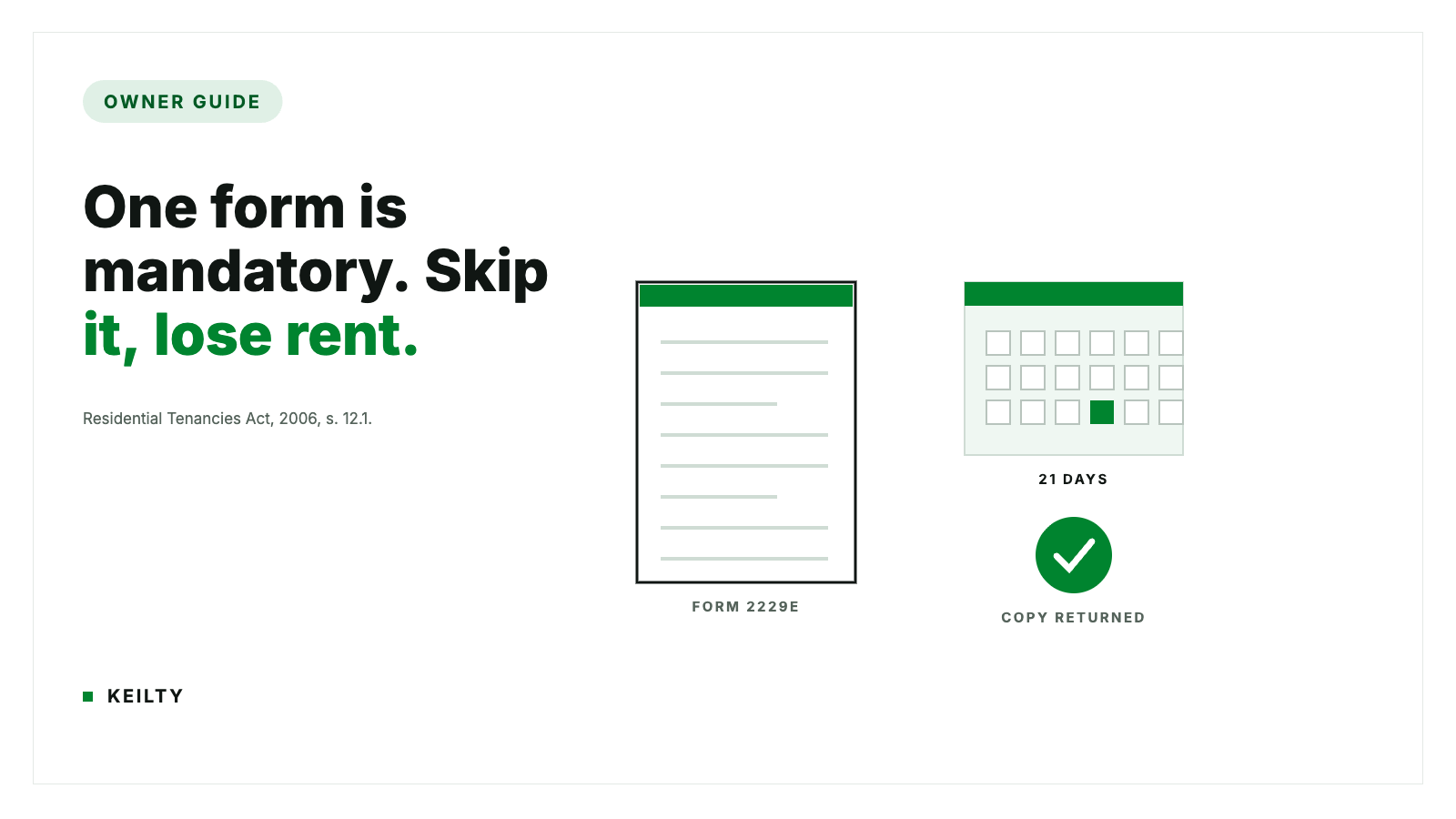
Yes. For almost every private residential tenancy entered into on or after 2018-04-30, Ontario law requires the government's Standard Form of Lease, Form 2229E. If you use your own lease instead, the tenancy is still perfectly valid and rent is still owed, but the tenant picks up two remedies: after demanding the standard lease in writing and waiting 21 days, they can hold back up to one month's rent, and they can end a fixed term early on at least 60 days' notice.
There is also a separate and larger exposure that has nothing to do with which form you used. If you never gave the tenant a signed copy of the agreement, the obligation to pay rent is suspended entirely until you do, with no one month cap. What follows is both risks in order, who is genuinely exempt, what you can still add to the form, and the mistakes we see most often on leases owners filled out themselves.
It is a fill-in-the-blanks contract published by the Ministry of Municipal Affairs and Housing. Seventeen numbered sections cover the parties, the unit, the term, the rent and what it includes, deposits, smoking, insurance, maintenance, assignment and subletting, and signatures. The requirement comes from section 12.1 of the Residential Tenancies Act, 2006, and the class of tenancies it applies to, plus the 2018-04-30 start date, come from O. Reg. 9/18, sections 1 and 2. The ministry also publishes a plain-language Guide to Ontario's standard lease.
Use the right version. The current lease is 2229E (2020/12), required for tenancies entered into on or after 2021-03-01. If your template still says 2018/01, replace it. Both versions sit side by side in the Central Forms Repository, which is how owners end up filing the wrong one for years.
Two more things about the form catch owners off guard. Some sections cannot be edited at all: sections 12, 13 and 14, covering changes to the unit, maintenance and repairs, and assignment and subletting, are fixed text. And using the wrong form does not undo the tenancy. Under s.12.1(11) an agreement is not void, voidable or unenforceable just because it fails to comply, so nobody gets a free exit from a deal they made.
Narrower than most owners assume, and the operative list is in O. Reg. 9/18 s.1 rather than in the ministry's summary. The prescribed class covers every tenancy the Act applies to except tenancies of:
Those last two categories are what the ministry's "certain other special tenancies" is actually hiding, and they matter to anyone operating an RGI unit.
Now the one that catches Kingston owners. A basement apartment is normally not exempt, but if the occupant has to share a bathroom or kitchen with the owner, or the owner's spouse, child or parent, and that person lives in the building, RTA s.5(i) takes the arrangement outside the Act completely. No Act, no standard lease obligation. A self-contained basement unit with its own kitchen and bathroom is a different animal and needs the form. A single detached house rented to a family needs it. A condo needs it, though the lease has a spot to note the condominium declaration and rules. A student rental in Kingston or Peterborough needs it.
Being outside the standard lease requirement is also not the same as being exempt from rent control, which is a separate test built around the unit's first occupancy date. We covered that in Is My Rental Unit Exempt from Rent Control in Ontario?. Either way, a lease can never sign away a right in the Act.
Nothing happens automatically. There is no inspector, no fine in the mail, no invalid tenancy. The consequence is that the tenant holds a set of levers and chooses when to pull them. That usually happens once the relationship has already gone sideways, which is the worst possible timing from an owner's point of view.
Before the standard lease question, deal with section 12 of the Act, because the number attached to it is bigger. A written tenancy agreement has to set out the landlord's legal name and address for giving notices, under s.12(1). Under s.12(2) you have to give the tenant a copy of the agreement, signed by both of you, within 21 days after the tenant signs it and gives it to you.
Miss either one and s.12(4) does something blunter than any remedy in s.12.1: the tenant's obligation to pay rent is suspended, and you shall not require the tenant to pay rent, until you comply. There is no one month ceiling on that. Under s.12(5) you can require the withheld rent once you have complied, so the money is recoverable, but until then you are running a rental with no enforceable rent. That is the real reason the notice address in section 3 of the lease matters, and it applies whether or not you used Form 2229E.
Under s.12.1(5) the tenant may, once during the tenancy, demand in writing that you provide a proposed standard lease for signature. The section requires only that the demand be in writing. It does not have to be served the way a notice under the Act is served, so an email or a text message starts the 21 days whether or not your lease says anything about email. Owners who wait for something formal are watching the clock run.
The once-per-tenancy limit is worth knowing. A tenant cannot re-arm this remedy every few months. And if you provide the lease, most of the exposure disappears, which is why a demand should be a same-week task rather than an argument.
If at least 21 days have passed since the demand and you have not complied, s.12.1(6) lets the tenant withhold rent that becomes due after that 21 day period. Two limits sit right beside it: s.12.1(7) caps the total at one month's rent, and s.12.1(8) stops any further withholding from the day you comply.
Then the clock runs the other way. Under s.12.1(9) you may require the withheld rent back only if you comply with the demand no later than 30 days after the date of the first withheld payment. Comply inside that window and s.12.1(10) says you can require the money even if the tenant never signs the lease you provided. Miss the window and the month is gone for good, while all other rent stays payable.
On a house in Kingston renting at $2,900, that is $2,900 gone because a form was not filled out. On a four-unit building in Belleville where every tenancy sits on a handwritten agreement, the exposure is four times one month's rent, once per tenancy.
Think twice before filing an N4 in this situation. Section 12.1(9) permits you to require withheld rent only if you complied inside the 30 days, so where you did not comply, the money you would be claiming as arrears is money you are not entitled to require. An application built on that number is a weak application, and it puts your paperwork failure in front of the Board.
This is the remedy owners rarely see coming, and it lives in s.47.0.1 rather than s.12.1. A tenant who has made a demand under s.12.1(5) can end a yearly or fixed term tenancy early in either of two situations: 21 days have passed and you have not complied, under s.47.0.1(1)(b)(i), or you did comply and the tenant simply did not sign the lease you provided, under s.47.0.1(1)(b)(ii).
The mechanics are specific. Under s.47.0.1(2) the notice has to be given no later than 30 days after you provided the proposed lease. Under s.47.0.1(3) it must give at least 60 days and the termination date has to fall on the last day of a rental period.
Read that again if you signed a 12-month term for the security of 12 months of rent. The term becomes roughly 60 days at the tenant's option. If they use it in November, you are marketing a vacant unit into the slowest leasing weeks of the Ontario calendar, and a January vacancy in Cornwall or Napanee costs real money. Our vacancy loss calculator puts a daily figure on that.
Yes, and this is the part owners get wrong in the other direction. They assume the standard lease strips out anything specific to their property, so they run a second private agreement on the side. There is no need.
Section 15 is for additional terms. Attach them, write them in plain language, keep typed text at 10 point or larger, and be concrete about what someone must or must not do. Workable additional terms include quiet hours, rules for a shared laundry room or driveway, snow clearing and lawn responsibilities in a single family rental, whether a barbecue is allowed on a balcony, and how a shared garage gets used. Section 10 lets you set rules about smoking inside the unit. Section 11 lets you require the tenant to carry liability insurance and to show proof when asked.
Any additional term that takes away a right or responsibility under the Act is void and cannot be enforced. The tenant's signature does not rescue it. The ministry's own examples include terms that:
Those four account for most of the void clauses we find when we take over management of a small portfolio. For the detail, see Can a Landlord Say No Pets in Ontario? and Can You Charge a Damage Deposit in Ontario?. A void clause is worse than no clause, because it teaches a tenant that the rest of your paperwork may not hold up either.
The form is short. Filling it out badly is still easy. The recurring problems:
No. A tenancy signed on a proper standard lease does not need a fresh one when the term ends. Under s.38(1), when a fixed term ends and nothing is signed, the agreement is deemed renewed as a monthly tenancy on the same terms, subject to lawful increases. That mechanic is worth understanding on its own, and we walked through it in Can a Landlord Refuse to Renew a Lease in Ontario?.
Rent increases run through an N1 notice with at least 90 days' written notice under s.116(1), not through a new lease. Anyone who tells you a tenant must sign a renewal to stay, or to accept an increase, has the mechanics backwards.
Tenancies entered into before 2018-04-30 are fine as they are. The requirement is not retroactive, and you do not owe those tenants a standard lease.
Agreements entered into after that date on something other than Form 2229E are the exposure, as are agreements after 2021-03-01 still using the 2018/01 template. A practical order of operations:
Be clear about what a documented offer does and does not do. It ends the withholding remedy from the day you comply under s.12.1(8), and if you got there within 30 days of the first withheld payment you can require that money back under s.12.1(9) and (10) even if the tenant never signs. It does not close the early exit. Section 47.0.1(1)(b)(ii) gives the tenant the 60 day termination right precisely because they did not sign the lease you handed over, for 30 days after you provided it. So a tenant who declines to sign has given up the withholding and kept the exit, and you should plan for a possible vacancy in that window rather than assume the file is closed.
Every tenancy we sign across Kingston, Belleville, Peterborough, Cornwall, Oshawa, Ottawa and the rest of our service area goes onto the current 2229E (2020/12), with property-specific rules in section 15 and nothing in there that the Act voids. Signed copies go back to residents inside the s.12 window, and the notice name and address are on every agreement. When we take over a portfolio, the paperwork audit above is part of onboarding rather than an extra. Owners arrive with a shoebox of leases more often than you would guess, and the fix takes days, not months.
Our fee is a flat monthly rate per unit, not a percentage of rent, so it does not climb every time market rent does. Current rates for houses and small portfolios are on the single family rental page, and buildings are priced on the small multi-family and apartment communities pages. If you are weighing whether to keep doing this yourself, our comparison of management versus self-management lays out where the hours and the risk actually sit.
If you have a rental in Ontario and you are not certain your lease paperwork would survive a challenge, we will look at it. Book a free rental evaluation or get in touch and we will tell you plainly what needs fixing.
This post is general information about Ontario residential tenancy law as of 2026-08-13, not legal advice. Legislation, regulations and tribunal practice change. For advice on a specific property or situation, speak with a lawyer or licensed paralegal.
Ontario property management with published pricing, same-day answers, and no surprises. Since 2003.
300-80 Queen StreetNot served yet. Join a list and hear from us the day we open.