
By A.J. Keilty, President, KEILTY Realty Management
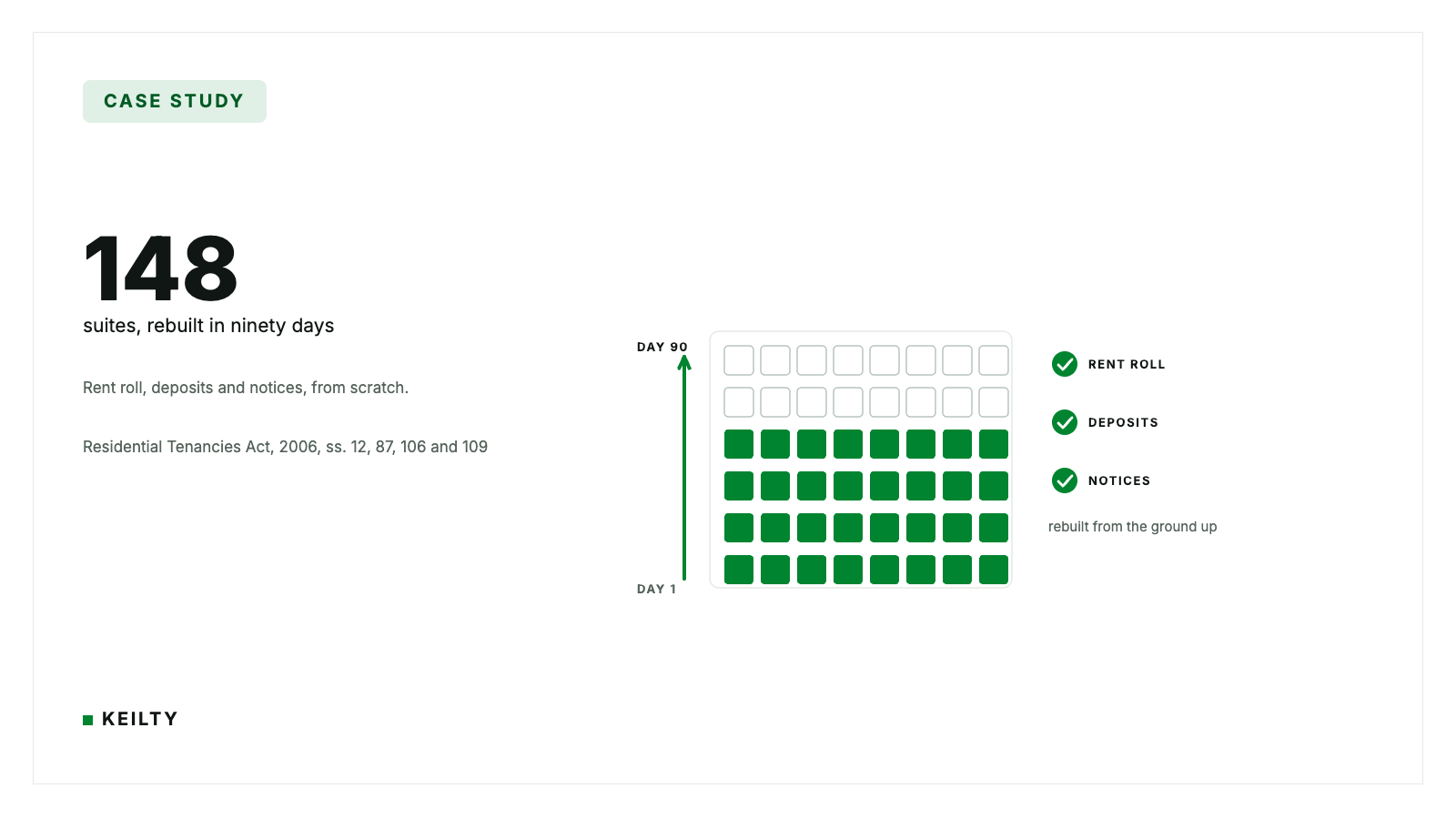
The first 90 days after a manager change go into rebuilding the record, not into marketing or maintenance. That means a rent roll that reconciles to the suite count, a deposit register with an amount and a date for every suite, an arrears ledger aged by charge rather than by resident, and a defensible position on every Landlord and Tenant Board file already in flight. Below is what that looked like on a 148-suite community in Eastern Ontario, and where the file stood on day 90. The figures are a composite drawn from transitions of roughly this size rather than one client's books, and every number the arithmetic rests on is labelled as an assumption where it is one.
It produces a working record. That is worth more than it sounds, because the claims an apartment building brings later, arrears, deposit top-ups, damage claims, former-tenant balances, are proved out of documents, and the Board's own forms ask for the dates and amounts those documents carry. On this file the difference showed up in the first week: with the register rebuilt, the items carrying a statutory deadline could be acted on straight away, where on the inherited record the same items would have waited on working out what the building actually held.
We wrote up the mechanics of moving a building between managers in how to switch property management companies on an apartment building. This post is the other half of that: not what to ask for, but what the first three months look like once the boxes arrive.
The asset is a 148-suite purpose-built rental community in Eastern Ontario, built in the mid-1980s, single private owner, managed by the same regional firm for eleven years before the change. No client name, building name or address appears here, and none will.
As set out above, the figures are a composite drawn from transitions of roughly this size rather than one client's books, and every number the arithmetic depends on is labelled as an assumption where it is one. That is a deliberate choice: a case study that quotes a real owner's rent roll is not a case study, it is a disclosure.
Five things were wrong, and none of them were unusual.
The first was the rent roll. The document handed over listed 141 rows against a 148-suite building. A rent roll lists every suite, including the vacant ones, normally with the market or asking rent and a vacancy flag against each empty suite. Those vacant rows are how an incoming manager reconciles suite count to the building. Deleting them does not tidy the report, it hides seven suites.
The second was the deposit register. Of the 148 suites, 122 were recorded as holding a rent deposit and 26 showed nothing at all, with no note saying whether nothing had ever been collected or whether the record had simply been lost.
The third was the rent increase history, which did not come across at all.
The fourth was the arrears report, which showed one balance per resident. An arrears aging ages individual unpaid charges from each charge's own due date, not a resident's balance as a single lump, which is why one resident's balance routinely splits across several buckets. The standard bucket set is current, 31 to 60, 61 to 90, and over 90, and the open-ended over-90 bucket is the one that matters most, because that is where the oldest and least collectable money sits.
The fifth was the Board files. Nine matters were in flight, and three former tenants were carrying balances with no application filed against any of them.
The first month was money and records, in that order.
Reconciling the rent roll came first, because nothing downstream is trustworthy until the suite count is. Every suite in the building was matched to a row, the seven missing rows were rebuilt as vacancies, and the roll was tied back to the general ledger.
The deposit register came second, and it was where the largest recoverable gap turned up. Section 106(1) of the Residential Tenancies Act, 2006 lets a landlord require a rent deposit only on or before entering into the tenancy agreement, and section 106(2) caps it at the lesser of the rent for one rent period and the rent for one month. On a monthly tenancy those two are the same figure. But section 106(3) is the one owners leave on the table: if the lawful rent has increased since the tenant paid the deposit, the landlord may require the tenant to pay an additional amount to bring the deposit up to the section 106(2) maximum.
Assume that on rebuilding the register, 78 of the 122 suites that had a deposit on record showed one set at a rent from an earlier year, all 78 on monthly rent periods so that the section 106(2) ceiling on each is one month's rent, and that across those same 78 suites the average gap between the deposit held and that ceiling is $190. That is 78 multiplied by $190, or $14,820 in deposits the building was entitled to require and had not. The 78 is the count of suites carrying a gap and the $190 is the average gap measured across those same 78 suites, so the two figures cover the same scope.
Read that denominator carefully, because it decides what you may lawfully do next. The 78 come out of the 122 suites with a deposit on record, not out of all 148. A top-up under section 106(3) increases a deposit the tenant has already paid. It is not a route to a first deposit from a sitting resident, because section 106(1) permits requiring a rent deposit only on or before entering into the tenancy agreement, and that moment has long passed on an occupied suite. So the 26 suites showing nothing are not an opportunity, and nobody should be sent a letter about them. Asking those residents for a deposit now would be requiring a payment the Act does not permit, which section 134(1) prohibits and section 234(l) makes an offence. Section 134(2) reaches the manager directly as well: "No superintendent, property manager or other person who acts on behalf of a landlord with respect to a rental unit shall, directly or indirectly, with or without the authority of the landlord, do any of the things prohibited under clause (1) (a), (b) or (c) or subsection (1.1) with respect to that rental unit." The words "with or without the authority of the landlord" mean the owner's instructions are neither a defence for the manager nor a requirement. Where the deposit was in fact collected and only the record was lost, the answer is to reconstruct the record from the bank history, the ledger and the resident's own receipts, not to ask for the money a second time.
The $14,820 is also an entitlement rather than a recovery, and the distinction matters more than the figure. Section 106(3) says the landlord may require the additional amount. Turning that into cash means asking 78 residents individually. Some pay on the first request, some ask for it to be spread across several months, and some decline and have to be worked through one at a time. No collection figure is claimed here, because on a composite there is no single reliable one to give. What the 90 days produced is a documented, suite-by-suite right to ask, which is what the building did not have on day one.
Deposit interest runs alongside it. Section 106(6) requires a landlord to pay interest to the tenant annually on the rent deposit at a rate equal to the guideline determined under section 120 that is in effect at the time payment becomes due, so the rate is whatever the guideline is for the year in which the payment falls due, not a fixed number to memorize. Section 106(7) then lets the landlord deduct from the amount payable under section 106(6) the shortfall between the section 106(2) maximum and the deposit actually paid, and deems the deducted amount to form part of the deposit the tenant paid. We went through the mechanics in detail in do you have to pay interest on a last month's rent deposit in Ontario.
Third came the rent increase history, and it is the record that is easiest to overlook because a rent roll looks as though it already contains it. It does not. A rent roll shows the rent being charged today. It does not show when that rent last moved or what notice supported the move. Section 119(1) permits an increase only where at least 12 months have elapsed since the day of the last increase for that tenant in that rental unit, or since the day the unit was first rented to that tenant where there has been no previous increase. Section 116(1) requires at least 90 days written notice, and section 116(4) makes an increase void where that notice was not given, leaving the landlord to serve a new notice before taking the increase. So the date of the last increase and the effective date of every N1 served have to be rebuilt suite by suite, from the notices themselves where they exist and from the ledger where they do not.
Fourth came the address for notices. For tenancy agreements entered into on or after 1998-06-17, section 12(1) requires every written agreement to set out the legal name and address of the landlord to be used for giving notices and other documents under the Act, and section 12(3) requires the same information in writing within 21 days after the tenancy begins where the agreement is not in writing. Section 12(2) adds a second duty on the written side: the landlord shall give the tenant a copy of the agreement, signed by both, within 21 days after the tenant signs it and gives it to the landlord. The consequence sits in section 12(4): until the landlord has complied with subsections 12(1) and 12(2), or with subsection 12(3), as the case may be, the tenant's obligation to pay rent is suspended and the landlord shall not require the tenant to pay rent. Section 12(5) provides that after that compliance the landlord may require the tenant to pay any rent withheld under section 12(4). That is why this is a day-one item and not a filing-cabinet item.
Three practical steps ran in the same month, and these are practice rather than anything the Act requires. Insurance first: certificates collected and the broker asked to confirm the change of manager in writing. Utilities second: every account transferred with a meter read taken on the transfer date, so the first month's variance is real. Keys and fobs third: counted and reconciled against the suite list, because a fob population nobody has counted is a security problem with no owner.
Month two was arrears and Board files.
Re-aging the arrears changed what the owner was looking at. Assume 14 residents carrying balances totalling $38,600. Under the inherited single-balance report that was one number. Aged by charge from each charge's due date, it split into $9,400 current, $7,200 at 31 to 60 days, $6,800 at 61 to 90, and $15,200 over 90. Those four add to $38,600, and the $15,200 and the $38,600 cover the same 14 residents, so the over-90 bucket is 15,200 divided by 38,600, or 39.4% of the book. A single $38,600 figure tells an owner to send reminders. A 39.4% over-90 share tells them where the collectable money stopped being collectable.
Two tracks exist for rent owed by a tenant still in possession, and they rest on different documents. The L9, Application to Collect Rent the Tenant Owes, rests on the rent ledger alone and collects money without ending the tenancy, and the LTB's own L1 instructions state that if the Board issues an order on an L9 and the tenant still does not pay, that order cannot be used to evict. The L1 ends the tenancy and collects, but it rests on the ledger plus an N4 given first, a wait until the day after the termination date on the N4, and a Certificate of Service showing how and when the N4 was given. It also cannot be filed at all if the tenant pays the amount required to void the N4 before the application goes in, and the filing package is four items, the completed L1, a copy of the N4, the Certificate of Service and the fee, with the application refused if any one of them is missing. Neither the L1 nor the L9 is the route once the tenant has moved out. At that point the application is the L10, the Application to Collect Money a Former Tenant Owes, which the landlord files against the former tenant, and it sits in the same fee row as the other two on the LTB's forms, filing and fees table at $201, or $186 through the Tribunals Ontario Portal.
The three former-tenant files were triaged against a rule with two branches: file immediately if fewer than 90 days remain on the statutory window, or if the balance is over $2,000. File A had ended possession ten months earlier carrying $1,150, so roughly two months remained and the age branch fired on its own, the balance being well under the threshold. File B had ended possession four months earlier carrying $3,400, so the balance branch fired on its own, with eight months still to run. File C, five months out at $640, triggered neither and went into the queue.
That is the same rule the switching post sets out, stated from the other end of the calendar. Nine months elapsed and 90 days remaining are the same line. The $2,000 balance branch is unchanged. File A is what the age branch exists for, File B is what the balance branch exists for, and File C is the case the rule is content to leave in the queue. Two posts, one method.
The window itself is section 87. Section 87(1.1)(b) allows an application for arrears against a former tenant no later than one year after the tenant or former tenant ceased to be in possession of the rental unit, and section 87(1)(b) adds a separate condition on that route: the former tenant must have ceased to be in possession on or after the day subsection 18(1) of Schedule 4 to the Protecting Tenants and Strengthening Community Housing Act, 2020 came into force. The LTB's own L1 instructions render the same threshold in plain language: a former tenant must have moved out on or after 2021-09-01 for the former-tenant application to be available. A claim filed inside that window is a claim that is not out of time under section 87(1.1)(b). A claim filed outside it is. Nothing about filing on time settles how a file will be decided, and an order is not money either: a former tenant who has moved on may have nothing to collect against.
Month three was reporting and the capital plan. The first monthly package with a real budget-to-actual comparison went out at the end of month two, and month three was spent making the variance commentary mean something, which requires two full periods of clean data before it can. We set out what belongs in that package in what should be in a monthly property management report for an apartment building.
One small statutory item came up repeatedly during the arrears work and is worth naming, because it costs nothing and refusing it costs credibility. Section 109(1) requires a landlord to provide free of charge, on request, a receipt for the payment of any rent, rent deposit, arrears of rent or any other amount paid to the landlord, to a tenant or a former tenant. Section 109(2) limits the former-tenant version to requests made within 12 months after the tenancy terminated.
Measured from the takeover date to day 90, the file moved from five broken records to five working ones. The rent roll reconciles to 148 suites with all seven vacancies flagged. The deposit register carries an amount and a collection date for every suite, with the interest position dated. The rent increase history carries a last-increase date and the N1 record for every occupied suite. Top-up requests under section 106(3) went out on the 78 suites carrying a gap, which is a request issued, not money banked. The arrears book is aged by charge with the over-90 bucket separated out. Two of the three former-tenant files were filed inside the section 87 window and the third is calendared against its own deadline. Each of the nine in-flight Board matters carries a current position on file with the next required step and its date, which is the only thing a transition can fairly claim to produce on files it did not open.
None of that shows up in a photograph of the lobby. It is what every later decision on this building will rest on.
A few things here were easier than they usually are, and an owner reading this should discount accordingly. The prior manager, whatever the state of the records, handed over promptly and answered questions for six weeks afterward. That is not universal, and a slow or hostile handover can add a month before day one really begins. The building also had a single owner making decisions, so approvals took hours rather than passing through a committee. And 148 suites with one on-site staff member is a scale where one person can genuinely hold the whole file in their head. At 400 suites across three sites, the same 90 days buys you less, because the reconciliation work multiplies while the calendar does not.
The deposit finding will not always repeat either. It was large here because the building had long tenancies and a manager who had never run a section 106(3) exercise. A building that changed hands recently, or one that has been actively managed on this point, will show a much smaller gap or none.
Most of this shrinks with the building. On a 12-suite property the rent roll reconciliation is an afternoon, the deposit register is a single spreadsheet, and the arrears aging fits on one screen. The reporting package compresses hardest, because a small building rarely needs formal variance commentary at all. If that is your scale, the small multi-family page is the right starting point.
One thing does not compress, and it is the one that catches small owners out. The section 87(1.1)(b) clock runs per tenancy, from the day each individual former tenant ceased to be in possession. It does not care whether you own 12 suites or 1,200. A four-suite owner with one departed tenant carrying a balance is on exactly the same one-year deadline as a 400-suite portfolio, and has far less chance of noticing it.
If you own an apartment building in Ontario and you are weighing a change of manager, or you have just made one and the records are not what you were promised, KEILTY runs this transition work as a defined 90-day program. Have a look at apartment communities and then let us walk your building through it.
This post is general information about Ontario residential tenancy law as of 2026-09-18, not legal advice. Legislation, regulations and tribunal practice change. For advice on a specific property or situation, speak with a lawyer or licensed paralegal.
Ontario property management with published pricing, same-day answers, and no surprises. Since 2003.
300-80 Queen StreetNot served yet. Join a list and hear from us the day we open.