
By A.J. Keilty, President, KEILTY Realty Management
Yes. Ontario lets a landlord and a tenant agree to end a tenancy, so long as the agreement was not part of signing the lease, and a payment can be part of that deal. What the money buys is a signed agreement, not vacant possession. If the tenant signs and then stays, your route is an application to the Landlord and Tenant Board, not a new set of keys.
Owners call this a buyout or cash for keys. The Residential Tenancies Act, 2006 (RTA) uses neither phrase, so the rules come from its sections on agreements to terminate, illegal charges and harassment. Here they are for a small owner, with an Oshawa semi as the worked example.
The short version.
The agreement is. Section 37 (1) of the RTA says "A tenancy may be terminated only in accordance with this Act." Section 37 (3) is one of the ways it provides: "A notice of termination need not be given if a landlord and a tenant have agreed to terminate a tenancy."
Because no notice is given, the 60-day period that section 44 (2) sets for a tenant's notice in a monthly tenancy never comes into it. The two of you pick the date.
The agreement cannot remove anyone. Section 77 (1) lets you apply to the Board, without notice to the tenant, for an order "terminating a tenancy and evicting the tenant" where "the landlord and tenant have entered into an agreement to terminate the tenancy". The agreement is the evidence; the order is what ends the tenancy.
Timing, first. Section 37 (5) says an agreement to terminate "is void if it is entered into, (a) at the time the tenancy agreement is entered into; or (b) as a condition of entering into the tenancy agreement." An exit form collected at move-in is void. So is one collected a week later if signing it was the price of getting the unit.
Subsections 37 (6) and (7) carve out some post-secondary student housing, and the LTB's form also names a care-home case. Neither reaches an ordinary house or duplex unless the landlord has a student-housing agreement with a college or university under subsection 37 (7).
Then the paper. The LTB publishes Form N11, Agreement to End the Tenancy, on its forms page. Its tenant field says "include all tenant names", so have every tenant named on it sign. The N11 has no field for money, so put the amount, the payment date and the conditions on a separate page that refers to it.
Then the proof. The L3 instructions require "the written agreement to end the tenancy" and a signed declaration or sworn affidavit confirming its contents. They say the declaration should give the date the lease was signed, the termination date, the date the tenant signed and who signed. They also say you should confirm that no later agreement changed or replaced the original. Record all of it at signing, not when you file.
Section 134 (3) of the RTA opens "Unless otherwise prescribed, no tenant and no person acting on behalf of the tenant shall, directly or indirectly,". Clause (b) then bars a tenant from collecting, or requiring or attempting to collect or require, "from any person any fee, premium, commission, bonus, penalty, key deposit or other like amount of money, for subletting a rental unit, for surrendering occupancy of a rental unit or for otherwise parting with possession of a rental unit".
"Otherwise prescribed" sends you to section 17 of O. Reg. 516/06. It lists nine payments exempt from subsections 134 (1) and (3). Eight concern keys, NSF charges, mobile home sites, unit transfers and property taxes. Paragraph 6 covers a payment "by a tenant" in settlement of a court action or a Board application. None of the nine is a landlord's payment to a tenant for moving out.
Two other provisions matter. The offence clause, section 234 (l), reaches a person who "charges or collects amounts from a tenant, a prospective tenant, a former tenant, a subtenant, a potential subtenant, an assignee or a potential assignee in contravention of section 134". A landlord is not on that list.
And section 194 (2), the Board's mediation provision, says a settlement agreed to under section 194 "may contain provisions that contravene any provision under this Act". The only limit is the rent-increase cap in subsection (3).
Our own view is that clause 134 (3) (b) is aimed at a tenant selling the unit on to the next occupant. We do not read it as making a landlord's offer unlawful. That is a reading of the provisions rather than something either instrument states outright, and we did not find a Board or court decision we could read for this post.
Two practical steps follow from the words as they stand. Make the payment your offer, not the tenant's demand, which keeps the "require" words out of play; the "collect" words, read alone, still cover money from any person. And where the Board is already involved, a settlement under section 194 is the cleanest home for the deal.
Section 113 sets "the lawful rent for the first rental period for a new tenant" as "the rent first charged to the tenant", subject to section 111.
Unless section 6.1 exempts the unit, a sitting tenant's rent can rise by no more than the guideline once in 12 months, apart from above-guideline increases the Board approves and the agreed increases in section 121. A new tenant's starts wherever the market is. The payment buys that reset, which is worth only the gap.
Illustrative figures for a two-bedroom semi in Oshawa, not market data:
Total cost of the change: $5,000 plus $1,750 plus $1,500, which is $8,250. Total gain: $4,800 in the first year of the new tenancy and $9,600 by the end of the second. The deal pays for itself in the 21st month, because 20 months of the gap is $8,000 and 21 months is $8,400. Guideline increases on the old rent would narrow the gap, so the true break-even is a little later.
If the tenant was likely to leave on their own within a year, the payment bought very little.
And if section 6.1 exempts your unit from the guideline, the reset matters less, because you could already raise the rent past it. Broadly, that covers a building no part of which was occupied for residential purposes on or before 2018-11-15. It also covers some units created after that date in a house. Read subsections 6.1 (2) and (3) against your property before relying on either.
How the payment is treated for tax is a question for your accountant. This post does not cover it.
On the day the keys come back, with the unit empty. An L3 order enforces the termination date, not your side letter.
A workable structure is a small amount when the N11 is signed and the balance on handover. Write the balance as payable once the tenant has moved out and returned all keys on or before the termination date. Pay by a traceable method and get a receipt.
Keep the payment separate from the last month's rent deposit. Section 106 (10) already requires you to apply that deposit "in payment of the rent for the last rent period before the tenancy terminates". Crediting it toward the buyout gives the tenant nothing new.
You file Form L3. The L3 instructions say you can apply "as soon as" the agreement is signed, and that you "do not need to wait until after the date that the tenancy is supposed to end". Section 77 (5) makes the order effective "not earlier than" the agreed date. The LTB's forms page listed the L3 fee at $201, or $186 through the Tribunals Ontario Portal, when we checked on 2026-11-18.
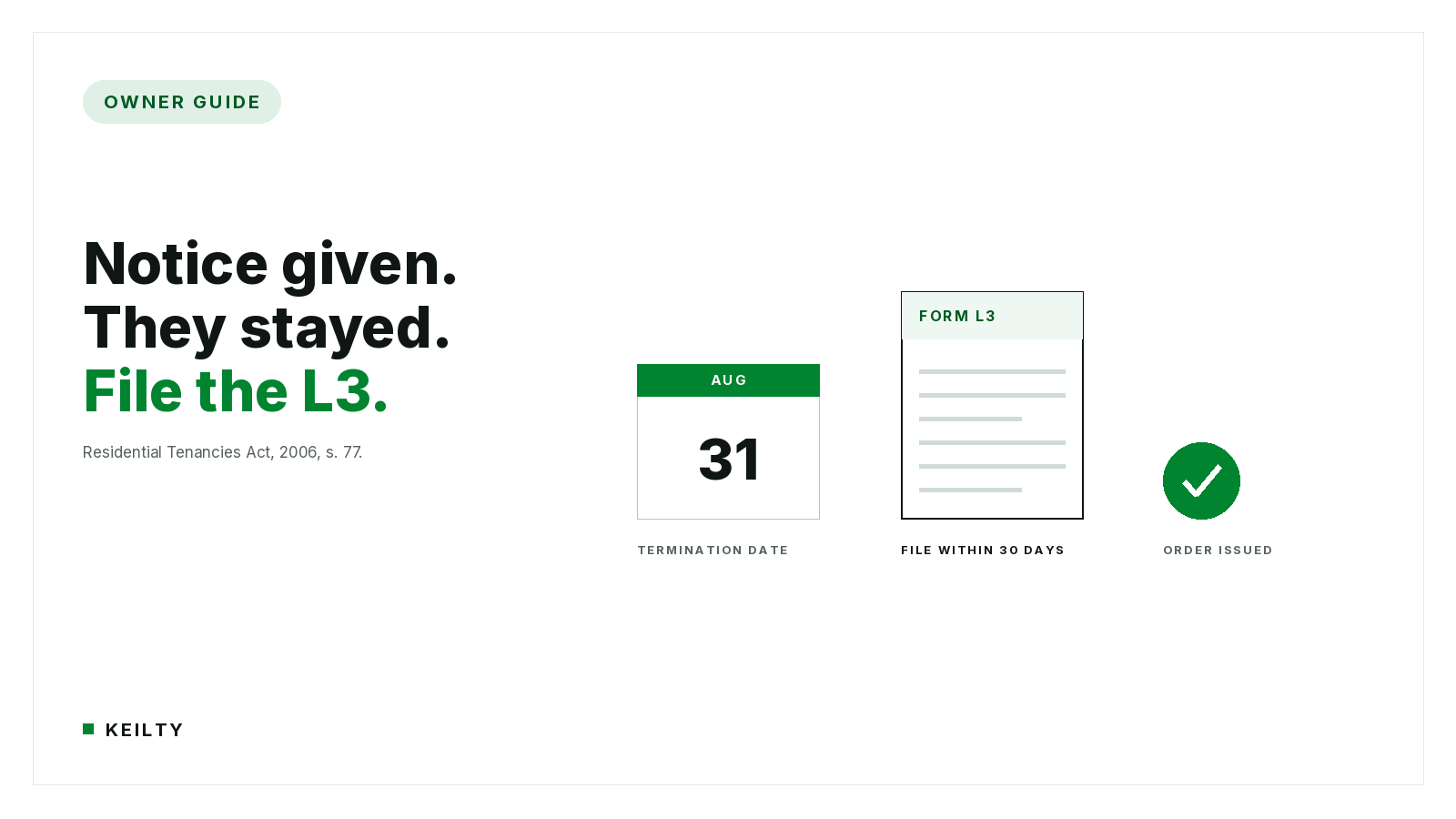
The outer limit is section 77 (3): the application "shall not be made later than 30 days after the termination date specified in the agreement or notice". That is a deadline to file. Section 193 says "Time shall be computed in accordance with the Rules", meaning the LTB's Rules of Procedure.
Worked through on dates: the tenant signs the N11 on Friday 2027-01-15 for a termination date of Monday 2027-03-15. Thirty days after that is Wednesday 2027-04-14, an ordinary weekday, so no holiday rule moves it. File in January, not April.
The order issues without a hearing. Under section 77 (6) the tenant has 10 days after it is issued to move to set it aside. Under section 77 (7), the order is stayed once that motion is received.
At the hearing, section 77 (8) gives the Board three outcomes. It must set the order aside if there was in fact no agreement and no notice. It must also set it aside "if the prescribed circumstances, conditions or tests have been satisfied". Otherwise it lifts the stay, immediately or from a later date.
The prescribed test changed on 2026-09-21. Since then, section 8.2 of O. Reg. 516/06 has the Board set the order aside if satisfied, "having regard to all the circumstances other than those set out in subsection (2)", that it would not be unfair to do so. Subsection (2) excludes changes in the tenant's circumstances that arose after the agreement was signed. A tenant whose plans simply fell through cannot rely on that alone.
Section 83 still applies, because an L3 is an application for an order evicting a tenant, so the Board can still refuse the eviction outright. Since 2026-09-21, though, section 8.4 of O. Reg. 516/06 lets the Board postpone enforcement on an application like this only with your consent, or where postponing would not be unfair to you and there are "compelling grounds". Our guide to filing an L3 when a tenant stays walks through the application itself.
When you, your spouse, or a child or parent of either of you genuinely need the unit to live in for at least a year. Section 48 (1) also covers a caregiver in narrower circumstances. Section 48 (5) adds that the landlord must be an individual and the unit owned at least partly by one, so a corporate owner cannot use it. An N12 comes with its own price, set by section 48.1, and there are two routes.
Under subsection 48.1 (1) you pay one month's rent or offer another unit acceptable to the tenant. Under subsection 48.1 (2), in force since 2026-09-21, no compensation is owed if three conditions all hold. The notice is given on or after that date. The termination date is at least 120 days after the notice is given. And that date is the day a period of the tenancy ends, or the end of a fixed term.
Either route can cost less than a negotiated payment, and neither depends on the tenant agreeing. If the tenant does not leave, though, you still need a Board order on an L2 after a hearing, where the tenant can dispute your good faith.
Both routes are only for the real purpose. A buyout is not a disguised N12, and an N12 cannot be used to get a rent reset. Our guide to own-use evictions sets out what happens when the person named never moves in.
Repetition and pressure. Section 23 says "A landlord shall not harass, obstruct, coerce, threaten or interfere with a tenant." One written offer, with time to think and a plain statement that the tenant can say no, is a negotiation. Weekly visits or hints that repairs will slow down are not.
At the Board, a tenant or former tenant can apply under paragraph 4 of section 29 (1) for an order that the landlord "harassed, obstructed, coerced, threatened or interfered with the tenant". Section 29 (2) gives them one year from the conduct.
If the tenant was "induced by the conduct of the landlord" to leave, section 31 (2) lets the Board add up to a year of increased rent paid elsewhere. It can also add "reasonable out-of-pocket moving, storage and other like expenses".
In court, clause 233 (i) makes it an offence to knowingly harass, coerce, threaten or interfere with a tenant "in such a manner that the tenant is induced to vacate the rental unit". Section 238 sets the maximum fine at $100,000 for an individual and $500,000 for a corporation.
For an owner in our Oshawa property management area or anywhere else, the safe pattern is short. Make one offer in writing, give a reasonable window, make no follow-up visits about it, and keep a record that the tenant was told they could refuse. If you would rather not make it yourself, it is part of what we do for owners of single-family rentals.
Is it legal to pay a tenant to move out in Ontario?
A landlord and tenant can agree to end a tenancy under section 37 (3) of the Residential Tenancies Act, 2006, and a payment can be part of that deal. The agreement is void if it was signed with the lease or as a condition of renting. Section 134 (3) limits what a tenant may collect or require for surrendering occupancy, and no regulation exempts a landlord's payment, so make the payment your offer rather than the tenant's demand.
What happens if the tenant signs an N11 and does not move out?
You apply to the Landlord and Tenant Board on Form L3 under section 77, no later than 30 days after the agreed termination date. The order issues without a hearing. The tenant has 10 days to move to set it aside, and since 2026-09-21 the Board leaves out changes in the tenant's circumstances after signing when it decides that motion.
When should I pay a tenant who agreed to leave?
Pay the balance once the tenant has moved out and returned the keys, by a traceable method, and keep a receipt. Put the amount and the conditions in a written side agreement that refers to the N11. Do not count the last month's rent deposit toward it, because section 106 (10) already applies that deposit to the last rent period.
A buyout is a business decision with a legal wrapper. Run the two totals first, make one clean offer, and let the paperwork do the work if the date arrives and the tenant has not moved.
Own a rental in Kingston or Eastern Ontario? KEILTY Realty Management manages it for a flat monthly rate. Get a free rental evaluation or book a 30-minute discovery call with A.J. Keilty.
This post is general information about Ontario residential tenancy law as of 2026-11-18, not legal advice. Legislation, regulations and tribunal practice change. For advice on a specific property or situation, speak with a lawyer or licensed paralegal.
Ontario property management with published pricing, same-day answers, and no surprises. Since 2003.
300-80 Queen StreetNot served yet. Join a list and hear from us the day we open.