
By A.J. Keilty, President, KEILTY Realty Management
In most cases the landlord pays to fix mould in an Ontario rental, because section 20 (1) of the Residential Tenancies Act, 2006 makes keeping the unit in good repair and fit for habitation your job. The tenant pays for damage only where you can prove, under section 34, that the tenant, another occupant or a guest caused undue damage wilfully or negligently. With mould, that turns almost entirely on where the water came from.
Because the repair duty is yours and it does not depend on fault. Section 20 (1) of the Residential Tenancies Act, 2006 reads: "A landlord is responsible for providing and maintaining a residential complex, including the rental units in it, in a good state of repair and fit for habitation and for complying with health, safety, housing and maintenance standards."
The Act never names mould. In the consolidation read on e-Laws on 2026-11-19, the words "mould", "mold", "mildew", "fungus", "damp", "moisture" and "humid" each appear zero times, searched case-insensitively across the whole page. The specific rules sit one level down, in the maintenance standards.
Two more provisions close the obvious exits. Section 20 (2) says subsection (1) "applies even if the tenant was aware of a state of non-repair or a contravention of a standard before entering into the tenancy agreement." So a tenant who viewed the unit and saw the stain on the ceiling has not taken it on.
A lease clause will not move the job either. Subject to two exceptions in its opening words, section 4 (1) makes a provision in a tenancy agreement that is inconsistent with the Act or the regulations void. A clause making the tenant responsible for "all mould" is that kind of provision. The same point decides who pays for bed bug treatment.
The provincial standards are in O. Reg. 517/06. Section 2 (2) puts compliance on you: "Except as otherwise provided, the landlord shall ensure that the maintenance standards in this Regulation are complied with."
The word "mould" appears once in the regulation. Section 39 (1) says: "Interior cladding of walls and ceilings shall be maintained free from holes, leaks, deteriorating materials, mould, mildew and other fungi."
The more useful provisions are the ones about water, because mould is almost always a moisture problem first:
One catch on where these standards apply. Section 224 (1) of the Act applies them to a building in a local municipality where no municipal property standards by-law applies to it, or where a by-law applies and prescribed circumstances apply.
Section 4 of the regulation keeps its interior standards in force where a by-law covers only the exterior. Where a full by-law applies, its own text is the standard, as our guide to what to do if you get a work order explains. Either way, section 20 (1) makes compliance your obligation.
Only where you can bring it inside section 34, which reads: "The tenant is responsible for the repair of undue damage to the rental unit or residential complex caused by the wilful or negligent conduct of the tenant, another occupant of the rental unit or a person permitted in the residential complex by the tenant."
Three things have to be proved, and each is yours to prove. There must be undue damage, such as rotted drywall or a ruined subfloor. It must have been caused by someone's conduct. And that conduct must be wilful or negligent, not ordinary living.
The causation question is where mould files are won or lost.
On our reading, the facts that point to a tenant are ones like a disabled or taped-over bathroom fan, a humidifier run continuously in a closed bedroom, or an overflowing tub left running. The facts that point to you are a roof or window leak, a cracked foundation, a slow plumbing leak inside a wall, or a bathroom with no working exhaust fan at all, which is a ventilation question under section 20 of O. Reg. 517/06 before it is anyone's conduct.
On our reading, a tenant who never runs a fan you never installed is unlikely to have been negligent. LTB Interpretation Guideline 5, on maintenance obligations, says that where the landlord alleges a repair was the tenant's responsibility, "this issue must be decided by the Member." It adds that the Board may hear evidence that the tenant "contributed to the severity of the maintenance problem, or aggravated its repair."
Ordinary housekeeping is a different section. Section 33 makes the tenant responsible for "ordinary cleanliness of the rental unit, except to the extent that the tenancy agreement requires the landlord to clean it." On our reading, wiping surface mildew from tile grout is ordinary cleanliness; mould growing through drywall from a hidden leak is not, and no amount of cleaning makes it the tenant's.
If you do have the evidence, the routes are the ordinary damage routes:
What you cannot do is send an invoice and treat it as rent. Even with a good section 34 case, on our reading you should fix the wall now rather than wait: the condition keeps getting worse, and section 89 (1) covers costs you "will incur" as well as costs already incurred.
Yes, and it runs separately from the Board. The Health Protection and Promotion Act defines a "health hazard" to include "a condition of a premises" that "has or that is likely to have an adverse effect on the health of any person". That Act does not mention mould either; whether a particular condition is a health hazard is for the inspector to decide.
Under section 13 (2), a medical officer of health or public health inspector may make an order on two conditions. They must be of the opinion, on reasonable and probable grounds, that a health hazard exists in their health unit. And they must consider the requirements in the order necessary to decrease its effect or eliminate it.
Section 13 (4) lists what an order may include, "but is not limited to": vacating premises, closing them, doing specified work and "cleaning or disinfecting, or both" are four of the nine listed items.
The order can land on you as owner or as "occupier", which the Act defines to include a person receiving the rent. Section 13 (5) (a) adds that where an order is directed to the occupier, a copy must go to the owner.
Section 44 (1) gives you a hearing before the Health Services Appeal and Review Board if you mail or deliver written notice requiring one, to both the inspector and that Board, within fifteen days after a copy of the order is served on you. Section 44 (3) says the order takes effect when served even though a hearing is required, unless that Board grants a stay. That hearing is before the Health Services Appeal and Review Board, not the Landlord and Tenant Board.
So check which Act the order cites. An inspector's work order under the Residential Tenancies Act can be reviewed by the Landlord and Tenant Board if you apply "within 20 days after the day the order is issued" (section 226 (1)). A property standards order under the Building Code Act, 1992 is appealed to the property standards committee by registered mail "within 14 days after being served" (section 15.3 (1)), and one not appealed "shall be deemed to be confirmed".
Potentially a great deal. Paragraph 1 of section 29 (1) lets a tenant or former tenant apply for an order that you breached section 20 (1). That is the T6, which we cover in full in what happens if a tenant files a T6.
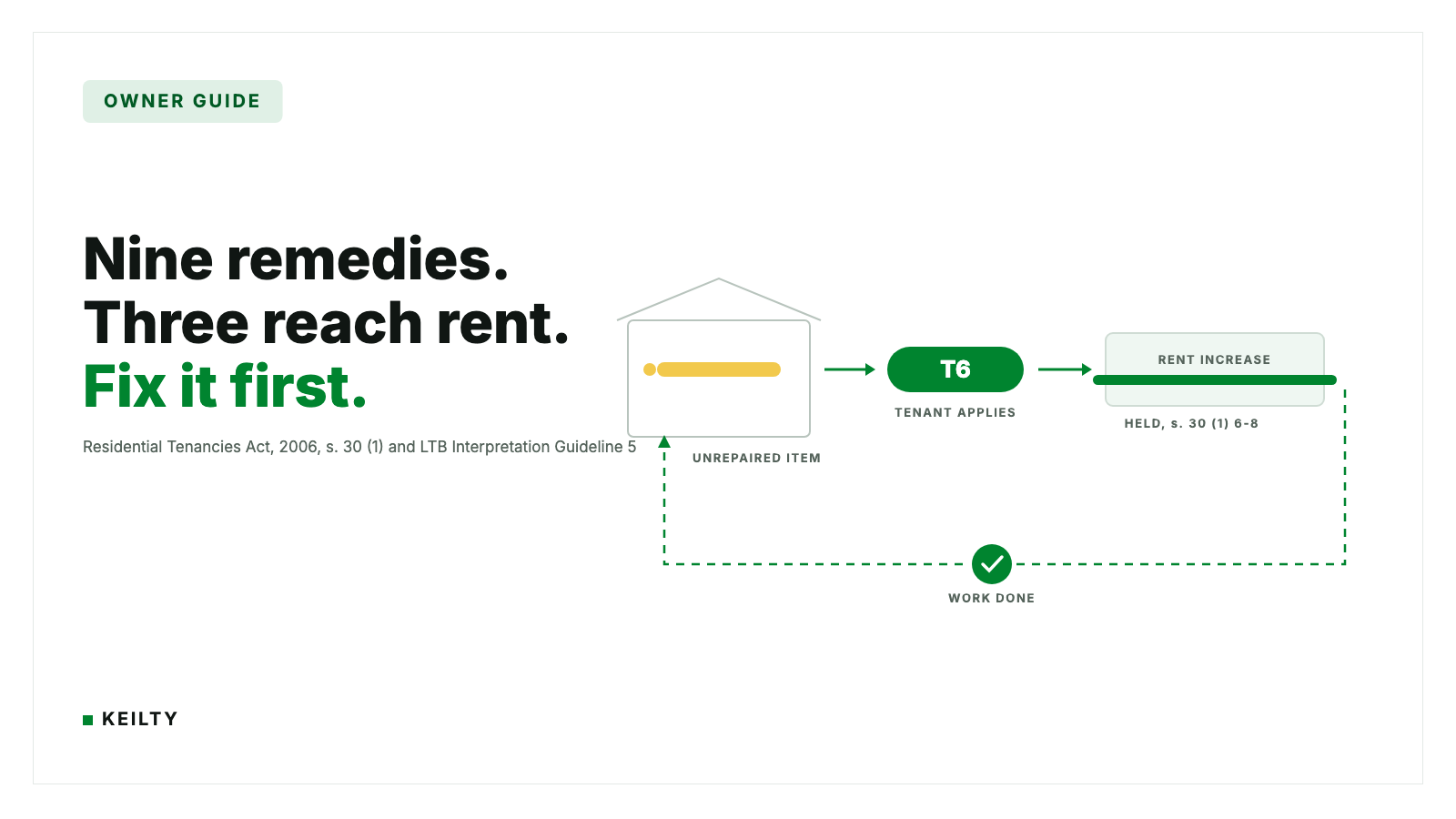
Section 30 (1) then gives the Board nine remedies. On a mould file the costly ones are usually three. Paragraph 2 is "an abatement of rent". Paragraph 4 is an order to do specified repairs within a specified time. Paragraph 5 covers the tenant's reasonable costs of repairing or replacing their own property "damaged, destroyed or disposed of as a result of the landlord's breach", plus other reasonable out-of-pocket expenses. Mouldy furniture and clothing belong in paragraph 5.
Three things work for an owner who acts:
Guideline 5 adds that a tenant who "unreasonably prevented the landlord from entering the unit to assess the problem or make the repairs" may get "no abatement or other remedy".
The limitation period does not help a slow owner. Section 29 (2) says no application may be made "more than one year after the day the alleged conduct giving rise to the application occurred". Guideline 5 says that where a breach is ongoing, "the limitation period runs from the date that the repair is completed or the standard is complied with." On that approach, a leak left unrepaired keeps the clock from starting.
Guideline 5 is dated 2018-12-15, and it says of itself that "a Member is not required to follow a Guideline and may make a different decision depending on the facts of the case."
Take a hypothetical side-by-side in Belleville with a basement apartment. On a Tuesday morning the basement tenant emails a photo of black spotting along the bottom of a bedroom wall and a musty smell. The owner replies the same morning to say someone will look.
The owner hands the tenant a written entry notice at 10 a.m. Tuesday for an inspection at 11 a.m. Wednesday, 25 hours later.
The notice relies on paragraph 4 of section 27 (1), an inspection to determine whether the unit is in a good state of repair and complies with standards, which applies only where "it is reasonable to carry out the inspection". A photographed growth is a strong reason. Section 27 (3) requires the notice to give the reason, the day and a time between 8 a.m. and 8 p.m.
The contractor finds wet drywall, a downspout discharging against the foundation, and grading that slopes toward the house. That points squarely at the owner: water entering through the foundation engages sections 6 and 7 (2) of the provincial standards where they apply, or the matching clauses of a municipal by-law where one does, and it is a section 20 (1) problem either way. The remediation, the regrading and the downspout extension are the owner's cost.
Now change one fact. Suppose the contractor finds a dry foundation, a working exhaust fan with its grille taped over, and a portable humidifier running in a closed bedroom. On our reading, the owner should still fix the wall now. But there is a genuine section 34 argument for the cost, built on the contractor's written findings, and a section 89 application or a written settlement is open.
In both versions, a T6 would meet a record showing a landlord who knew on Tuesday and acted on Wednesday.
Treat it as a water problem with a clock running:
A property manager takes this off your hands: one call, a contractor who reports cause as well as cure, and a file that stands up if anyone applies.
Who pays to fix mould in an Ontario rental?
The landlord in most cases. Section 20 (1) of the Residential Tenancies Act, 2006 makes the landlord responsible for keeping the unit in a good state of repair, fit for habitation and compliant with maintenance standards, and where O. Reg. 517/06 applies, section 39 (1) requires wall and ceiling cladding to be kept free of mould, mildew and other fungi.
Can I charge my tenant if their habits caused the mould?
Only if you can prove undue damage caused by the wilful or negligent conduct of the tenant, another occupant or a guest, under section 34. Disabling a working fan or running a humidifier in a closed room may qualify; on our reading, failing to run a fan that was never installed is unlikely to. The routes are an application under section 89, a section 62 notice or a written settlement, and on our reading you should fix the problem without waiting.
Can a public health inspector order a landlord to remove mould?
Yes, if the inspector forms the opinion that a health hazard exists and that the order is necessary to reduce or eliminate it. Section 13 of the Health Protection and Promotion Act lets a medical officer of health or public health inspector order work, cleaning or even vacating. You have fifteen days after service to require a hearing before the Health Services Appeal and Review Board, and the order takes effect when served unless that Board grants a stay.
Mould is a symptom; the water is the repair. Owners who find the source fast, and write down what they found, pay for the fixes that are theirs and keep a real claim for the ones that are not.
Own a rental in Kingston or Eastern Ontario? KEILTY Realty Management manages it for a flat monthly rate. Get a free rental evaluation or book a 30-minute discovery call with A.J. Keilty.
This post is general information about Ontario residential tenancy law and Ontario public health law as of 2026-11-19, not legal advice. Legislation, regulations and tribunal practice change. For advice on a specific property or situation, speak with a lawyer or licensed paralegal.
Ontario property management with published pricing, same-day answers, and no surprises. Since 2003.
300-80 Queen StreetNot served yet. Join a list and hear from us the day we open.